



 |
|
 |
|
|
© Chemnitzer Verlag und Druck
GmbH & Co. KG |
 German
By Antje Weger
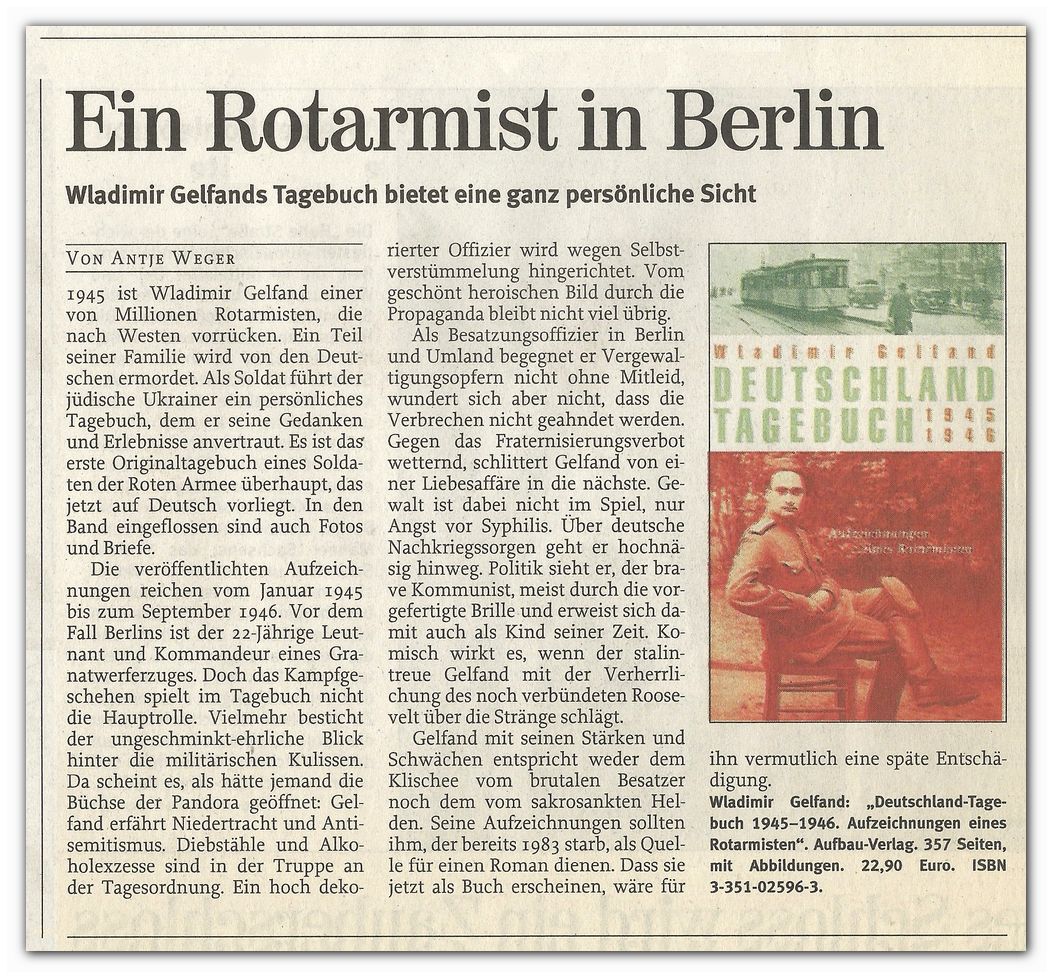
In 1945 Wladimir Gelfand is one of millions of Red Army soldiers advancing westward. Part of his family is murdered by the Germans. As a soldier, the Jewish Ukrainian keeps a personal diary in which he records his thoughts and experiences. It is the first original diary by a Red Army soldier ever to appear in German; the volume also includes photographs and letters.
The published entries cover January 1945 to September 1946. Before the fall of Berlin, the twenty-two-year-old is a lieutenant and commander of a mortar platoon. Yet combat itself does not play the leading role in the diary. What is striking instead is the unvarnished, honest look behind the military scenes. It is as if someone had opened Pandora’s box: Gelfand encounters baseness and antisemitism. Theft and alcoholic excess are commonplace in the unit. A highly decorated officer is executed for self-mutilation. Little remains of the polished heroic image created by propaganda.
As an occupation officer in Berlin and its surroundings, he encounters rape victims not without compassion, yet is not surprised that the crimes go unpunished. Railing against the ban on fraternization, Gelfand slides from one love affair to the next. Violence is not involved — only fear of syphilis. He brushes aside German postwar worries with arrogance. In politics, the dutiful Communist usually sees the world through a ready-made lens and thus proves himself a child of his time. It becomes almost comic when the Stalin-loyal Gelfand goes overboard in glorifying Roosevelt, still an ally.
With all his strengths and weaknesses, Gelfand fits neither the cliché of the brutal occupier nor that of the untouchable hero. His notes were intended as source material for a novel. That they are now appearing as a book would probably have seemed to him a late compensation.