


© 非中国日报网
 Chinese
China Daily Online — Love News, Yu Yulin — June 17, 2015
Seventy years ago, the Soviet Union defeated Nazi Germany in the Second World War, a moment that became one of the most glorious in the country's history. Yet there was another, darker side: near the end of the war Soviet soldiers raped a vast number of German women.
At Treptower Park on the outskirts of Berlin, dusk has just fallen. I look up at the statue, its silhouette merging with the lavender sky. It is a 12-metre (40-foot) figure of a Soviet soldier: in one hand he holds a sword, in the other a little German girl, while beneath his feet lies a shattered Nazi swastika.
From April 16 to May 2, 1945, during the Battle of Berlin, around 80,000 Soviet soldiers were killed, and 5,000 of them were buried here. This monumental memorial symbolizes the scale of the sacrifice made by the Red Army. From the top of the staircase one can see the temple-like pedestal. An inscription caught my attention, declaring that the Soviet people had saved European civilization from fascism.
And yet some people call this memorial, with bitter irony, the “tomb of the unknown rapist.”
As Stalin's army advanced toward the German capital, countless rapes of German women were committed along the way. Yet in postwar Germany — in both East and West — and still more so in modern Russia, the subject long remained taboo.
There is abundant reliable evidence that these crimes really occurred. One source is the diary kept by a Soviet soldier at the time, which frankly describes scenes of violence against German women. Russian media, however, have often ignored the subject of rape and dismissed such accounts as fabricated Western propaganda.
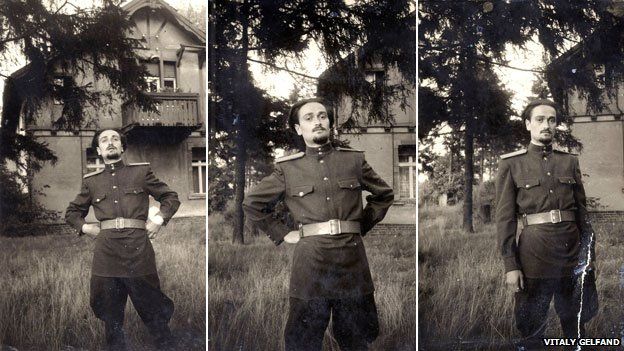
Although Red Army soldiers were strictly forbidden to reveal military secrets or keep private records, Vladimir Gelfand, a Jewish lieutenant from central Ukraine, nevertheless kept a detailed diary. He began writing in 1941 and continued until the very end of the war, truthfully recording everything he saw and felt.
The manuscript, unpublished for many years, does not present an embellished heroic image of the war but a disorderly and brutal chaos. His entries contain shortages, everyday antisemitism, quarrels, theft, and even scenes of soldiers stealing boots from their comrades.
In February 1945, while stationed at a bridgehead near the Oder and preparing for the final offensive on Berlin, Gelfand described how his fellow soldiers captured a detachment of female soldiers.
“The captured German women say that they want to avenge their dead husbands,” he wrote. “We must execute them without mercy. Our soldiers suggest raping them, while I would simply shoot them.”
What followed was even worse.
Several passages in Gelfand's diary are striking in their candor. One is dated April 25, 1945, the day he arrived in Berlin. He was riding a bicycle along the River Spree, his first ride through the city, when he came across a group of German women carrying suitcases and bags.
Germany was in ruins. He asked them where they were going and why they had left their homes. “Their faces were full of horror as they told me what had happened on the first night after the Soviet Red Army arrived,” he wrote.
“They raped me here,” said a pretty German girl, lifting her skirt. “All night. They were very old, and some had pimples on their faces. They all crawled over me; there were more than twenty of them.” She suddenly burst into tears.
“They raped my daughter in front of me,” her poor mother added. “They may come back and rape her again.” The thought made everyone shudder.
“Don't leave!” the girl suddenly threw herself toward me. “Come to bed with me. Do anything you want — just let it be you!”
The closer Gelfand came to Berlin, the more clearly he realized that during the previous four years German soldiers had committed many atrocities on Soviet territory, including sexual violence.
“He passed through many villages,” his son Vitaly later said. “The Nazis killed people everywhere, even children. He saw evidence of rape with his own eyes. It was undeniable.”
After Gelfand's death, Vitaly discovered the diary his father had left behind.
According to Nazi doctrine, a Wehrmacht soldier was supposed to be a model Aryan and was ideologically forbidden to have sexual relations with “inferior races,” including women in occupied territories.
Yet the prohibition was systematically violated. As Oleg Budnitsky, a historian at the Higher School of Economics in Moscow, notes, the Third Reich's command was concerned less with morality than with the danger of venereal disease spreading among soldiers. Special military brothels were therefore established in occupied territories.
Direct evidence of rapes committed by German soldiers on Soviet territory is difficult to find because many victims did not survive. Evidence nevertheless exists. At the German-Russian Museum in Berlin, curator Jörg Morré showed wartime photographs from Wehrmacht soldiers' private albums. One, taken in Crimea, shows the body of a woman lying on the ground.
“It appears that she was killed after being raped, or during the assault,” Morré says. “Her skirt is raised and her hands cover her face. It is terrible.”
He continues: “The photograph is shocking. We are still discussing at the museum whether it should be displayed publicly. But this is war. We do not merely talk about war; we show it. This is sexual violence as part of German policy in the East.”
When the Red Army began advancing onto German territory, Soviet propaganda accompanied the offensive with aggressive slogans. One read: “Soldiers, you are standing on German soil! The bell of vengeance has already sounded!”
When the Red Army's 19th Army reached the Baltic coast, its soldiers were told that a true Soviet soldier should be filled with anger and disgust and under no circumstances have sexual relations with German women. This idealistic injunction was quickly contradicted by the soldiers themselves.
While researching his book Berlin: The Downfall 1945 (2002), historian Antony Beevor found documents on sexual violence in the State Archive of the Russian Federation. In the autumn of 1944, NKVD officers gathering information in the field had sent these materials to Lavrentiy Beria, the minister responsible for state security.
“They were passed to Stalin,” Beevor says. “Special markings in the margins show that he read them. These documents record cases of mass rape in East Prussia. Some German women chose suicide — or even killed their children — to avoid the violence.”
Another source is the diary of a young woman engaged to a German soldier. Her entries, as candid and unsparingly honest as Gelfand's, reflect the horrifying reality of survival in ruined Berlin.
The diary begins on April 20, 1945, ten days before Hitler's suicide. The author, whose name remained unknown, describes the surrounding chaos with restraint and irony despite the horrors taking place.
She writes about herself in the third person: “A woman in the same winter coat, with a pale face, sitting all day in the cellar.” Neighbours gathered in the cramped air-raid shelter beneath her apartment: “A man in grey trousers and horn-rimmed glasses. When he came closer, it turned out to be a young woman.” Three elderly sisters looked like “tightly rolled black puddings.”
In May 1945 Soviet soldiers distributed food in Berlin. Before the Red Army arrived, people joked that “being raped by the Soviets is better than being killed by American bombs.” But when soldiers entered their cellar and began dragging women out one by one, the others begged the diarist to speak Russian in the hope that this might influence the commanding officer.
Despite the destruction in the streets, she ventured outside and crossed the chaos in search of a senior officer. She explained what was happening, but he merely shrugged. Although Stalin had formally prohibited violence against civilians, the officer replied: “It doesn't matter — it happens everywhere.”
The officer returned with her to the cellar and reprimanded the soldiers. One of them, furious, shouted: “What do you mean? And what did the Germans do to our women? Get out!”
When the diarist went into the corridor to see whether the soldiers had left, they were waiting for her and seized her. She was brutally raped and nearly suffocated. Her terrified neighbour, whom she later called “the cave man,” had already tied the cellar door handle shut, blocking her way back inside.
“Later the two cast-iron bolts finally opened. Everyone stared at me,” she wrote. “My stockings had slipped down to my shoes; I was holding my suspender belt. I screamed: ‘You pigs! They raped me twice, and you let me lie there like a piece of dirt!’”
Eventually the author realized that she needed a “wolf,” a single “alpha male” with whom she could establish a relationship and thereby avoid gang rape. The relationship between aggressor and victim became less violent but more transactional and ambiguous. She shared a bed with a senior officer from Leningrad, with whom she discussed literature and the meaning of life.
“One cannot say that this officer raped me,” she wrote. “Did I do it for bacon, butter, sugar, candles, and canned meat? Partly, yes. And besides, I even like it. The less he wants physical pleasure from me, the more I like him.”
In the ruins of Berlin, many of the diarist's neighbours made similar arrangements with the conquerors.
In 1959 the diary was published under the title A Woman in Berlin. The author admitted that she had chosen sexual relations as a means of survival, but she was attacked for supposedly “disgracing German womanhood.” She therefore categorically forbade republication of the book during her lifetime.
For seventy years after the war, new research on sexual violence continued to appear in the United States, Britain, France, and even the Soviet Union. Over time, however, the subject seemed quietly to disappear from public attention. Fewer people spoke about such crimes, and even fewer were willing to listen.
Alongside social stigma, in East Germany it was considered sacrilegious to criticize the Soviet soldier, portrayed as the hero who had defeated fascism. In West Germany, the frozen sense of guilt over Nazi crimes made it difficult even to begin talking about the subject.
In 2008, however, a film with the same title, A Woman in Berlin, starring the well-known German actress Nina Hoss, was released. The film had a powerful psychological impact on German audiences and inspired many women to speak about their own experiences. One of them was Ingeborg Bullert.
Ingeborg says: “My mother always liked to boast that her daughter had not been raped.”
Ninety-year-old Ingeborg lives in a Hamburg apartment filled with paintings of cats and books about the theatre. In 1945 she was twenty. She dreamed of becoming an actress and lived with her mother on an upscale market street in Berlin's Charlottenburg district. When Soviet troops began storming the city, she, like the heroine of A Woman in Berlin, took shelter in the wine cellar of their building.
“Suddenly tanks appeared on the other side of the street, and the bodies of soldiers from both armies lay everywhere,” she recalls. “I still remember the deafening howl of the rockets — we called them ‘Stalin's organs.’”
When the shelling stopped, Ingeborg left the cellar and ran upstairs to find a piece of rope so she could hang a lamp.
“Then two Russian soldiers pointed pistols at me,” she says. “One forced me to undress and raped me. Then they changed places and the second did the same. I thought I was going to die. I thought they would kill me.”
For decades Ingeborg remained silent about this pain. She told no one because it was too difficult. “My mother always liked to boast that her daughter had not been raped,” she says bitterly.
Ingeborg said: “I thought I was going to die.”
Yet rape affected women throughout Berlin. Ingeborg remembers that all women between the ages of fifteen and fifty-five were required to undergo medical examinations for venereal disease. “Without a doctor's certificate it was impossible to receive a food ration card. I still remember the doctors who conducted those examinations, and the room full of women waiting in silence.”
How extensive was the violence? The most frequently cited figures are shocking: 100,000 women raped in Berlin and around two million throughout Germany. These estimates are based on incomplete medical records and extrapolations from available data.
At the National Archive, formerly a military department, historian Martin Lederhand showed me stacks of blue cardboard folders. They contain medical documentation, including records of abortions performed in the Neukölln district between July and August 1945. It was only one of Berlin's twenty-four districts — and every woman who survived an attack was fortunate to remain alive.
Under Section 218 of the German Criminal Code, abortions were prohibited. But, Lederhand explained, “In 1945, in view of the exceptional circumstances — the mass rapes — women were temporarily given the possibility of legally terminating a pregnancy.”
Between 1945 and 1946 the district medical office registered 995 requests for abortions. The archive folder contains more than a thousand fragile sheets of paper, all in different colours and formats. On one, faint handwriting survives: a girl wrote that she had been raped in front of her parents in her own living room.
We will probably never know the exact scale of what happened. Institutions such as the Soviet Army Military Tribunal continued to avoid the subject. Recently the Russian parliament passed a law under which anyone who diminishes Russia's contribution to the Second World War can be fined or sentenced to up to five years in prison.
Vera Dubina, a young historian at a humanities university in Moscow, admitted that she herself first learned about the mass rapes only after travelling to Berlin with one of her teachers. She later wrote an article on the subject but was unable to publish it because of censorship difficulties and repeated rejections.
“The reaction of the Russian media is extremely sharp,” she says. “People only want to hear about the glorious victory we achieved in the Great Patriotic War. Today, serious research on this subject is becoming increasingly difficult.”