



 |
 |
 |
| © Neues Deutschland Druckerei und Verlag GmbH |
 German
Sabine Neubert
Aufbau Verlag presents a unique historical document: German Diary 1945/1946 by Vladimir Natanovich Gelfand. These are excerpts from the original diary that the young Red Army officer kept almost daily during the final months of the war and the first postwar years.
For the first time, readers can encounter the authentic, deeply personal testimony of a liberator, describing in detail not only the final weeks of the war but also life in devastated Berlin through the eyes of a "hostile victor."
"Never before have we been able to penetrate so deeply into the thoughts of a victor," the editor writes in the foreword.
But was Vladimir Gelfand truly a victor?
In 1942, the nineteen-year-old Ukrainian Jew volunteered for the Red Army. He survived horrific battles and spent long months on the very front line as a mortar-platoon commander. Yet his sensitive nature and his sense of justice made military service tormenting for him: he suffered not only from the horrors of war but also from the lack of principle among some of his comrades, especially commanders who avoided combat while never missing a chance to claim decorations.
Soldierly life became increasingly hateful to him, and at a certain point his notes turn into an antiwar statement.
At the end of April 1945 Gelfand entered Berlin. After Germany's surrender he was appointed a staff officer, but was continually transferred from place to place. His hope of returning home was disappointed: he remained in Germany until September 1946.
He was merciless in his judgment of Nazi Germany, which had brought pain and destruction to his family, yet he retained an ability to distinguish and to see nuance. During the final days of the war, amid looting and chaos, he saved a bust of Goethe from destruction, taking it away from drunken comrades and writing: "Geniuses cannot be equated with barbarians, and destroying the memory of them is a great sin and a disgrace for a civilized person."
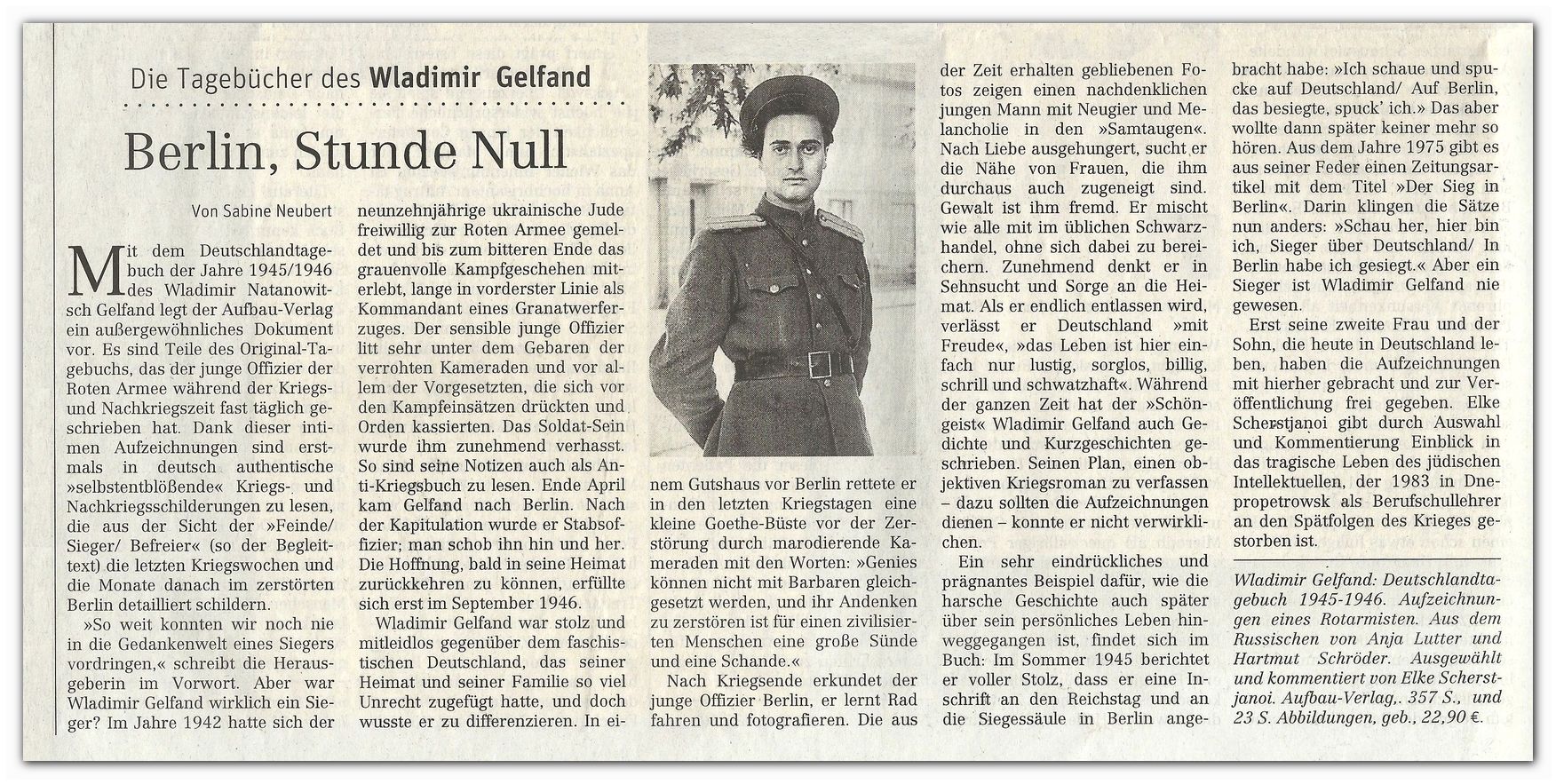
After the war he explored Berlin, learned to ride a bicycle and became fascinated by photography. The surviving photographs show a thoughtful young man with melancholy in his "velvet eyes," as he once described himself.
He was hungry for love, and German women were as drawn to him as he was to them. He rejected violence and did not take part in mass looting, though he did become involved in illegal trading—not for profit so much as out of necessity.
Yet the longer he stayed in Germany, the more strongly he longed for home. When his departure finally became real, he wrote in his diary: "I am leaving Germany gladly. Life here is easy, carefree, cheap, harsh, and full of empty chatter."
Throughout the war years Gelfand never stopped writing. Besides the diary, he wrote poems and stories and dreamed of one day producing a realistic war novel. That plan was never realized.
A particularly revealing episode shows how history and public perception change. In Berlin in 1945, proud of victory, Gelfand wrote on the Reichstag wall: "I look at Germany and spit. I spit on defeated Berlin!" Three decades later, in a newspaper article published in 1975, his wording was different: "Look, here I am—the victor over Germany. In Berlin I won victory." Time changes not only people, but also the way they see themselves.
After the war Gelfand returned home and became a teacher in Dnipropetrovsk, but his fate was far from triumphant. He died in 1983 from the consequences of the war years, never becoming the recognized writer he had hoped to be. Only decades later were his second wife and son, who had emigrated to Germany, able to preserve his diaries and make them public. Elke Scherstjanoi, the editor of the volume, collected and analyzed the records, giving readers a unique view of a man caught in the maelstrom of history. These are not merely wartime recollections, but the tragic chronicle of a Jewish intellectual whose wartime past followed him to the end of his life.