


 |
 |
efemérides do éfemellotodo dia é histórico. |
 |
Há 70 anos… dia 2 de maio de 1945.
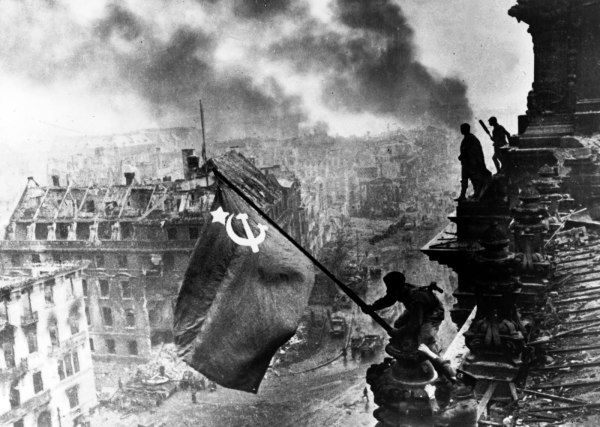
Último capítulo da Segunda Guerra Mundial no front europeu, a Batalha de Berlim durou 17 dias. De 16 de abril a 2 de maio, a capital da Alemanha assistiu o exército vermelho de Stalin e as tropas nazistas de Hitler travarem o derradeiro combate no Velho Continente. Ao final, vitória completa dos soviéticos, tanto bélica quanto simbólica.
No campo de guerra, Stalin triunfou sobre os alemães, assistiu ao suicídio de Adolf Hitler (30 de abril) e dos outros líderes do Nazismo, como Joseph Goebbels, e ainda conquistou a capital do Terceiro Reich antes das tropas aliadas do ocidente, ou seja, do exército americano.
O exército vermelho usou cerca de 2,5 milhões de soldados no combate, contra pouco mais de 760 mil dos nazistas. Estima-se que os soviéticos perderam pouco mais de 80 mil, com mais 280 mil feridos. Já as baixas do exército alemão ficaram na casa dos 100 mil, com mais 220 mil feridos e outros 480 mil capturados.
A história obscura e pouco conhecida por trás da Batalha de Berlim é a que relata estupros de mulheres alemãs pelos soldados soviéticos. Há fortes depoimentos de homens do lado vermelho, como os de Vladimir Gelfand, indicando os abusos durante a tomada da capital alemã (leia mais no link da BBC, abaixo).
Saindo do front e entrando no campo do simbolismo, há a saborosa história sobre a famosa foto da bandeira vermelha no Reichstag, o Parlamento alemão, um dos ícones de poder de Berlim.
Reza a lenda que o “hasteamento” do pavilhão da foice e do martelo foi uma ordem direta de Stalin, que pessoalmente coordenou a “operação”. A extrema publicidade da famosa imagem dos soldados americanos em Iwo Jima revelara o poder midiático de uma fotografia. Ciente disso, o líder da União Soviética queria criar a sua própria.
Então, destacou soldados para a missão. Muito tempo depois, quando da queda da União Soviética, se conheceu o homem responsável pela fotografia: Yevgeny Khaldei. Sob ordens superiores, o fotógrafo viajou de Moscou para Berlim com uma bandeira soviética na bagagem.
Com a cidade controlada e a rendição quase completa dos nazistas, Khaldei foi ao prédio do Reichstag. Chegando lá, chamou dois soldados para criar a cena. Segundo o fotógrafo, o homem que segura a bandeira é Alexei Kovalyov, então de 18 anos. Os “coadjuvantes” da icônica imagem são Abdulkhakim Ismailov e Leonid Gorychev (ou Aleksei Goryachev).
Quando retornou à Moscou, Khaldei percebeu que um deles estava com dois relógios, um em cada punho, fruto, obviamente, de um desvio de conduta. A pedido do alto escalão soviético, ele alterou a imagem, retirando um dos relógios e ainda intensificando a fumaça ao fundo.
Em 13 de maio, a fotografia foi publicada na revista Ogonyok e se transformou na grande imagem-símbolo da conquista de Berlim. Stalin venceu dentro e fora das quatro linhas. Iniciava o jogo do pós-guerra com certa vantagem sobre os americanos.
A Segunda Guerra Mundial seguiria no front oriental. Em agosto, Harry Truman mexeria rei e rainha de seu tabuleiro: as fatídicas Hiroshima e Nagasaki.
Mas essas (tristes) histórias ficam pra outro dia… Porque todo dia é histórico.
Documentário sobre a Batalha de Berlim:
Battlefield S1/E6 - The Battle of Berlin
 Portuguese
Ephemerides do Éfemello — Every Day Is History
Daily archive: 2 May 2015
Fernando Figueiredo Mello
The Battle of Berlin Ends
Seventy years ago — 2 May 1945.
The final chapter of the Second World War on the European front, the Battle of Berlin, lasted seventeen days. From 16 April to 2 May 1945 the German capital became the scene of the last major battle between Stalin’s Red Army and Hitler’s Nazi forces. The complete Soviet victory marked not only the end of the war in Europe but also carried enormous symbolic meaning.
On the battlefield Stalin defeated Nazi Germany. The battle was accompanied by Hitler’s suicide on 30 April, the deaths of other Nazi leaders such as Joseph Goebbels, and the capture of Berlin, capital of the Third Reich, before the American and British Allies advancing from the west could enter the city.
The Red Army committed about 2.5 million soldiers against roughly 760,000 German troops. Estimates put Soviet losses at more than 80,000 killed and about 280,000 wounded. German losses were approximately 100,000 killed and more than 220,000 wounded, while another 480,000 were taken prisoner.
A less widely known and for many years suppressed aspect of the Battle of Berlin was the mass rape of German women by Soviet soldiers. Testimonies by participants in the events, including Vladimir Gelfand, point to the scale of the violence during the capture of the city. The BBC material linked below discusses this in greater detail.
Another chapter in the history of the victory concerns its symbols, above all the famous photograph of the red flag being raised over the Reichstag, the German parliament — one of the most recognisable images of the Second World War.
According to the often-told story, Stalin personally ordered a hammer-and-sickle banner to be raised over the Reichstag. Impressed by the powerful American photograph of the flag-raising on Iwo Jima, the Soviet leader wanted an equivalent symbol of Soviet victory.
Photographer Yevgeny Khaldei was sent on this mission. Acting on instructions, he travelled from Moscow to Berlin carrying a red flag in his suitcase. After the city had been taken he climbed onto the roof of the Reichstag and asked soldiers to pose for a staged photograph. The flag was held by Alexei Kovalyov, then eighteen years old. The image also shows Abdulkhakim Ismailov and Leonid Goryachev — or, according to other accounts, Alexei Goryachev.
When Khaldei returned to Moscow and developed the film, one of the soldiers appeared to be wearing a watch on each wrist, something that might have been interpreted as evidence of looting. At the insistence of the Soviet authorities the photograph was retouched: one watch was removed and extra smoke was added to make the scene more dramatic.
The picture was published in the magazine Ogonyok on 13 May 1945 and became an icon of the Soviet victory in Berlin. Stalin’s victory was not only military but symbolic. A new post-war reality was beginning, with the USSR seeing itself as a leading world power.
Meanwhile, the Second World War continued in the Far East. In August 1945 US President Harry Truman decided to use atomic weapons, and Hiroshima and Nagasaki were destroyed.
But that is another story. History, as we know, is written every day.