



 |
||
 |
||
 |
||
 |
©Berliner Zeitung

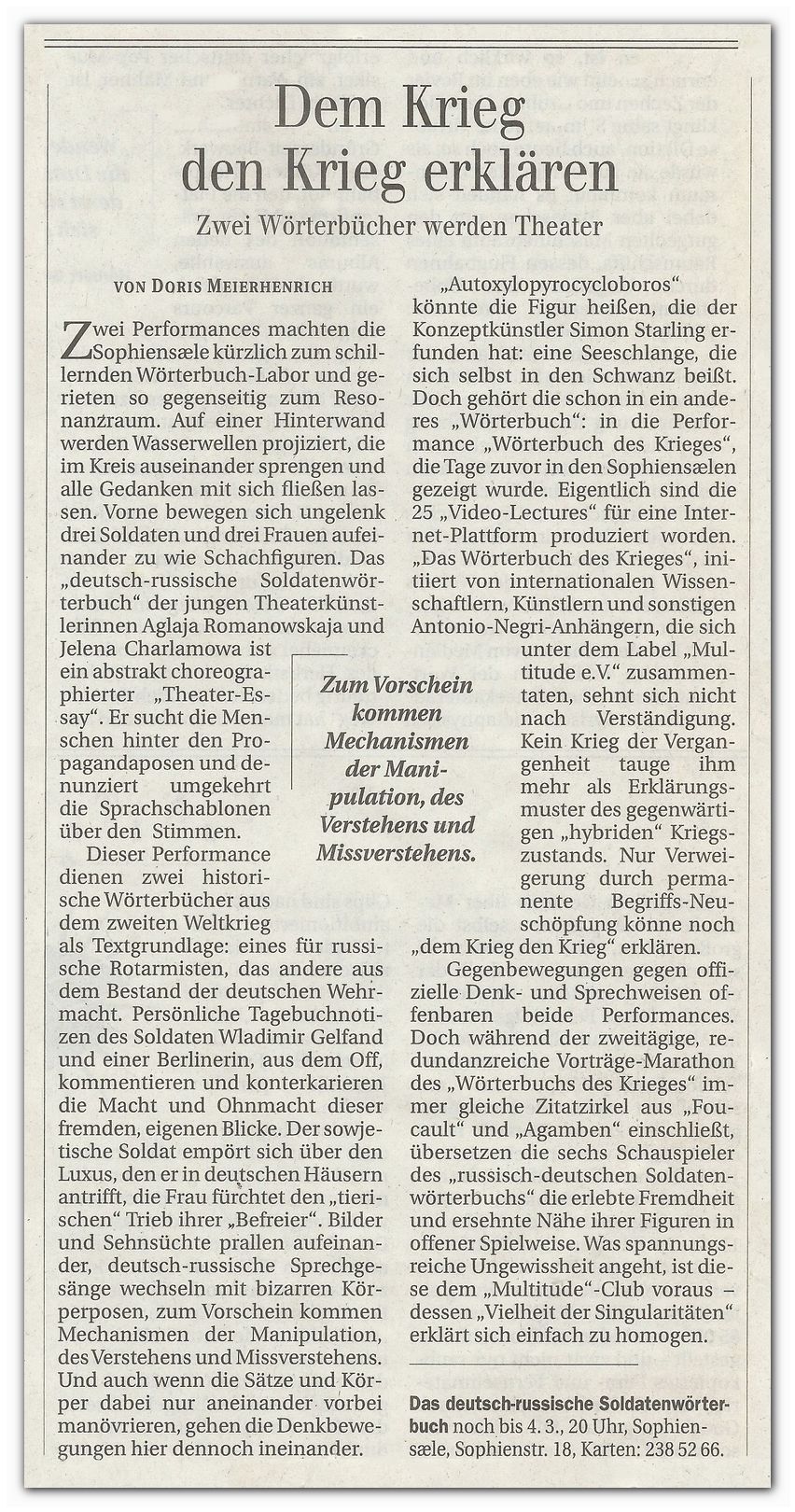
Two Dictionaries Declare War on War
Two recent productions turned the Sophiensaele into a dazzling linguistic laboratory, a resonant space in which one performance seemed to reflect the other. On the rear wall, waves of water are projected as they break against a circle and seem to carry every thought away. In front, three awkward soldiers and three women move toward one another like pieces on a chessboard.
The German-Russian Soldier's Dictionary, created by the young theatre directors Aglaja Romanovskaya and Jelena Kharlamova, is an abstract piece of theatre that searches for the individuals hidden behind propagandistic poses while exposing the power of standardized language over individual voices. It is based on two historical dictionaries from the Second World War: one made for Red Army soldiers and the other for the German Wehrmacht.
Personal diary entries by the Soviet soldier Vladimir Gelfand and an anonymous Berlin woman enter into dialogue and reveal contrasting experiences. The Soviet soldier is astonished by the luxury he encounters in German homes, while the woman lives in fear of the "animal" instincts of her "liberators." Images and desires collide; German-Russian chants alternate with strange bodily poses, while mechanisms of manipulation, understanding and misunderstanding come to the foreground. Although words and gestures often seem to miss each other, their collision produces a single theatrical movement.
Autoxylopyrocycloboros sounds like a character invented by conceptual artist Simon Starling - a sea serpent biting its own tail. Yet the word belongs to another "dictionary," the Dictionary of War, shown at the Sophiensaele a few days earlier. That project is built around a series of twenty-five video lectures created for an online platform.
The Dictionary of War was initiated by an international group of academics, artists and followers of philosopher Antonio Negri associated with Multitude e.V. It deliberately avoids a conventional historical model: no war of the past is treated as a direct template for understanding contemporary hybrid conflicts. Its proposed resistance to war begins by refusing familiar definitions and continually rethinking the word itself.
But while the two-day lecture marathon of the Dictionary of War sinks into repeated quotations from Foucault and Agamben, The German-Russian Soldier's Dictionary offers a lively and flexible theatrical language. Six performers translate the alienation their characters have experienced - and their equally powerful longing for closeness - into an open, physical form.
Where the Multitude circle preaches a "multiplicity of singularities" that in practice can feel surprisingly uniform, The German-Russian Soldier's Dictionary leaves room for a genuinely many-sided perception.
The production runs through 4 March, beginning at 20:00. Sophiensaele, Sophienstrasse 18. Tickets: 238 52 66.
Doris Meierhenrich - Berliner Zeitung, 2 March 2007