

Erinnerungspolitischer
Gezeitenwechsel
Einige
ausgewählte Bücher über das Ende des Dritten
Reiches und die letzten Kriegswochen
 |
|
 |
© Neue
Presse Verlags-GmbH
 German
Sex sells — that much is clear. Hitler does too.
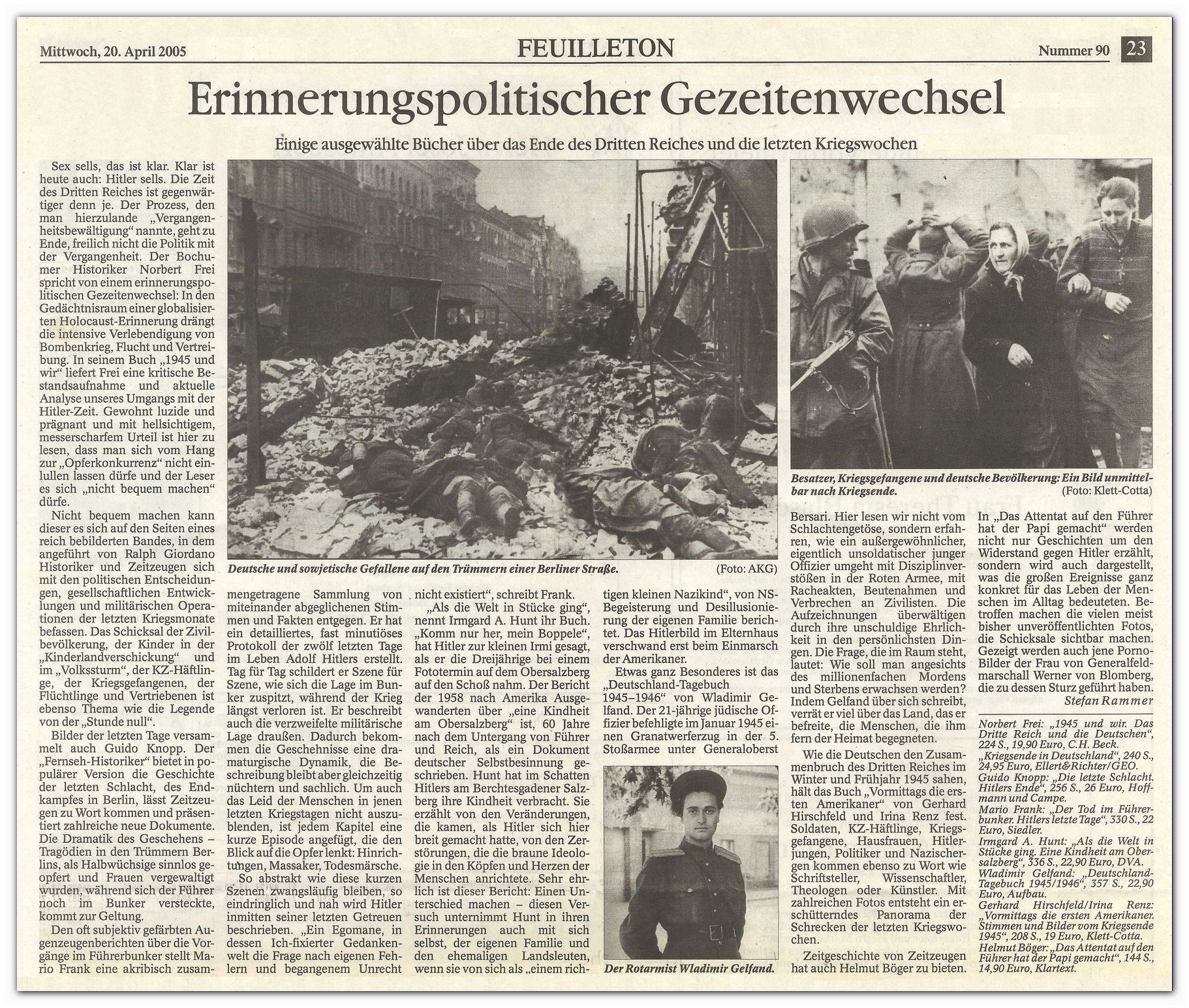
The Third Reich remains a subject of intense interest, perhaps more than ever. The process once described in Germany as Vergangenheitsbewältigung, coming to terms with the past, does not in fact bring the past to a final conclusion. Bochum historian Norbert Frei speaks of a “tidal shift in the politics of memory”: alongside collective remembrance of the Holocaust, the bombing of German cities, flight and expulsion are moving increasingly into the foreground.
In his book 1945 and Us, Frei takes critical stock of, and analyzes, our present-day relationship with the Hitler era. His style remains as lucid and perceptive as ever. He shows that no one should lull themselves into illusions about a “competition of victims,” even if readers may find that reality uncomfortable.
There is equally no easy escape from objectivity in a richly illustrated volume in which historians, eyewitnesses and analysts examine political decisions, social developments and military operations during the final months of the war. At its center are the fates of civilians: children evacuated through the wartime relocation program, residents of fortified shelters, concentration-camp prisoners, prisoners of war and refugees. One subject is the myth of the “zero hour,” long presented as the clean starting point of a new Germany.
Television historian Guido Knopp also reconstructs the last days of the Reich. His account of events in Berlin is designed for a broad audience: eyewitnesses speak, new documents are presented, and the drama of the catastrophe is emphasized. The tragedy of Berlin in ruins unfolds before the reader — teenagers sacrificing themselves senselessly, women subjected to violence, while Hitler hides in his bunker.
Mario Frank, by contrast, offers a meticulous, almost minute-by-minute reconstruction of the last twelve days of Adolf Hitler’s life. He sets numerous testimonies alongside one another and places them in context, showing how tension in the bunker mounted while the war outside had already been lost. Frank does not forget the suffering beyond the bunker walls either. Each chapter is supplemented with brief episodes about executions, massacres and death marches.
“When the World Fell to Pieces” is the title Irmgard A. Hunt gives her book.
“Come here, my little Joppele,” Hitler would say to three-year-old Irmi when he picked her up for photographs.
The book grew out of an account written in the United States in 1958 by an emigrant looking back on childhood at the Obersalzberg, where the author’s family lived in Hitler’s immediate vicinity. Sixty years after the collapse of the Third Reich and its leader, the text has become a distinctive document of Germany’s confrontation with its past.
Hunt describes how life at the Obersalzberg changed after Hitler’s arrival and how destructive Nazi ideology became. Her account is unusually candid: she tries to understand not only her country’s history but also her own family, recalling that she herself had once been “a proper little Nazi child.” Recognition came only with the arrival of the Americans.
A very different perspective is offered by Vladimir Gelfand’s Germany Diary 1945–1946.
In January 1945 the twenty-one-year-old Jewish officer of the Red Army commanded a mortar platoon in the 5th Shock Army under Colonel General Berzarin.
Unlike familiar narratives of military victory, this diary is not primarily about battles. Gelfand looks inside the Red Army: breaches of discipline, acts of revenge and brutality toward civilians.
What makes his notes especially valuable is their guileless, disarming candor.
The central question raised by the diary is this: how does one go on living when millions have been killed around you? What does one do when one’s duty is to liberate, yet one finds oneself far from home among strangers?
Gelfand reflects not only on himself but also on the country he has come to conquer and on the people he encounters in Germany.
How did Germans themselves experience the collapse of the Third Reich in the winter and spring of 1945? Gerhard Hirschfeld and Irina Renz address that question in The Morning the Americans Came. The volume brings together memories of soldiers, concentration-camp prisoners, prisoners of war, housewives, members of the Hitler Youth, politicians and even Nazi criminals. With many rare photographs, the authors recreate a disturbing and detailed panorama of the final weeks of the war.
Contemporary history depends on personal testimony.
In The Attempt on the Führer: My Father Did It, Helmut Böger gathers stories of resistance to Hitler while also showing how major historical events shaped the lives of ordinary people.
A particular strength of the book is its little-known and previously unpublished photographs, which make individual historical fates more tangible. Among them are the notorious photographs of the wife of Field Marshal Werner von Blomberg that contributed to his downfall.
Stefan Rammer
Norbert Frei: 1945 und wir. Das Dritte Reich und die Deutschen, 224 pp., €19.90, C. H. Beck.