


La Seconda Guerra Mondiale nella sua interezza: storia di un conflitto che ha cambiato il mondoRipercorriamo il suo sviluppo, le battaglie più importanti, gli schieramenti che vi presero parte, i personaggi storici che presero le decisioni più importanti, le bombe atomiche di Hiroshima e Nagasaki e molto altro ancora. |
||
 |
||
|
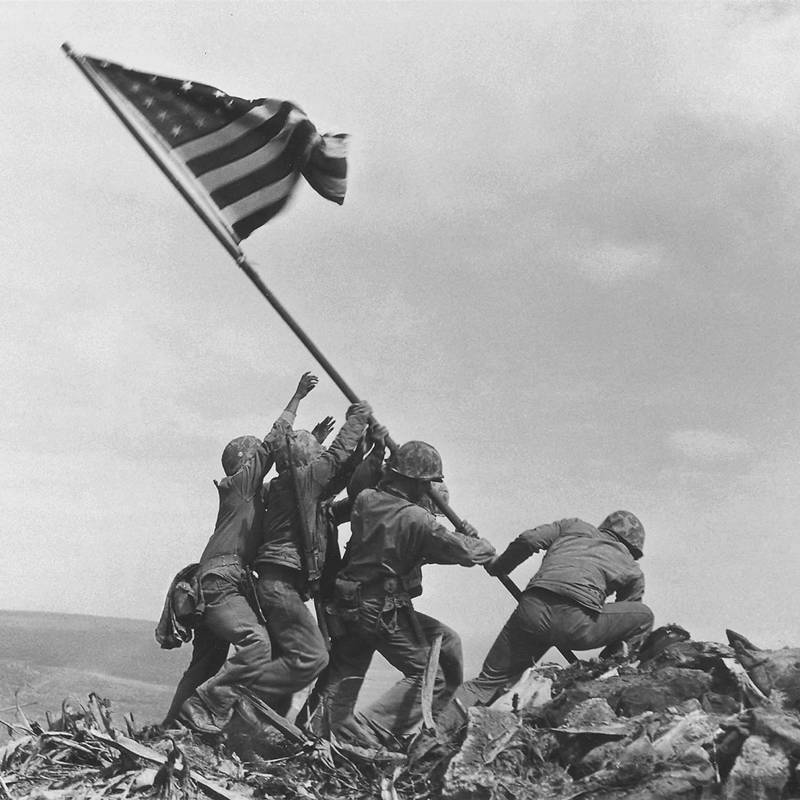
Iconica foto di Joe Rosental che ritrae i soldati americani che conquistano la cima di Iwo Jima. PD
|
||
L'origine della Seconda Guerra MondialeSenza dubbio, la Seconda Guerra Mondiale è stato il conflitto armato più devastante nella storia dell'umanità. Le perdite in termini di vite umane furono tremende. Si stima che tra i 55 e i 60 milioni di persone morirono durante i sei anni di scontri armati che si estesero in tutto il mondo, dall'Europa all'Asia e dall'Africa all'Oceania. Tuttavia, per comprendere le origini della Seconda Guerra Mondiale dobbiamo tornare alla fine della Prima Guerra Mondiale, nota anche come Grande Guerra, che culminò con la firma del Trattato di Versailles il 28 giugno 1919 (anche se l'armistizio era stato firmato mesi prima, l'11 novembre 1918, per porre fine alle ostilità sul campo di battaglia). Questo fatto sarebbe stato, almeno in parte, il fattore scatenante degli eventi che si svilupparono negli anni successivi e che avrebbero portato Adolf Hitler al potere e scatenato un nuovo conflitto che avrebbe portato a episodi terribili come l'Olocausto. La firma del trattato fu un duro colpo da incassare per la delegazione tedesca. Sia i rappresentanti del paese sconfitto, sia i giornali e la popolazione in generale, capirono che si trattava di un atto di imposizione più che di una negoziazione. Tuttavia, ciò che finì per irritare maggiormente la società tedesca manipolata dalla destra fu l'accettazione dell'articolo 231, che consideravano inaccettabile e umiliante. Questo articolo era introduttivo alla parte VIII del trattato, relativa alle indennità, ed era stato introdotto dai negoziatori statunitensi. Sapevano che i tedeschi non avrebbero potuto pagare (come volevano principalmente i francesi e gli inglesi) indennità che coprissero tutti i costi della guerra. L'articolo 231 riconosceva quindi la responsabilità morale della Germania per la guerra e la sua imputabilità legale per i danni causati. D'altra parte, l'articolo 232 riconosceva implicitamente la sua incapacità economica di soddisfarli. Tuttavia, la destra tedesca utilizzò questo articolo come elemento centrale della campagna contro il trattato. Alti ufficiali dell'esercito e settori conservatori della società tedesca si mostrarono riluttanti a firmare le condizioni imposte dai vincitori, pur sapendo che l'alternativa era la ripresa delle ostilità e l'invasione del territorio tedesco. Un'umiliazione ancora maggiore. In questa situazione, i sostenitori della firma sostennero che non c'era altra scelta e alla fine la Germania dovette rinunciare a tutte le sue colonie e accettare la consegna dei territori invasi a paesi come Francia, Danimarca e Polonia. |
||
 |
||
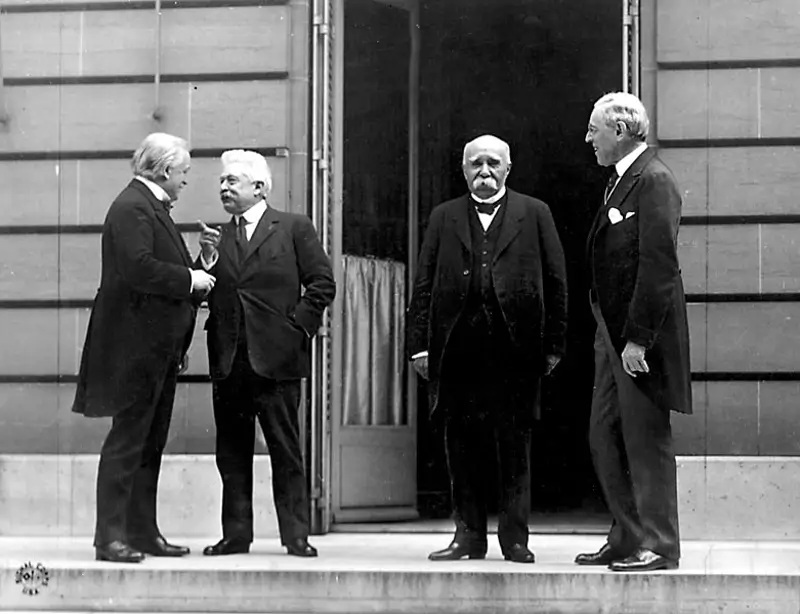
| I “Quattro Grandi” alla Conferenza di pace di Parigi del 27 maggio 1919. Da sinistra a destra: David Lloyd George, Vittorio Orlando, Georges Clemenceau e Woodrow Wilson. PD | ||
Il periodo tra le due guerreMa quelle condizioni non furono l'unica cosa che la Germania dovette affrontare dopo la firma del Trattato di Versailles. Furono incluse anche una serie di clausole militari che imponevano una drastica riduzione dell'esercito tedesco e la fine del servizio militare obbligatorio. Furono inoltre aboliti l'aviazione, l'artiglieria pesante e i sottomarini. Inoltre, furono imposte alcune condizioni economiche alla Germania in quanto perdente della prima guerra mondiale. Il trattato non stabiliva un importo da pagare, ma lasciava che fosse una commissione a fissarlo nel 1921, ma prima doveva essere versato un pagamento di 20 miliardi di marchi d'oro, che includeva anche il cibo che gli Alleati avrebbero dovuto fornire alla Germania affamata e il costo dell'occupazione della Renania da parte degli Alleati, per un totale di circa 8 000 milioni. Gran parte di questo pagamento fu effettuato in natura. I piroscafi e i pescherecci consegnati dai tedeschi nei due anni successivi come parte del pagamento ammontavano a oltre 2,6 milioni di tonnellate, ma gli inglesi ne avevano persi più di 8 durante la guerra.
Successivamente, l'importo stabilito dalla Commissione per le riparazioni fu di 132 miliardi di marchi d'oro (circa 33 miliardi di dollari). Il sistema di pagamento fu suddiviso in obbligazioni A e B, per un totale di circa 50 miliardi, e obbligazioni C, per il resto (82 miliardi), con inizio del pagamento dopo 36 anni. I membri della Commissione sapevano che probabilmente non sarebbero mai stati pagati, come poi effettivamente avvenne. Per quanto riguarda i 50 miliardi iniziali, alla conferenza di Losanna del 1932 fu chiaro che la Germania non avrebbe effettuato ulteriori pagamenti, per un totale complessivo fino a quel momento compreso tra 20 e 21 miliardi. Per capire il contesto, si trattava di una cifra inferiore a quella che la Francia aveva pagato come risarcimento per la guerra franco-prussiana. I pagamenti totali durante i 13 anni della Repubblica di Weimar rappresentarono un onere del 2,72% per l'economia tedesca. In realtà, quindi, le indennità non frenarono la ripresa, e l'iperinflazione non ebbe nulla a che vedere con esse, ma con il fatto che la Germania aveva finanziato sia la guerra e il dopoguerra, sia la resistenza all'occupazione della Ruhr da parte di francesi e belgi tra il 1923 e il 1925 emettendo carta moneta (anziché ricorrere alle tasse). In realtà, ciò che provocò l'ascesa del nazismo (e del comunismo) in Germania furono le conseguenze della crisi del 1929, che seguì un periodo di stabilità politica, economica e sociale.
|
||
 |
||
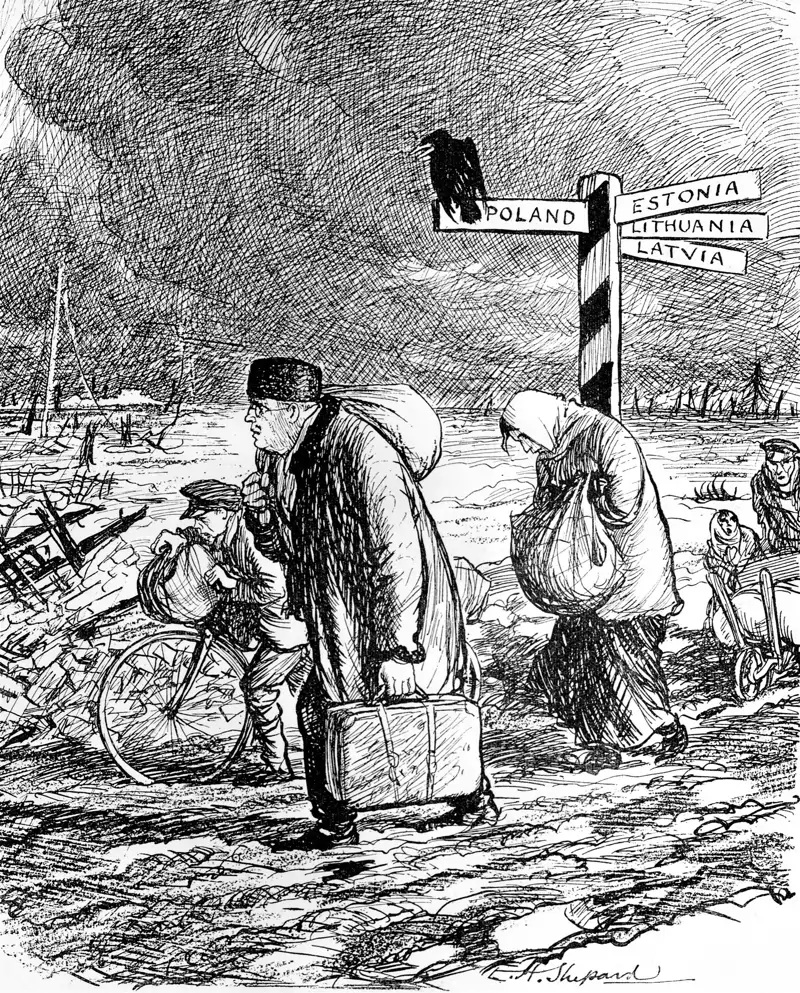
| Il periodo tra le due guerre |
||
Il Lebensraum divenne un principio ideologico del nazismo che giustificava la sua espansione territoriale nell'Europa centrale e orientale.In Germania, in quel contesto estremamente complicato, i militari e la destra conservatrice iniziarono a fomentare la popolazione con un messaggio chiaro: “I democratici ci hanno tradito a Versailles”. Così, con l'unico scopo di invertire la svolta rivoluzionaria richiesta dalla classe operaia, arrivarono ad affermare che le condizioni imposte al popolo tedesco non erano affatto quelle che erano state tradizionalmente imposte in Europa, meno dure e più rispettose, ai perdenti di una guerra. Fu allora che cominciò ad emergere una lettura geopolitica e razziale dello sviluppo dei popoli e della necessità di spazio vitale per espandersi. Conosciuto come Lebensraum (spazio vitale), fu un'espressione coniata dal geografo tedesco Friedrich Ratzel, fortemente influenzato dal biologismo e dal naturalismo del XIX secolo. Così, l'Europa orientale e il mondo slavo erano visti come il Lebensraum proprio di una Germania a cui il trattato di Versailles aveva imposto dei limiti che rendevano impossibile lo sviluppo del popolo tedesco. L'ascesa al potere di HitlerAlla fine degli anni '20, i paesi dell'Europa centrale iniziarono a sperimentare una grande instabilità politica causata dall'instabilità economica, particolarmente devastante per la Germania. Questa instabilità finì per diventare un terreno fertile per movimenti politici di natura estremista e con spirito di rivalsa che riuscirono a ottenere un importante seguito tra la popolazione. Tra tutti questi gruppi spiccava il Partito Nazionalsocialista Tedesco dei Lavoratori, guidato da Adolf Hitler, che poco a poco andava conquistando simpatizzanti e seguaci desiderosi di ribaltare quanto firmato a Versailles e riportare la Germania al posto che ritenevano le spettasse. Da quel momento in poi, gli eventi si susseguirono rapidamente. Hitler fu nominato cancelliere della Germania il 30 gennaio 1933 dal presidente Paul von Hindenburg, il 27 febbraio ebbe luogo il famoso incendio del Reichstag e il giorno successivo Hindenburg firmò il “Decreto del Presidente del Reich per la protezione del popolo e dello Stato”, con il quale le libertà individuali venivano totalmente sospese “fino a nuovo avviso”. La libertà di espressione, di stampa, di associazione e di riunione fu limitata e fu istituito il segreto delle comunicazioni. |
||
 |
||
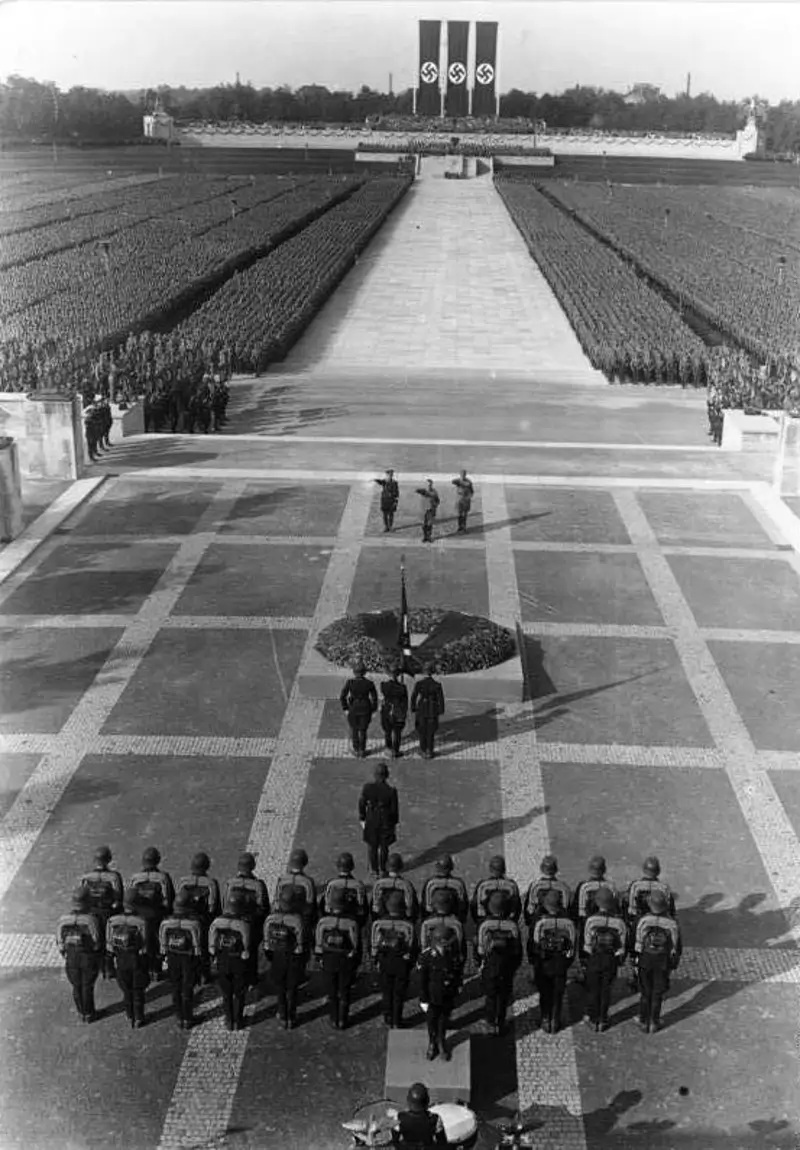
| Raduno del partito nazista dopo la vittoria alle elezioni del 1933. CC | ||
|
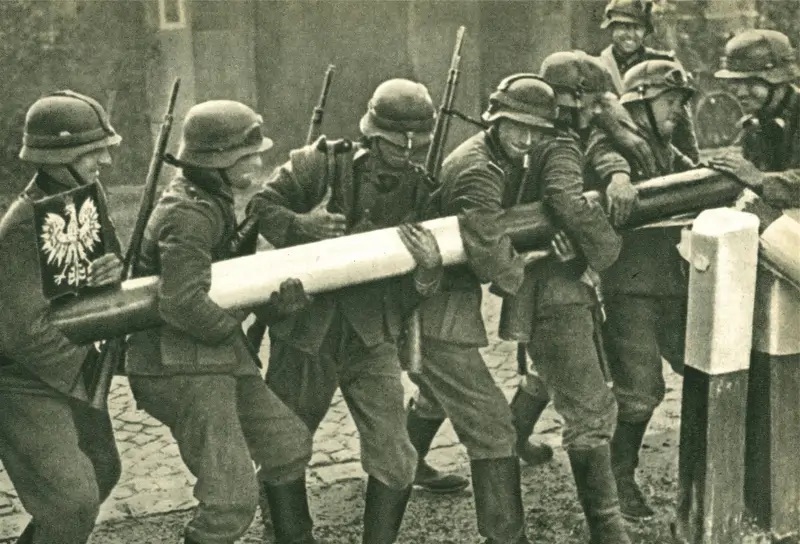
Una volta al potere, Hitler violò gli accordi del Trattato di Versailles e ordinò immediatamente il riarmo del Paese. Infatti, aumentò la spesa per gli armamenti fino a 18 miliardi di marchi tra il 1934 e il 1938. Così, dopo essersi assicurato l'aiuto militare, Hitler iniziò la sua politica espansionistica con l'annessione dell'Austria nel marzo 1938, l'episodio noto come Anschluss, durante il quale si tennero delle elezioni con lo scopo di legalizzare l'annessione. Ma lo “spazio vitale” di Hitler non finì lì. All'Austria seguirono i Sudeti, una zona di confine della Cecoslovacchia abitata da tre milioni di tedeschi, un'idea con cui la Francia e il Regno Unito transigevano con gli Accordi di Monaco, nel settembre 1938, pensando di placare così Hitler. Niente di più lontano dalla realtà. Hitler, invece di scoraggiarsi, decise di invadere la Cecoslovacchia nel marzo 1939. Una volta occupata quella regione, Hitler pretese anche il corridoio di Danzica, un territorio creato dopo il Trattato di Versailles che si estendeva lungo la foce del fiume Vistola e che serviva alla Polonia per accedere al Mar Baltico. Va sottolineato che all'epoca la Polonia era uno Stato che, dopo essere scomparso nel XVIII secolo, era stato restaurato dalla Francia e dal Regno Unito negli accordi di pace come parte della creazione di un “cordone sanitario” di paesi dell'Europa centrale che contribuissero a frenare l'espansione della Russia rivoluzionaria. Dopo il rifiuto del governo polacco di cedere la propria sovranità e dopo che la Germania e la Russia firmarono un patto di non aggressione il 23 agosto 1939, la Germania invase la Polonia una settimana dopo. L'invasione della Polonia segna l'inizio della Seconda Guerra Mondiale“Questa notte, soldati polacchi hanno sparato per la prima volta contro il nostro territorio”. Con questa menzogna, Adolf Hitler cercava di giustificare il fatto che l'esercito tedesco non avesse altra scelta che invadere la Polonia il 1° settembre 1939. In realtà, il piano per invadere la Polonia era stato elaborato il 31 agosto 1939 nell'ambito dell'Operazione Himmler, quando una mezza dozzina di membri delle SS, fingendo di essere dei rivoltosi, irruppero con la forza in una stazione radio di Gleiwitz, una regione dell'Alta Slesia, sparando colpi in aria. Una volta neutralizzati i tre impiegati e il poliziotto che si trovavano all'interno, gli assalitori lanciarono violenti proclami contro il Führer e il Terzo Reich. Fu allora che accesero il microfono affinché un interprete iniziasse a lanciare proclami patriottici e antitedeschi in polacco: “Attenzione! Qui è Gleiwitz. La stazione radio è in mano polacca”.
|
||
 |
||
| German troops remove the border barrier between Poland and Germany on 1 September 1939. Cordon Press | ||
|
Per rendere la scena ancora più credibile, gli assalitori portarono lì un nazionalista polacco di nome Franz Honiok, arrestato dalle SS il giorno prima. Honiok era un agricoltore di 43 anni che era stato scelto per aver partecipato ad altre rivolte simili. Lo trascinarono alla stazione radio completamente drogato e, appena arrivato, gli spararono all'ingresso della stazione radio affinché tutti potessero vederlo. Per evitare qualsiasi tipo di confusione, vestirono Honiok con un'uniforme dell'esercito polacco che avevano precedentemente rubato e, dopo essere rimasti solo 15 minuti nella stazione radio, il commando fuggì senza rendersi conto che solo una parte del falso discorso era stata trasmessa a causa di un problema tecnico. Sebbene la parte della trasmissione che fu possibile ascoltare non annunciasse la falsa invasione della Germania, ciò fu sufficiente perché Adolf Hitler avesse il suo tanto desiderato casus belli e potesse così giustificare l'invasione del paese confinante. Prima di fuggire dalla stazione radio, il commando delle SS portò il cadavere di Franz Honiok nella sala di trasmissione, dove gli scattarono alcune foto che sarebbero state poi pubblicate su tutta la stampa.
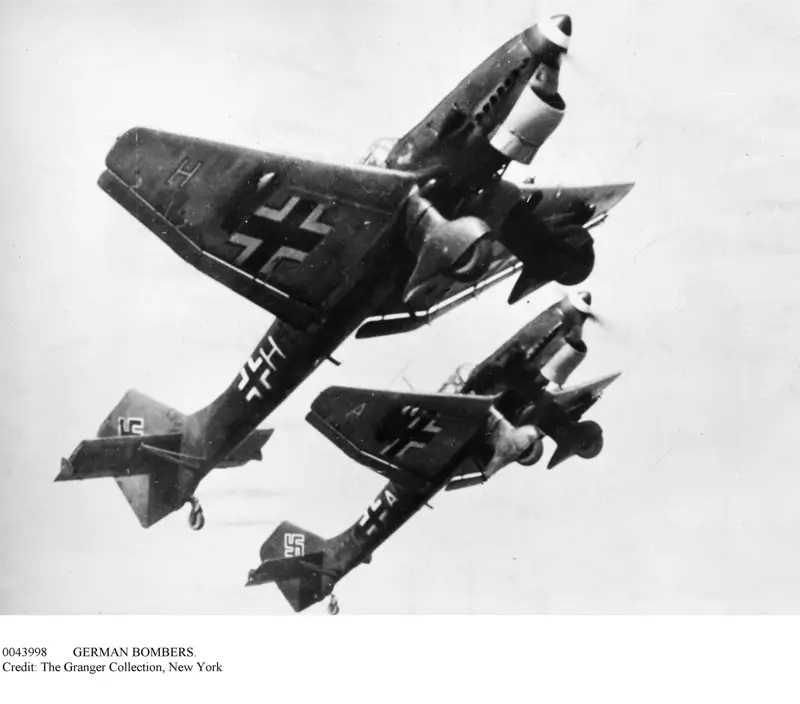
Nonostante gli stratagemmi dell'esercito tedesco per trovare un motivo per invadere la Polonia, l'invasione era già stata annunciata giorni prima da Adolf Hitler. Come spiega Richard Lukas nel suo libro Out of the Inferno: Poles Remember the Holocaustnel discorso di Obersalzberg pronunciato il 22 agosto 1939, poco prima dell'invasione della Polonia, Hitler diede esplicito permesso ai suoi comandanti di uccidere “senza pietà né rimorso, tutti gli uomini, le donne e i bambini di origine o lingua polacca”. Infine, la mattina del 1° settembre 1939, con la giustificazione di quanto era accaduto il giorno prima, il potente esercito tedesco avanzò verso la Polonia attraverso diversi punti di frontiera. La Polonia aveva un esercito forte e i suoi effettivi erano superiori in numero agli invasori, ma non aveva decretato la mobilitazione generale su richiesta dei francesi e degli inglesi, che ritenevano che ciò potesse essere un pretesto per Hitler per attaccare. Questa incapacità di difendersi fu ancora maggiore quando, il 17 settembre, l'URSS invase la Polonia, rendendo impossibile ogni resistenza e dividendo il paese tra l'URSS e la Germania. Hitler desiderava da tempo iniziare la guerra contro questo paese, ma non aveva previsto che nel giro di pochi giorni la Gran Bretagna e la Francia si sarebbero schierate dalla parte della Polonia e gli avrebbero dichiarato guerra. La seconda guerra mondiale era iniziata. La blitzkrieg, la strategia vincente di HitlerDurante la prima fase della seconda guerra mondiale nel continente europeo, la Germania cercava con tutti i mezzi di evitare un conflitto che si protraesse nel tempo. La sua strategia era quella di sconfiggere rapidamente tutti i suoi avversari in una serie di campagne brevi. Grazie a quella tattica denominata Blitzkrieg, l'esercito tedesco invase gran parte dell'Europa e ne uscì vittorioso per diversi anni. Il termine Blitzkrieg è una parola tedesca che letteralmente si traduce come “guerra lampo” ed è usato per riferirsi a una tattica militare basata sullo sviluppo di una campagna rapida e decisiva. La tattica Blitzkrieg richiedeva una grande concentrazione di armi offensive come carri armati, aerei e artiglieria pesante. La velocità era la caratteristica più distintiva della Blitzkrieg. Dopo il bombardamento iniziale dell'aviazione, i carri armati attaccavano l'obiettivo rapidamente e in modo autonomo, causando una grande disorganizzazione nelle linee difensive nemiche. Come sottolinea Martin H. Folly nel suo Atlante della Seconda Guerra Mondiale, «l'esercito polacco non era una forza insignificante, ma non era preparato al nuovo tipo di guerra praticato dai tedeschi. Questa era la Blitzkrieg, la guerra lampo». La punta di diamante era la divisione Panzer, una concentrazione di veicoli blindati, con fanteria completamente motorizzata e supporto aereo ravvicinato fornito dalla Luftwaffe e concretizzato dai temibili bombardieri in picchiata, gli stukas. La Germania disponeva solo di carri armati leggeri e l'esercito non era completamente preparato alla guerra, ma la chiave della Blitzkrieg era la rapidità, che avrebbe travolto le difese nemiche prima che queste potessero organizzare le loro forze o prima che venissero scoperti i punti deboli nascosti delle forze attaccanti. L'uso della forza aerea contro obiettivi civili avrebbe riempito le strade di profughi e contribuito alla disintegrazione del morale, una componente fondamentale di ogni Blitzkrieg efficace. I polacchi erano superiori di numero, con 30 divisioni e dieci di riserva, ma il loro equipaggiamento e la loro dottrina strategica erano obsoleti. Le loro forze erano schierate lungo i confini. Sfortunatamente per i polacchi, le loro principali aree industriali si trovavano in Slesia, proprio ai confini, il che li rendeva estremamente vulnerabili alla Blitzkrieg.
|
||
 |
||
| Gli Stuka furono una parte molto importante della guerra lampo (Blitzkrieg). Cordon Press | ||
|
La Germania utilizzò la Blitzkrieg durante l'invasione della Polonia il 1° settembre 1939, così come su altri fronti come in Danimarca (aprile 1940), Norvegia (aprile 1940), Belgio (maggio 1940), Olanda (maggio 1940), Lussemburgo (maggio 1940), Francia (maggio 1940), Jugoslavia (aprile 1941) e Grecia (aprile 1941). La potenza aerea tedesca era schiacciante e non permetteva ai difensori né di rifornirsi, né di organizzare le loro forze, né di inviare rinforzi che potessero difendere le brecce aperte dai carri armati. Tuttavia, nonostante l'evidente efficacia della Blitzkrieg, ci furono alcuni paesi che la Germania non riuscì a sconfiggere con questo sistema: la Gran Bretagna, grazie al fatto che le isole potevano contare sull'aiuto inestimabile del Canale della Manica e dell'efficace Marina Reale Britannica, e l'Unione Sovietica, nonostante la Blitzkrieg fosse riuscita a spingere le truppe sovietiche alle porte di Mosca nel 1941. La “guerra buffa” e la fuga da DunkerqueDopo l'invasione della Polonia, nel settembre 1939, seguirono otto mesi di quella che fu conosciuta come la drôle de guerre (la guerra buffa o falsa guerra), che si sarebbe conclusa con l'invasione della Danimarca e della Norvegia nell'aprile 1940. In realtà, ciò che gli Alleati non sapevano era che, dopo quella presunta calma, l'idea di Hitler era quella di avanzare verso ovest per sferrare il primo grande colpo della guerra: la presa di Parigi. Incoraggiato dalla rapida caduta della Polonia, Hitler intendeva utilizzare la Blitzkrieg per fare lo stesso con la Francia, nonostante le maggiori dimensioni del nemico e la difficoltà di dover superare la storica linea Maginot per entrare trionfalmente a Parigi.
|
||
 |
||
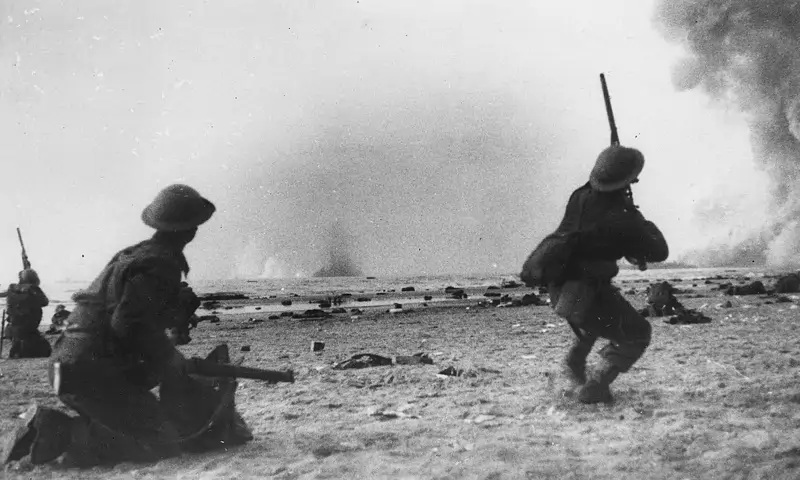
| Soldati britannici sparano contro aerei tedeschi durante l'evacuazione di Dunkerque. PD | ||
|
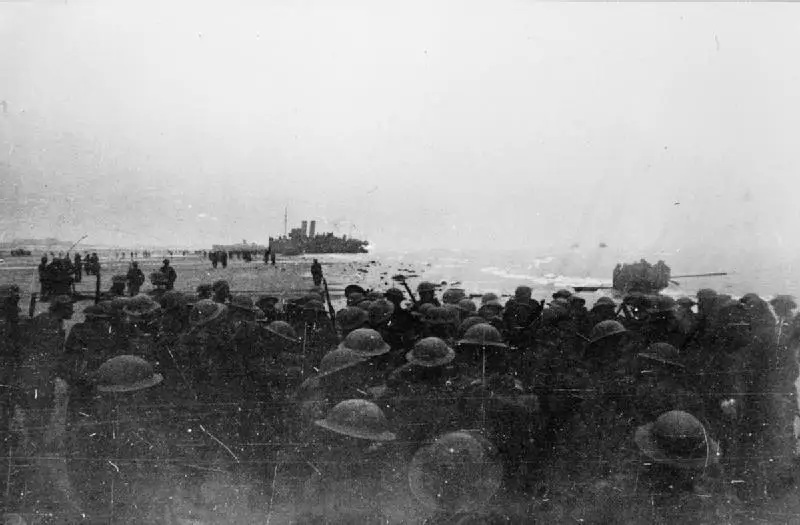
I tedeschi attaccarono il Belgio facendo credere che da lì avrebbero invaso la Francia, mentre in realtà l'attacco principale alla Francia avvenne attraversando la zona boschiva delle Ardenne, tra il Belgio e l'estremità settentrionale della linea Maginot, cogliendo completamente di sorpresa i francesi. Queste truppe avanzarono fino al Canale della Manica, mettendo alle strette francesi, britannici e belgi contro il mare. Sebbene Hitler si aspettasse di subire un milione di perdite tra i suoi effettivi, quando l'esercito nazista sfilò sugli Champs-Élysées di Parigi si stimava che le perdite tra le sue file fossero state di 27.000 uomini. Ma nonostante il successo ottenuto, il grande trionfo dell'esercito tedesco va cercato in un luogo imprevedibile per tutti, data l'inaspettata importanza: le spiagge di Dunkerque, nel nord della Francia, dove finirono accerchiati più di 338.000 soldati alleati, che videro nel porto francese l'unica via di fuga. Fu il generale Gort, al comando della British Expeditionary Force (BEF), il responsabile dell'organizzazione della cosiddetta Operazione Dinamo, che consisteva nell'evacuazione delle truppe alleate in territorio francese e che fu portata a termine tra il 26 maggio e il 4 giugno 1940.
|
||
 |
||
| Raduni di soldati britannici sulle spiagge di Dunkerque. PD | ||
|
In realtà, l'operazione non avrebbe avuto successo se il 24 maggio Hitler non avesse ordinato di fermare le sue divisioni corazzate. La decisione obbediva alla volontà di poterle utilizzare contro le forze francesi che si trovavano più a sud se queste fossero riuscite a riorganizzarsi, e all'idea di Herman Göring, capo delle forze aeree tedesche, la Luftwaffe, che avrebbe potuto vanificare qualsiasi tentativo di evacuazione dei britannici. Ciò permise agli assediati di preparare un perimetro difensivo che riuscì a opporre un'efficace resistenza. Il fuoco dell'artiglieria tedesca non riuscì a fermare l'operazione, né l'azione dei bombardieri tedeschi, che non poterono contare su un efficace supporto dei caccia decollati dalle basi in Germania contro gli Spitfire alleati arrivati da basi molto più vicine, come il Kent. A ciò si aggiunse un mare calmo, che facilitò l'evacuazione.
|
||
 |
||
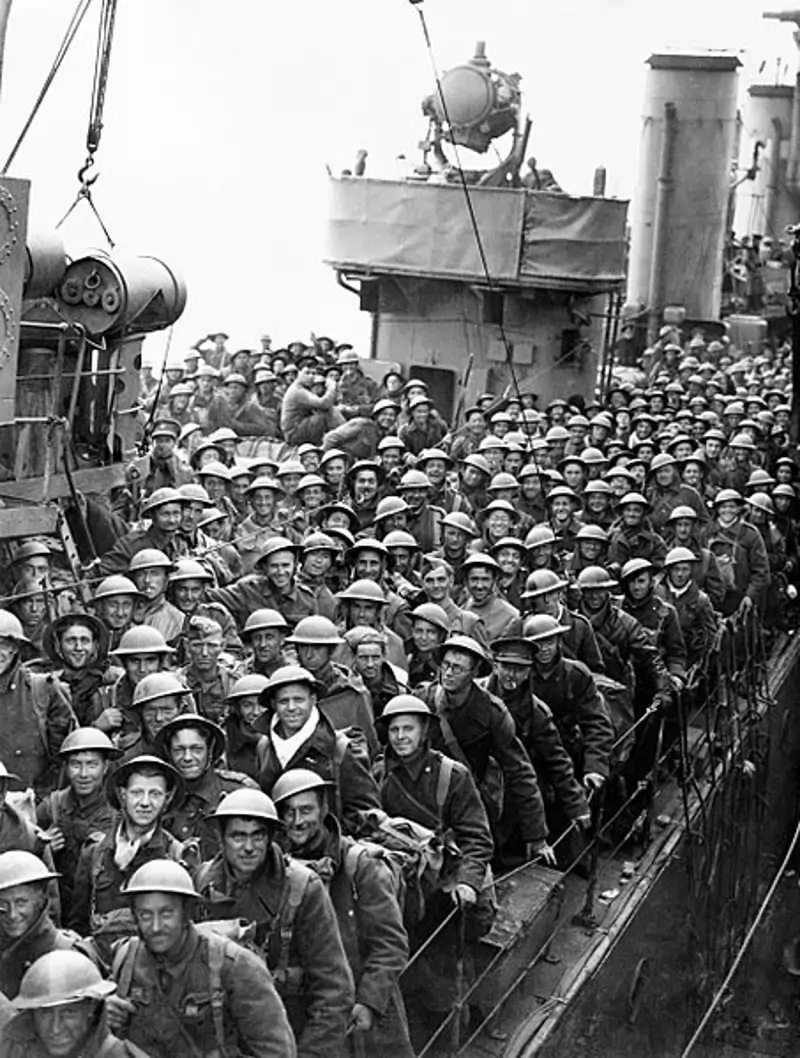
| Soldati britannici in attesa di sbarcare a Dover. PD | ||
|
La maggior parte dei soldati alleati fuggì su navi della Royal Navy, come l'incrociatore leggero HMS Calcutta o uno degli oltre 30 cacciatorpediniere schierati nella zona, ma altri lo fecero a bordo di imbarcazioni civili, che accorsero in loro aiuto vedendo che la marina non riusciva a trasportare così tanti uomini. Il 4 giugno, il primo ministro britannico Winston Churchill si rivolse alla nazione con un messaggio molto chiaro: le guerre non si vincono con le evacuazioni. Il premier britannico pronunciò il suo discorso più memorabile con frasi famose come “we shall go on to the end” (andremo avanti fino alla fine) o “we shall never surrender” (non ci arrenderemo mai). Ciò che fu ottenuto a Dunkerque permise alla Gran Bretagna di continuare la lotta e, cosa ancora più importante, di ottenere il riconoscimento e la simpatia dell'opinione pubblica e della stampa americana. L'Inghilterra entra nella Seconda Guerra MondialeNell'estate del 1940, la Germania nazista aveva conquistato in tempo record Polonia, Norvegia, Danimarca, Olanda, Belgio, Lussemburgo e Francia con l'inestimabile aiuto dell'Italia di Mussolini, che si era appena unita alle potenze dell'Asse con tutti i suoi domini nel Mediterraneo e in Africa. Di fronte a questa nuova situazione strategica in Europa, dopo la gravissima sconfitta subita sulle spiagge di Dunkerque e dopo la rottura dei colloqui di pace tra diplomatici inglesi e tedeschi in Svizzera, l'Inghilterra era sul punto di affrontare una nuova offensiva da parte della Germania: l'Operazione Leone Marino, che prevedeva un uso massiccio dell'aviazione tedesca, comandata dal maresciallo dell'aria Hermann Göring, con l'obiettivo di distruggere la Royal Air Force britannica (RAF) e ottenere così la superiorità aerea necessaria per invadere la Gran Bretagna.
|
||
 |
||
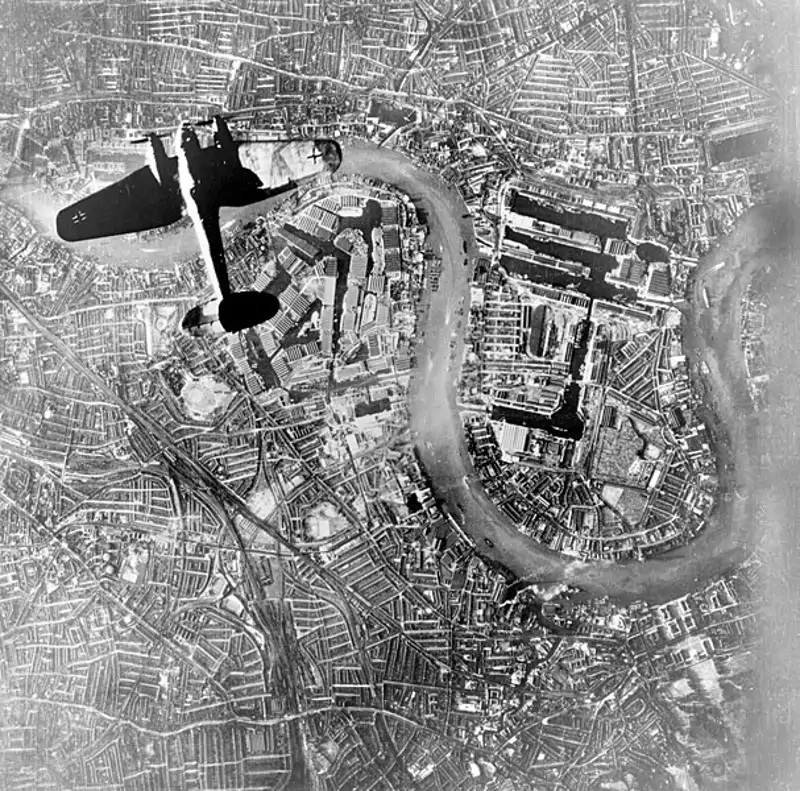
| Un bombardiere tedesco Heinkel He 111 sorvola i moli commerciali del Surrey, a sud di Londra, il 7 settembre 1940. PD | ||
|
Il 30 giugno, il comandante Alfred Jodl e il feldmaresciallo Wilhelm Keitel, dando prova di un ottimismo smisurato, sostennero che la vittoria sull'Inghilterra era solo questione di tempo, anche se non tutti la pensavano allo stesso modo. Altri, come Erich Raeder, comandante in capo della Marina tedesca fino al 1943, avevano messo in guardia dall'insensatezza di quel piano, poiché non si disponeva di imbarcazioni in grado di compiere uno sbarco di tale portata. A favore dei tedeschi c'erano tre flotte ancorate in Francia, Norvegia e Paesi Bassi (la 5ª Flotta Aerea (Luftflotte 5) aveva il quartier generale a Oslo, la Luftflotte 3 a Parigi e la Luftflotte 2 a Bruxelles) e 3. 600 aerei contro i soli 870 velivoli della RAF. Ma l'ostacolo principale per portare a termine l'operazione era l'uso del radar da parte degli inglesi e i limiti dei caccia tedeschi, meno manovrabili degli Spitfire e Hurricane britannici. Durante il mese di luglio, i BF109 bombardarono le difese costiere e i convogli britannici nel Canale della Manica, ma la produzione bellica britannica non cessò mai per paura di una completa distruzione. La maggior parte degli storici concorda nell'affermare che in quel momento l'azione del primo ministro britannico Winston Churchill fu provvidenziale per trasformare la paura dei britannici in speranza. Il suo instancabile lavoro in tal senso fu ricompensato nell'emiciclo di Westminster, dove fu applaudito da laburisti e conservatori. Il premier gettò inoltre le basi per ricevere aiuto dagli Stati Uniti grazie alla sua amicizia con il presidente Roosevelt e alla sua vigilanza sull'Oceano Atlantico. In realtà, si potrebbe dire che Churchill, con il suo carisma, divenne un antidoto contro il disfattismo che cominciava a farsi strada nella società. Inoltre, diede prova della sua astuzia ingannando i tedeschi, durante il mese di agosto, con falsi hangar per evitare così la distruzione massiccia degli aeroporti britannici. Il 20 agosto, in segno di gratitudine per il lavoro svolto dai piloti della RAF, Churchill pronunciò la sua leggendaria frase “mai tanti hanno dovuto tanto a così pochi”.
|
||
 |
||
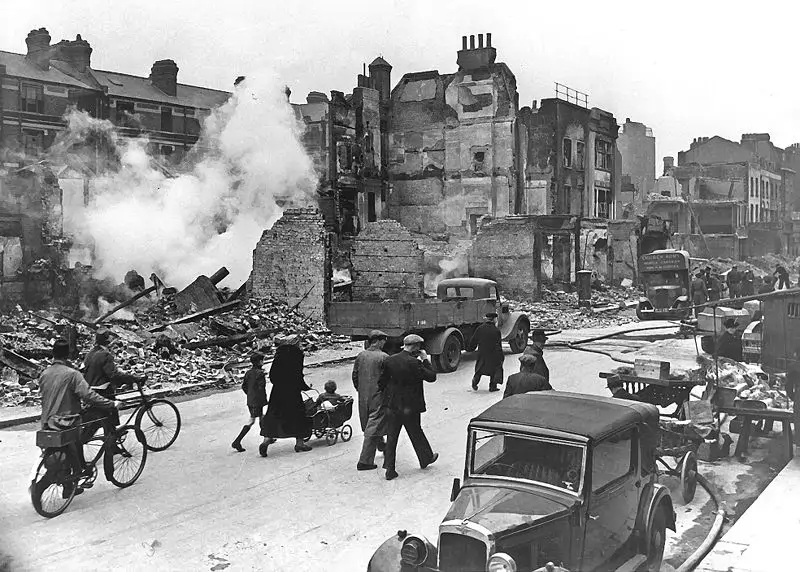
| Immagine di una delle strade di Londra dopo un bombardamento. PD | ||
|
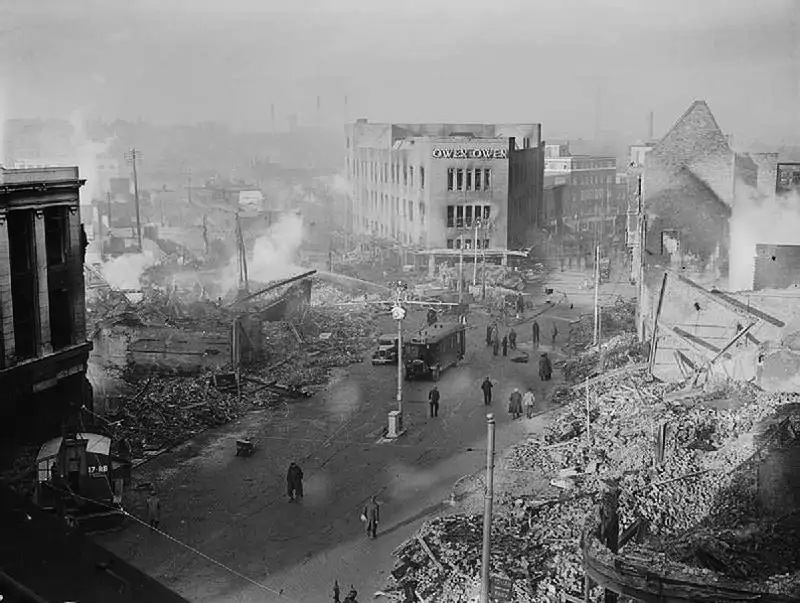
Infatti, alcuni storici ritengono anche che il maresciallo Keitel fosse ingenuo nel voler paragonare l'Inghilterra alla Polonia. Così, il 25 agosto, le sorti cominciarono a cambiare quando la RAF si vendicò del bombardamento tedesco sull'East End londinese facendo lo stesso all'aeroporto di Tempelhof a Berlino e alla fabbrica Siemens. I danni furono minimi, ma sufficienti per far infuriare Hitler e modificare tutto ciò che era stato pianificato fino a quel momento. Il 17 settembre fu rinviato l'operazione Leonmar e da quel momento Hitler diede l'ordine disvolgere i Blitz, bombardamenti aerei indiscriminati e prolungati da parte della Luftwaffe che ebbero luogo da settembre a novembre 1940 contro Londra e altre città industriali come Coventry.
|
||
 |
||
| La città di Coventry dopo uno dei devastanti bombardamenti tedeschi. PD | ||
|
Quelli furono tempi duri per i britannici, e infatti il cinema ha mitizzato quei mesi in cui è facile immaginare i londinesi rifugiarsi nella metropolitana. Churchill vedeva impotente una capitale in rovina, ma manteneva la calma sapendo che i suoi radar erano al sicuro dal fuoco nazista. A metà settembre, proprio quando i tedeschi avevano in programma di sferrare il colpo definitivo e mettere piede sul suolo britannico, la Royal Navy bombardò i principali porti di invasione come Calais, Cherbourg e Boulogne, con il supporto della RAF. A quanto pare, le perdite di entrambe le parti furono esagerate per motivi propagandistici e alla fine la battaglia d'Inghilterra si concluse con un pareggio. Poco dopo, il 17 settembre, Hitler dichiarò conclusa l'Operazione Leone Marino e rivolse la sua attenzione verso un nuovo obiettivo: l'Unione Sovietica. Va inoltre sottolineato che sia l'Operazione Leone Marino, sia l'Operazione Giorno dell'Aquila e il Blitz fanno parte della cosiddetta Battaglia d'Inghilterra. I nazisti invadono l'Unione Sovietica, l'Operazione BarbarossaDurante il Natale del 1940, Adolf Hitler giunse alla conclusione che per sbarazzarsi definitivamente della minaccia che Winston Churchill rappresentava per gli interessi della Germania era necessario dare una grande dimostrazione di forza. A tal fine, il dittatore nazista concepì la Direttiva 21, nota in seguito come Operazione Barbarossa, così chiamata in onore dell'imperatore del Sacro Romano Impero Federico I Barbarossa. L'obiettivo di questa operazione era quello di attaccare l'Unione Sovietica, porre fine al comunismo e disintegrare quel paese per ottenere l'ambito Lebensraum (spazio vitale), espellendo la popolazione slava e occupando il territorio sovietico fino agli Urali, colonizzandolo con tedeschi e riducendo la popolazione locale in servi al proprio servizio. Ai paesi vicini, come l'Ucraina o la Confederazione dei Paesi Baltici, sarebbe stata concessa un'indipendenza controllata da Berlino.
|
||
 |
||
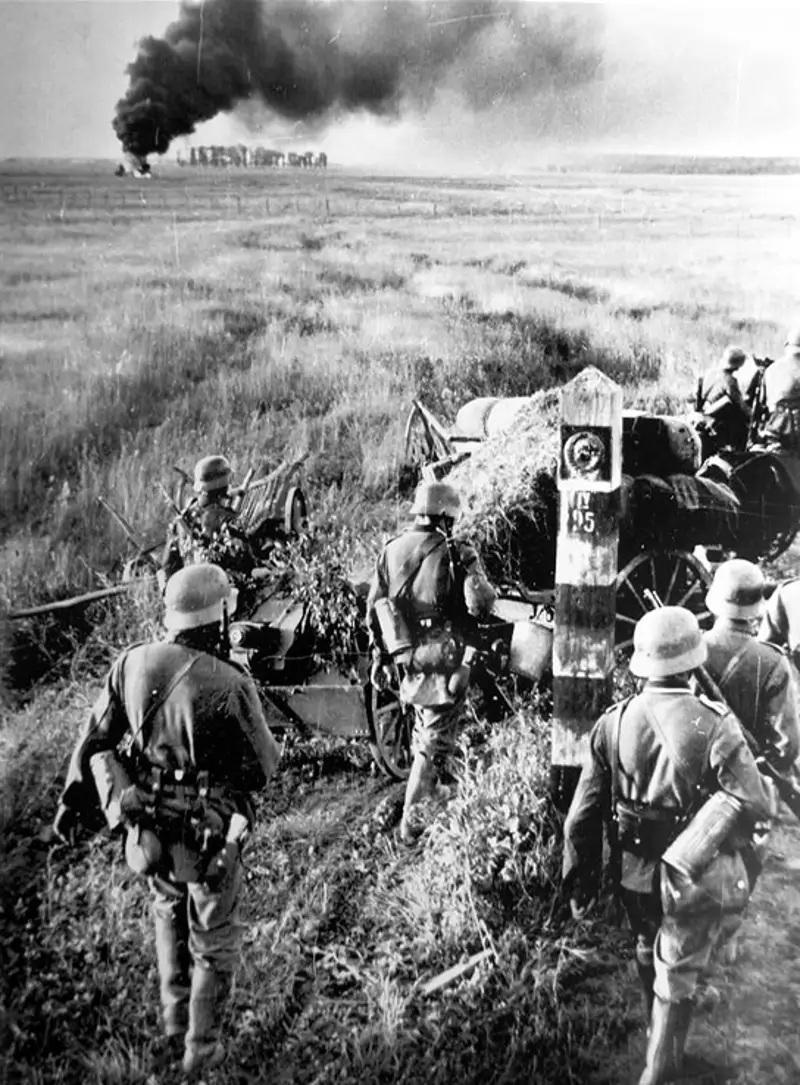
| All'inizio, l'avanzata tedesca era inarrestabile e senza opposizione. CC | ||
|
Infatti, alla genesi dell'Operazione Barbarossa si nascondeva anche il profondo disprezzo che Adolf Hitler provava per gli slavi, che la dottrina nazista considerava Untermenschen, “subumani”. In questo modo, nonostante il patto di non aggressione tedesco-sovietico, firmato nell'agosto del 1939, Hitler e Stalin sapevano che questa “pace” non poteva durare e che il loro scontro era inevitabile. L'Operazione Barbarossa aprì così un secondo fronte per la Germania nazista, che portò la guerra a livelli di barbarie mai visti prima. Ma in realtà quell'operazione non solo avrebbe rappresentato l'inizio della fine per Adolf Hitler, ma avrebbe anche segnato l'inizio in tutta Europa della terribile persecuzione e dello sterminio sistematico degli ebrei: l'Olocausto. Fino a quel momento la guerra stava andando a gonfie vele per i nazisti e, dopo la schiacciante conquista della Francia, Hitler pensò, erroneamente, che conquistare la Russia europea gli avrebbe richiesto solo tre o quattro mesi. Per raggiungere Mosca, Hitler pianificò un'offensiva su tre fronti: il fronte nord avrebbe attaccato lungo la costa baltica verso la Lituania e avrebbe preso Leningrado (l'attuale San Pietroburgo); al centro avrebbe operato un esercito che si sarebbe diretto prima a Minsk (l'attuale capitale della Bielorussia), poi a Mosca, la capitale sovietica; infine, un altro esercito a sud avrebbe attaccato l'Ucraina, dove si trovavano le terre più fertili dell'URSS; avrebbe poi avanzato verso le principali regioni industriali sovietiche, i bacini dei fiumi Don e Donets, per occupare infine i giacimenti petroliferi del Caucaso.
Una volta assicurata la zona, lo stesso esercito avrebbe avuto il compito di conquistare la base navale della Crimea e i giacimenti petroliferi del Caucaso. Ma col senno di poi, gli esperti militari ritengono che dividere l'offensiva su tre fronti sia stato un errore cruciale. A loro avviso, l'obiettivo principale avrebbe dovuto essere Mosca stessa, in quanto principale snodo delle comunicazioni e importante centro industriale. In questo modo, Hitler avrebbe potuto dividere in due l'Unione Sovietica e conquistarla molto più facilmente.
|
||
 |
||
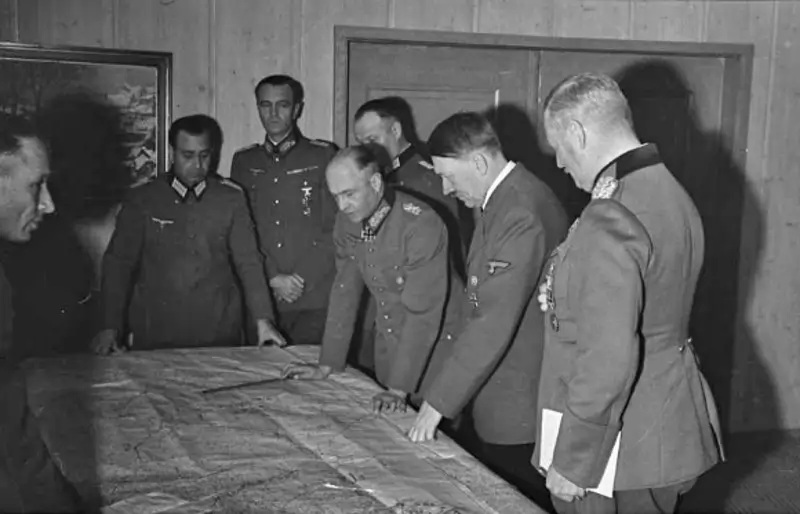
| L'alto comando tedesco, con Hitler in testa, segue le operazioni. CC | ||
|
Un'ulteriore dimostrazione dell'eccessiva fiducia con cui i tedeschi affrontarono la campagna è che solo un quinto delle loro forze disponeva di indumenti pesanti per affrontare il rigido inverno russo, poiché Hitler era convinto che entro dicembre ci sarebbe stata una nuova frontiera orientale del Reich segnata dal fiume Volga. Ma ciò che né Hitler né il suo Stato Maggiore avevano previsto era di non occupare Mosca prima che le condizioni meteorologiche diventassero più avverse. Le piene dei fiumi dopo le piogge primaverili avevano trasformato l'intero territorio in un vero e proprio pantano, costringendo a ritardare l'invasione fino alla torrida estate. Alla fine, ai quasi quattro milioni di soldati che combattevano dalla parte della Germania nazista si unirono 3.400 carri armati che dovevano affrontare quasi 11.000 carri armati e tre milioni di soldati sovietici. Ma perché i nazisti impiegarono così pochi blindati? Secondo gli esperti, ciò fu dovuto alla carenza di carburante, che in quel momento era bloccato dagli Alleati, costringendo i tedeschi a utilizzare animali da tiro per il trasporto. L'offensiva dell'esercito tedesco in territorio sovietico iniziò il 22 giugno 1941 con un intenso bombardamento dell'artiglieria pesante e della Luftwaffe sulle posizioni sovietiche. Il loro obiettivo principale erano gli aeroporti, che avrebbero potuto garantire loro il controllo dello spazio aereo durante i primi mesi dell'invasione. Dopo quattro giorni di violenti combattimenti, le truppe del generale Hoth entrarono a Minsk, dove fecero prigionieri 324.000 soldati e catturarono 2.500 carri armati. Gli eserciti del nord e del sud avanzavano in modo simile e l'esercito del generale Hoth, che avanzava in media di 32 chilometri al giorno, raggiunse Smolensk (a 369 chilometri da Mosca) il 18 luglio.
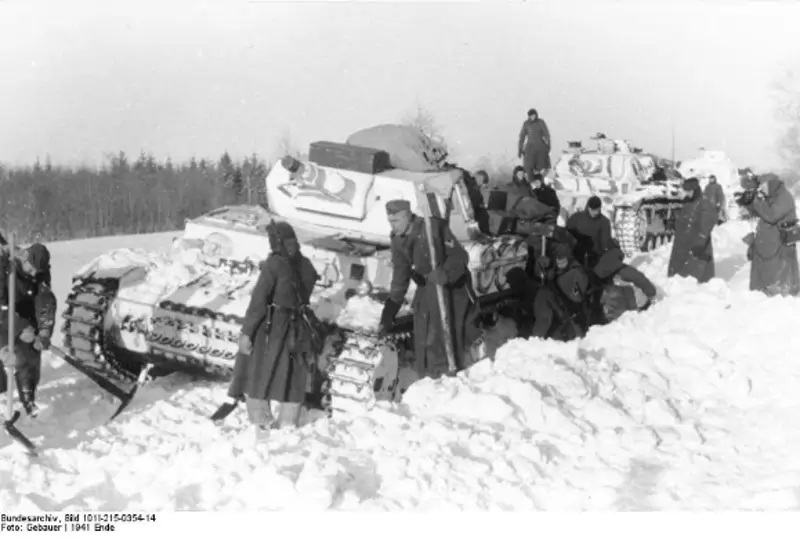
Ma nonostante il momentaneo successo dell'operazione, il dittatore tedesco ordinò di dare priorità alla conquista dell'Ucraina e di Leningrado. Così, ignorando i consigli dei suoi generali, il 19 luglio Adolf Hitler emanò la Direttiva 33, con la quale ordinava ai carri armati dell'esercito centrale di rinforzare gli altri due fronti: il generale Hoth avrebbe cambiato rotta per assicurare l'accerchiamento di Leningrado e il generale Guderian avrebbe fatto lo stesso per invadere Kiev, le regioni carbonifere ucraine e conquistare la penisola di Crimea. Quel cambiamento di strategia permise ai sovietici di avere il tempo di riorganizzarsi e ricostruire le loro difese, contro le quali l'esercito nazista avrebbe finito per schiantarsi. Nel frattempo, nelle retrovie, le SS tedesche esercitavano una dura e crudele repressione sulla popolazione civile, mentre gli attentati perpetrati da gruppi di partigiani organizzati dalla NKVD (la polizia segreta russa) rendevano le strade delle città conquistate luoghi molto pericolosi, impedendo ai tedeschi di consolidare le loro conquiste e rallentando anche il trasporto dei rifornimenti. In realtà, con l'attuazione della Direttiva 33, i tedeschi avevano perso più di due mesi, cruciali per il successo dell'Operazione Barbarossa. E anche gli elementi sembravano allearsi contro di loro. Il 15 ottobre, l'esercito tedesco si trovava a soli 105 chilometri da Mosca, pronto ad assaltare la capitale in quella che chiamarono Operazione Tifone, quando una forte tempesta, insieme all'arrivo delle prime nevicate, rese impraticabili le strade. I sovietici approfittarono di questa circostanza per rinforzarsi con truppe provenienti dalla Siberia e con un numero significativo di carri armati e aerei al comando del generale Gueorgui Zhúkov. Nonostante l'arrivo del freddo, i tedeschi non modificarono la loro strategia e continuarono con le loro tattiche abituali, ma i sovietici li respinsero quando erano a soli otto chilometri dalla capitale. Le basse temperature finirono per mandare all'aria la strategia tedesca in una delle campagne militari più sanguinose della Seconda Guerra Mondiale.
|
||
 |
||
| La neve ha frenato l'avanzata tedesca verso Mosca. CC | ||
Pearl Harbor e l'entrata degli Stati Uniti nella Seconda Guerra MondialeMentre la Germania nazista continuava la sua inarrestabile conquista dell'Europa, gli Stati Uniti erano ufficialmente neutrali nei confronti dei conflitti che i giapponesi stavano combattendo nella loro espansione in Cina e dell'atteggiamento della Germania di Hitler in Europa. Tuttavia, nel 1940, gli Stati Uniti iniziarono a considerare minacciosa per i propri interessi l'espansione del Giappone e il governo americano decise di fornire aiuto ai cinesi e di sanzionare i giapponesi. Così, dopo la firma del patto Antikomintern nel novembre 1941 tra la Germania nazista, l'Italia e il Giappone, gli Stati Uniti congelarono i beni giapponesi e vietarono tutte le esportazioni verso il Paese del Sol Levante.
|
||
 |
||
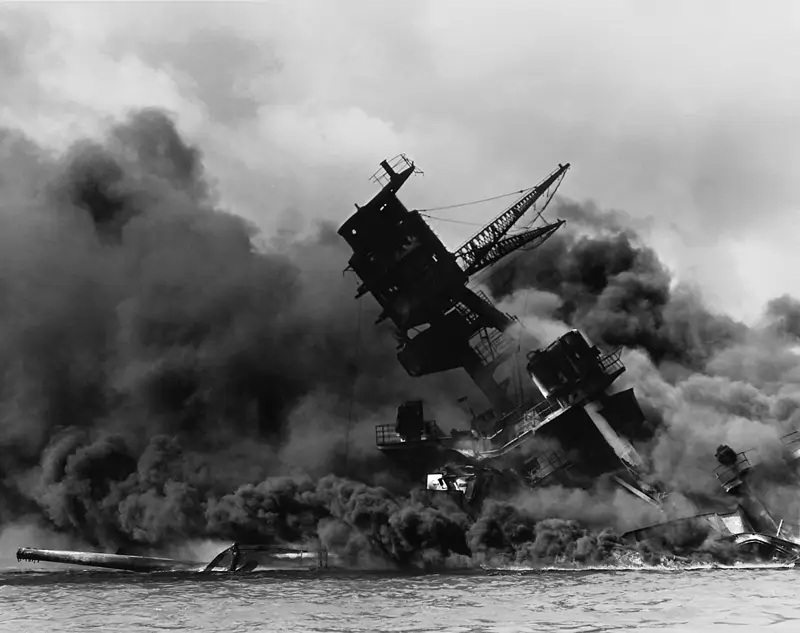
| La USS Arizona affonda dopo l'attacco giapponese a Pearl Harbor. PD | ||
|
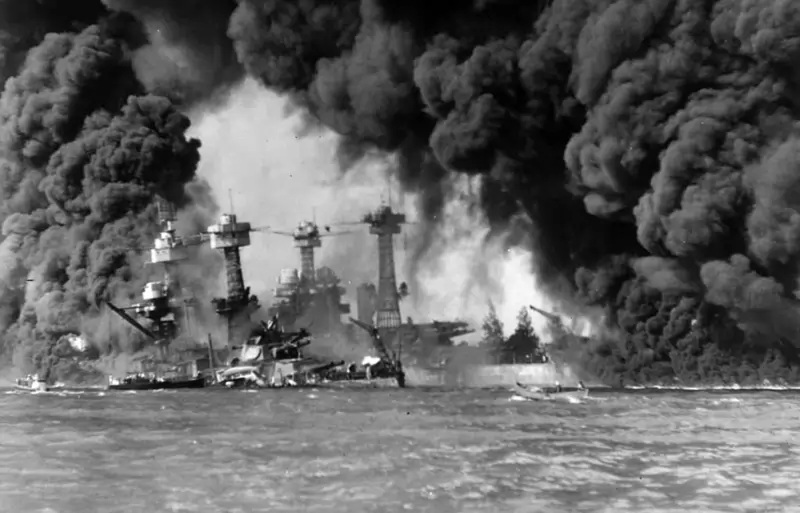
Così, mentre il Giappone continuava la sua guerra con la Cina, il conflitto con gli Stati Uniti divenne inevitabile. Di fronte al pericolo che ciò rappresentava, l'alto comando giapponese valutò le opzioni, ma non ebbe altra scelta che riconoscere la superiorità della Marina americana, che era superiore in numero, quindi il Giappone non aveva le risorse necessarie per affrontare il colosso americano. Fu allora che il Giappone pensò di avere un asso nella manica: poteva attaccare gli Stati Uniti sfruttando il fattore sorpresa. Così, l'ammiraglio Yamamoto convinse l'alto comando giapponese che invece di dichiarare guerra agli Stati Uniti sarebbe stato meglio causare loro il maggior danno possibile attaccando la loro flotta ancorata nel Pacifico. Il giorno scelto dai giapponesi per sferrare uno degli attacchi più famosi della Seconda Guerra Mondiale, che alla fine si sarebbe rivelato decisivo per lo svolgimento del conflitto, fu domenica 7 dicembre 1941. Poco prima dell'alba, la Marina imperiale giapponese attaccò a sorpresa la base militare di Pearl Harbor, alle Hawaii, dove la Marina degli Stati Uniti aveva il quartier generale della flotta del Pacifico. Per portare a termine l'attacco, 353 velivoli, tra caccia, bombardieri e aerosiluranti, attaccarono senza una previa dichiarazione di guerra con l'unico obiettivo di spazzare via dalla regione la flotta statunitense. In pochi minuti, gran parte della flotta americana fu gravemente danneggiata o completamente distrutta. L'attacco giapponese avvenne in due ondate: nella prima, i bombardamenti distrussero le corazzate Oklahoma e Arizona, danneggiando gravemente il resto delle navi. Il secondo obiettivo dei giapponesi era quello di distruggere gli aeroporti più vicini. Ma anche se l'attacco colse di sorpresa gli americani, questi riuscirono a difendersi con i cannoni antiaerei e persino a far decollare alcuni aerei, abbattendo infine 29 velivoli giapponesi. Tuttavia, l'attacco non fu così efficace come l'esercito giapponese avrebbe voluto e la fortuna volle che il grosso della flotta navale americana non fosse ancorato nel porto in quel momento. Ma questo non fu l'unico errore commesso dai giapponesi, che lasciarono intatti diversi punti strategici della base di Pearl Harbor, come la centrale elettrica, il cantiere navale, i depositi di carburante e siluri, i moli dei sottomarini e gli edifici del quartier generale e della sezione intelligence americana.
|
||
 |
||
| Il bombardamento di Pearl Harbor segnò l'entrata degli Stati Uniti nella Seconda Guerra Mondiale. CC | ||
|
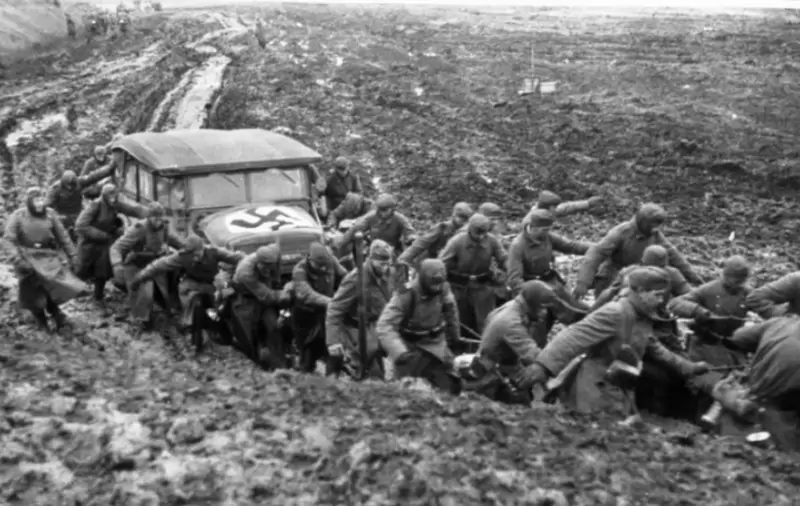
Sebbene l'attacco fosse un duro colpo per gli Stati Uniti, il giorno successivo gli americani dichiararono guerra al Giappone, facendo entrare a pieno titolo la grande potenza nel conflitto. Tre giorni dopo, l'11 dicembre 1941, la Germania di Hitler e l'Italia di Mussolini, le altre due potenze dell'Asse, risposero agli Stati Uniti con la loro dichiarazione di guerra. Senza volerlo, l'esercito imperiale giapponese aveva risvegliato il gigante addormentato. Infatti, il bombardamento di Pearl Harbor fece infuriare l'opinione pubblica americana e quell'atto sarebbe stato decisivo per l'esito della più grande guerra della storia dell'umanità. La decisiva battaglia di StalingradoPrimavera del 1942. La Seconda Guerra Mondiale continuava sul fronte orientale, ma la scarsità di risorse, l'esaurimento di entrambe le parti e un inverno particolarmente rigido, seguito dal disgelo e dal fenomeno noto ai russi come rasputitsa (un fenomeno stagionale che trasforma la terraferma in un vero e proprio pantano) rallentarono il corso della guerra. Tuttavia, nel 1942 Hitler decise di dare il colpo di grazia all'Unione Sovietica prima che gli Stati Uniti potessero mobilitare tutte le loro risorse economiche e militari per la guerra. Così, il 28 giugno Hitler diede il via alla cosiddetta Operazione Blu, il cui obiettivo era quello di impadronirsi dei giacimenti petroliferi del Caucaso, poiché la scarsità di petrolio avrebbe potuto fermare la macchina bellica tedesca. Ma sulla sua strada si trovava Stalingrado. Hitler pensava che una volta conquistata questa città sarebbe stato possibile tagliare i rifornimenti all'Armata Rossa.
|
||
 |
||
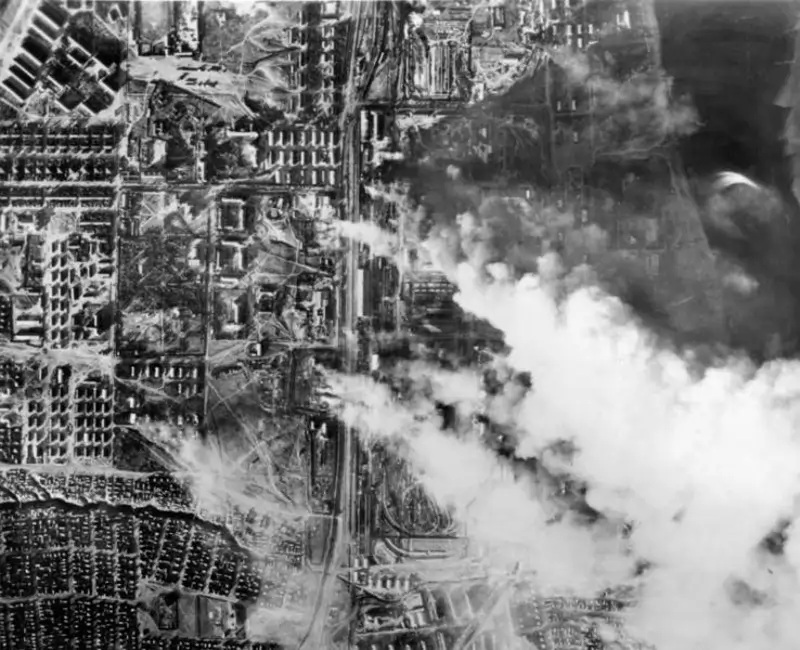
| Bombardamento aereo della Luftwaffe tedesca su Stalingrado nel settembre 1942. CC / German Federal Archives | ||
|
L'Operazione Blu (Fall Blau in tedesco), l'offensiva strategica dell'estate del 1942, si sviluppò in due direzioni: verso sud, dove si trovavano i giacimenti petroliferi, e verso est, in direzione di Stalingrado, seguendo il fiume Don, per proteggere l'avanzata verso sud. Il controllo di Stalingrado era quindi diventato un punto chiave dell'offensiva nazista sul fronte orientale e il 23 agosto 1942 iniziarono i combattimenti per conquistare una città che possedeva una potente industria militare ed era un importante nodo ferroviario. Un mese prima, Stalin aveva dato l'ordine di iniziare i preparativi per affrontare un più che probabile attacco tedesco, impedendo ai civili di lasciare la città. Preoccupato che i tedeschi potessero dividere il paese in due, il 28 luglio Stalin emanò il famoso ordine 227, in seguito noto come l'ordine “Non un passo indietro!”, secondo il quale qualsiasi militare o civile che si fosse arreso sarebbe stato fucilato immediatamente per tradimento. In questo contesto, le truppe del Führer arrivarono in una città difesa con le unghie e con i denti dai generali Emerenko e Chuikov. I tedeschi non potevano sapere che entrambi i militari avevano in serbo per loro una sorpresa sotto forma di violenti combattimenti di strada in una città completamente in rovina e contro un nemico che conosceva perfettamente ogni angolo. Inoltre, nonostante le numerose perdite subite dall'Armata Rossa, ogni notte arrivavano nuovi rinforzi sulle rive del Volga. Tuttavia, anche se l'esercito tedesco subiva lo stesso numero di perdite, sembrava riuscire a respingere l'esercito sovietico, il che portò all'annuncio della conquista di Stalingrado l'8 novembre da parte di Hitler.
|
||
 |
||
| Soldati della Wehrmacht che trainano un'auto impantanata a causa della terribile Raspútitsa nel mese di novembre del 1941. CC / German Federal Archives | ||
|
Ma quella gioia si rivelò prematura. Hitler non sapeva che Stalin aveva dato l'ordine di dare il via all'Operazione Urano, proprio nel bel mezzo della battaglia di Stalingrado, il cui obiettivo era quello di accerchiare la Sesta Armata tedesca, la Terza e la Quarta Armata rumena e parte della Quarta Armata Panzer. Quelle mosse strategiche dei sovietici, unite all'errore di calcolo di Hermann Göring, che assicurò che la Luftwaffe avrebbe potuto fornire supporto aereo alle truppe, isolarono la Sesta Armata tedesca. Con l'ordine di Hitler di mantenere le posizioni, i tedeschi videro l'Armata Rossa avvicinarsi sempre più. Così, alla fine, senza altra scelta che la resa, il 2 febbraio 1943, il maresciallo Paulus disobbedì agli ordini diretti di Adolf Hitler e si arrese. Dopo la sconfitta nella battaglia di Stalingrado, alcuni ritengono che il fronte orientale abbia iniziato a sbilanciarsi a favore dei sovietici, ma non fu esattamente così. Stalingrado fu la prima grande vittoria sovietica, ma non fu una battaglia decisiva. Lo fu invece la battaglia di Kursk nel luglio 1943, la più grande battaglia di carri armati della storia, che segnò una svolta nella guerra nell'Est. Fino ad allora, i tedeschi erano riusciti a stabilizzare il fronte, anche se con difficoltà. D-Day: lo sbarco in NormandiaDurante la Conferenza di Teheran, tenutasi nella capitale iraniana alla fine del 1943, alla quale parteciparono Stalin, Churchill e Roosevelt, i sovietici avevano già chiesto l'apertura di un nuovo fronte occidentale per alleviare la pressione che le loro truppe stavano subendo nel settore orientale. Alla fine gli Alleati decisero di organizzare l'invasione dell'Europa attraverso le spiagge della Normandia, la cosiddetta Operazione Overlord, il cui inizio era previsto per il 6 giugno 1944 e il cui nome in codice sarebbe stato D-Day. Quello sbarco fu uno degli eventi militari più importanti della Seconda Guerra Mondiale, che avrebbe segnato una svolta nello svolgimento del conflitto. L'Operazione Overlord iniziò con una gigantesca manovra militare terrestre, aerea e navale (Operazione Neptune), che causò migliaia di morti in pochi metri di spiaggia tra le difese tedesche note come Muraglia Atlantica e le acque del Canale della Manica.
|
||
 |
||
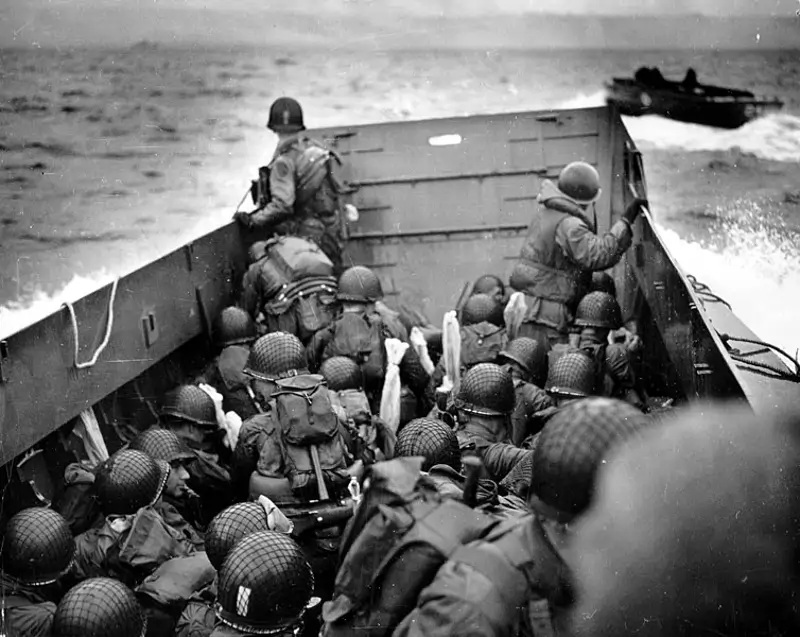
| Soldati americani a bordo di un mezzo da sbarco mentre si avvicinano alla spiaggia di Omaha, in Normandia. PD | ||
|
Lo sbarco di tutti quei soldati americani, britannici e canadesi, molti dei quali persero la vita sulla sabbia, permise agli Alleati di aprire un secondo fronte in Europa che, insieme all'avanzata sovietica a est, avrebbe contribuito a cambiare definitivamente il corso della guerra. Ma pianificare l'Operazione Overlord fu un compito estremamente complesso. Tutto doveva essere pianificato alla perfezione e doveva essere eseguito meticolosamente, come se si trattasse di un'operazione chirurgica, con l'obiettivo di conquistare la Normandia per poi avanzare verso il centro dell'Europa. Adolf Hitler sapeva che qualcosa si stava tramando, ma era convinto che l'invasione alleata avrebbe avuto luogo attraverso Calais e non in Normandia. Così, lo schieramento dell'esercito alleato durante l'Operazione Overlord avvenne nelle prime ore del 6 giugno su una linea di 80 chilometri di spiaggia da est a ovest che comprendeva le seguenti cinque spiagge: Utah, Omaha, Gold, Juno e Sword. In un messaggio trasmesso alle truppe prima della partenza, il generale Eisenhower disse loro: "La marea è cambiata! Gli uomini liberi del mondo marciano insieme verso la vittoria... Non accetteremo nulla di meno che la vittoria totale”. La notte prima degli sbarchi anfibi, circa 23.000 paracadutisti alleati si lanciarono dietro le linee difensive tedesche, con paracadute e alianti, con la missione di impedire ai tedeschi di contrattaccare durante la mattina dello sbarco. La missione di questo gruppo di paracadutisti era quella di ottenere un accesso sicuro alle spiagge, distruggere i ponti e stabilire delle teste di ponte (linee difensive per dare tempo all'arrivo dei rinforzi che avrebbero permesso alle truppe di avanzare) in attesa che il grosso delle truppe sbarcasse.
|
||
 |
||
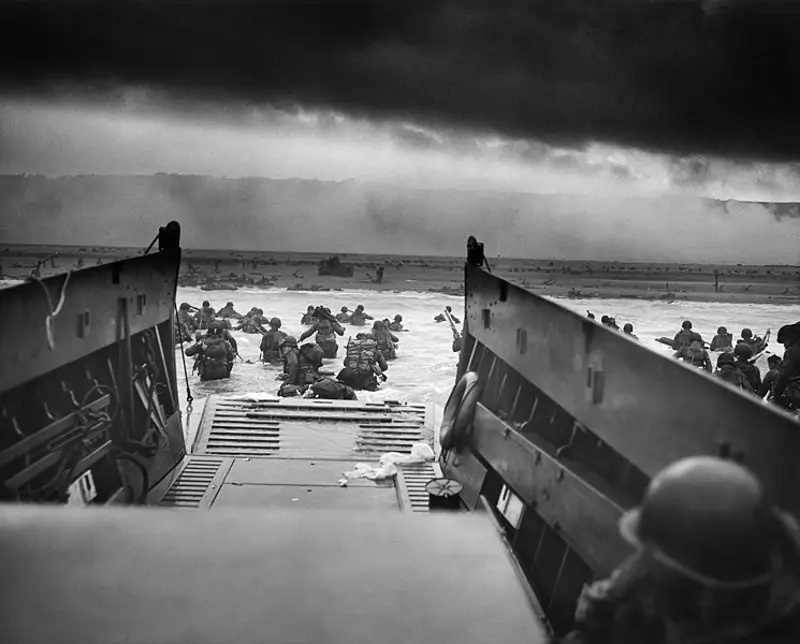
| En las fauces de la Muerte, fotografía de Robert F. Sargent que muestra a las tropas estadounidenses desembarcando en la playa Omaha el 6 de junio de 1944. CC / Robert F. Sargent | ||
| Per portare a termine un'operazione di tale portata, le catene di produzione aumentarono la produzione di armamenti e, durante la prima metà del 1944, circa 9 milioni di tonnellate di rifornimenti e attrezzature attraversarono l'Atlantico dagli Stati Uniti alla Gran Bretagna. D'altra parte, al contingente si aggiunse un importante contingente di soldati canadesi che si era addestrato in Gran Bretagna dal dicembre 1939, e oltre 1,4 milioni di soldati statunitensi arrivarono in Europa tra il 1943 e il 1944 per partecipare agli sbarchi. In questo modo, il D-Day divenne la più grande operazione navale, aerea e terrestre coordinata della storia, poiché lo sbarco sulle spiagge della Normandia richiese la totale cooperazione tra le forze armate che parteciparono all'operazione. Nel 1944, più di 2 milioni di soldati provenienti da oltre 12 paesi si trovavano in Gran Bretagna in attesa di ricevere l'ordine di invasione. Il giorno dello sbarco, le forze alleate che parteciparono erano principalmente truppe statunitensi, britanniche e canadesi con il supporto navale, aereo e terrestre di truppe australiane, belghe, ceche, olandesi, francesi, greche, neozelandesi, norvegesi e polacche. |
||
 |
||
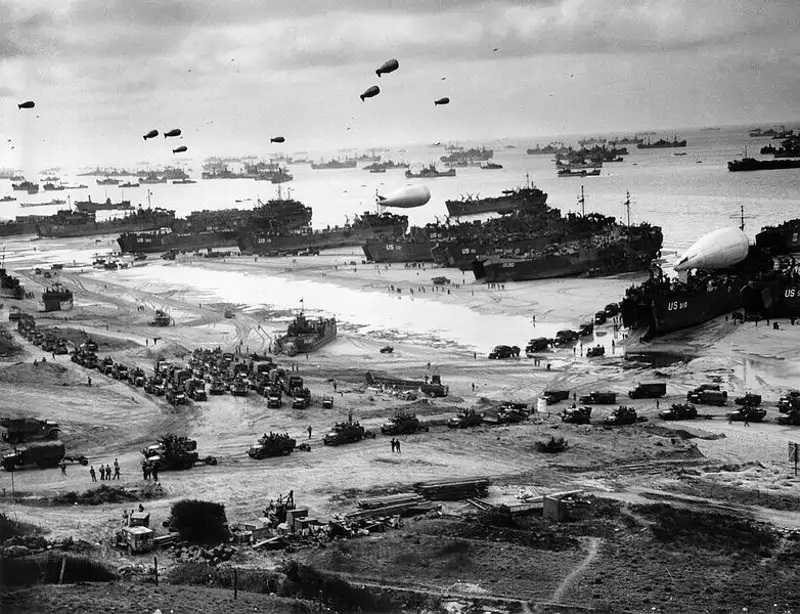
| Sbarco dei rifornimenti sulla spiaggia di Omaha nel giugno 1944 durante il D-Day. PD | ||
|
Spesso il D-Day, a causa della sua spettacolarità, ha oscurato l'importanza che ebbe in generale la campagna di Normandia. Nei tre mesi successivi allo sbarco, gli Alleati lanciarono una serie di offensive che permisero loro di avanzare verso i confini della Germania. Tuttavia, non tutte le operazioni ebbero successo. Le truppe alleate dovettero affrontare una dura resistenza da parte dei tedeschi e anche il bocage, una peculiarità del paesaggio normanno caratterizzato dalla presenza di sentieri incassati fiancheggiati da siepi alte e fitte, che i tedeschi utilizzarono per fortificarsi. Ma nonostante tutte le difficoltà, quel sanguinoso 6 giugno e tutti i giorni che seguirono si conclusero con una vittoria decisiva per gli Alleati che contribuì alla liberazione di gran parte dell'Europa nord-occidentale. Dopo il D-Day, le campagne in Italia condotte dagli Alleati allontanarono le truppe tedesche dai fronti occidentale e orientale, mentre l'Operazione Bagration, una dura offensiva sferrata dai sovietici nell'Europa centrale, riuscì a mantenere immobilizzate le forze tedesche a est. Infine, dieci settimane dopo il D-Day, gli Alleati lanciarono una seconda invasione sulla costa meridionale della Francia per avanzare verso il cuore della Germania. Con un fronte così diviso, le forze di Adolf Hitler non potevano fare altro che resistere in una guerra in cui la somma di gravi errori di calcolo e l'usura avrebbero finito per costare loro un prezzo terribile. La caduta di Berlino e la fine del nazismoPrimavera del 1945. La situazione della Germania in questo momento della seconda guerra mondiale era un vero inferno. Invaso dalle forze dell'Unione Sovietica a est e dagli Alleati a ovest, il Terzo Reich non poteva contare praticamente su alcun aiuto da parte dei suoi alleati Italia e Ungheria, che erano già stati occupati, né dal Giappone, accerchiato dagli americani nel Pacifico. Questo sarebbe stato uno degli ultimi e più sanguinosi capitoli della Seconda Guerra Mondiale, che alla fine avrebbe portato alla fine del dittatore nazista Adolf Hitler.
|
||
 |
||
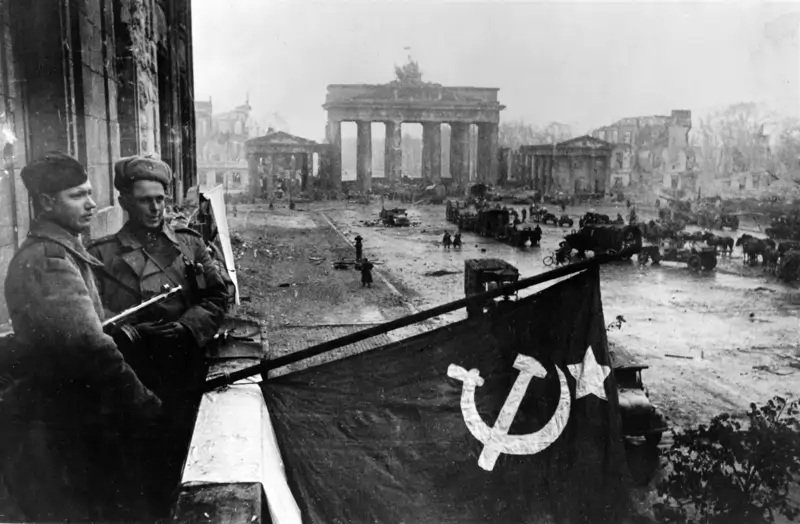
| Soldati sovietici issano una bandiera dal balcone del famoso Hotel Adlon a Berlino. Cordon Press |
||
| Sebbene l'alto comando militare nazista avesse assicurato che Berlino sarebbe stata la tomba dell'Armata Rossa, quella previsione non si sarebbe mai avverata. In quei giorni, Hitler era nascosto nel suo bunker e aveva completamente perso il senso della realtà. Il Terzo Reich, che avrebbe dovuto durare mille anni, non aveva i mezzi necessari per difendersi e stava crollando a vista d'occhio. Per tutti coloro che erano stati al fronte (e che ora erano feriti o mutilati), le detonazioni che si sentivano alla periferia di Berlino quel 19 aprile 1945 avevano un suono molto diverso. Quel suono era prodotto dai proiettili dell'artiglieria sovietica; non assomigliava affatto al rumore delle bombe dell'aviazione alleata a cui erano abituati. Poteva significare solo una cosa: Berlino era ormai alla portata dei cannoni sovietici e la fine si avvicinava. In effetti, non si sbagliavano. Nonostante la superiorità dell'esercito attaccante, gli ordini di Hitler erano chiari: bisognava resistere fino alla fine. Il Führer, rifugiato nel suo bunker insieme ad altri gerarchi nazisti, come Martin Borman, Albert Speer e Joseph Goebbels, non voleva nemmeno sentire parlare di resa. Alla fine, in preda al nervosismo, Hitler era disposto a sacrificare inutilmente tutta la popolazione di Berlino: arrendersi e mostrare la bandiera bianca era punito con la morte, e chi disertava o si nascondeva per evitare il combattimento veniva impiccato senza pietà. Ci fu un momento in cui i russi offrirono una breve tregua nella loro avanzata, ma i tedeschi non poterono approfittare di quella circostanza per preparare la difesa della città. Berlino disponeva solo di alcune unità antiaeree delle SS e della milizia popolare (volkssturm) e, nonostante ciò, si decise di non intraprendere alcuna opera di fortificazione. Hitler si mostrava intrattabile, costantemente immerso in lunghe e infruttuose divagazioni. Ma il suo potere era ancora intatto, al punto che promulgò il cosiddetto Ordine Nerone, che stabiliva una politica di terra bruciata nei confronti del nemico. In sostanza si trattava di distruggere qualsiasi infrastruttura (di trasporto, industriale, di comunicazione, ecc.) che potesse favorire il nemico, il che significava in pratica la distruzione della Germania. L'ordine non fu mai applicato. Il Führer alternava stati di euforia a scoppi di rabbia incontrollata contro tutto e tutti, in particolare contro tutti i suoi generali, che definiva inefficienti e traditori. Sopraffatto dalla situazione, incolpò i suoi generali di non aver preso le decisioni giuste per quanto riguardava la difesa di Berlino, per cui concesse un permesso per motivi di salute al generale Guderian, lo sostituì come capo di Stato Maggiore e nominò al suo posto il generale Hans Krebs. Il 20 aprile 1945, proprio il giorno in cui Hitler compiva 56 anni, aerei americani B-17 e britannici Lancaster bombardarono il centro urbano di Berlino, distruggendo numerosi edifici, costringendo all'evacuazione 2.000 berlinesi e lasciando la città senza elettricità. Due giorni dopo, il 22 aprile, durante una riunione nel bunker di Hitler, qualcuno lodò l'eccellente lavoro della 12ª Armata comandata dal generale Walther Wenck che combatteva contro gli americani a Magdeburgo. Alla notizia, i tremori che affliggevano il Führer sembrarono scomparire e, in uno dei suoi abituali cambiamenti d'umore, sembrò aver finalmente trovato la soluzione: il generale Wenck avrebbe fatto marcia indietro e avrebbe salvato Berlino. Ovviamente, Wenck non riuscì a raggiungere quell'obiettivo impossibile: Berlino era circondata e agonizzava. Alla fine, il generale Helmuth Weidling tentò di organizzare una difesa operativa della città, ma poteva contare solo sul sostegno di alcune truppe in disgregazione. Insieme ai membri del volkssturm, della Hitlerjugend e della polizia, questi uomini costruirono barricate con i tram e riempirono i muri ancora in piedi con slogan che incitavano alla resistenza e alla vittoria finale. Ma tutto fu vano. I proiettili sovietici cominciarono a cadere sul centro di Berlino. Nonostante ciò, la capitale resistette con la determinazione di chi sa di non avere altra scelta. Inutilmente. Uno dopo l'altro, i quartieri di Berlino furono occupati dai sovietici, mentre la popolazione civile si rifugiava nei tunnel della metropolitana invasi dal fumo. Nel pomeriggio del 30 aprile 1945, uno sparo proveniente dalla camera da letto del Führer ruppe il silenzio impenetrabile del bunker. Dopo aver ingerito una capsula di cianuro, Hitler si era appena sparato un colpo. Accanto a lui, Eva Braun, che aveva sposato il giorno prima, giaceva senza vita sul divano. Gli ufficiali trasportarono entrambi i corpi nel giardino della Cancelleria, un'operazione complicata a causa dei continui bombardamenti sovietici. Dopo aver gettato i cadaveri in una fossa precedentemente scavata, li incendiarono e, mentre i resti del dittatore nazista venivano consumati dalle fiamme, all'esterno Goebbels, Bormann, Burgdorf e Krebs resero l'ultimo saluto nazista in suo onore. In questo modo, Adolf Hitler, il fondatore del Terzo Reich, scomparve per sempre. Il 2 maggio Berlino era sul punto di cadere e molti seguaci del regime, tra cui numerosi membri delle SS, preferirono suicidarsi piuttosto che cadere nelle mani dei sovietici. Il 7 maggio 1945, la Germania si arrese incondizionatamente agli Alleati occidentali a Reims e il 9 maggio fece lo stesso con i sovietici a Berlino. Nella capitale regnava il caos totale, poiché dopo la vittoria arrivò il saccheggio. I soldati russi, provenienti per lo più dalle steppe e dalle montagne del Caucaso, non avevano mai visto una città come quella e non conoscevano nulla di simile al lusso berlinese. Rubarono tutto ciò che poterono e, dopo il saccheggio, iniziarono le violenze sessuali di massa (un argomento di cui si parlò poco durante la Guerra Fredda). Sebbene i media russi abbiano definito questi fatti “invenzioni” dell'Occidente, molte delle prove provengono dal diario di un giovane tenente ebreo originario della regione centrale dell'Ucraina di nome Vladimir Gelfand. |
||
 |
||
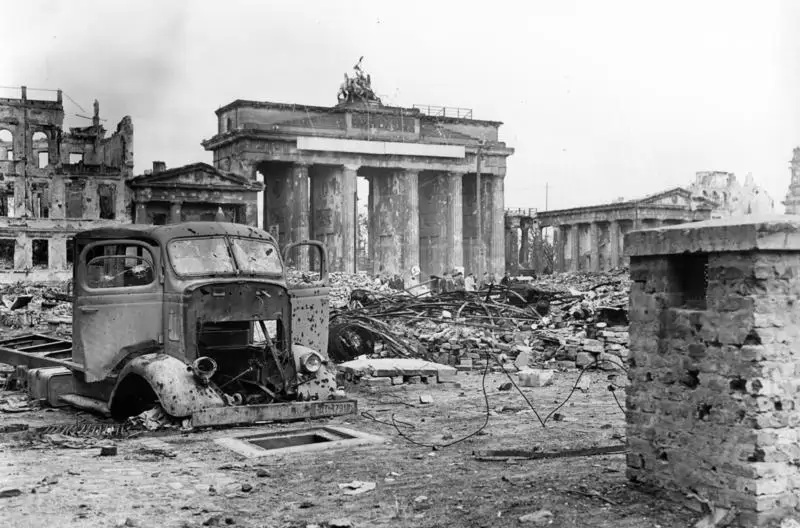
| La Porta di Brandeburgo a Berlino, rasa al suolo dai bombardamenti. CC / German Federal Archives | ||
| In realtà, ancora oggi non si conosce il numero esatto delle donne che furono violentate dopo la caduta di Berlino. Alcuni storici parlano addirittura di centomila. In ogni caso, molte di loro, giovani e adulte, ma anche bambine e anziane, si suicidarono o morirono a causa della brutalità dei maltrattamenti subiti. Le madri nascondevano le figlie per proteggerle, e gli uomini che cercavano di impedirlo lo pagavano con la vita, così come le donne che opponevano resistenza. La Seconda Guerra Mondiale continua in GiapponeMentre in Europa, con la caduta e la morte di Adolf Hitler e del regime nazista, si intravedeva la fine della Seconda Guerra Mondiale, nel Pacifico gli Stati Uniti avevano liberato praticamente tutte le isole che erano in mano ai giapponesi e gli americani erano decisi a sbarcare in Giappone. Così, dopo le clamorose sconfitte a Midway (giugno 1942) e Guadalcanal (novembre 1942), la flotta giapponese fu distrutta nella battaglia del Golfo di Leyte (ottobre 1944), rendendo il Giappone ormai privo di rivali in mare e la sua resa imminente. Tuttavia, il Giappone era disposto a negoziare la pace con gli Stati Uniti con la cessione di territori, ma senza alterare il carattere divino dell'imperatore. L'obiettivo finale degli americani non era però questo, bensì ottenere la resa incondizionata e totale dell'esercito imperiale giapponese. |
||
 |
||
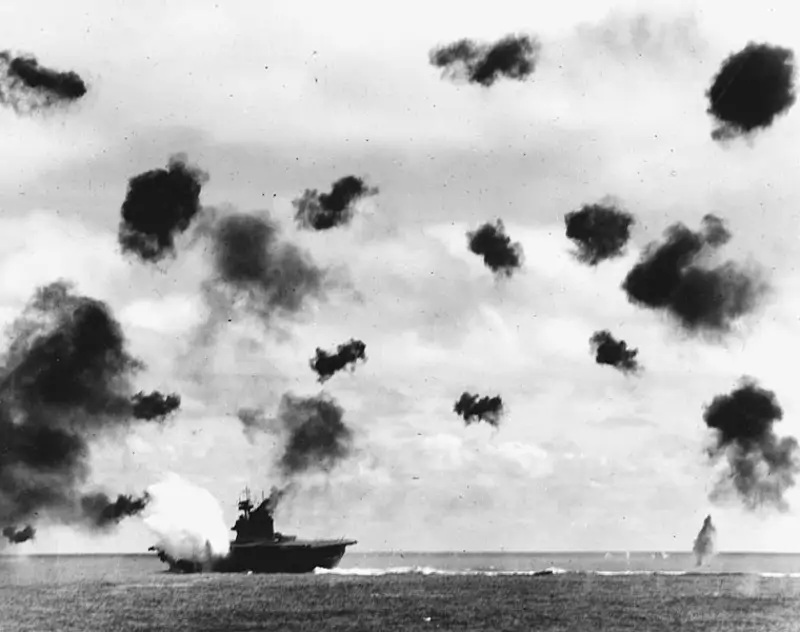
| La USS Yorktown viene colpita da siluri giapponesi a Midway. PD | ||
| Di fatto, la guerra del Pacifico fu lunga e sanguinosa. Uno degli scontri più simbolici fu quello che ebbe luogo a Iwo Jima, non solo per la fotografia dei soldati americani che issavano la bandiera del loro Paese, scattata dal fotografo Joe Rosental e diffusa come icona della propaganda alleata, ma anche per la sua ferocia e violenza. Questa campagna, che si svolse tra febbraio e marzo 1945, non ha avuto eguali fino ad oggi, poiché i soldati giapponesi, accovacciati tra i vulcani e le gallerie sotterranee, massacrarono migliaia di soldati americani che sbarcarono sulle spiagge di sabbia nera durante la loro avanzata sulle montagne scoscese. Per questo motivo la campagna ricevette il macabro nome di “tritacarne”. Un'altra data chiave del conflitto tra Stati Uniti e Giappone fu il 9 marzo 1945 nelle isole Marianne. Si trattava dell'avvio dell'Operazione Meetenghouse, una missione che aveva come obiettivo quello di cancellare Tokyo dalla faccia della Terra in meno di ventiquattro ore. La prima ondata dell'attacco americano fu composta da 54 aerei e la seconda da 271 bombardieri in più. L'operazione era stata progettata per iniziare a mezzanotte tra il 9 e il 10 marzo, poiché, secondo l'alto comando americano, sorprendere addormentati e impreparati gli abitanti della città era il modo più facile e sicuro per causare un gran numero di vittime. |
||
 |
||
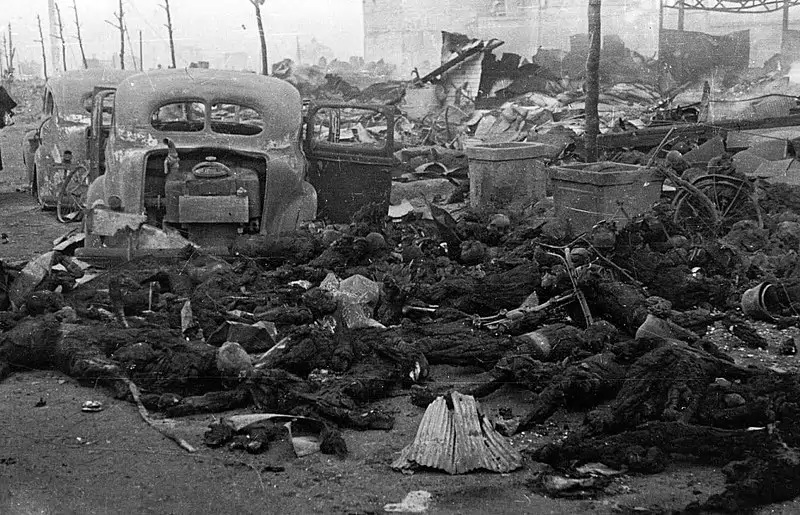
| L'operazione Meetenghouse devastò Tokyo e causò migliaia di morti tra i suoi abitanti. PD | ||
| Durante il micidiale bombardamento sulla capitale giapponese, gli aerei lanciarono bombe a grappolo, ribattezzate dagli americani “biglietti da visita di Tokyo”. Una volta toccato terra, questi ordigni spargevano il loro contenuto letale di fosforo bianco e napalm, un gel appiccicoso a base di benzina sviluppato dai laboratori dell'Università di Harvard. L'atmosfera a Tokyo raggiunse i 980 gradi, facendo bollire l'acqua dei fiumi e dei canali e fondendo i vetri delle finestre. Il fuoco consumò rapidamente molte case costruite in legno e carta, progettate solo per resistere ai terremoti. Circa 260.000 case furono rase al suolo e almeno 105.400 persone morirono in una città di tre milioni di abitanti. Si fusero, letteralmente. In totale, un quarto della città fu rasa al suolo. Curtis LeMay, il generale americano che organizzò l'operazione, si vantò del successo ottenuto con queste parole: “Li abbiamo arrostiti e cotti a morte”. Prima di morire, nel 2009, Robert S. McNamara, responsabile intellettuale dell'Operazione Meetenghouse e segretario alla Difesa al momento dei bombardamenti, chiese scusa per l'attacco, pur continuando a giustificarlo con queste parole: “Per fare il bene, a volte bisogna fare il male”. Da parte sua, il generale Curtis LeMay, comandante del Comando Bombardieri XXI e responsabile materiale degli attacchi, riteneva che l'immoralità non fosse stata quella di aver ucciso circa 100.000 persone in una sola notte lanciando bombe incendiarie, ma che la vera imprudenza sarebbe stata quella di non averlo fatto e di aver perso migliaia di soldati americani in battaglia: “Credo che se avessimo perso, sarei stato trattato come un criminale di guerra”, dichiarò. Mentre era in corso il bombardamento di Tokyo, nel Pacifico gli Alleati continuavano la loro inarrestabile avanzata fino a raggiungere l'isola di Okinawa, la più grande delle isole Ryukyu (a sud delle quattro grandi isole del Giappone). I giapponesi non potevano più opporre resistenza e decisero di lanciare un disperato attacco suicida contro la flotta americana, la cosiddetta Operazione Ten-Gō. La corazzata giapponese Yamato, la più grande del mondo durante la seconda guerra mondiale, salpò insieme ad altre nove navi da guerra dal Giappone per compiere un attacco suicida contro le forze alleate che stavano combattendo a Okinawa. Ma le forze giapponesi furono intercettate e quasi completamente distrutte dalla supremazia aerea americana. Infatti, la Yamato e altre cinque navi giapponesi furono affondate. Quell'azione, nel momento culminante della guerra, confermò la decisione delle autorità giapponesi di portare all'estremo gli attacchi kamikaze per cercare di fermare l'inarrestabile avanzata alleata verso l'arcipelago giapponese. Alla fine Okinawa cadde nelle mani degli americani e fu dichiarata zona sicura il 21 giugno 1945. Le bombe nucleari di Hiroshima e NagasakiL'attacco a sorpresa a Pearl Harbor fu sufficiente perché, solo un giorno dopo, l'8 dicembre 1941, gli Stati Uniti, fino a quel momento nominalmente neutrali, prendessero parte in modo attivo e definitivo al terribile conflitto che stava devastando il mondo, dichiarando guerra al Giappone. Durante i quattro anni successivi, gli americani combatterono una dura battaglia contro i giapponesi, sia in territorio cinese che nelle acque del Pacifico, dove la conquista di ciascuna isola si trasformò in una guerra su piccola scala.
|
||
 |
||
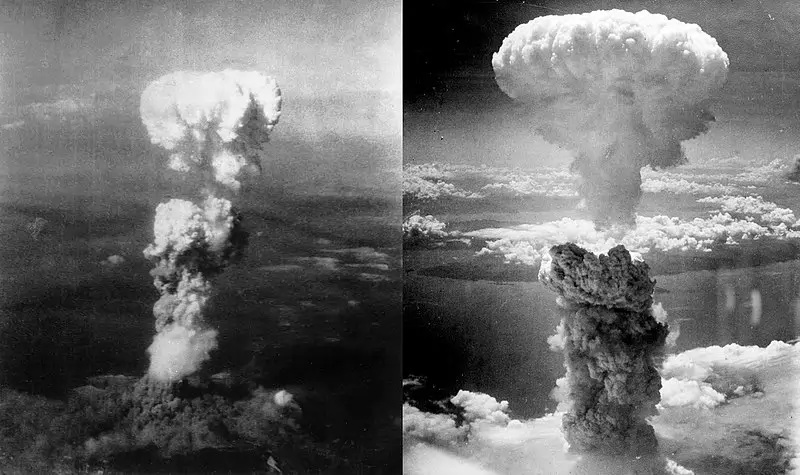
| Esplosioni delle bombe sganciate su Hiroshima (a sinistra) e Nagasaki (a destra). PD | ||
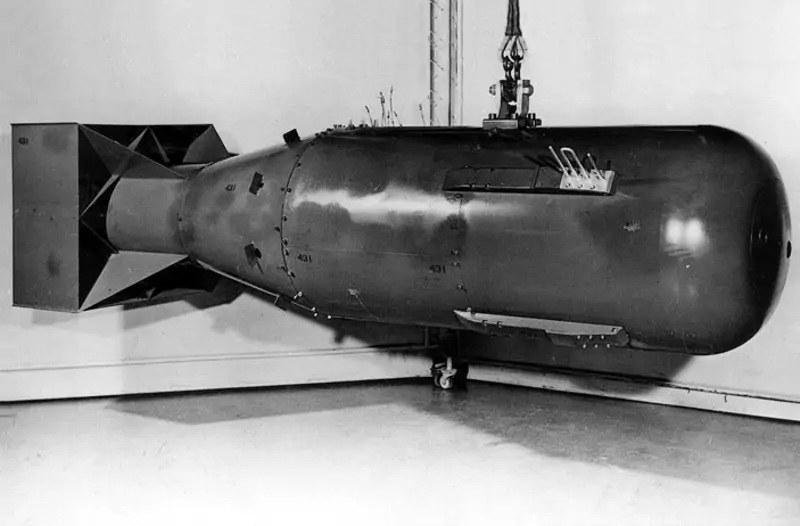
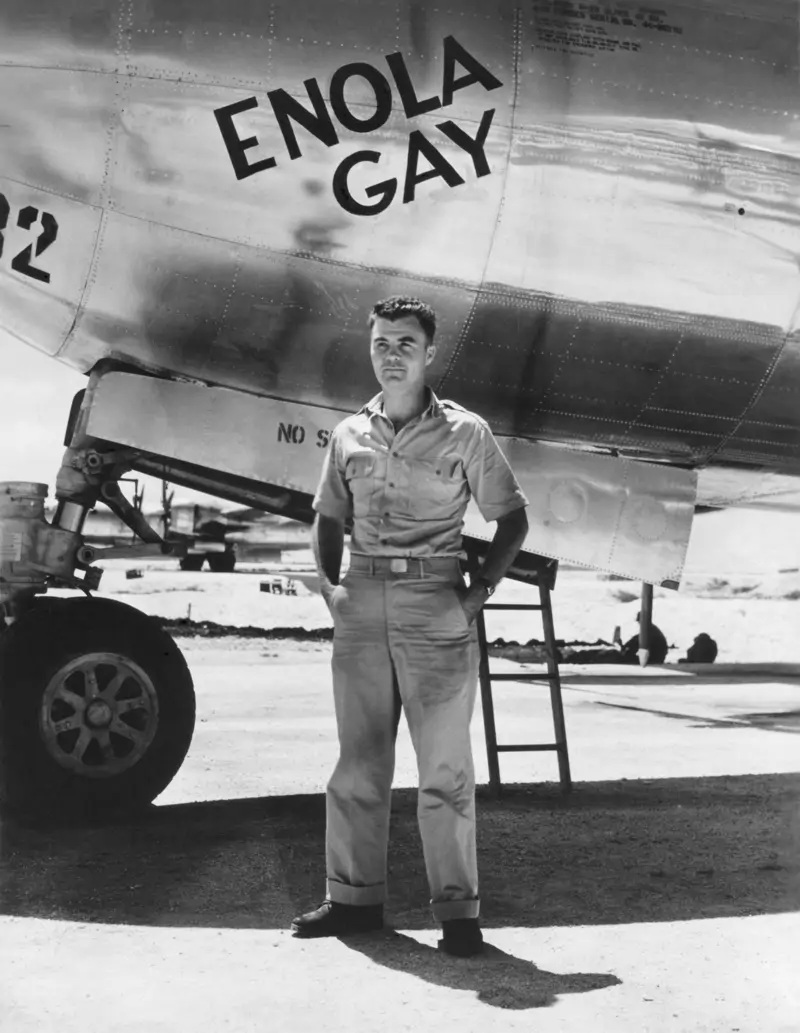
| Sebbene lo scontro tra i due paesi fosse abbastanza equilibrato, la caduta della Germania nazista avrebbe reso le cose molto più difficili per l'esercito giapponese. Tuttavia, ciò che avrebbe finito per far pendere la bilancia a favore degli Alleati sarebbe stato lo sviluppo e la produzione di una terribile arma segreta, un progetto che gli americani avrebbero battezzato con il nome in codice di Progetto Manhattan. Quell'arma definitiva fu sviluppata dagli Stati Uniti con l'aiuto del Regno Unito e del Canada. Il progetto, che riunì un gran numero di eminenti scienziati come Robert Oppenheimer, Niels Böhr ed Enrico Fermi, aveva l'obiettivo di sviluppare la prima bomba atomica prima che potessero farlo i nazisti. La ricerca culminò con Trinity, nome che sarebbe stato dato al primo test atomico effettuato nel deserto di Alamogordo, nel New Mexico, il 16 luglio 1945. Alla fine, la bomba non sarebbe stata utilizzata contro i tedeschi, ma sarebbe stata l'arma definitiva che gli americani avrebbero usato per porre fine alla guerra una volta per tutte. All'alba del 6 agosto 1945, tra l'1:12 e l'1:15, il bombardiere B-29 Enola Gay, comandato dal colonnello Paul Tibbets, decollò dall'aerodromo di Tinian, nelle Isole Marianne, diretto a Hiroshima. A bordo c'era un ordigno nucleare carico di uranio-235 battezzato Little Boy, che in poche ore avrebbe dovuto colpire il centro di quella popolosa città giapponese. Alle 7:09 del mattino, gli allarmi antiaerei di Hiroshima allertarono la popolazione quando lo Straight Flush, un B-29 comandato dal comandante Claude Eatherley, effettuò un volo di ricognizione sulla città. Sorprendentemente, non fu intercettato né dalle batterie antiaeree né dai caccia giapponesi, e poté quindi avvisare l'Enola Gay che la via era libera. |
||
 |
||
| Replica de la bomba nuclear Little Boy lanzada sobre Hiroshima. PD | ||
| Quel lunedì 6 agosto 1945, a Hiroshima l'alba sorse come qualsiasi altro giorno fino alle 8:11 del mattino, quando i suoi abitanti videro apparire all'orizzonte tre bombardieri americani B-29, tra cui l'Enola Gay con il suo carico mortale. Pochi minuti dopo, i portelli di carico del bombardiere si aprirono mentre gli altri due velivoli lanciavano dei calibratori di onde d'urto con il paracadute (con il compito di verificare successivamente l'effetto dell'arma). Little Boy iniziò la sua caduta libera su Hiroshima. Era l'inizio della fine per tutti coloro che vivevano lì.
|
||
 |
||
| Il colonnello Paul Tibbets in posa accanto all'Enola Gay. Cordon Press | ||
| Tre giorni dopo, giovedì 9 agosto 1945, il B-29 Bockscar pilotato dal maggiore Charles Sweeney fu incaricato di trasportare una seconda bomba nucleare chiamata Fat Man con l'intenzione di lanciarla sulla città di Kokura. In realtà, Nagasaki era un obiettivo secondario e si prevedeva di sganciare il carico mortale sulla città solo nel caso in cui il primo obiettivo non potesse essere raggiunto. Il piano della missione era praticamente identico a quello di Hiroshima. Quando l'aereo arrivò a Kokura, la città era coperta dalle nuvole e, dopo averla sorvolata tre volte con il carburante al minimo, il pilota decise di dirigersi verso Nagasaki. L'indicatore del carburante segnalava che il bombardiere non avrebbe avuto abbastanza carburante per raggiungere Iwo Jima e sarebbe stato costretto a deviare verso Okinawa.
Sweeney decise che se Nagasaki avesse presentato le stesse condizioni meteorologiche di Kokura, sarebbero tornati con la bomba a Okinawa e avrebbero cercato di lanciarla in mare. Ma all'ultimo momento si aprì uno squarcio tra le nuvole che coprivano anche il cielo di Nagasaki, consentendo all'aereo americano di stabilire un contatto visivo con l'obiettivo, così che alla fine poterono sganciare la bomba alle 11:01 del mattino. Quarantatre secondi dopo, Fat Man esplose a 469 metri di altezza sopra la città e a quasi 3 chilometri di distanza dall'obiettivo originale. La detonazione fu di 22 kilotoni e generò una temperatura stimata di 3.900 gradi e venti di 1.005 chilometri all'ora.
|
||
 |
||
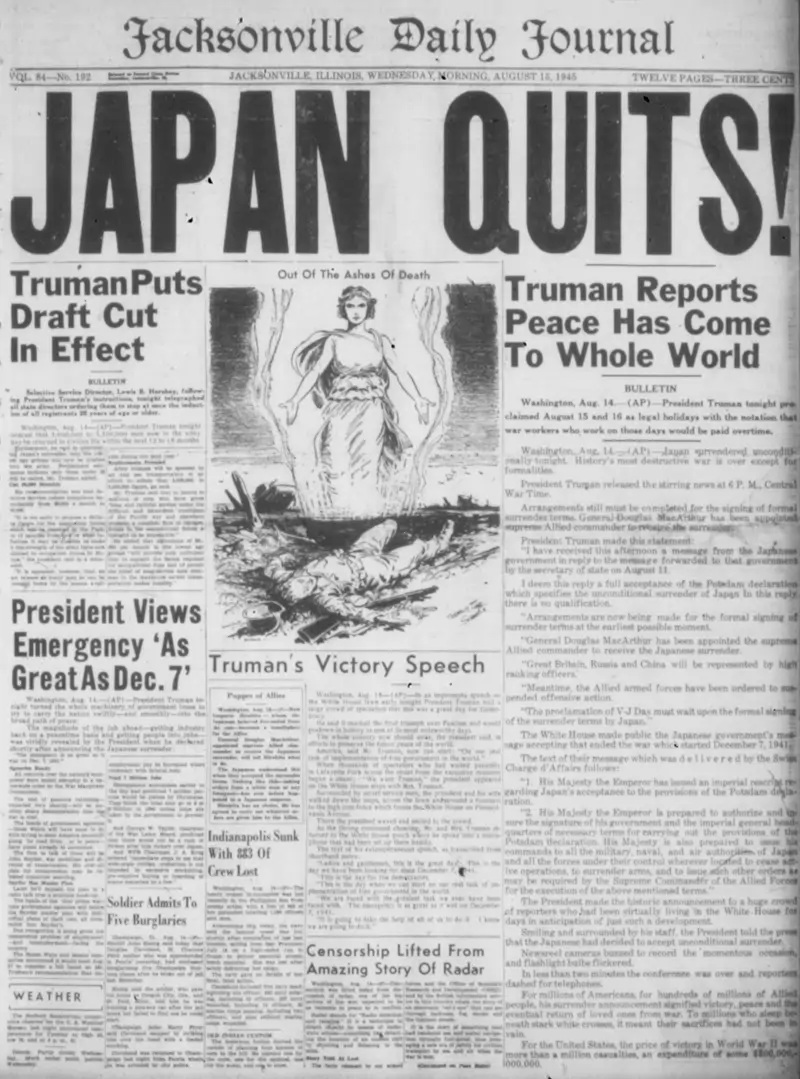
| Prima pagina del 15 agosto 1945 del Jacksonville Daily Journal che riporta la notizia della resa del Giappone. Cordon Press |
||
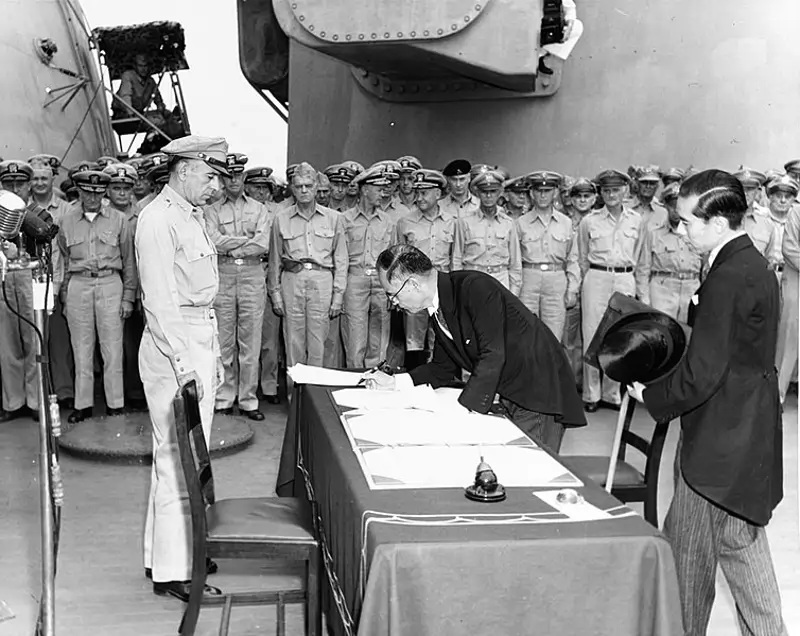
| La tragedia umana che si abbatté sulle città di Hiroshima e Nagasaki causò la morte di circa 140.000 vittime a Hiroshima e circa 70.000 a Nagasaki, comprese le vittime dirette del bombardamento e quelle decedute a causa delle radiazioni fino alla fine del 1945. La notizia della distruzione totale di Nagasaki da parte di una seconda bomba atomica fu un duro colpo per l'Impero giapponese, che quello stesso giorno, il 9 agosto 1945, subì l'inaspettata aggressione dell'Unione Sovietica in Manciuria. Ciò finì per accelerare gli eventi e l'imperatore Hiro-Hito annunciò la resa incondizionata del Giappone agli Alleati il 15 agosto 1945. La capitolazione divenne effettiva il 2 settembre con la firma della pace a bordo della corazzata USS Missouri nella baia di Tokyo. La seconda guerra mondiale era finita. Resa e fine della seconda guerra mondialeNon c'è dubbio che la Seconda Guerra Mondiale sia stato il conflitto più distruttivo e sanguinoso della storia dell'umanità. Milioni di persone persero la vita, soprattutto in Europa e in Asia, nel periodo buio che va dal 1939 al 1945. Tutto questo bagno di sangue culminò con il lancio delle bombe atomiche sulle città giapponesi di Hiroshima e Nagasaki, un evento che costrinse l'imperatore Hiro-Hito ad annunciare la capitolazione del Giappone e a firmare la pace definitiva con gli Alleati.
|
||
 |
||
| Il ministro degli Esteri giapponese Mamoru Shigemitsu firma l'atto di resa del Giappone a bordo della USS Missouri. | ||
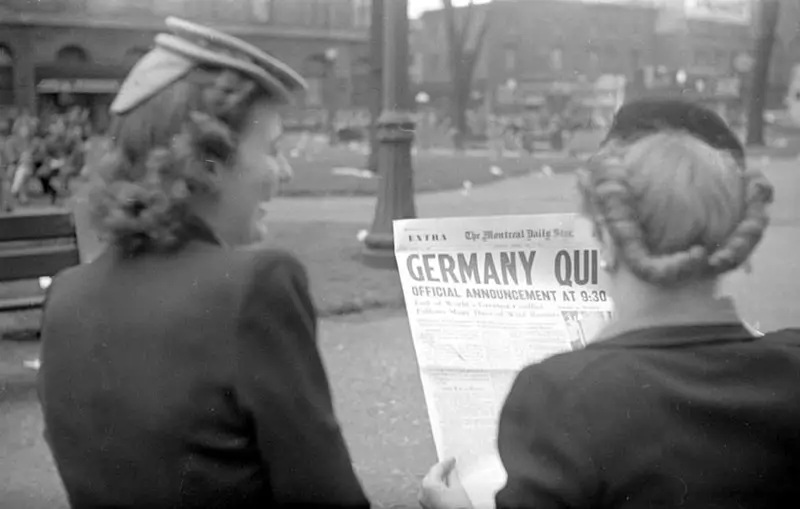
| Il 1945 rappresentò un punto di svolta. Quell'anno vide la caduta della Germania nazista dopo il suicidio di Adolf Hitler, la distruzione del cuore del Terzo Reich e la firma dell'armistizio di Reims l'8 maggio 1945. Quello fu anche l'anno della morte del dittatore fascista Benito Mussolini e della dissoluzione dell'Italia fascista (Repubblica di Salò). Insieme alla Germania nazista e all'Italia fascista caddero altri regimi affini, come quelli di Ungheria, Slovacchia e Croazia, anche se quest'ultima resistette fino a metà giugno, quando fu assorbita dalla Jugoslavia. |
||
 |
||
| Prima pagina del The Montreal Daily Star che annuncia la resa tedesca. PD | ||
|
La seconda guerra mondiale fu anche teatro di terribili atrocità. Durante il conflitto si verificarono attacchi indiscriminati contro la popolazione civile e la persecuzione sistematica di vari gruppi per motivi politici, razziali o religiosi. Con la fine del conflitto vennero alla luce gli orrori perpetrati dalla Germania nazista nei campi di concentramento e di sterminio costruiti in tutta l'Europa conquistata e la cosiddetta “soluzione finale della questione ebraica”, che avrebbe portato all'Olocausto. È sconvolgente sentire nomi come Auschwitz, Belzec, Bergen Belsen, Buchenwald, Dachau e una lunga lista di campi dell'orrore che costrinsero gli Alleati ad avviare un intero apparato giudiziario per processare gli autori e i complici del regime nazista, accusati di crimini contro la pace, crimini di guerra e crimini contro l'umanità. La città scelta per celebrare questi processi fu Norimberga, la città emblematica in cui il partito nazionalsocialista (NSDAP) aveva tenuto in passato i suoi congressi di massa. Conosciuti come i processi di Norimberga, questi processi storici gettarono le basi per lo sviluppo di una giustizia internazionale e la creazione di una nuova legislazione che andasse oltre la giustizia propria di ogni paese. Le udienze di questi processi, in cui furono processati diversi gerarchi nazisti, come Göering, Hess o Ribbentrop, fino a semplici funzionari del regime, durarono poco meno di un anno (dal 20 novembre 1945 al 1° ottobre 1946) e furono inflitte dure condanne, tra cui la pena di morte per dodici degli imputati.
Ma Norimberga non fu l'unico tribunale istituito per giudicare i crimini commessi durante la seconda guerra mondiale. Fu istituito anche un tribunale per giudicare i crimini perpetrati dai giapponesi, noto come Tribunale militare internazionale per l'Estremo Oriente (1946-1948), in cui si svolsero i Processi di Tokyo. Tuttavia, lì non fu applicato lo stesso metro di giudizio di Norimberga. Un esempio di ciò fu il fatto che l'imperatore Hiro-Hito non fu processato, ma rimase invece in carica, e molte delle pene inflitte finirono per essere ridotte e persino commutate. La situazione politica stava cambiando. Il Giappone non era più il nemico da sconfiggere, ma stava per diventare un alleato indispensabile per affrontare la crescente minaccia del comunismo. |
||
| |
||
| RBA Italia srl – P.iva 05801500967. Registrazione al Tribunale di Milano n. 90 del 26/06/2024 | ||
 |
||
© J.M. Sadurní
© Storica National Geographic

The Second World War in Full: The History of a Conflict That Changed the WorldWe retrace its course, its most important battles, the opposing sides, the historical figures who made the crucial decisions, the atomic bombs on Hiroshima and Nagasaki, and much more. J. M. Sadurní · 28 April 2025, 12:04 Second World War · Hitler Joe Rosenthal's iconic photograph of American soldiers taking the summit of Iwo Jima. PD 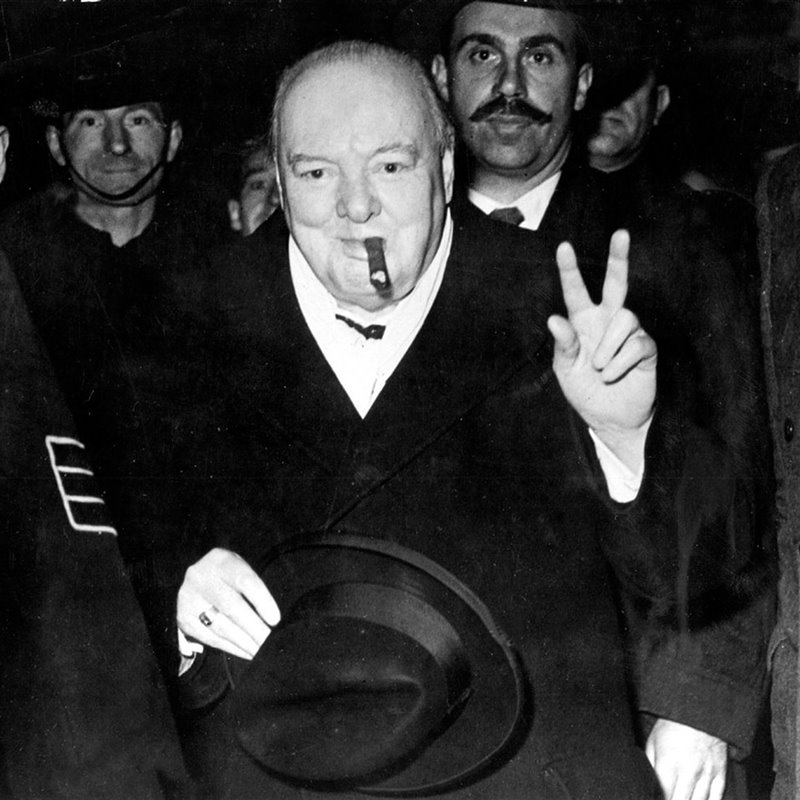 Contents: The origins of the Second World War; the interwar period; Hitler's rise to power; the invasion of Poland; Blitzkrieg; the Phoney War and the escape from Dunkirk; Britain enters the war; Operation Barbarossa; Pearl Harbor and American entry; Stalingrad; D-Day; Berlin and the end of Nazism; the war in Japan; Hiroshima and Nagasaki; surrender and the end of the war. The Origins of the Second World WarThe Second World War was undoubtedly the most devastating armed conflict in human history. The loss of life was tremendous. An estimated 55–60 million people died during six years of fighting extending across the world, from Europe to Asia and from Africa to Oceania. To understand its origins, however, we must return to the end of the First World War, also known as the Great War, which culminated in the signing of the Treaty of Versailles on 28 June 1919. An armistice had been signed months earlier, on 11 November 1918, ending battlefield hostilities. Read also: Churchill, Britain's most famous politician. That settlement would, at least in part, trigger developments leading to Adolf Hitler's rise and a new conflict that would produce horrors such as the Holocaust. Signing the treaty was a bitter blow for the German delegation. The defeated country's representatives, its newspapers and the population generally regarded it as an imposition rather than a negotiation. What most angered German society, manipulated by the right, was acceptance of Article 231, considered unacceptable and humiliating. This introduced Part VIII, concerning reparations, and had been included by the American negotiators. They knew Germany could not pay reparations covering the entire cost of war, as the French and British chiefly wanted. Article 231 therefore recognized Germany's moral responsibility for the war and legal liability for the damage. Article 232, on the other hand, implicitly acknowledged its economic inability to meet those demands. The German right nevertheless made Article 231 central to its campaign against the treaty. Senior army officers and conservative sections of society resisted signing the victors' conditions, even knowing that the alternative was renewed fighting and invasion of German territory, an even greater humiliation. Supporters argued there was no other choice. Germany ultimately had to renounce all its colonies and accept the transfer of occupied territories to countries including France, Denmark and Poland. The “Big Four” at the Paris Peace Conference, 27 May 1919. From left: David Lloyd George, Vittorio Orlando, Georges Clemenceau and Woodrow Wilson. PD The Interwar PeriodThose were not the only conditions Germany faced. Military clauses drastically reduced its army and ended conscription. Its air force, heavy artillery and submarines were abolished. Economic conditions were imposed too. The treaty did not specify the final amount, leaving a commission to determine it in 1921, but required an initial payment of twenty billion gold marks. This included food the Allies were to supply to starving Germany and the cost of Allied occupation of the Rhineland, totaling about eight billion. Much was paid in kind. Steamships and fishing vessels handed over during the next two years amounted to more than 2.6 million tonnes, while Britain had lost more than eight million during the war. The Treaty of Versailles included military clauses requiring a drastic reduction of Germany's army. The Reparations Commission subsequently fixed the total at 132 billion gold marks, about 33 billion dollars. Payments were divided into A and B bonds totaling about fifty billion and C bonds for the remaining eighty-two billion, whose payments would begin after thirty-six years. The commissioners knew these would probably never be paid, as proved the case. At the Lausanne Conference in 1932 it became clear Germany would pay no more of the initial fifty billion. Its total payments by then were twenty to twenty-one billion. For context, this was less than France had paid in compensation for the Franco-Prussian War. Payments over the Weimar Republic's thirteen years imposed a burden of 2.72 percent on Germany's economy. Reparations therefore did not in fact prevent recovery. Hyperinflation was unrelated to them, arising instead because Germany financed the war, the postwar period and resistance to French and Belgian occupation of the Ruhr between 1923 and 1925 by printing money rather than taxation. What really caused Nazism—and communism—to rise was the aftermath of the 1929 crisis, following a period of political, economic and social stability. The interwar period. 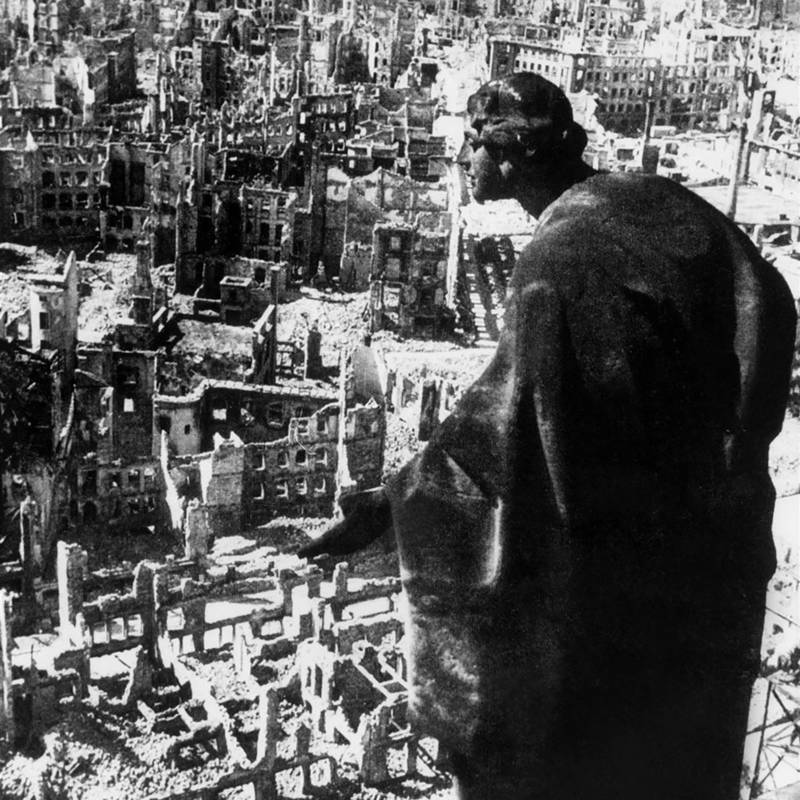 “The most absolute desolation.” Lebensraum became a Nazi ideological principle justifying territorial expansion in Central and Eastern Europe. Cordon Press In this extremely complicated situation, the military and conservative right stirred up Germany's population with a clear message: “The democrats betrayed us at Versailles.” Seeking to reverse the revolutionary change demanded by the working class, they claimed the conditions imposed on Germans differed entirely from Europe's supposedly traditional, milder and more respectful treatment of defeated peoples. A geopolitical and racial interpretation of peoples' development and their need for living space emerged. The German geographer Friedrich Ratzel coined the term Lebensraum, strongly influenced by nineteenth-century biological and naturalistic thought. Eastern Europe and the Slavic world were thus seen as Germany's natural living space, while Versailles supposedly imposed limits preventing the German people's development. Hitler's Rise to PowerIn the late 1920s, Central European countries experienced profound political instability caused by economic insecurity, particularly devastating in Germany. It became fertile ground for extremist, revanchist political movements that won substantial popular support. Read also: The Allied bombing of Dresden, Germany. Fourteen photographs. Prominent among these was Adolf Hitler's National Socialist German Workers' Party, gradually attracting supporters eager to overturn Versailles and restore Germany to what they regarded as its rightful position. Events then moved quickly. President Paul von Hindenburg appointed Hitler chancellor on 30 January 1933. The Reichstag fire followed on 27 February, and the next day Hindenburg signed the Reich President's Decree for the Protection of People and State, suspending individual liberties “until further notice.” Freedom of expression, the press, association and assembly was restricted, alongside restrictions on communications. Nazi Party rally after its electoral victory in 1933. CC Once in power, Hitler violated Versailles and immediately ordered rearmament. He increased armaments spending to eighteen billion marks between 1934 and 1938. Having secured military support, he began territorial expansion by annexing Austria in March 1938, the Anschluss, accompanied by a vote intended to legitimize annexation. His living space did not end there. Next came the Sudetenland, a Czechoslovak border region inhabited by three million Germans. France and Britain acquiesced in the September 1938 Munich Agreement, hoping to appease him. Nothing could have been further from the outcome. Far from stopping, Hitler invaded Czechoslovakia in March 1939. He then demanded the Danzig Corridor, created after Versailles along the Vistula's mouth to give Poland access to the Baltic. Poland, which had disappeared in the eighteenth century, had been restored by France and Britain in the peace settlement as part of a Central European “cordon sanitaire” intended to check revolutionary Russia's expansion. After Poland refused to surrender sovereignty and Germany and Russia signed a non-aggression pact on 23 August 1939, Germany invaded a week later. The Invasion of Poland Begins the Second World War“Tonight Polish soldiers fired on our territory for the first time.” With this lie Hitler tried to justify the claim that Germany had no choice but to invade Poland on 1 September 1939. The provocation had been prepared on 31 August as part of Operation Himmler. Half a dozen SS men posing as insurgents forced their way into a radio station at Gleiwitz in Upper Silesia, firing into the air. After overpowering three employees and a policeman, they proclaimed violent denunciations of the Führer and Third Reich. An interpreter then broadcast patriotic, anti-German statements in Polish: “Attention! This is Gleiwitz. The radio station is in Polish hands.” German troops remove the border barrier between Poland and Germany on 1 September 1939. Cordon Press To make the scene more convincing, the attackers brought a Polish nationalist, Franz Honiok, arrested by the SS the day before. The forty-three-year-old farmer had been chosen because he had participated in similar uprisings. They dragged him to the station heavily drugged and shot him at the entrance where everyone could see. They dressed him in a stolen Polish army uniform to prevent any confusion. After just fifteen minutes the commando fled, unaware that technical problems meant only part of the fabricated speech had been broadcast. Although the audible portion did not announce the fictitious invasion of Germany, it was enough to give Hitler his desired casus belli. Before fleeing, the SS moved Honiok's body into the broadcasting room and photographed it for publication throughout the press. Hitler had announced the invasion that began the Second World War days earlier. Despite these contrivances to find a pretext, Hitler had already announced the invasion. Richard Lukas explains in Out of the Inferno: Poles Remember the Holocaust that in his Obersalzberg speech on 22 August 1939, Hitler explicitly authorized commanders to kill “without pity or remorse, all men, women and children of Polish descent or language.” On the morning of 1 September the German army crossed at several points, using the previous day's events as justification. Poland had a strong army and more personnel than the invaders, but had not ordered general mobilization at French and British request: they feared it might give Hitler a pretext. Defense became still more impossible when the USSR invaded on 17 September, crushing resistance and dividing Poland with Germany. Hitler had long wanted this war but had not expected Britain and France to side with Poland and declare war on him within days. The Second World War had begun. Blitzkrieg: Hitler's Winning StrategyIn the first European phase of the war, Germany sought by every means to avoid a prolonged conflict. Its strategy was to defeat each opponent quickly in a succession of short campaigns. Using Blitzkrieg, the German army invaded much of Europe and remained victorious for several years. Blitzkrieg literally means “lightning war”: a rapid, decisive military campaign requiring concentrated offensive weapons such as tanks, aircraft and heavy artillery. Its defining feature was speed. After initial aerial bombardment, tanks attacked swiftly and independently, disrupting enemy defensive lines. Martin H. Folly writes in his Atlas of the Second World War: “The Polish army was not an insignificant force, but it was unprepared for the new kind of warfare practiced by the Germans. This was Blitzkrieg, lightning war.” The spearhead was the Panzer division: concentrated armored vehicles, fully motorized infantry and close Luftwaffe support, epitomized by the feared Stuka dive bombers. Germany had only light tanks and its army was not fully prepared for war. Speed was the key: overwhelm defenses before the enemy could organize or expose the attackers' hidden weaknesses. Air attacks on civilians filled roads with refugees and helped destroy morale, essential to effective Blitzkrieg. The Poles had numerical superiority, with thirty divisions and ten reserve divisions, but obsolete equipment and strategic doctrine. Their forces were deployed along the borders. Unfortunately, their principal industrial areas were in frontier Silesia, especially vulnerable to Blitzkrieg. Stukas played a very important role in Blitzkrieg. Cordon Press Germany used Blitzkrieg in Poland on 1 September 1939, Denmark and Norway in April 1940, Belgium, the Netherlands, Luxembourg and France in May 1940, and Yugoslavia and Greece in April 1941. Overwhelming German air power prevented defenders from resupplying, organizing or sending reinforcements into breaches opened by tanks. Nevertheless, the system could not defeat Britain, protected by the English Channel and the effective Royal Navy, or the Soviet Union, despite driving Soviet forces to Moscow's gates in 1941. The Phoney War and the Escape from DunkirkAfter Poland's invasion in September 1939 came eight months of drôle de guerre, the “funny” or phoney war, ending with the invasion of Denmark and Norway in April 1940. Unknown to the Allies, behind the apparent calm Hitler planned to advance west and deliver the first great blow: capture Paris. Encouraged by Poland's rapid collapse, he intended to repeat Blitzkrieg against the larger French enemy despite the Maginot Line. British soldiers fire at German aircraft during the Dunkirk evacuation. PD The Germans attacked Belgium as if it were their invasion route into France. The main assault instead crossed the wooded Ardennes, between Belgium and the Maginot Line's northern end, completely surprising the French. The attackers reached the Channel, trapping French, British and Belgian troops against the sea. Hitler had expected a million casualties, but by the Nazi parade down the Champs-Élysées German losses were estimated at 27,000. Yet despite that success, the German army's great triumph lay in a place whose importance no one had expected: Dunkirk's beaches in northern France, where more than 338,000 Allied soldiers were encircled and the port offered their only escape. General Gort, commanding the British Expeditionary Force, organized Operation Dynamo, evacuating Allied troops from French territory between 26 May and 4 June 1940. British soldiers assembled on Dunkirk's beaches. PD The operation would not have succeeded had Hitler not halted his armored divisions on 24 May. He wanted them available against French forces farther south if these regrouped. Luftwaffe chief Hermann Göring also believed his aircraft could prevent any British evacuation. The pause allowed the besieged troops to build an effective defensive perimeter. Neither German artillery nor bombers stopped the evacuation. Fighters from distant German bases could not adequately support the bombers against Allied Spitfires arriving from much nearer bases such as Kent. Calm seas helped too. The withdrawal would not have succeeded without Hitler's decision to halt his troops, still debated by historians. British soldiers waiting to disembark at Dover. PD Most escaped aboard Royal Navy ships, including the light cruiser HMS Calcutta and more than thirty destroyers. Others used civilian vessels that came to help when the navy could not transport so many men. On 4 June Churchill addressed the nation with a clear warning: wars are not won by evacuations. His memorable speech included “we shall go on to the end” and “we shall never surrender.” Dunkirk allowed Britain to continue fighting and, even more importantly, won recognition and sympathy from the American public and press. Britain Enters the Second World WarBy summer 1940 Nazi Germany had conquered Poland, Norway, Denmark, the Netherlands, Belgium, Luxembourg and France in record time, with invaluable help from Mussolini's Italy, newly joined to the Axis with its Mediterranean and African possessions. After the grave defeat at Dunkirk and the breakdown of British-German peace talks in Switzerland, Britain faced another German offensive: Operation Sea Lion. Massed Luftwaffe aircraft under Hermann Göring were to destroy the RAF, securing the air superiority necessary to invade Britain. After Dunkirk's grave defeat, Britain faced another offensive. A German Heinkel He 111 over the Surrey commercial docks in south London, 7 September 1940. PD On 30 June Alfred Jodl and Field Marshal Wilhelm Keitel optimistically asserted that victory over Britain was only a matter of time. Others disagreed. Erich Raeder, German naval commander-in-chief until 1943, warned that the plan was senseless without enough vessels for such a landing. Germany had three air fleets based in France, Norway and the Low Countries: Luftflotte 5 headquartered in Oslo, Luftflotte 3 in Paris and Luftflotte 2 in Brussels. Its 3,600 aircraft faced only 870 RAF machines. The principal obstacles were British radar and German fighters' poorer maneuverability compared with Spitfires and Hurricanes. In July Bf 109s bombed coastal defenses and Channel convoys, but British war production continued despite fear of complete destruction. Most historians agree Churchill's intervention was providential in transforming fear into hope. His tireless work won applause from Labour and Conservatives at Westminster. His friendship with Roosevelt and vigilance over the Atlantic laid foundations for American aid. His charisma countered spreading defeatism. In August he also tricked the Germans with dummy hangars to prevent mass destruction of British airfields. On 20 August he thanked RAF pilots with his legendary words: “Never in the field of human conflict was so much owed by so many to so few.” Most historians agree Churchill's action at that moment was providential. A London street after a bombing raid. PD Some historians also consider Keitel naïve for comparing Britain with Poland. On 25 August fortunes began changing when the RAF retaliated for the bombing of London's East End by attacking Berlin's Tempelhof airfield and the Siemens factory. Damage was slight but enough to enrage Hitler and alter his plans. Sea Lion was postponed on 17 September. Hitler ordered the Blitz: indiscriminate, prolonged Luftwaffe bombing of London and industrial cities such as Coventry from September to November 1940. Coventry after a devastating German raid. PD These were hard months, since mythologized by cinema, with Londoners sheltering in the Underground. Churchill watched a ruined capital helplessly but remained calm, knowing his radar was safe. In mid-September, as Germany planned its final blow and a landing, the Royal Navy and RAF bombarded invasion ports including Calais, Cherbourg and Boulogne. Both sides apparently exaggerated losses for propaganda, and the Battle of Britain ultimately ended in a draw. On 17 September Hitler ended Sea Lion and turned toward the Soviet Union. Sea Lion, Eagle Day and the Blitz all form part of the Battle of Britain. The Nazis Invade the Soviet Union: Operation BarbarossaAt Christmas 1940 Hitler concluded that eliminating Churchill's threat to German interests required a great demonstration of strength. Directive 21, later called Operation Barbarossa after Holy Roman Emperor Frederick I Barbarossa, was intended to attack the Soviet Union, end communism and dismember the country to obtain Lebensraum. Slavs would be expelled, Soviet territory colonized by Germans as far as the Urals, and local people reduced to servants. Neighboring countries such as Ukraine or a Baltic Confederation would receive independence controlled by Berlin. At first the German advance was unstoppable and unopposed. CC Behind Barbarossa also lay Hitler's profound contempt for Slavs, whom Nazi doctrine regarded as Untermenschen, “subhumans.” Despite their August 1939 non-aggression pact, Hitler and Stalin knew this peace could not last and confrontation was inevitable. Barbarossa opened Germany's second front, taking the war to unprecedented barbarity. It marked not only the beginning of Hitler's end but also the beginning across Europe of the terrible persecution and systematic extermination of Jews: the Holocaust. Until then the war had gone extremely well for the Nazis. After France's overwhelming defeat, Hitler mistakenly thought conquering European Russia would take only three or four months. He planned three lines of attack: north along the Baltic coast toward Lithuania and Leningrad, today's St. Petersburg; center through Minsk, now Belarus's capital, toward Moscow; and south into Ukraine's fertile lands, then the Don and Donets industrial basins and the Caucasian oil fields. Once the area was secured, the southern army would capture the Crimean naval base and Caucasian oil. In hindsight, military experts regard dividing the offensive among three fronts as a crucial German error. They believe Moscow should have been the principal objective, as the main communications hub and a major industrial center. Taking it could have split the Soviet Union in two and made conquest easier. The German high command, led by Hitler, follows operations. CC German overconfidence was also evident in the fact that only one fifth of the troops had heavy clothing for the Russian winter: Hitler expected the Volga to mark the Reich's new eastern frontier by December. Neither he nor his staff anticipated failing to occupy Moscow before worsening weather. Spring rains and swollen rivers had turned the country into a quagmire, delaying invasion until the scorching summer. Almost four million soldiers on Germany's side and 3,400 tanks faced nearly 11,000 tanks and three million Soviet troops. Why so few German armored vehicles? Experts attribute it to fuel shortages caused by the Allied blockade, forcing the Germans to use draft animals for transport. The offensive began on 22 June 1941 with heavy artillery and Luftwaffe bombardment of Soviet positions, especially airfields, to secure control of the skies in the invasion's early months. After four days of fierce fighting, General Hoth's forces entered Minsk, taking 324,000 prisoners and 2,500 tanks. Northern and southern armies advanced similarly. Hoth's army, averaging thirty-two kilometers daily, reached Smolensk, 369 kilometers from Moscow, on 18 July. German aircraft principally targeted airfields to secure air superiority during the invasion's first months. Despite this success Hitler prioritized Ukraine and Leningrad. Ignoring his generals, he issued Directive 33 on 19 July, ordering the central army's tanks to reinforce the other fronts. Hoth would turn toward Leningrad's encirclement, while Guderian moved to invade Kyiv, Ukraine's coal regions and Crimea. This strategic change gave the Soviets time to reorganize and rebuild defenses against which the Nazis would ultimately founder. In the rear, the SS brutally repressed civilians, while partisan groups organized by the NKVD, the Russian secret police, made conquered towns' streets dangerous. Attacks prevented consolidation and slowed supplies. Directive 33 cost Germany more than two months crucial to Barbarossa's success. The elements also seemed to turn against them. On 15 October the Germans were just 105 kilometers from Moscow, ready for Operation Typhoon, when a violent storm and the first snow made roads impassable. The Soviets reinforced with Siberian troops and substantial numbers of tanks and aircraft under General Georgy Zhukov. The Germans persisted with their usual tactics despite the cold, but were driven back only eight kilometers from the capital. Low temperatures ruined German strategy in one of the war's bloodiest campaigns. Snow halted the German advance on Moscow. CC Pearl Harbor and American Entry into the Second World WarWhile Nazi Germany continued its seemingly unstoppable European conquest, the United States remained officially neutral toward both Japan's expansionist war in China and Hitler's actions in Europe. In 1940 Washington began regarding Japanese expansion as a threat to American interests, aiding China and sanctioning Japan. After Germany, Italy and Japan signed the Anti-Comintern Pact in November 1941, the United States froze Japanese assets and prohibited all exports to Japan. In 1940 the United States began seeing Japanese expansion as a threat to its interests. USS Arizona sinks after the Japanese attack on Pearl Harbor. PD As Japan continued fighting China, conflict with the United States became inevitable. Japan's high command considered its options but had to recognize the American navy's numerical superiority. Japan lacked the resources to confront the American colossus. It thought it had one trump card: surprise. Admiral Yamamoto persuaded the high command that rather than declaring war, Japan should inflict maximum damage on the American fleet anchored in the Pacific. Sunday, 7 December 1941 was chosen for one of the war's most famous and ultimately decisive attacks. Shortly before dawn, the Imperial Japanese Navy surprised Pearl Harbor in Hawaii, headquarters of the American Pacific Fleet. Without declaring war, 353 fighters, bombers and torpedo aircraft attacked to wipe out American naval power in the region. Within minutes much of the fleet was badly damaged or destroyed. There were two waves. The first destroyed the battleships Oklahoma and Arizona and severely damaged other ships. 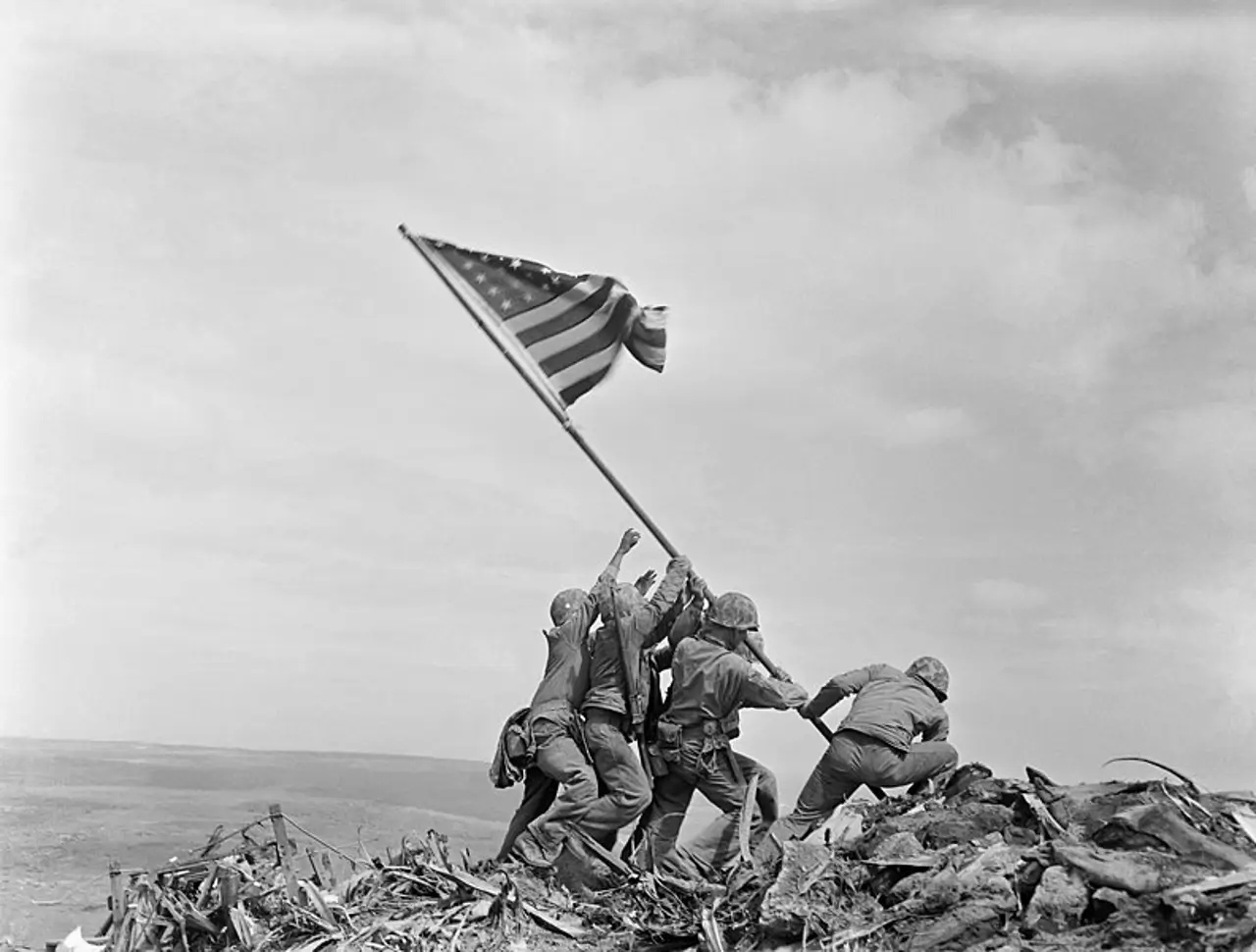 Read also: Iwo Jima, photographs of the decisive battle. Sixteen photographs. The second objective was nearby airfields. Despite their surprise, the Americans defended with anti-aircraft guns, launched some aircraft and shot down twenty-nine Japanese machines. The attack was less effective than Japan intended: fortunately, much of the American fleet was not in port. Japan also left strategic facilities intact, including the power station, shipyard, fuel and torpedo stores, submarine docks, headquarters and intelligence buildings. The bombing of Pearl Harbor brought the United States into the Second World War. CC The blow was severe, but America declared war on Japan the next day, fully bringing the great power into the conflict. Three days later, on 11 December 1941, Hitler's Germany and Mussolini's Italy responded with their own declarations. Unintentionally, the Imperial Japanese Army had awakened the sleeping giant. Pearl Harbor enraged American public opinion, a decisive development in the outcome of history's greatest war. The Decisive Battle of StalingradSpring 1942: war continued on the Eastern Front, slowed by scarce resources, exhaustion on both sides and an especially harsh winter followed by the thaw and rasputitsa, the seasonal transformation of dry ground into a quagmire. Hitler nevertheless decided to finish the Soviet Union before America could mobilize all its economic and military resources. On 28 June he launched Operation Blue, aimed at the Caucasus oil fields: a shortage of petroleum could stop Germany's war machine. Stalingrad lay in the way. Hitler believed taking it would cut Red Army supplies. On 28 June Operation Blue began, seeking Ukraine's and the Caucasus's mineral and oil wealth. A Luftwaffe air raid on Stalingrad, September 1942. CC / German Federal Archives Operation Blue, Fall Blau, developed in two directions: south toward the oil fields and east along the Don toward Stalingrad to protect the southern advance. Controlling Stalingrad became crucial. Fighting for the city, a powerful military-industrial and railway center, began on 23 August 1942. A month earlier Stalin ordered preparations against the likely German attack and prevented civilians from leaving. Fearing the country might be divided, on 28 July he issued Order 227, “Not a step back!”, under which any soldier or civilian surrendering would immediately be shot for treason. The Germans reached a city defended tooth and nail by Generals Yeremenko and Chuikov. The surprise awaiting them was ferocious street fighting amid ruins against an enemy familiar with every corner. Despite heavy Red Army losses, reinforcements arrived nightly across the Volga. The Germans, suffering comparable losses, nevertheless appeared to push the Soviets back, prompting Hitler to announce Stalingrad's conquest on 8 November. The Germans could not know the Soviets had prepared a surprise in the form of violent street fighting. Wehrmacht soldiers tow a vehicle stuck in the terrible rasputitsa mud, November 1941. CC / German Federal Archives Their joy was premature. Stalin had ordered Operation Uranus, intended in the midst of the battle to encircle Germany's Sixth Army, Romania's Third and Fourth Armies and part of the Fourth Panzer Army. Soviet maneuvers, combined with Göring's miscalculation that the Luftwaffe could support the troops, isolated the Sixth Army. Ordered to hold by Hitler, the Germans watched the Red Army close in. With no alternative, Field Marshal Paulus disobeyed Hitler and surrendered on 2 February 1943. Some consider Stalingrad the moment the Eastern Front shifted toward Soviet victory, but that is not quite right. It was the first great Soviet victory, not the decisive battle. The decisive turning point was Kursk in July 1943, history's largest tank battle. Until then the Germans had managed, with difficulty, to stabilize the front. D-Day: The Normandy LandingsAt the Tehran Conference in late 1943, attended by Stalin, Churchill and Roosevelt, the Soviets had already requested a new Western front to relieve pressure on their forces in the east. The Allies decided to invade Europe through Normandy's beaches in Operation Overlord, scheduled for 6 June 1944, code-named D-Day. One of the war's most important military events, it would mark a turning point. Overlord began with a gigantic combined land, air and naval maneuver, Operation Neptune, costing thousands of lives within a few meters between the Atlantic Wall's German defenses and the Channel. American soldiers aboard a landing craft approaching Omaha Beach, Normandy. PD The landing of American, British and Canadian soldiers, many dying on the sand, opened a second European front that, together with the Soviet advance, decisively changed the war's course. Planning was extraordinarily complex. Everything had to work with surgical precision to conquer Normandy and advance into Europe's heart. Hitler knew something was being prepared but expected Calais, not Normandy. In the early hours of 6 June, Allied forces deployed along eighty kilometers of coast, from east to west encompassing Utah, Omaha, Gold, Juno and Sword. Before departure Eisenhower told the troops: “The tide has turned! The free men of the world are marching together to victory... We will accept nothing less than full victory.” The previous night about 23,000 Allied paratroopers and glider troops landed behind German defenses to prevent morning counterattacks. They were to secure beach access, destroy bridges and establish bridgeheads—defensive positions buying time for reinforcements—until the main forces landed. “Into the Jaws of Death,” Robert F. Sargent's photograph of American troops landing on Omaha Beach, 6 June 1944. CC / Robert F. Sargent Armaments production rose to supply the operation. In the first half of 1944 about nine million tonnes of equipment and supplies crossed from America to Britain. A substantial Canadian contingent had trained in Britain since December 1939, and more than 1.4 million American soldiers arrived in Europe during 1943–1944 to participate. D-Day became history's largest coordinated naval, air and land operation, requiring complete cooperation among the participating armed services. By 1944 more than two million soldiers from over twelve countries waited in Britain for invasion orders. The principal landing forces were American, British and Canadian, supported at sea, in the air and on land by Australian, Belgian, Czech, Dutch, French, Greek, New Zealand, Norwegian and Polish troops. Supplies landing on Omaha Beach during the D-Day campaign, June 1944. PD D-Day's spectacular nature has often overshadowed the Normandy campaign as a whole. During the next three months Allied offensives advanced toward Germany, though not every operation succeeded. The Germans resisted fiercely, exploiting Normandy's bocage, sunken lanes bordered by tall, dense hedges, as fortifications. Despite the difficulties, bloody 6 June and the days that followed produced a decisive victory and helped liberate much of northwestern Europe. After D-Day, Allied campaigns in Italy drew German troops away from both fronts, while the Soviet Operation Bagration in Central Europe pinned them down in the east. Ten weeks after D-Day a second invasion struck southern France, advancing toward Germany's heart. With so divided a front, Hitler's forces could only resist a war in which grave miscalculations and attrition would exact a terrible price. The Fall of Berlin and the End of NazismSpring 1945: Germany's situation was hellish. Invaded by Soviet forces in the east and Western Allies in the west, the Reich could expect almost no help from Italy and Hungary, already occupied, or Japan, pressed by the Americans in the Pacific. One of the war's final and bloodiest chapters would bring Hitler's end. Soviet soldiers raise a flag from Berlin's famous Hotel Adlon balcony. Cordon Press The Nazi high command promised Berlin would become the Red Army's grave. It never did. Hitler hid in his bunker, having lost touch with reality. His supposedly thousand-year Reich lacked the means to defend itself and was visibly collapsing. Veterans, now wounded or disabled, recognized a different sound in the explosions on Berlin's outskirts on 19 April 1945: Soviet artillery, unlike the familiar bombs of Allied aircraft. Berlin was within Soviet gun range; the end was approaching. They were right. Despite the attackers' superiority, Hitler ordered resistance to the end. Sheltering with Nazi leaders including Martin Bormann, Albert Speer and Joseph Goebbels, he refused even to hear of surrender. In his agitation he would sacrifice Berlin's entire population pointlessly. Surrender or a white flag meant death; deserters and men hiding from combat were hanged mercilessly. A brief pause in the Russian advance offered respite, but Germany failed to prepare the city's defense. Berlin had only some SS anti-aircraft units and Volkssturm militia, yet no fortification work was undertaken. Hitler remained intractable, lost in long, fruitless digressions. His power nevertheless remained intact: he issued the Nero Order, a scorched-earth policy requiring destruction of transport, industrial, communications and any other infrastructure that could help the enemy—in practice, Germany's destruction. It was never implemented. Hitler alternated between euphoria and uncontrollable rage, especially at generals he called incompetent traitors. Blaming their decisions over Berlin's defense, he gave Guderian medical leave, removed him as chief of staff and appointed Hans Krebs instead. On his fifty-sixth birthday, 20 April 1945, American B-17s and British Lancasters bombed central Berlin, destroying buildings, displacing 2,000 residents and cutting electricity. Two days later, during a bunker meeting, someone praised General Walther Wenck's Twelfth Army fighting the Americans at Magdeburg. Hitler's tremors seemed to vanish in another mood swing: Wenck would turn back and save Berlin. Naturally Wenck could not accomplish the impossible. Berlin was encircled and dying. General Helmuth Weidling finally tried to organize a viable defense with disintegrating troops. Alongside Volkssturm, Hitler Youth and police, they built tramcar barricades and covered surviving walls with slogans demanding resistance and final victory. It was futile. Soviet shells struck the center. The capital resisted with the determination of those believing they had no alternative, but district after district fell while civilians sheltered in smoke-filled Underground tunnels. On the afternoon of 30 April a shot from Hitler's bedroom broke the bunker's impenetrable silence. After taking cyanide, he had shot himself. Eva Braun, whom he married the previous day, lay dead beside him on the sofa. Officers carried both bodies to the Chancellery garden under continuous Soviet bombardment, put them in a prepared pit and set them alight. As Hitler's remains burned, Goebbels, Bormann, Burgdorf and Krebs gave the final Nazi salute. The founder of the Third Reich disappeared forever. By 2 May Berlin was about to fall. Many regime followers, including SS members, preferred suicide to Soviet capture. Germany surrendered unconditionally to the Western Allies at Reims on 7 May and to the Soviets in Berlin on 9 May. Chaos followed victory. Russian soldiers, mostly from the steppes and Caucasian mountains, had never seen such a city or Berlin's luxury. They stole everything possible, and looting was followed by mass sexual violence, little discussed during the Cold War. Though Russian media dismissed these events as Western “inventions,” much evidence comes from the diary of Vladimir Gelfand, a young Jewish lieutenant from central Ukraine. Berlin's Brandenburg Gate devastated by bombing. CC / German Federal Archives The exact number of women raped after Berlin's fall remains unknown. Some historians speak of as many as 100,000. Young and adult women, children and elderly women committed suicide or died from brutal treatment. Mothers hid daughters for protection. Men attempting to intervene, and women resisting, paid with their lives. The Second World War Continues in JapanAs Hitler and Nazism fell and Europe's war neared its end, America had liberated practically all Japan's occupied Pacific islands and intended to land in Japan. After resounding defeats at Midway in June 1942 and Guadalcanal in November 1942, Japan's fleet was destroyed at Leyte Gulf in October 1944, leaving it without effective naval power and apparently near surrender. Japan was prepared to negotiate peace and territorial concessions while preserving the emperor's divine status. America instead sought the imperial army's total, unconditional surrender. USS Yorktown struck by Japanese torpedoes at Midway. PD The Pacific war was long and bloody. Iwo Jima became symbolic not only through Joe Rosenthal's flag-raising photograph, an icon of Allied propaganda, but through its ferocity. During February–March 1945, Japanese troops hidden among volcanic terrain and underground tunnels massacred thousands of Americans landing on black-sand beaches and advancing into rugged mountains. Its unprecedented violence earned the campaign the macabre name “meat grinder.” Another crucial date was 9 March 1945 in the Mariana Islands: the start of Operation Meetinghouse, intended to erase Tokyo from the earth in less than twenty-four hours. The first American wave comprised fifty-four aircraft, followed by another 271 bombers. The operation was planned for midnight on 9–10 March because, according to the American high command, surprising the city's sleeping, unprepared inhabitants was the easiest and safest way to cause large numbers of casualties. Operation Meetinghouse devastated Tokyo and killed thousands of residents. PD During the lethal raid, aircraft dropped cluster bombs nicknamed “Tokyo calling cards.” On impact they scattered white phosphorus and napalm, a sticky petrol-based gel developed in Harvard University laboratories. Tokyo's atmosphere reached 980 degrees, boiling river and canal water and melting window glass. Fire rapidly consumed houses of wood and paper designed only to withstand earthquakes. About 260,000 homes were razed and at least 105,400 people died in a city of three million. They literally melted. A quarter of Tokyo was destroyed. General Curtis LeMay, who organized the operation, boasted: “We scorched and boiled and baked them to death.” Before his death in 2009, Robert S. McNamara, the intellectual architect of Meetinghouse and secretary of defense at the time of the bombing, apologized while continuing to justify it: “In order to do good, you may have to engage in evil.” LeMay, commander of XXI Bomber Command and responsible for carrying out the attacks, believed the immorality was not killing about 100,000 people in one night with incendiaries. The real recklessness, to him, would have been not doing it and losing thousands of Americans in battle. “I suppose if I had lost the war, I would have been tried as a war criminal,” he said. Meanwhile the Allies advanced through the Pacific to Okinawa, largest of the Ryukyu Islands, south of Japan's four main islands. Unable to resist further, Japan launched the desperate suicide attack Operation Ten-Go. Yamato, the world's largest Second World War battleship, sailed with nine other warships to attack Allied forces fighting at Okinawa. American air superiority intercepted and almost completely destroyed them: Yamato and five other ships sank. This action confirmed Japan's decision to intensify kamikaze attacks against the Allied advance. Okinawa fell and was declared secure on 21 June 1945. The Atomic Bombs on Hiroshima and NagasakiPearl Harbor had brought the nominally neutral United States into active, definitive participation in the world conflict on 8 December 1941, when it declared war on Japan. Over the next four years Americans fought Japan in China and the Pacific, where every island's conquest became a miniature war. On 8 December 1941 the previously nominally neutral United States entered the war actively. The bomb explosions over Hiroshima, left, and Nagasaki, right. PD Although the struggle was fairly balanced, Nazi Germany's collapse made matters much harder for Japan. What ultimately tipped the balance was a terrible secret weapon developed under the Manhattan Project. America, aided by Britain and Canada, brought together eminent scientists including Robert Oppenheimer, Niels Bohr and Enrico Fermi to build the first atomic bomb before the Nazis. Research culminated in Trinity, the first atomic test, in the Alamogordo desert of New Mexico on 16 July 1945. Ultimately the bomb was not used against Germany but became the weapon with which America ended the war. Before dawn on 6 August 1945, between 1:12 and 1:15 a.m., Colonel Paul Tibbets's B-29 Enola Gay took off from Tinian in the Marianas for Hiroshima. It carried Little Boy, a uranium-235 nuclear weapon intended to strike the city's center within hours. At 7:09 a.m. Hiroshima's air-raid alarms sounded as the reconnaissance B-29 Straight Flush, commanded by Claude Eatherley, flew over. Surprisingly, neither Japanese fighters nor anti-aircraft batteries intercepted it, allowing it to tell Enola Gay the way was clear. Replica of Little Boy, the nuclear bomb dropped on Hiroshima. PD Monday, 6 August began like any other day in Hiroshima until 8:11 a.m., when residents saw three American B-29s, including Enola Gay, on the horizon. Minutes later the bomber's bay doors opened. The accompanying aircraft parachuted instruments to measure shock waves and assess the weapon's effects. Little Boy began its free fall. For the people below, it was the beginning of the end. At 8:11 a.m. Hiroshima's residents saw three American B-29s, including Enola Gay with its deadly cargo. Colonel Paul Tibbets beside Enola Gay. Cordon Press Three days later, Thursday, 9 August, Major Charles Sweeney's B-29 Bockscar carried the second nuclear bomb, Fat Man, intended for Kokura. Nagasaki was the secondary target, to be attacked only if the first could not be reached. The mission closely resembled Hiroshima's. Clouds covered Kokura. After three passes and with fuel low, Sweeney turned toward Nagasaki. The fuel gauge indicated they could not reach Iwo Jima and would have to divert to Okinawa. If Nagasaki's weather was the same, he decided, they would return toward Okinawa carrying the bomb and try to drop it into the sea. Sweeney decided that if Nagasaki had the same weather as Kokura, they would return toward Okinawa and attempt to drop the bomb at sea. At the last moment a gap opened in Nagasaki's clouds, allowing visual contact. The bomb was released at 11:01 a.m. Forty-three seconds later Fat Man exploded 469 meters above the city, almost three kilometers from the intended target. Its twenty-two-kiloton detonation generated an estimated temperature of 3,900 degrees and winds of 1,005 kilometers an hour. The Nagasaki bomb's twenty-two-kiloton explosion generated an estimated 3,900 degrees and winds of 1,005 kilometers an hour. The Jacksonville Daily Journal's front page of 15 August 1945, announcing Japan's surrender. Cordon Press The catastrophe killed about 140,000 people in Hiroshima and 70,000 in Nagasaki, counting direct victims and deaths from radiation through the end of 1945. Nagasaki's destruction was a severe blow to Japan, which also faced an unexpected Soviet attack in Manchuria that same day, 9 August. Events accelerated. Emperor Hirohito announced unconditional surrender to the Allies on 15 August. Capitulation became effective on 2 September with the signing aboard USS Missouri in Tokyo Bay. The Second World War was over. Surrender and the End of the Second World WarThe Second World War was undoubtedly humanity's most destructive and bloodiest conflict. Millions died, especially in Europe and Asia, in the dark years 1939–1945. The bloodshed culminated in atomic bombs on Hiroshima and Nagasaki, forcing Hirohito to announce capitulation and conclude peace with the Allies. The Second World War was the most destructive and bloodiest conflict in human history. Japanese Foreign Minister Mamoru Shigemitsu signs the surrender aboard USS Missouri. The year 1945 was a turning point: Nazi Germany fell after Hitler's suicide, the Third Reich's heart was destroyed and the Reims armistice was signed on 8 May 1945. Mussolini died and Fascist Italy, the Republic of Salò, dissolved. Related regimes in Hungary, Slovakia and Croatia fell too, although Croatia held out until mid-June before incorporation into Yugoslavia. The Montreal Daily Star's front page announcing Germany's surrender. PD The war also witnessed terrible atrocities: indiscriminate attacks on civilians and systematic persecution for political, racial or religious reasons. Its end exposed Nazi concentration and extermination camps throughout occupied Europe and the “Final Solution of the Jewish Question” that produced the Holocaust. Auschwitz, Bełżec, Bergen-Belsen, Buchenwald, Dachau and many other names remain horrifying. The Allies established judicial machinery to try the Nazi regime's perpetrators and accomplices for crimes against peace, war crimes and crimes against humanity. Nuremberg, emblematic site of the Nazi Party's mass rallies, was chosen for the trials. The historic Nuremberg Trials laid foundations for international justice and laws extending beyond individual countries' jurisdiction. Hearings of Nazi leaders such as Göring, Hess and Ribbentrop, as well as ordinary regime officials, lasted less than a year, from 20 November 1945 to 1 October 1946. Severe sentences included death for twelve defendants. The Nuremberg Trials took place in that German city from 20 November 1945 to 1 October 1946. Nuremberg was not the only tribunal judging Second World War crimes. The International Military Tribunal for the Far East, 1946–1948, held the Tokyo Trials. The same standards were not applied there: Emperor Hirohito was not tried and remained in office, while many sentences were reduced or commuted. Politics was changing. Japan was no longer the enemy to defeat but was becoming an indispensable ally against the growing threat of communism. RBA Italia srl · VAT number 05801500967. Registered with the Milan Court, no. 90 of 26 June 2024. © J. M. Sadurní · © Storica National Geographic |