




 |
||
 |
||
 |
||
 |

A Private War Diary
Book: German Diary 1945-46: Notes of a Soviet Officer
Author: Vladimir Gelfand
Translation: Lars Wiklund
Publisher: Ersatz
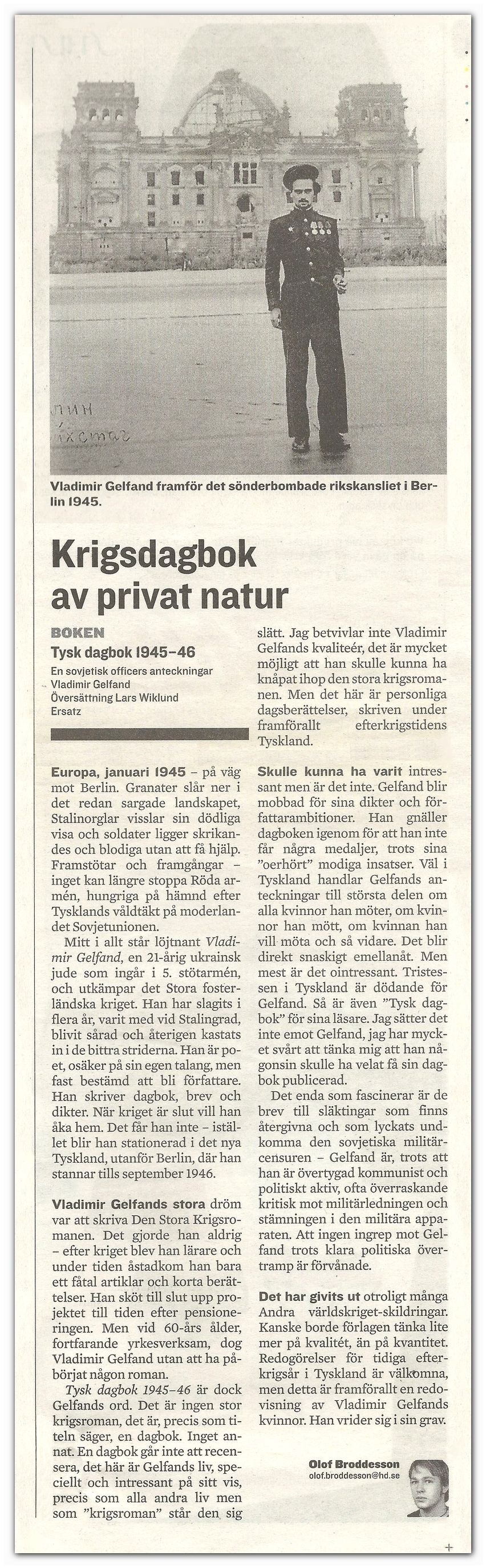
Europe, January 1945: the course is set for Berlin. Bombs fall on an already devastated landscape, Stalin's "Katyusha" rockets whistle through the air, and Red Army soldiers fight while remembering the suffering of their families. Nothing seems able to stop them; the enemy will be defeated.
Among them is Lieutenant Vladimir Gelfand, a twenty-one-year-old Ukrainian Jew and officer who has already travelled a long and bloody road through the war. He fought near Stalingrad, was wounded, and repeatedly returned to the front. Alongside his military duty he has another passion: literature. He dreams of becoming a writer, keeps diaries, writes poetry and letters, and hopes one day to turn his experience into a great novel about the war.
When the Third Reich capitulates, Gelfand does not return home as he had dreamed. Instead he remains in Germany, in the Soviet occupation zone, until September 1946.
His dream of writing an epic war novel is never fulfilled. After the war he becomes a teacher and publishes only occasional articles and stories. He hoped to carry out his literary plan in retirement, but died at the age of sixty before he could begin the book.
German Diary 1945-46 nevertheless became his principal legacy. It is not a grand novel but a diary: notes written at different times without later polishing, a living document of the period. They record Gelfand's life, as individual and interesting as that of any person who lived through the war. He may indeed have been capable of writing a great novel, but the diary's greatest value is its record of everyday experience.
The book does not always hold the reader's attention. Gelfand writes about military hardship, injustice, comrades mocking his poetry and his failure to receive decorations for his service. Yet much of the diary, especially after the war, is devoted to women - women he meets, hopes to meet, or has relationships with - and at times this becomes repetitive.
Some of the most valuable material consists of letters to relatives that escaped Soviet military censorship. Despite his commitment to Communist ideology, Gelfand often criticizes army leadership and conditions within the military. It is striking that these remarks did not bring reprisals.
The book market is crowded with publications about the Second World War, and perhaps publishers should pay more attention to quality than quantity. Gelfand's observations on the first postwar years in Germany are certainly interesting, but German Diary too often turns into a chronicle of his private life, particularly his relations with women. That reduces its weight as a historical document.
Olof Broddesson