



 |
 |
 |
| © LN Online GmbH |
 German
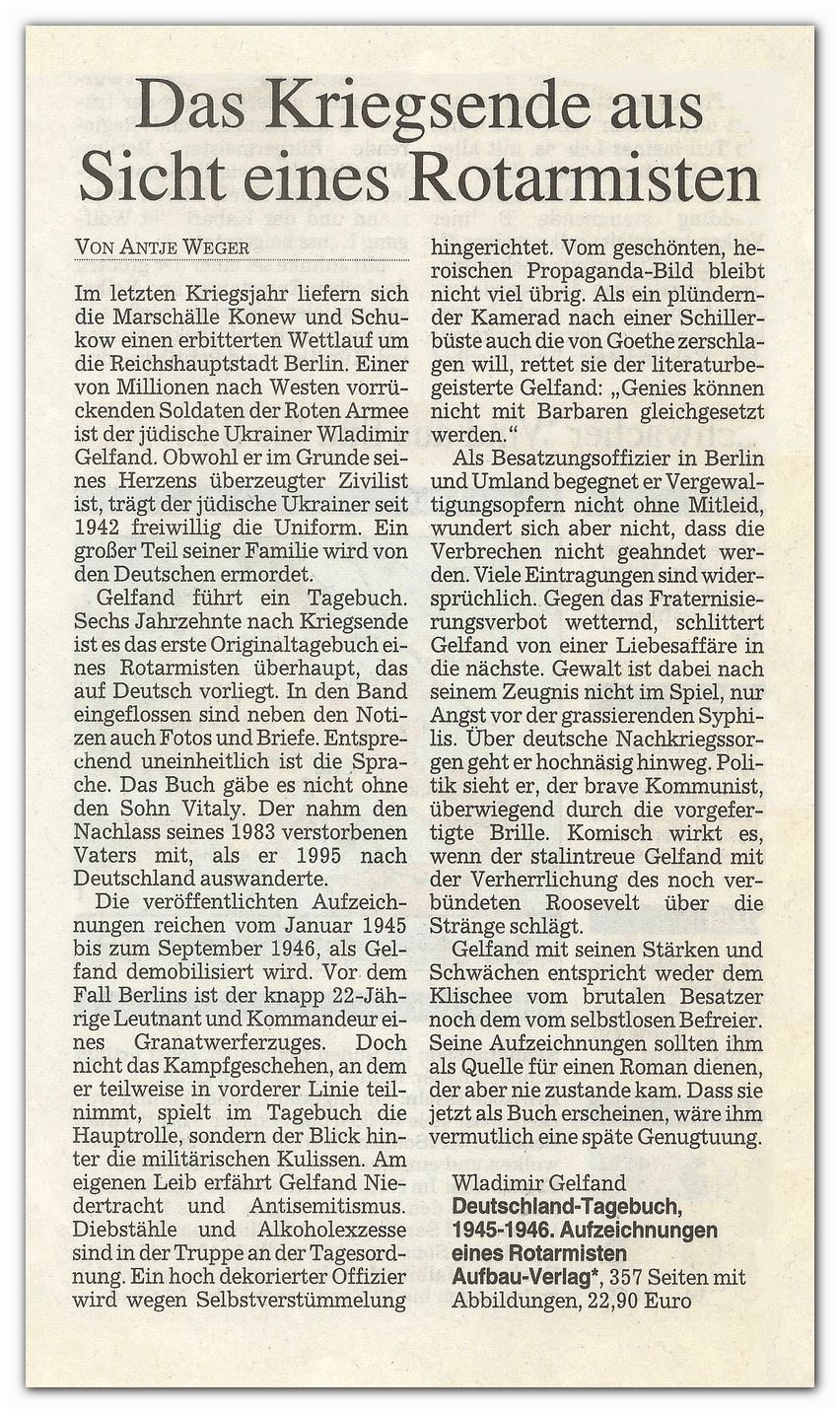
In the final year of the war, Marshals Konev and Zhukov entered into a fierce race for Berlin, the capital of the collapsing Reich. One of the millions of Red Army soldiers advancing westward was Vladimir Gelfand, a Jewish Ukrainian. Although at heart he regarded himself as a civilian, he had voluntarily worn a soldier’s uniform since 1942; much of his family had been murdered by the Germans.
Gelfand kept a diary. Six decades after the end of the war, it became the first original diary of a Red Army soldier to be published in German. In addition to the diary entries, the book contains photographs and letters. The language of the diary is uneven, which only underlines its authenticity. The book would never have appeared without Gelfand’s son Vitaly, who emigrated to Germany in 1995 and brought with him the archive of his father, who had died in 1983.
The published entries cover the period from January 1945 to September 1946, when Gelfand was demobilized. On the eve of Berlin’s fall, the almost twenty-two-year-old lieutenant, commander of a mortar platoon, took part in front-line fighting. Yet the diary is concerned less with military feats than with the inner life of the army behind the scenes of its victories.
Gelfand personally encountered meanness and antisemitism. Theft and drunkenness became ordinary features of military life. He saw even highly decorated officers deteriorate morally. Little remained of the heroic image of the Red Army carefully constructed by Soviet propaganda. When a fellow soldier looted a castle and wanted to smash busts of Schiller and Goethe, Gelfand, an admirer of literature, intervened: “Geniuses cannot be equated with barbarians.”
As an occupation officer in and around Berlin, he encountered victims of violence with sympathy, while not being surprised that many crimes went unpunished.
His diary is full of contradictions. Despite the prohibition on fraternization with the local population, he readily entered into new romances, moving from one love affair to another. Behind this was more than fear of syphilis, which was rampant among the soldiers. He viewed German postwar hardship with a certain arrogance and interpreted events through the ideological lens of a convinced communist. At times this produced striking paradoxes: while remaining loyal to Stalin, he could also step outside official Soviet discourse and praise the allied American president Franklin D. Roosevelt with genuine enthusiasm.
With all his strengths and weaknesses, Gelfand fits neither the stereotype of the brutal occupier nor that of the selfless liberator. He intended his notes to become the basis of a novel that was never written. That the diaries eventually became a book years later would probably have given him a measure of belated satisfaction.