




 |
||
 |
||
 |
 German
“You are entering Germany — no fraternization,” read a sign that soldiers of Patton’s Third Army nailed to a hastily repaired bridge over the Sauer in March 1945. War correspondent Osmar White saw it and remembered reading that the Russians used different warning signs, such as “The Beast’s Lair.” The Australian reporter accompanying U.S. forces wondered “what the difference was.”
The sight of bombed-out cities — the ruins of Bitburg, Jülich and Düren — seemed to fill the soldiers with “a kind of quiet satisfaction.” White could “almost hear the thought running through their minds: ‘It serves them right.’” A twenty-year-old fighter pilot told the Australian reporter after low-level attacks on Wehrmacht columns: “It was like hunting rats. Yes, rat hunting. You flush them out. You take aim. You smash the vermin. You kill it.”
A month earlier, in February, Soviet lieutenant Wladimir Gelfand, stationed with a mortar unit on the Oder embankment, had heard of a German women’s battalion said to have been completely wiped out. The twenty-one-year-old wrote in his diary: “I don’t know what was done with them, but they should be executed without mercy. Our soldiers suggest impaling these villains through their sexual organs, but I would simply liquidate them.”
And I spit on Berlin
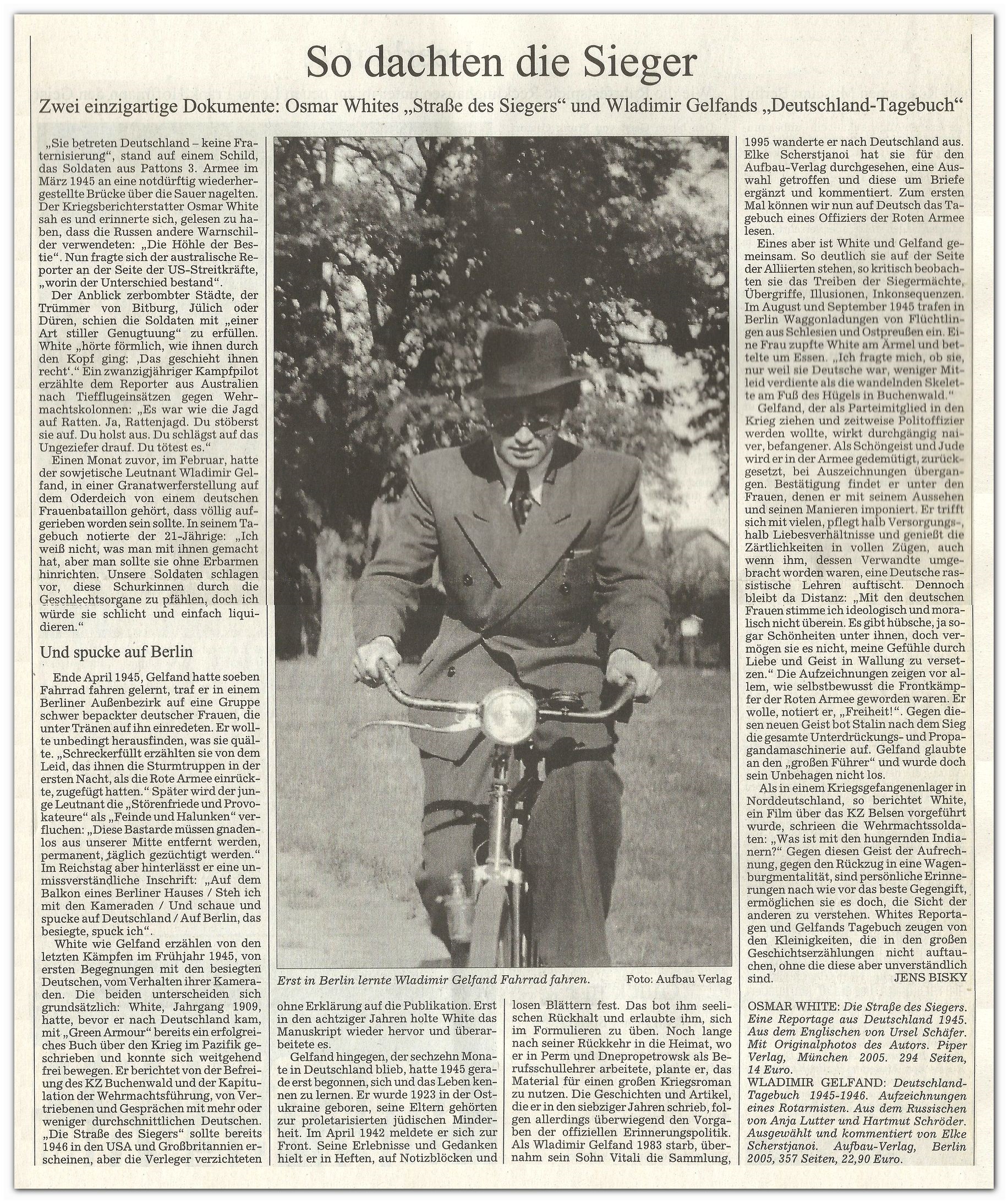
At the end of April 1945, shortly after learning to ride a bicycle, Gelfand encountered a group of heavily laden German women in an outlying district of Berlin. They spoke to him in tears. He was determined to understand what tormented them. “Terrified, they told of the suffering inflicted on them by the assault troops on the first night the Red Army entered.” Later the young lieutenant curses the “troublemakers and provocateurs” as “enemies and scoundrels”: “These bastards must be mercilessly removed from our midst, punished permanently, every day.” Yet in the Reichstag he leaves an unmistakable inscription: “On the balcony of a Berlin house / I stand with my comrades / And look and spit on Germany / On Berlin, the defeated, I spit.”
Both White and Gelfand tell of the final fighting in spring 1945, of their first encounters with defeated Germans, and of their comrades’ behavior. But they differ fundamentally. White, born in 1909, had already written the successful Green Armour about the Pacific war and could move with considerable freedom. He reports on the liberation of Buchenwald concentration camp and the Wehrmacht leadership’s surrender, on displaced persons, and on conversations with more or less ordinary Germans. Conquerors’ Road was to appear in the United States and Great Britain in 1946, but the publishers abandoned publication without explanation. Only in the 1980s did White take up the manuscript again and revise it.
Gelfand, by contrast, spent sixteen months in Germany and in 1945 had only just begun to discover himself and life. Born in eastern Ukraine in 1923 to a family from the proletarianized Jewish minority, he volunteered for the front in April 1942. He recorded his experiences and thoughts in exercise books, notepads and on loose sheets. Writing gave him emotional support and a chance to practice formulation. Long after returning home, where he worked as a vocational-school teacher in Perm and Dnepropetrovsk, he planned to use the material for a major war novel. The stories and articles he wrote in the 1970s, however, largely followed the patterns of official memory.
After Wladimir Gelfand died in 1983, his son Vitali took over the collection. In 1995 Vitali emigrated to Germany. Elke Scherstjanoi examined the papers for Aufbau Verlag, made a selection, supplemented it with letters and added commentary. For the first time, a German readership can now read the diary of a Red Army officer.
White and Gelfand nevertheless have one thing in common. Firmly as they stand on the Allied side, they observe the behavior of the victorious powers critically: assaults, illusions and inconsistencies. In August and September 1945 trainloads of refugees from Silesia and East Prussia arrived in Berlin. A woman tugged at White’s sleeve and begged for food. “I wondered whether, simply because she was German, she deserved less compassion than the walking skeletons at the foot of the hill in Buchenwald.”
Gelfand — who wanted to go to war as a Party member and for a time hoped to become a political officer — appears throughout more naïve and more constrained. As an intellectual and a Jew he is humiliated in the army, passed over and denied decorations. He finds affirmation among women, whom he impresses with his appearance and manners. He meets many of them, enters relationships that are partly about provisions and partly about affection, and thoroughly enjoys their tenderness, even when a German woman lectures him on racial doctrines although his own relatives had been murdered. Yet distance remains. “Ideologically and morally I do not agree with German women. There are pretty ones, even beauties among them, but they cannot set my feelings aflame through love and spirit.” His notes show, above all, how self-confident the Red Army’s front-line soldiers had become. “Freedom!” he writes that he wants. Against this new spirit Stalin deployed the whole machinery of repression and propaganda after victory. Gelfand believed in the “great leader” and yet could not rid himself of unease.
White recounts that when a film about Bergen-Belsen concentration camp was shown in a prisoner-of-war camp in northern Germany, Wehrmacht soldiers shouted: “What about the starving Indians?” Against this spirit of score-settling, memories remain one of the best antidotes, because they allow us to understand the other side’s view. White’s reports and Gelfand’s diary testify to the small things absent from grand historical narratives but without which those narratives remain incomprehensible.
Jens Bisky