


| …В лице советских солдат мы имеем дело со степными подонками. Это подтверждают поступившие к нам из восточных областей сведения о зверствах. Они действительно внушают ужас. Их невозможно даже воспроизвести в отдельности. Прежде всего, следует упомянуть об ужасных документах, поступивших из Верхней Силезии. В отдельных деревнях и городах бесчисленным изнасилованиям подверглись все женщины от 10 до 70 лет. Кажется, это делается по приказу сверху, так как в поведении советской солдатни можно усмотреть явную систему. |
| Офицеры и красноармейцы! Мы идем в страну противника. Каждой должен хранить самообладание, каждый должен быть храбрым...Оставшееся население на завоеванных областях, независимо от того немец ли, чех ли, поляк ли, не должно подвергаться насилию. Виновные будут наказаны по законам военного времени. На завоеванной территории не позволяется половые связи с женским полом. За насилие и изнасилования будут виновные расстреляны. |
20 апреля 1945 г. Ставка Верховного Главнокомандования приказывает: 1. Потребуйте изменить отношение к немцам как к военнопленным, так и к гражданским. Обращаться с немцами лучше. Жестокое отношение с немцами вызывает у них боязнь и заставляет их упорно сопротивляться, не сдаваясь в плен. Гражданское население, опасаясь мести, организуется в банды. Такое положение нам невыгодно. Более гуманное отношение к немцам облегчит нам ведение боевых действий на их территории и, несомненно, снизит упорство немцев в обороне. 2. В районах Германии к западу от линии устье реки Одер, Фюрстенберг, далее река Нейсе (западнее) создавать немецкие администрации, а в городах ставить бургомистров — немцев. Рядовых членов национал-социалистической партии, если они лояльно относятся к Красной армии, не трогать, а задерживать только лидеров, если они не успели удрать. 3. Улучшение отношения к немцам не должно приводить к снижению бдительности и панибратству с немцами. Ставка Верховного Главнокомандования. И.СТАЛИН АНТОНОВ |
Применялся ли этот указ на практике? По данным профессора РАН Олега Ржешевского, заведующего отделом истории войн и геополитики Центра истории войн XX века, за совершенные бесчинства по отношению к местному населению были осуждены военными трибуналами 4148 офицеров и большое число рядовых. Несколько показательных судебных процессов над военнослужащими завершились вынесением смертных приговоров.
Вскоре после вступления в Восточную Пруссию нас ознакомили с приказом, осуждавшим насилие в отношении гражданского населения, особенно женщин, и мародерство. В приказе говорилось о строгих наказаниях, которым будут подвергнуты нарушители. Я не припомню заседаний трибунала, арестов или разжалований в нашей дивизии. Но приказ сам по себе был сильным сдерживающим средством. В моем непосредственном окружении, а это две-три сотни человек, приказ не нарушался. Среди нас не было отъявленных насильников. Было бы наивно утверждать, что никто и нигде не нарушал этот приказ. Но, подчеркиваю, открытых нарушений приказа, массового насилия над немецкими женщинами не было.
Теперь попробуем разобраться с цифрами. На территории Восточной Германии, оккупированной советскими войсками, в 1945 году проживало около 20-21 млн. человек. Если принять долю женщин в 60-65% (очевидно, что в военный и послевоенный период число женщин больше, чем число мужчин), то получим 12-13.7 млн. женщин всех возрастов, находившихся под советской оккупацией. Очевидно, что хотя бы из этих соображений 15 млн. никак не может быть изнасиловано. Точно также совершенно невероятно число в 2 млн. изнасилованных – оно означает, что каждая шестая немка вне зависимости от возраста и физической привлекательности была изнасилована. Столь массовые изнасилования не могли пройти мимо социологов тех лет, однако сторонники теории о массовых изнасилованиях ни разу не ссылаются на социологические исследования того времени, предпочитая брать цифры с потолка.
На следующий день приходят ее родители с местными властями к нам в бригаду. А еще через день органы их вычислили и взяли — СМЕРШ работал неплохо. Иванов сразу сознался, что стрелял, но он не понял, что убил. На третий день суд. На поляне построили всю бригаду, привезли бургомистра и отца с матерью. Механик плакал навзрыд. Иванов еще ему говорит: «Слушай, будь мужиком. Тебя все равно не расстреляют, нечего нюни распускать. Пошлют в штрафбат — искупишь кровью». Когда ему дали последнее слово, тот все просил прощения. Так и получилось — дали двадцать пять лет с заменой штрафным батальоном. Лейтенант встал и говорит: «Граждане судьи Военного трибунала, я совершил преступление и прошу мне никакого снисхождения не делать». Вот так просто и твердо. Сел и сидит, травинкой в зубах ковыряется. Объявили приговор: «Расстрелять перед строем. Построить бригаду. Приговор привести в исполнение». Строились мы минут пятнадцать двадцать. Подвели осужденного к заранее отрытой могиле. Бригадный особист, подполковник, говорит нашему батальонному особисту, стоящему в строю бригады: «Товарищ Морозов, приговор привести в исполнение». Тот не выходит. «Я вам приказываю!» Тот стоит, не выходит. Тогда подполковник подбегает к нему, хватает за руку, вырывает из строя и сквозь зубы матом: «Я тебе приказываю!!» Тот пошел. Подошел к осужденному. Лейтенант Иванов снял пилотку, поклонился, говорит: «Простите меня, братцы». И все. Морозов говорит ему: «Встань на колени». Он это сказал очень тихо, но всем слышно было — стояла жуткая тишина. Встал на колени, пилотку сложил за пояс: «Наклони голову». И когда он наклонил голову, особист выстрелил ему в затылок. Тело лейтенанта упало и бьется в конвульсиях. Так жутко было…. Особист повернулся и пошел, из пистолета дымок идет, а он идет, шатается, как пьяный. Полковник кричит: «Контрольный! Контрольный!» Тот ничего не слышит, идет. Тогда он сам подскакивает, раз, раз, еще.
Что мне запомнилось, после каждого выстрела, мертвый он уже был, а еще вздрагивал. Он тело ногой толкнул, оно скатилось в могилу: «Закопать». Закопали. «Разойдись!» В течение пятнадцати минут никто не расходился. Мертвая тишина. Воевал он здорово, уважали его, знали, что румыны сожгли его семью. Мог ведь снисхождения просить, говорить, что случайно, нет…. После этого никаких эксцессов с местным населением у нас в бригаде не было.
“The Myth of Millions of Raped German Women”
| 20 October 2009
In recent years, the myth that hundreds of thousands or millions of German women were raped by Soviet soldiers in 1945 has spread widely in the Russian liberal press. The Russian translation of the British historian Antony Beevor's book Berlin: The Downfall 1945 has contributed especially strongly to this. The author estimates the number of women raped at between 95,000 and 135,000, but even that is far from the highest figure. Some “researchers” speak of two million victims, or even fifteen million (the latter, implausible figure is given by the American author Johnson in his article “Red Army troops raped even Russian women...”). The origin of this myth is clear, in the author's view: it helps turn Germans from aggressors into victims, equate the USSR with Nazi Germany, and ultimately revise the results of the Second World War, with all the geopolitical consequences that would follow.
Of course, it would be foolish to claim that no rapes at all occurred in territory occupied by Soviet troops. The question is their scale. It is one thing if they were as widespread as Beevor describes. In that case, one could speak, first, of the cruelty and immorality of most Soviet soldiers and, second, of such conduct being encouraged by Soviet command. It is quite another if rapes were exceptions rather than the rule, one of the inevitable excesses that occur during war in any army.
The well-known master of propaganda Joseph Goebbels had already begun laying the foundations of the myth of mass rape.
Here is what he wrote on 2 March 1945:
...In the Soviet soldiers we are dealing with scum from the steppes. This is confirmed by the reports of atrocities reaching us from the eastern regions. They are truly horrifying. It is impossible even to recount them individually. First of all, mention must be made of the dreadful documents received from Upper Silesia. In certain villages and towns, countless rapes have been inflicted upon all women aged ten to seventy. It seems that this is done on orders from above, since a clear system can be discerned in the conduct of the Soviet soldiery.
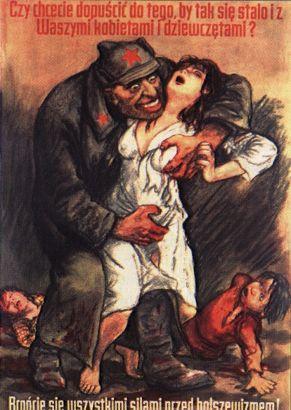
Here is another example of Goebbels's propaganda, this time directed at the inhabitants of Poland:
Fascist propaganda made statements of this kind more than once, so the German population had come to see the Soviet Army as wild hordes from the East, looting and raping everything in their path. But were rapes carried out “on orders from above,” as Goebbels asserted, or not? The answer, the author argues, is obvious after reading two documents. Here is Stalin's order of 19 January 1945:
Officers and Red Army soldiers! We are entering the enemy’s country. Everyone must maintain self-control; everyone must be brave... The remaining population in the conquered areas, whether German, Czech or Polish, must not be subjected to violence. Those responsible will be punished under the laws of wartime. Sexual relations with women are not permitted in conquered territory. Those guilty of violence and rape will be shot.
And here is another document: a directive of the Headquarters of the Supreme High Command to the commanders and members of the Military Councils of the 1st Belorussian and 1st Ukrainian Fronts, concerning a change in the treatment of German prisoners of war and civilians, dated 20 April 1945:
20 April 1945.
The Headquarters of the Supreme High Command orders:
1. Demand a change in attitudes toward Germans, both prisoners of war and civilians. Treat Germans better. Cruel treatment makes them afraid and compels them to resist stubbornly rather than surrender. The civilian population, fearing revenge, forms armed groups. This situation is not to our advantage. More humane treatment of Germans will make it easier for us to conduct military operations in their territory and will undoubtedly reduce their determination to defend it.
2. In areas of Germany west of the line from the mouth of the Oder River through Fürstenberg and then along the Neisse River (to the west), establish German administrations and appoint German burgomasters in the towns. Do not interfere with ordinary members of the National Socialist Party if they behave loyally toward the Red Army; arrest only the leaders, provided they have not managed to flee.
3. Better treatment of Germans must not lead to diminished vigilance or familiarity with Germans.
Headquarters of the Supreme High Command. I. STALIN. ANTONOV.
I think these two orders need no comment. Did the order have any effect on ordinary soldiers? This is what Isaak Kobylyansky, who commanded an artillery platoon during the war, writes:
Soon after we entered East Prussia, we were informed of an order condemning violence against the civilian population, especially women, and looting. The order spoke of severe penalties for those who broke it. I do not remember any tribunal hearings, arrests or reductions in rank in our division. But the order itself was a powerful deterrent. In my immediate circle — two or three hundred men — the order was not violated. There were no notorious rapists among us. It would be naive to claim that nobody anywhere broke this order. But I emphasize that there were no open violations of the order, no mass violence against German women.
Was this order enforced in practice? According to Professor Oleg Rzheshevsky of the Russian Academy of Sciences, head of the Department of the History of Wars and Geopolitics at the Centre for the History of Twentieth-Century Wars, military tribunals convicted 4,148 officers and a large number of enlisted men for outrages committed against the local population. Several publicized trials of servicemen ended in death sentences.
As an illustration, let us turn to the recollections of V. P. Bryukhov, quoted by Miroslava Berdnik in her article “In the Beast's Lair, or Once Again About 'Raped Germany'.” Bryukhov recalls an incident in which an officer from his regiment and the mechanic of his tank attempted to rape a Romanian girl and shot her when she tried to escape:
The following day, her parents came to our brigade with the local authorities. Another day later, the authorities tracked them down and arrested them — SMERSH worked well. Ivanov immediately admitted that he had fired, but said he had not realized he had killed her. On the third day there was a trial. The entire brigade was assembled in a clearing, and the burgomaster and the girl’s father and mother were brought there. The mechanic wept uncontrollably. Ivanov told him, “Listen, be a man. They won’t shoot you anyway; stop sniveling. They’ll send you to a penal battalion — you’ll redeem yourself in blood.”
When given the last word, the mechanic kept asking for forgiveness. That is what happened: he received twenty-five years, with the sentence replaced by service in a penal battalion. The lieutenant stood up and said, “Citizens, judges of the Military Tribunal, I have committed a crime and ask you to show me no leniency.” It was simple and firm. He sat down and began picking his teeth with a blade of grass. The sentence was announced: “To be shot before the ranks. Assemble the brigade. Carry out the sentence.”
It took us fifteen or twenty minutes to form up. The condemned man was brought to a grave that had been dug beforehand. The brigade’s security officer, a lieutenant colonel, addressed our battalion security officer, who stood in the ranks: “Comrade Morozov, carry out the sentence.” He did not move. “I am ordering you!” He still stood there. Then the lieutenant colonel rushed up, seized his arm, dragged him out of formation and swore through clenched teeth: “I am ordering you!” Morozov went over to the condemned man.
Lieutenant Ivanov removed his field cap, bowed and said, “Forgive me, brothers.” That was all. Morozov told him, “Kneel down.” He said it very quietly, but everyone heard: there was a terrible silence. Ivanov knelt, tucked his cap behind his belt. “Lower your head.” When he lowered it, the security officer shot him in the back of the head. The lieutenant’s body fell and convulsed. It was dreadful... The officer turned and walked away; smoke was coming from his pistol and he was staggering like a drunk. The colonel shouted, “A finishing shot! A finishing shot!” But he heard nothing and kept walking. Then the colonel himself rushed forward and fired again and again. What I remember is that after each shot — he was already dead — the body still jerked. The colonel pushed it with his foot and it rolled into the grave. “Bury him.” They buried him. “Dismissed!”
For fifteen minutes nobody left. Dead silence. He had fought very well; everyone respected him and knew that the Romanians had burned his family. He could have asked for leniency, said it was an accident, but he did not... After that, there were no further incidents involving the local population in our brigade.
Now let us try to make sense of the figures. About 20–21 million people lived in the territory of eastern Germany occupied by Soviet troops in 1945. If we assume that women accounted for 60–65 percent of the population (the number of women was clearly higher than the number of men during and after the war), we arrive at 12–13.7 million women of all ages under Soviet occupation. On this basis alone, fifteen million could not possibly have been raped. The figure of two million is just as incredible: it would mean that every sixth German woman, regardless of age or physical attractiveness, had been raped. Violence on such a scale could hardly have escaped the attention of sociologists at the time; yet supporters of the theory of mass rape never cite contemporary sociological studies, preferring instead to pull figures out of thin air.
To justify their figures for the number of German women raped, “researchers” use abortion statistics from Berlin clinics and try to extrapolate them to all of Germany. They justify this method by pointing out that in some applications for abortions submitted by women in the Soviet occupation zone, the applicants stated that Soviet soldiers had raped them. But this argument, the author maintains, cannot withstand criticism for one simple reason: on 28 March 1945 Martin Bormann issued a decree permitting an abortion if a German woman said she had been raped by a foreign soldier. Previously, abortion had been strictly prohibited in the Reich. After that decree, the abortion statistics based on women's declarations that they had supposedly been raped by Russians cannot be taken at face value. Doctors did not verify whether the declarations were true, so it is impossible to determine how many reflected actual assaults and how many were used as grounds for obtaining a legal abortion.
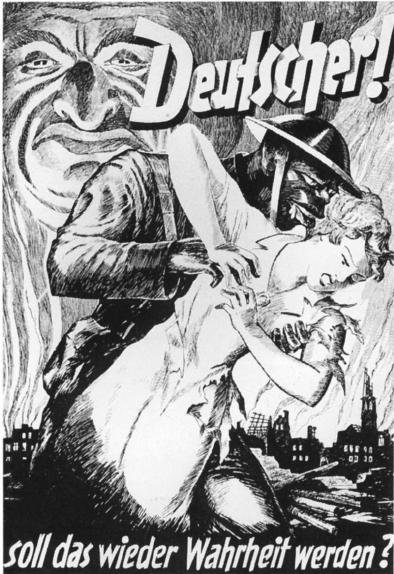
Another curious detail: N. Mendkovich, in his article “Who 'Raped Germany'?” in the journal Current History, cites A. Grossman's “A Question of Silence: The Rape of German Women by Occupation Soldiers” (Berlin 1945: War and Rape; 'Liberators Take Liberties', October 1995, vol. 72, pp. 50, 58). As Mendkovich writes, women who later declared that they had suffered sexual violence described their attackers with striking persistence as Asians (or, in western Germany, as Black men). Logically this is doubtful, since the population of the USSR was predominantly of European appearance, but the descriptions closely resembled Nazi propaganda stereotypes about “slant-eyed barbarians.” On the Western Front, German propaganda, instead of portraying Russians as a threat, used the image of a Black man raping blond German women to frighten the population:
The appearance of a Black man in this propaganda poster is understandable: it corresponded to the Nazi ideology of the supremacy of the “white race.” At the same time, just as servicemen from Central Asia accounted for only a small proportion of the Soviet Army, Black servicemen made up a relatively small proportion of the U.S. Army at that time: 8.7 percent. The reasons were different, however: during the Second World War the United States remained a racially discriminatory society, and the recruitment of Black soldiers was substantially restricted despite the large Black population.
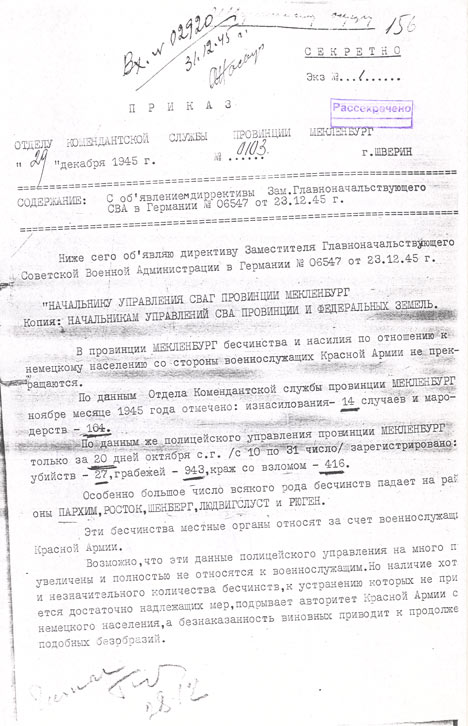
What do the documents say? In the same article, Mendkovich quotes a report from the Front Military Prosecutor's Office, written by Major General Yasin: “While shootings of Germans are now almost entirely absent and cases of looting are isolated, violence against women still occurs... On 5 May I shall submit another memorandum to the Front Military Council on this subject, in which I shall provide a detailed analysis of all cases of improper treatment of the German population recorded since these documents were issued.” Obviously, the author argues, such a detailed accounting would have been impossible if there had been several hundred incidents to discuss. Yasin gives no overall total but reports two or three cases of this kind in each settlement. These figures relate to April 1945. The article says that the situation in the postwar period was no different. The following order is reproduced on the website 9may.ru:
As we can see, “according to the Commandant Service Department of Mecklenburg Province, the following were recorded in November 1945: rapes — 14 cases; looting — 104 cases.” The document adds that “these police department figures may be considerably exaggerated and may not all concern military servicemen.” Fourteen rape cases in an entire province in one month. Multiply that by the number of months in a year and by the number of occupied provinces, and introduce a correction factor: the result, the author argues, still falls far short of millions or even tens of thousands.
In conclusion, it should be noted that soldiers who wanted sex did not necessarily have to rape German women. After the war, the occupied territories were devastated and suffered food shortages; there was also an acute shortage of men, which led to a general decline in social mores and an increase in prostitution. According to Hungarian authorities, the number of prostitutes in Budapest rose twentyfold after the beginning of the occupation.
According to the German book Hungerwinter: Deutschlands humanitäre Katastrophe 1946/47 (“Hunger Winter — Survival after the War”), published in 2009, around 1,600 young women were arrested in Munich alone over three months on suspicion of prostitution and spreading sexually transmitted diseases. In the British zone, the number of arrests in 1946 was estimated at 15,000; most of those arrested were minors, and 80 percent reportedly had sexually transmitted diseases.
Here is what the already quoted Isaak Kobylyansky writes about Germany: “In the evenings, after lights-out, some of the bold and fortunate officers left their quarters to visit a German 'girlfriend' in secret. As a rule, the visitor carried a little parcel containing something to eat. Knowledge of German was not necessary for these visits.” As we can see, the material price of sex was modest: “something to eat.”
And here is an entry from the diary of Red Army lieutenant Vladimir Gelfand, also quoted in Hungerwinter: Deutschlands humanitäre Katastrophe 1946/47: “I would have liked to know all the charms of beautiful Marianne; kisses and embraces were not enough for me. I had high hopes, but did not force her. Her mother was pleased with me. What could be better! In the end I placed on the altar of trust and goodwill food, sweets and butter, sausage and German cigarettes. Half of that would have been enough to do everything possible with the daughter in front of her mother, with the mother's full approval; she would not have said a word against it. For today food is more precious than life itself, even the life of a young, tender and beloved beauty such as this girl.”
As follows from everything said above, rapes of German women by Soviet soldiers did indeed take place, and there are documents and statistics concerning the number convicted. However, the author concludes, these crimes were neither mass nor systematic. Moreover, if the total number convicted for these crimes is compared with the overall strength of Soviet forces in the occupied territories, the resulting percentage would be extremely small.
Nor were these crimes committed only by Soviet troops. According to Rzheshevsky, 69 men in the U.S. Army were executed for murder and rape. The French also distinguished themselves: according to some accounts, 1,198 people were raped in Stuttgart, which French forces captured, while 500 rapes were recorded in Villingen, a town with a population of 12,000.
statehistory.ru on LiveJournal: statehistory.livejournal.com
© 2009–present, History of the State