



|
Текст историка, профессора Щецинского университета Яна-Марии Пискорского, опубликованный в «Газете Выборчей», — это попытка найти необходимые слова для разговора на очень травматичную тему — изнасилования женщин солдатами армии-победительницы. До сих пор эта тема крайне болезненно воспринимается обществом как в России, так и в других странах. Пискорский предпринимает попытку без излишних эмоций поговорить о том, что делало и делает возможным насилие над женщинами во время войны
|
 |
||
| |
||
Селекция в БерлинхенеО, Боже! Боже! — причитают военнослужащие немецкого женского батальона, дрожа всем телом. После неудачной атаки где-то на Одере — между Кюстрином (ныне Костшин, Польша. — Прим. ред.) и Бервальде (ныне Мешковице, Польша. — Прим. ред.) — они попали в советский плен. «Кошки-немки», записывает в дневнике 21 февраля 1945 года Владимир Гельфанд, сражались на левом фланге его подразделения. Женщины хотели отомстить за убитых на войне мужей, но их батальон разбили наголову. Советский лейтенант 1923 года рождения не знает, что с ними сделали. Отмечает лишь озадаченность солдат этим нечаянным подарком. Солдаты предлагают «заколоть (их) через половые органы». Гельфанд добавляет, что сам бы ликвидировал их каким-то менее изобретательным способом. Месяцем
позже, 20 марта в Моринге (ныне Морынь, Польша. — Прим. ред.)
старший лейтенант Андреев рассказывает Гельфанду подробности, связанные
с захватом в плен другого женского батальона. С Андреевым они знакомы
давно, а сейчас оказываются расквартированы в одном из самых живописных
городков Ноймарка. Рыбацкий поселок перешел в руки Красной армии без
единого выстрела, немецкие жители бежали. Красноармейцев приветствовало
лишь несколько десятков подневольных рабочих. Никаких разрушений. Рядом
озеро. Погода дополняет идиллию — переменчивая, как обычно в
марте, и все же солнце греет с каждым днем все сильнее, и иногда
температуры почти летние. Витрина адаВыставочной
витриной ада, сооруженной для мучений и унижений человечества,
метафорически назвал передвижение фронта писатель Станислав
Винценц.
Зрелище, которое писатель наблюдал в Венгрии, стране-союзнице Третьего
рейха, подчиняется своим законам и имеет, можно сказать, интерактивный
характер. Хорошо разбираясь в наших атавистических наклонностях,
дьявольские проектировщики намечают лишь общие рамки витрины. А затем
присматриваются к человеческой изобретательности. Они нашептывают, но
не подсказывают деталей. И смотрят, чем мы их удивим. Польское войско было лучше большевиков лишь в том, что не равняло все с землей. Революционная армия напоминает русскому писателю всеразрушающую лаву. Впрочем, и персидские солдаты в первом более-менее подробно описанном европейском конфликте ведут себя примерно так же и сжигают города. Групповые изнасилования — в порядке вещей. Не одна гречанка заплатила персам смертью, отмечает Геродот, современник тех событий. От описанных Владимиром Гельфандом встреч советских солдат с немецкими женскими батальонами кровь стынет в жилах. И все же они довольно точно описывают реалии того времени и места. В феврале 1945 года Красная армия в результате молниеносного удара с берегов Вислы выходит к Одеру. Немцы бросают в бой последние резервы — прежде всего, более или менее принудительно записанных в армию «добровольцев», набранных среди союзных народов и голодающих советских военнопленных. Девушки и молодые бездетные женщины служат во вспомогательных подразделениях вермахта с начала войны. Для них это одна из немногих возможностей избежать работы на военных заводах. Также это шанс исполнить мечту о красивом мундире или почувствовать вкус приключений. Никто не выбирает время, на которое выпадает его молодость. Стон женщин сопровождал занятие Германии и союзных ей стран. Если на Востоке он был более громким, то лишь потому, что война тут с первых дней шла не так, как на Западе, а солдатские массы были более многочисленными. Женщин
брали у всех на виду. Как правило, они не защищались. Стихали под
напором, как Греф в «Жестяном барабане». Близкие
прятались
за их спинами. За месть пришлось бы платить слишком дорого, в том числе
и посторонним лицам. Советские солдаты, наконец, на территории врага. «На ничьей земле», как пишет Гельфанд. В первые дни действует принцип безнаказанности. Вокруг все пылает, если не из-за обстрелов советских «катюш», то в результате налетов англо-американской авиации, которая превращает в руины один город за другим. Вот, наконец, Свинемюнде (ныне Свиноуйсьце, Польша. — Прим. ред.) До Берлина осталось 100 километров. Офицерам сложно наказывать молодых солдат — они прошли большой путь. Их вырвали из своих домов несколько лет назад, на войне они одичали и забыли, что бывает другая жизнь. Чем ближе конец войны, тем больше они боятся смерти. Героизм переплетается с жестокостью так, что невозможно отделить одно от другого. Кто зла бежит, тот сердцем слабПеред попаданием на фронт, в зону смерти, как писал Антон Майрер, солдат охватывает горячка похоти, которая почти лишает их разума. Американский писатель участвовал в войне на Тихом океане. Его книги используют как учебники в военных академиях. На передний план выступает, прежде всего, физиология и биология вида. Кишечник избавляется от всего, что помешает убежать. Инстинкт подсказывает: перед тем, как погибнешь, зарони семя. Способности принимать решения у солдат ограничены из-за постоянной невозможности выспаться. И все же реакции солдат не автоматические, как показывает на примере Австрии венгерская исследовательница Андреа Пето. Там, где взятие населенного пункта происходит в результате тяжелых боев, «карательным» изнасилованиям подвергается вплоть до 40% местного женского населения. Если сопротивление не оказывают, этот показатель падает ниже 6%. А на малонаселенных территориях он еще ниже. Уже
Еврипид знал, что в большой армии самоуправство солдат хуже, чем пламя. «Для них, кто зла бежит, тот сердцем
слаб»,
— говорит он устами Гекубы, лицезреющей гибель Трои и мучения
троянок. Солдаты перестают отличать добро от зла. Хуже всего, если
эмоции и усталость смешиваются с алкоголем. Майрер вспоминает о «пьяных земноводных»,
идущих в атаку на японцев. Гельфанд признается, что боится пьяных шаек.
Солдаты постоянно пьют, а потом стреляют, грабят, насилуют. И в итоге
умирают от перепоя и в разных происшествиях. Сьюзан Браунмиллер — автор классического исследования об изнасилованиях в человеческой культуре — говорит, что во время конфликтов женское тело становится церемониальным полем битвы и площадью для победного парада. Безусловно, она права, хотя я бы сильнее подчеркнул то, что обусловлено биологией, особенно в случае долгих войн. Также я не стал бы забывать о подлинных самородках. Мы найдем их в каждой армии, особенно среди бывалых солдат. При помощи разных ухищрений они стараются ограничить масштабы бедствия. Они не в состоянии сделать многое, но совершают чудеса. На погибель дьяволу проносят человеческую цивилизацию через варварское время. Без них мы бы давно пропали. Неправдивые подлинные историиДневник Гельфанда сочится аутентичностью в своих деталях. Начиная от описания «добровольного» изнасилования в те времена, когда, как пишет Этгар Керет, добровольности было меньше, чем насилия, вплоть до подаренного девушке платья. Солдаты похищают бабье белье, удивляется Исаак Бабель. Это старая история. Крадут его для удовлетворения тайных желаний, как фетиши, а также на подарки. Благодаря таким подаркам они впоследствии могут не называть изнасилование изнасилованием. В тяжелые времена насилие и связанный с ним лексикон табуируется, появляется иллюзия добровольности. Это касается обеих сторон. И все же, несмотря на иллюзию подлинности, написанное Гельфандом не соответствует фактам. Под Кюстрином и Берлингеном, как, по-видимому, и где бы то ни было еще, дело не доходило до атак женских батальонов на советские позиции. Таких подразделений в немецкой армии попросту не было, а написанное лишь выражает вечные солдатские желания. Геродот рассказывал, что, когда две с половиной тысячи лет назад на Черное море прибыли амазонки, скифы даже не думали воевать с женщинами. Они решили, что выберут удалых молодцов, которые убедят амазонок жить с мужчинами. Историк не сомневался, что план был успешен. Апокрифические происшествия, связанные с женщинами, редко записывались. Солдаты не похваляются ими, так же как подростки не бахвалятся своими эротическими фантазиями вне круга сверстников. Историки пренебрегали этими сообщениями и считали их вымыслом с точки зрения «твердой» фактографии. Интересовались ими разве что писатели, а начиная с определенного времени также психологи. Сервантес,
сам будучи солдатом, приводит мечтания мужчин о купающих их нагих
девах. Эрнест Хемингуэй, прошедший не через одну войну, приводит
историю солдата морской пехоты, вернувшегося из Германии через год
после окончания войны. В Америке уже никто не хотел слушать о ее
ужасах, поэтому он повторял услышанный от приятелей рассказ о том, как
они отбили в Аргонском лесу немок, прикованных цепями к пулеметам. Юноши,
отправленные на войну против стран, охваченных революцией, трепещут от
мысли о сексуально опытных пролетарках. Раскрепощение увлекает, если не
касается собственного дома. Военные обычаи, а тем более человеческую ментальность трудно изменить. Надежды сейчас связывают с призывом в армию женщин. В Красной армии они были повсюду. Репортажи Светланы Алексиевич из книги «У войны не женское лицо» не могли появиться где-либо еще. Однако название вводит в заблуждение. Женщины действительно сохраняют другую память о войне — многоцветную и внимательную к деталям, однако ведут они себя на войне так же, как мужчины. Они горят желанием мести. Убивают. Даже радуются изнасилованиям женщин врага. Многие воспоминания, причем не только от лица мужчин, заставляют думать, что женщины больше расположены к грабежу и более жестоки. Впрочем, эти признания могут быть результатом столкновения культурных стереотипов о нежных женщинах с атавистической реальностью войны. О мужских батальонах врага женщины, скорее всего, не мечтают. Им с трудом удается защититься от обилия вожделеющих их мужчин в собственных рядах. Они даже не могут выйти из палатки по нужде. С другой стороны, пытки в иракской тюрьме Абу-Грейб имели очевидный эротический подтекст. Американки-военнослужащие развлекались со связанными мужчинами-мусульманами, унижали их, причиняли им боль, перевязывали проволокой гениталии. Женщины на войне, прежде всего, мечтают о любви. Несмотря на то что, говоря на эту тему, они подвергают себя особенной самоцензуре, причин им не верить нет. Они не отличаются от мужчин, которые рассуждают на эту тему более свободно. «Все
тщетно, мечтаю о любви, пусть с немкой, но лишь бы она была умна,
красива, чистоплотна, и, самое главное, преданно любила меня»,
— предается мечтам Владимир Гельфанд в Берлине, спустя месяц
после окончания войны. Он гнушается советских женщин-солдат, относится
к ним как к «развращенным
и пошлым тварям». В этом он мало отличается от
Бабеля, который говорил о женщинах Конармии: «Все ***, но товарищи».
Оригинал текста
вышел в еженедельнике Ale Historia, приложении к газете Gazeta
Wyborcza. |
||
© 2008–2020 ООО «Сноб Медиа»
 Russian
This text by historian Jan M. Piskorski, professor at the University of Szczecin, was originally published in Gazeta Wyborcza. It is an attempt to find the necessary words for discussing an exceptionally traumatic subject: the rape of women by soldiers of victorious armies. The subject remains extremely painful for society in Russia and in other countries alike. Piskorski tries, without unnecessary emotion, to examine what made—and still makes—violence against women possible during wartime.
“Oh God! God!” the soldiers of a German women’s battalion cry, their whole bodies shaking. After an unsuccessful attack somewhere on the Oder, between Küstrin (today Kostrzyn, Poland) and Bärwalde (today Mieszkowice, Poland), they have fallen into Soviet captivity.
Lieutenant Vladimir Gelfand, seated, was a Red Army soldier and the author of a diary that he kept regularly from 1941 to 1946. Public domain.
“German pussycats,” Lieutenant Vladimir Gelfand writes in his diary on 21 February 1945. The women’s battalion had operated on the left flank of his unit. The women wanted revenge for husbands killed in the war, but their detachment was completely destroyed. The Soviet lieutenant, born in 1923, does not know what eventually happened to the prisoners. He records only the confusion of his comrades at this unexpected “gift.” Some soldiers proposed “stabbing [them] through the genitals.” Gelfand adds that he himself would have disposed of them “in a less inventive way.”
A month later, on 20 March, in Mohrin (today Moryń, Poland), Senior Lieutenant Andreyev tells Gelfand details of another capture of a women’s battalion. The two men have known one another for a long time; now they are billeted in one of the most picturesque towns of the former Neumark. The fishing town passed to the Red Army without a shot: the entire German population had fled, and only several dozen forced laborers remained to greet the troops. The town survived intact. There is a lake nearby, spring is already in the air, the sun grows warmer by the day, and at times the weather is almost summery.
During the fighting for nearby Berlinchen (today Barlinek), Andreyev’s unit encountered an advancing enemy women’s battalion. The women, armed with automatic weapons, advanced in a formation three ranks deep; supporting men followed in a fourth line. The well-entrenched Soviet soldiers were astonished. No order to fire came. Only when the German women, encouraged by the silence of the Soviet guns, came close to the positions did machine guns open fire from the flanks. The dead fell particularly thickly in the fourth rank. The remaining women dropped their weapons and fled in panic through the streets. There Soviet soldiers captured them, meeting them with a vivid mixture of hatred, malicious satisfaction, and excitement.
The prisoners cried as they wiped away their tears: “Oh God, God, God!” Gelfand writes the exclamations phonetically and, as the German editor of his diary Elke Scherstjanoi notes, repeatedly corrects them in an effort to convey what he most often heard: “Oy, Gote, Gote, Gote.” The Russian transcription sounds authentic. It probably reflects a Low or Middle German dialect in which the word Gott could indeed sound like Gote.
According to Andreyev, both married women and young girls served in the battalion. They were separated. First two Russian volunteers were questioned and shot without further discussion. Then the women whose husbands or relatives served in the same unit were set apart. At this point the story becomes less clear; apparently these women too were killed. Some, Andreyev said, “admitted themselves” that they were officers’ wives, and both sides treated such admissions with equal severity.
The Soviet infantrymen, it seems, were interested only in the girls. The youngest were seventeen. The “trophies” were distributed among beds. There the girls were subjected to various sexual “experiments,” “impossible to put on paper,” as Gelfand cautiously writes. The terrified German women did not resist the young soldiers; on the contrary, they begged the young men to sleep with them, hoping in this way to avoid rape by older men.
Sergeant Andreyev was among the “lucky ones.” He chose the youngest prisoner. “Emerald tears of bitterness” shone in her beautiful eyes.
Placed in the same apartment with him, the girl refused to “help with the urgent matter.” She shook her head and whispered that she was still a virgin. The admission only increased the desire of “our hero,” as Gelfand writes with a touch of warm irony. The girl continued to resist until Andreyev took out a pistol. Then she fell silent, trembled, and slowly removed her leggings. The impatient Russian immediately proceeded. He did not entirely believe her claim of innocence.
“Do you know how to move with it?” he asked bluntly. The girl was silent. The soldier pointed again to the weapon. Realizing that he would not back down, the German woman said “yes” twice.
“I will do it well,” she added. The sergeant warned: “Only well, not badly,” pronouncing the words in German: “gut, nicht schlecht.”
The girl then “herself” pulled Andreyev toward her. He noted with satisfaction the tearing of her hymen. The teenage girl cried out in pain, then moaned, and finally forced a smile.
The sergeant gave her a civilian dress and watched with pleasure as she emerged, confused but smiling, to join the other prisoners.
German soldiers and women captured by American troops in March 1945. Robert Capa / Getty Images
The writer Stanisław Vincenz metaphorically called the advancing front a display window of hell built for the torment and humiliation of the human race. The scene he observed in Hungary, an ally of the Third Reich, followed its own rules and was, one might say, interactive. Knowing our atavistic instincts perfectly well, the infernal designers merely sketched the general frame of the display. Then they listened to human inventiveness. They whispered—but did not dictate—and waited with interest to see how humanity would surprise them.
The musical background to this dramatic spectacle was the crying of women subjected to mass rape. A German woman from Tübingen, liberated by the French, could not forget that sound even decades later.
“The crying of women tears through the walls of houses,” Libussa von Krockow wrote as she watched Soviet forward units approach Stolp (today Słupsk, Poland).
“There is a war. There are soldiers, and there are women,” stated a Czech forced laborer who witnessed rapes committed by American soldiers on the Rhine.
At the front, Wilhelm Reich argued, a woman is reduced to the role of a living latrine. He knew what he was talking about: the American psychiatrist was born around the turn of the twentieth century near Lviv, a region across which army after army had passed from 1914 onward with the outbreak of the First World War.
“All the girls and women can barely walk,” Isaac Babel wrote in Galicia in 1920 during the Polish-Bolshevik War. This applied especially to Jewish women; among the peoples of the world, no one came to their defense.
The Polish army was better than the Bolsheviks only in that it did not wipe everything from the face of the earth. To the Russian writer, the revolutionary army resembled lava—destroying everything and rushing forward indiscriminately. Persian soldiers in one of the first European conflicts described in any detail behaved similarly: they burned cities and mass rape was commonplace.
“More than one Greek woman paid the Persians with her death,” wrote Herodotus, a contemporary of those events.
Vladimir Gelfand’s recollections of Red Army encounters with Wehrmacht women’s battalions make the blood run cold. Yet they are precise in another sense: they reflect the realities, fears, fantasies, and moral atmosphere of that time and place. In February 1945, after a rapid advance from the Vistula, the Red Army reached the Oder. The Germans threw their final reserves into battle, above all forcibly mobilized “volunteers” from allied peoples and starving Soviet prisoners of war. Girls and young women had served in Wehrmacht auxiliary formations from the beginning of the war. For some, it was one of the few ways to avoid heavy factory labor; for others it was the fulfillment of a dream to wear an attractive uniform and touch a life of adventure. No one chooses the historical moment into which youth happens to fall.
The groans of women accompanied the occupation of Germany and its allies. They sounded louder in the East only because war there had been waged differently from the outset and the armies were larger.
Women were taken in front of everyone. As a rule, they did not defend themselves. They remained silent under pressure, like Greff in The Tin Drum. Their relatives hid behind them. Revenge would have cost too much and could have fallen even on the innocent.
At least since Cicero it has been understood that the march of an allied army can, in the scale of the disaster it causes, resemble an enemy invasion. Yet the comparison is useful only insofar as it helps us understand differences. Exhausted Poles were not sparing in their kind words about the Red Army.
“The Poles speak of Russia almost with affection,” Gelfand says. “The girls enthusiastically greet their liberators,” he adds, remembering the road between Żnin and Janowiec. Testimony from eastern Poland confirms that the Red Army was at that time welcomed with more joy than many people today are prepared to acknowledge.
Every expression of gratitude, Vincenz observed in Hungary, disarms a soldier. Gelfand does not hide his shame at the behavior of his comrades in Poland. Yet after crossing the German border he is no longer capable of sympathy:
“Germany is burning, and for some reason it is gratifying to watch this evil spectacle. Death for death, blood for blood. I do not pity these haters of humanity.”
The Soviet soldiers are finally on enemy soil—“on no man’s land,” as Gelfand himself writes. In the first days, a law of impunity prevails. Everything burns: if not from Katyusha rockets, then from British and American air attacks that turn cities into heaps of stone. Swinemünde, today Świnoujście in Poland, is one such place. Berlin is one hundred kilometers away. Officers find it difficult to punish their men. The soldiers have gone through the entire war, torn from their homes while still boys, and now they are brutalized and barely remember what any other life means. The closer the end comes, the stronger the fear. Heroism becomes so tightly intertwined with cruelty that it is no longer possible to separate one from the other.
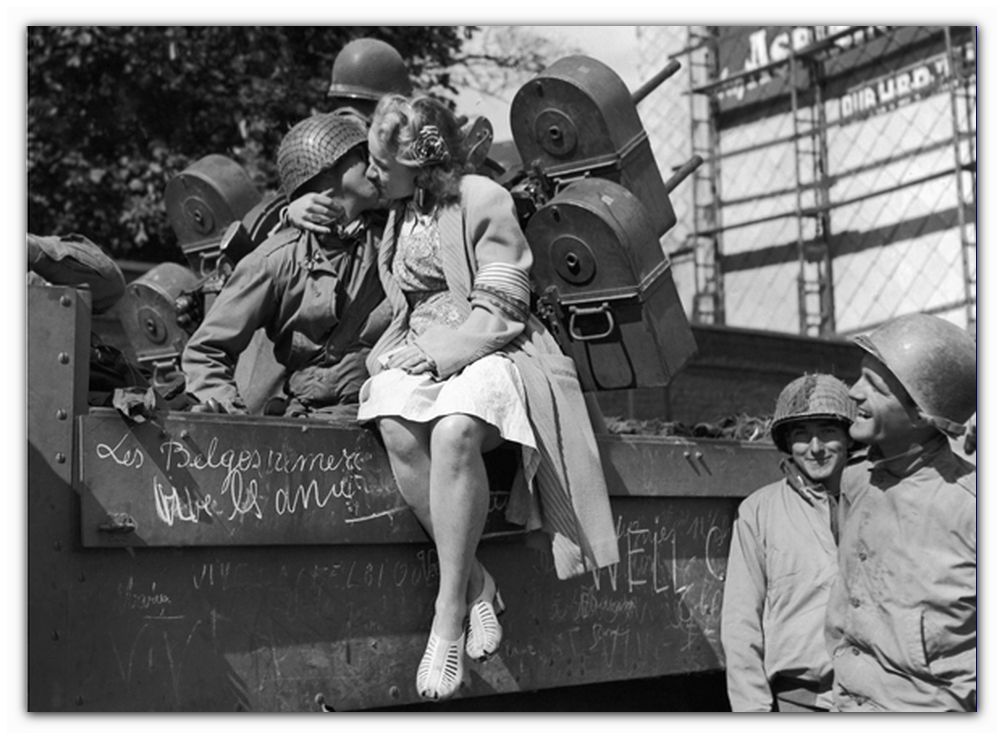
Soviet soldiers meet a German woman on a street in Leipzig in the summer of 1945. Photo: public domain
Before reaching the front, the zone of death, soldiers are seized by a fever of lust, Anton Myrer wrote. The condition almost robs them of reason. The American writer, a veteran of the Pacific War whose books are now used as teaching texts in military academies, argued that physiology and the biology of the species come to the fore. The intestines rid themselves of everything that might hinder flight. Instinct dictates: before you die, leave your seed behind. The ability to make rational decisions is diminished; chronic sleep deprivation makes sustained thinking impossible.
And yet soldiers’ reactions are not entirely automatic. Data cited by the Hungarian researcher Andrea Pető concerning Austria demonstrate this. Where a settlement was taken by force, up to 40 percent of local women were subjected to “punitive” rape. Where there was no resistance, the figure fell below 6 percent, and in sparsely populated areas it was lower still.
Euripides already knew that in a great army the arbitrary violence of soldiers can be more dangerous than fire. “He who avoids evil is weak at heart,” he has Hecuba say as she watches the fall of Troy and the suffering of its women. Soldiers lose the ability to distinguish good from evil. The worst situations arise when exhaustion and fear are mixed with alcohol. Myrer remembers “drunken amphibians” going into battle against the Japanese. Gelfand admits frankly that he fears drunken packs of soldiers. Soldiers drink constantly; afterward they shoot, rob, and rape. In the end they die—from alcohol poisoning, accidents, or their own violence.
Alcohol and violence are not problems only at the front; they also appear deep in the rear. In his book Drunken War, Kamil Janicki cites testimony from British women who complained about the brutal behavior of Polish airmen. Women could not pass their bases without risking attack. When one woman killed a man who assaulted her with a shoehorn, officers mourned the dead man. The scale is different, but the mechanism is similar. Every mission is a pilot’s step into the death zone. His life is valued more highly in wartime than a woman’s, and this can create a sense of impunity.
Susan Brownmiller, author of a major study of sexualized violence in culture, argues that during conflict the female body becomes a ceremonial battlefield, an arena for the victor’s parade. She is certainly right, although I would emphasize the role of biology more strongly, especially under the conditions of a prolonged war.
Yet one should not forget the truly exceptional people found in every army, most often among veterans. By all kinds of stratagems they try to limit the scale of violence. Their possibilities are restricted, but they accomplish the seemingly impossible. In defiance of the devil, these people carried human civilization through a barbarous age. Without them, we would have destroyed ourselves long ago.
Gelfand’s diary exudes authenticity in its details, from the description of “voluntary” rape in a time when, to borrow Etgar Keret’s formulation, there was less voluntariness than violence, to the dress given to the girl. Isaac Babel had already been struck by soldiers stealing women’s underwear. It is an old story: underwear is stolen to satisfy secret fetishistic desires, but also as a gift, a way to rationalize an act of violence and avoid calling it rape. In hard times violence becomes taboo along with the vocabulary used to describe it. An illusion of voluntariness appears. It affects both sides.
And yet, despite their apparent authenticity, the episodes described by Gelfand do not correspond to established facts. Near Küstrin and Barlinek, and apparently nowhere else, women’s battalions did not attack Soviet positions. Units of this type did not exist in the German army. What Gelfand records is more likely an expression of soldiers’ fantasies than a literal reflection of reality.
Herodotus wrote that when the Amazons landed on the Black Sea coast, the Scythians did not want to fight them. Instead, they selected bold young men from among their own people to persuade the women to live together with men. The historian had no doubt that the plan would succeed.
Stories like these almost never entered official chronicles. Soldiers rarely boasted about such episodes, just as adolescents do not usually share erotic fantasies outside a circle of peers. Historians, for their part, ignored such testimony as unworthy of attention within “hard” factual history. Only writers and, later, psychologists took an interest in it.
Cervantes, himself a former soldier, described soldiers dreaming of naked maidens bathing. Hemingway, who lived through more than one war, tells of a Marine who did not return from Germany until a year after the war ended. By then no one in America wanted to hear about the horrors of war, and he kept repeating a story he had heard about soldiers finding German women chained to machine guns in the Argonne Forest.
People do not go to war joyfully. When soldiers in barracks realize how close the front is, they become especially conscious of the absence of women. At first they dream of one last leave.
“I’ll grab a few girls,” one of Myrer’s characters fantasizes, “pack them into a room no bigger than a telephone booth and say: there isn’t much time. Panties off, legs up—one after another.” Then the fantasies turn to enemy women, who throughout history have been regarded as valuable spoils of war.
Young men sent to fight revolutionary countries tremble at the thought of sexually liberated proletarian women. Liberation is exciting—until it reaches their own home.
Italian soldiers setting out for Africa dream of Ethiopian women. Skin color excites the imagination. In a story by Toni Morrison, an American soldier catches a Korean girl stealing oranges from a refuse container. Terrified, she smiles and offers “yum-yum,” evidently hoping to make a bargain. Children learn fastest in war. The soldier experiences a moment of arousal, then feels ashamed—and kills her.
Military customs, and still more deeply human mentalities, change only with great difficulty. Today some hopes are placed in the increasing presence of women in armies. In the Red Army they were everywhere. Svetlana Alexievich’s reports in The Unwomanly Face of War could hardly have appeared in any other culture. Yet the title itself can mislead. Women certainly preserve a distinctive memory of war—vivid and attentive to detail—but in war they can behave much like men. They want revenge. They kill. Some even rejoice at the rape of enemy women. Certain memoirs, and not only men’s memoirs, suggest that women may also engage in looting and cruelty. Perhaps this impression results partly from the collision between the cultural stereotype of the “gentle woman” and the reality of war.
Women are unlikely to dream of enemy male battalions. They already have difficulty fending off endless male harassment within their own army. Sometimes they cannot leave a tent even to relieve themselves. History also knows contrary examples. At Abu Ghraib prison in Iraq, American female servicemembers humiliated bound Muslim prisoners, inflicted pain on them, and attached wires to their genitals. The abuse had an obvious erotic undertone.
Women at war dream above all of love. When speaking about it they are more likely to censor themselves, but there is no reason not to believe them. In this respect they are no different from men, who discuss the same longing much more openly.
“Everything is futile. I dream of love. Even with a German woman, as long as she is intelligent, beautiful, clean—and, above all, devotedly loves me,” Vladimir Gelfand dreams in Berlin one month after the end of the war. At the same time he despises Soviet women soldiers, calling them “depraved and vulgar creatures.” In this he differs little from Babel, who wrote about the women of the Red Cavalry: “All are whores, but comrades.”
Soldiers are selective. Rape does not damage their reputation in women’s eyes. They display their medals and court the women they desire. Women, by contrast, often have to conceal their participation in the war. In the postwar shortage of men, it becomes especially difficult for them to turn into peaceful reality the dreams that were born in the hell of war.
Professor Jan M. Piskorski, historian and professor at the University of Szczecin.
The original text appeared in the weekly Ale Historia, a supplement to Gazeta Wyborcza.
Translation into Russian by Stanislav Kuvaldin.
© 2008–2020 Snob Media LLC