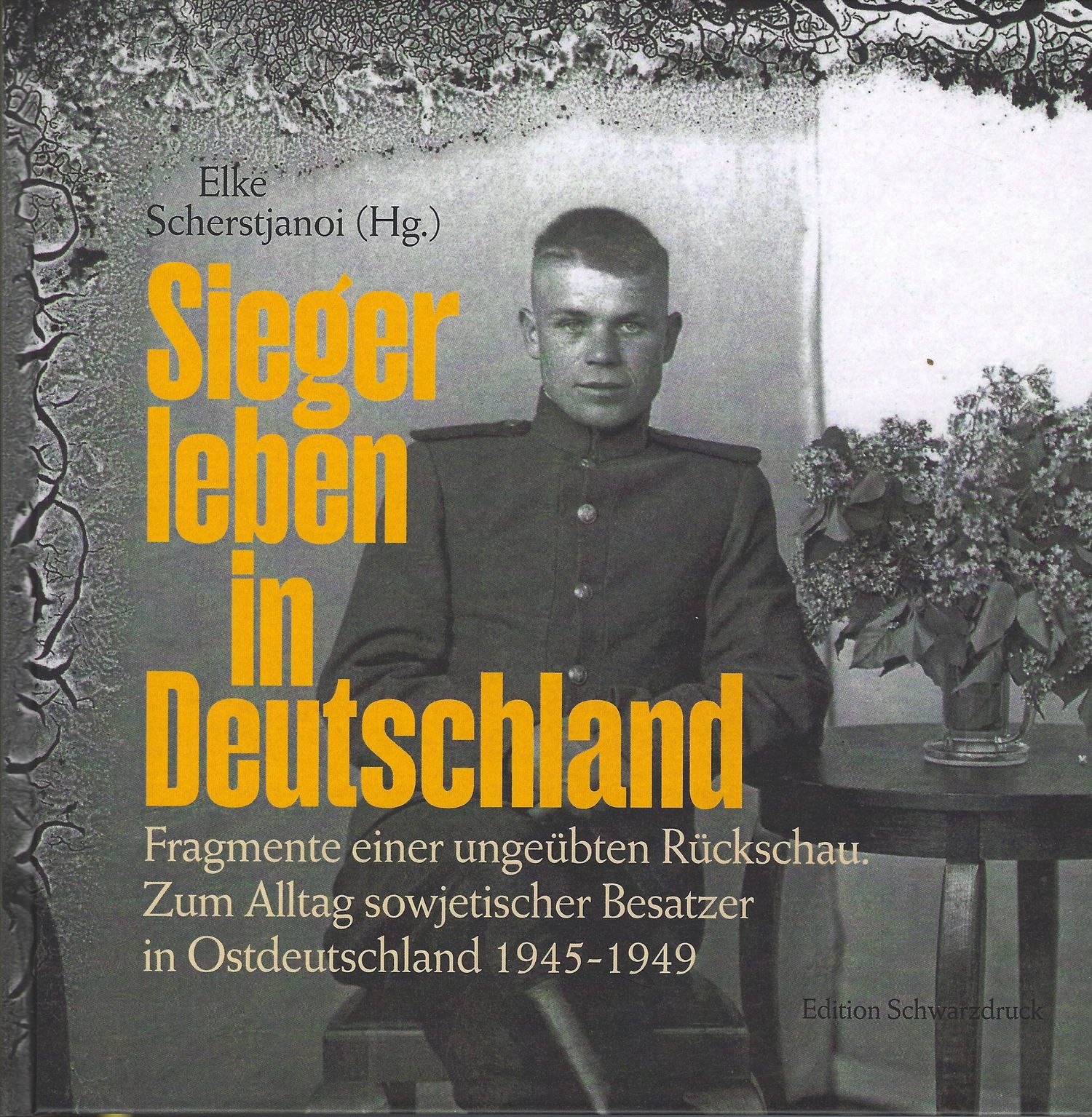
Elke Scherstjanoi — Victors Live in
Germany: Fragments of a Tentative Look Back. On the Everyday
Life of Soviet Occupiers in East Germany, 1945–1949
Much is reported, and quite a lot is propagated,
about how relations between the Soviet occupiers and the defeated
and/or liberated Germans in the Soviet occupation zone developed in the
immediate postwar period. Yet the further these events recede into the
past, the less we actually know about them. The “big
politics” can still be traced reasonably well, but everyday life
has so far received comparatively little attention. And as contemporary
witnesses become ever rarer, the way is open for the creation of
legends.
Historian Elke Scherstjanoi has taken up this
subject. This volume presents a whole series of accounts by Soviet
occupiers in very different functions, each describing individual
experiences and encounters with Germans in East Germany. These
testimonies are supplemented by a rich collection of historical
photographs, many of them previously unpublished — at least in
Germany — taken by Soviet and German photographers. They too
reveal much about the “ordinary” everyday life of the time.
It is an unusual view, from an unfamiliar perspective, of human
encounters seventy-five years ago that ultimately helped create peace.
Elke Scherstjanoi
Privatdozent Dr. Elke Scherstjanoi is a historian
of contemporary history. From 1975 to 1980 she studied history at the
university in Krasnodar in the USSR. From 1980 to 1991 she was a
research associate at the Central Institute of History of the Academy
of Sciences of the GDR, where she received her doctorate in 1987. She
completed her habilitation at Chemnitz University of Technology in
2010. Since 1994 she has worked at the Institute of Contemporary
History Munich–Berlin; since 1992 she has taught in Berlin and
Chemnitz and at Russian universities in Voronezh and Arkhangelsk. Her
research focuses on the political history of the Soviet Occupation Zone
and the GDR, German-Soviet state relations since 1945 and German-Soviet
postwar encounters, the history of Soviet military field post, German
prisoners of war in the USSR, commemoration policy, and oral history.
Her current research concerns the everyday life of Soviet occupiers in
the Soviet Occupation Zone from 1945 to 1949.
Book Information
ISBN-10: 3966110059
Hardcover: 236 pages
ISBN-13: 978-3966110051
Publisher: Edition Schwarzdruck; first edition (September 2, 2020)
Editor: Elke Scherstjanoi
Language: German
Format: with ribbon bookmark
Publisher: Edition Schwarzdruck
Weight: 665 g
Illustrations: partly in color
Price: €27.00
Review by Lothar Zieske in “Junge Welt”
Elke Scherstjanoi grew up in the GDR, studied in
the Soviet Union and began her academic career in 1988 with a doctoral
dissertation at the Academy of Sciences of the GDR. In a path highly
unusual for historians with a professional background in East Germany,
she was able to join the Institute of Contemporary History in Munich in
1994 and completed her habilitation at Chemnitz University of
Technology in 2010. Her work has consistently dealt with German-Soviet
history — and from both perspectives, for example German
prisoners of war and the Soviet administration in the Soviet Occupation
Zone/GDR. Her latest publication belongs to the same field.
The title can provoke very different reactions.
Germans who regard the end of the war in 1945 as defeat rather than
liberation will probably see it as a provocation. Their view is
difficult to correct, especially because in the past seventy-five years
a number of clichés about the Red Army have become entrenched in
public opinion, above all in West Germany. But for those who want to
know how Soviet soldiers and administrative personnel actually lived in
the Soviet Occupation Zone, the book offers vivid material. Between
2002 and 2009 Scherstjanoi herself interviewed people born between 1919
and 1940, with one exception. The interviews are opened up by a careful
and fact-rich introduction. The explanatory and corrective
“marginal comments” — literally printed in the
margins — are also very helpful. The many carefully documented
photographs, some made in German studios and others as private
snapshots, provide additional illustration.
Some of the accounts are strongly shaped by
professional experience — for example those of a military
prosecutor and a historian — although the editor stresses that
the interviewees were not selected according to a criterion of
“everyday life.” Naturally, the two people who had lived in
the Soviet Occupation Zone as children with their parents were best
able to meet that expectation. It is striking how vivid their memories
remained after at least fifty-five years. The views they express differ
so greatly that, in my opinion, this is one of the book’s
strengths: they cannot be reduced to a single common denominator.
To mention only a few examples: I was surprised by
how often behaviors and characteristics associated with “the
Germans” — qualities that can also be viewed as rather
problematic “secondary virtues,” such as orderliness,
organizational ability and cleanliness — are highlighted
positively. Cultural differences from the Soviet Union are also
frequently mentioned, differences that in Germany are often emphasized
with disparaging intent. The gain in understanding, however, is not
confined to a positivist factual level and seems considerable to me.
Above all, the book conveys what the German war of aggression against
the USSR did to the families of the interviewees and to the
interviewees themselves; the accounts of soldiers and nurses complement
one another impressively.
Equally important is the opportunity to understand
through concrete examples what the postwar campaign against
“cosmopolitanism” meant for people repatriated to the
Soviet Union: discrimination in their own country against former Soviet
prisoners of war after the war, and, connected with that, antisemitism.
The book speaks openly about the sense and nonsense of dismantling
industrial equipment; it repeatedly addresses the connection between
violence against the civilian population — not only, but
especially, against women — and the experience of war. The discussion of crime in the rear areas behind the front was new to me.
All of this speaks in favor of the book. Its
greatest problem, in my view, is that it has appeared so late —
not because memories may have shifted, but because so much time has
been lost. As the introduction to the second interview notes, there was
a decades-long dispute in the Federal Republic over the term
“liberation.” But that is still saying far too little.
Clichés had arisen that were based on facts, but were then
enriched and distorted by interested parties in order to minimize
German guilt. The result is that anyone who contradicts these
clichés — not across the board, but merely by qualifying
them — is immediately regarded by many as someone who trivializes
rape. The interviewees do not avoid this issue either. Nowhere do they
deny that such violence occurred; the most extreme formulation is,
“Where I was in charge, it did not happen.”
And yet, given the existing clichés, the
editor’s exemplary attempt to question certain “icons of
abhorrence” can seem doomed to fail from the outset, especially
at a time when the negative icon of “Putin” dominates the
prevailing image of Russia. Nevertheless, Elke Scherstjanoi’s
attempt to correct clichés — not least by also allowing
apparent confirmations of them to be voiced — seems worthwhile to
me. The alternative would be to accept the clichés without
question.
Dr. habil. Elke Scherstjanoi
© Edition Schwarzdruck
Book-cover text: “Victors Live in
Germany. Fragments of a Tentative Look Back. On the Everyday
Life of Soviet Occupiers in East Germany, 1945–1949. Elke
Scherstjanoi.”
Image-source page heading: “Image
Sources.” The page lists, with the corresponding picture numbers,
AKG-images; the Archive of the Academy of Arts, Konrad Wolf collection;
the Hanseatic City of Wismar archive; bpk Picture Agency; Brandenburg
State Main Archive Potsdam; Federal Archive/SAPMO; Deutsche
Fotothek/SLUB Dresden; Ravensbrück Memorial; Berlin State Archive;
Saxony-Anhalt State Archive; Thuringia State Archive, Weimar Main State
Archive; Museum of Everyday Culture of the Griesen Region and Old
Synagogue Hagenow; Russian State Archive for Film and Photo Documents,
Krasnogorsk; Saxon State Archive, Chemnitz State Archive; municipal and
district archives in Schmalkalden, Bitterfeld-Wolfen, Erfurt, Freiberg,
Jena, Weimar and Zwickau; Leipzig City History Museum; Hildburghausen
City Museum; Riesa City Museum; and private/family collections
including Friedland, Gelfand, Geruljajtis, Hauck, Jünke,
Kostjukowitsch, Retzlaff, Schapiro, Schwerdtfeger, Seliverstowa, Jan
Bejšovec, Christian Hermann, and Vitali Guhbin.
Acknowledgments page: “Acknowledgments.
With deep gratitude I remember my meetings with the contemporary
witnesses, the authors of the stories presented here. They gave me a
great deal personally. Most of the witnesses are no longer alive. Some
meetings were arranged and accompanied by relatives and friends. May
this book provide them with many new impulses. I thank the numerous
private collectors of photographs who entrusted their treasures to me
— with and without a personal connection — because they
supported the basic idea of this book. With particular warmth I greet
the Gelfand and Friedland families, the family of photographer
Jünke, military historian Christian Hermann and, representing all
the helpful hobby collectors and family chroniclers, Jan
Bejšovec and Natalja Lipelis. I thank the municipal, district
and state archives for information, practical help and, in some cases,
very generous assistance. The Russian State Archive for Film and Photo
Documents in Krasnogorsk handled my request quickly and without
complications, making it possible to meet all printing deadlines; that
deserves special thanks. Research for this book, the translations and
the acquisition of rights were financed by the Institute of
Contemporary History Munich–Berlin. The Rosa Luxemburg Foundation
supported the printing.” — Elke Scherstjanoi.
Editor page: “The Editor. Dr. habil.
Elke Scherstjanoi, born in 1956, is a contemporary historian. She spent
her childhood in the Ore Mountains and studied history in the Soviet
Union. From 1980 to 1991 she worked at the Central Institute of History
of the Academy of Sciences of the GDR and received her doctorate in
1986. Since 1994 she has been a research associate at the Institute of
Contemporary History Munich–Berlin. She completed her
habilitation at Chemnitz University of Technology in 2010; teaching
assignments have taken her to various universities in Germany and
Russia. Alternating between political history and the reconstruction of
everyday history, her research on the Soviet Occupation Zone and the
early GDR explores Soviet influence on East Germany and the scope of
intercultural encounters between Germans and ‘Russians’
under state socialism.”
Imprint page: “Imprint: Edition
Schwarzdruck, Gransee. © for this edition by Edition Schwarzdruck.
First edition 2020. Reprinting or reproduction — in any medium
— only with written permission from the publisher or the editor.
Cover using an image from the Museum of Everyday Culture of the Griesen
Region and Old Synagogue Hagenow, Elise Hartmann collection. Design,
typesetting (from Weiss-Antiqua) and image editing: Marc Berger,
Gransee. Printing and binding: Schaltungsdienst Lange, Berlin. ISBN
978-3-96611-005-1.”
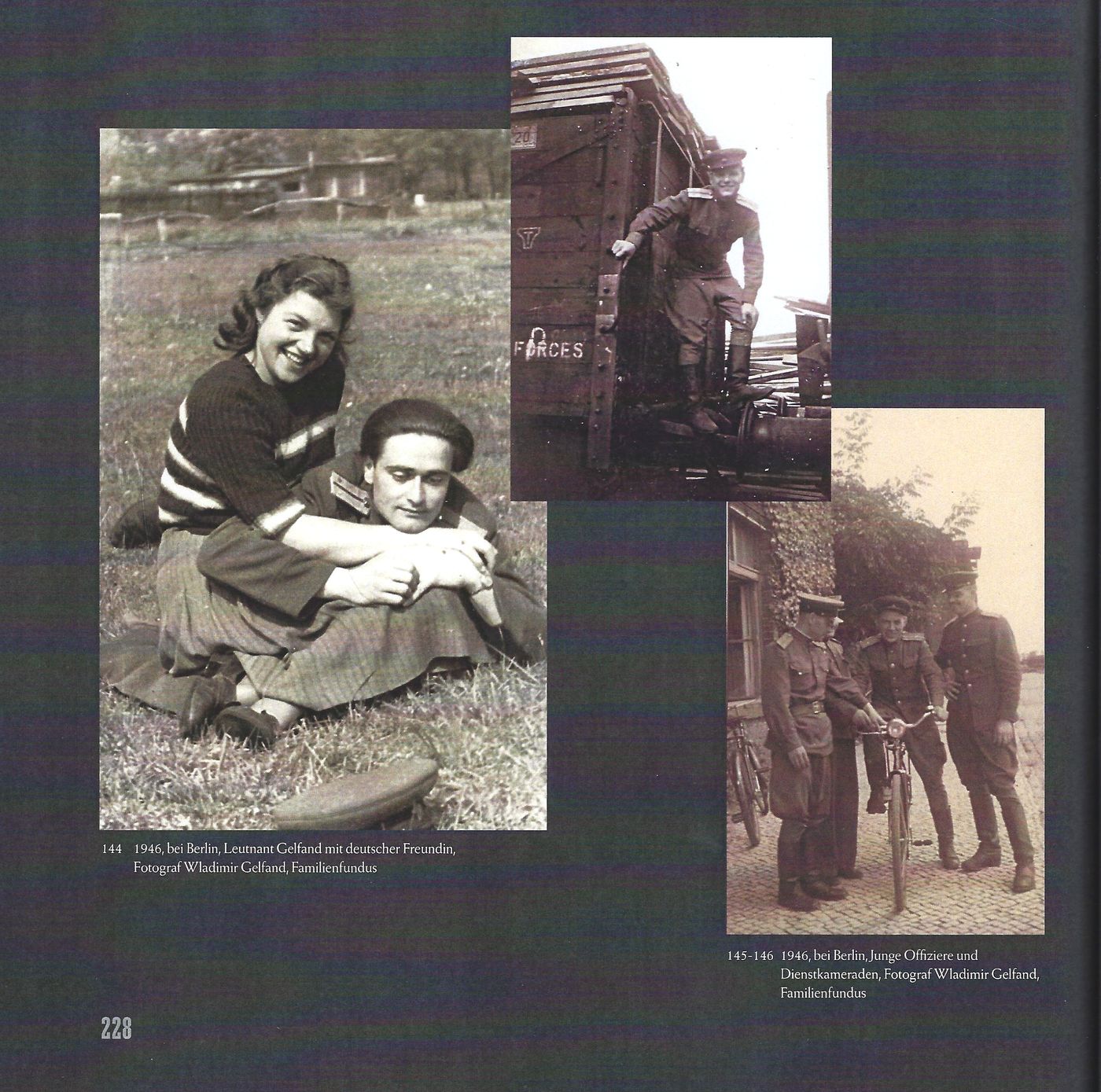
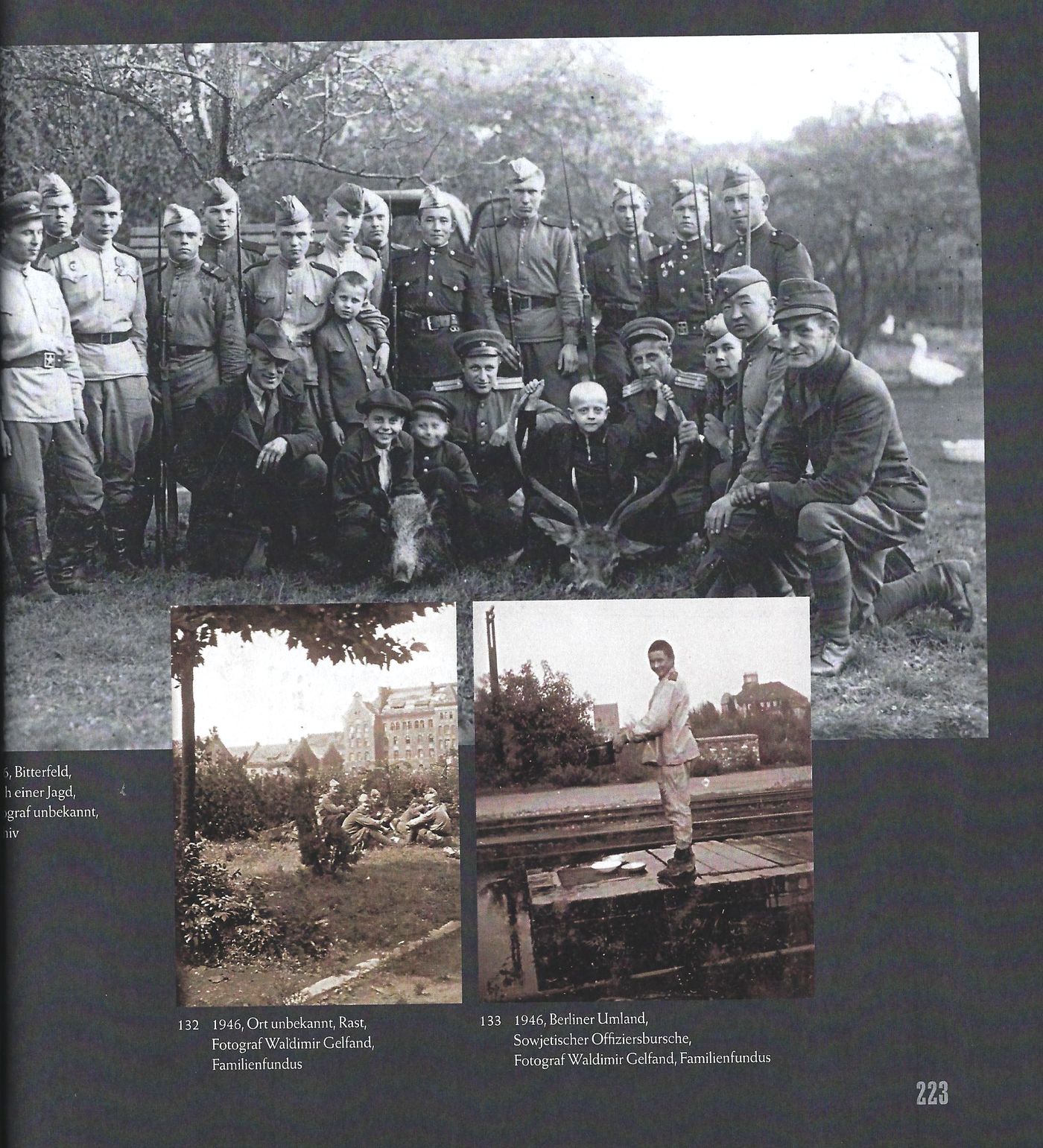
Photo captions from the book: “1946,
near Berlin, Lieutenant Gelfand with a German girlfriend, photographer
Vladimir Gelfand, family collection.” “1946, near Berlin,
young officers and comrades, photographer Vladimir Gelfand, family
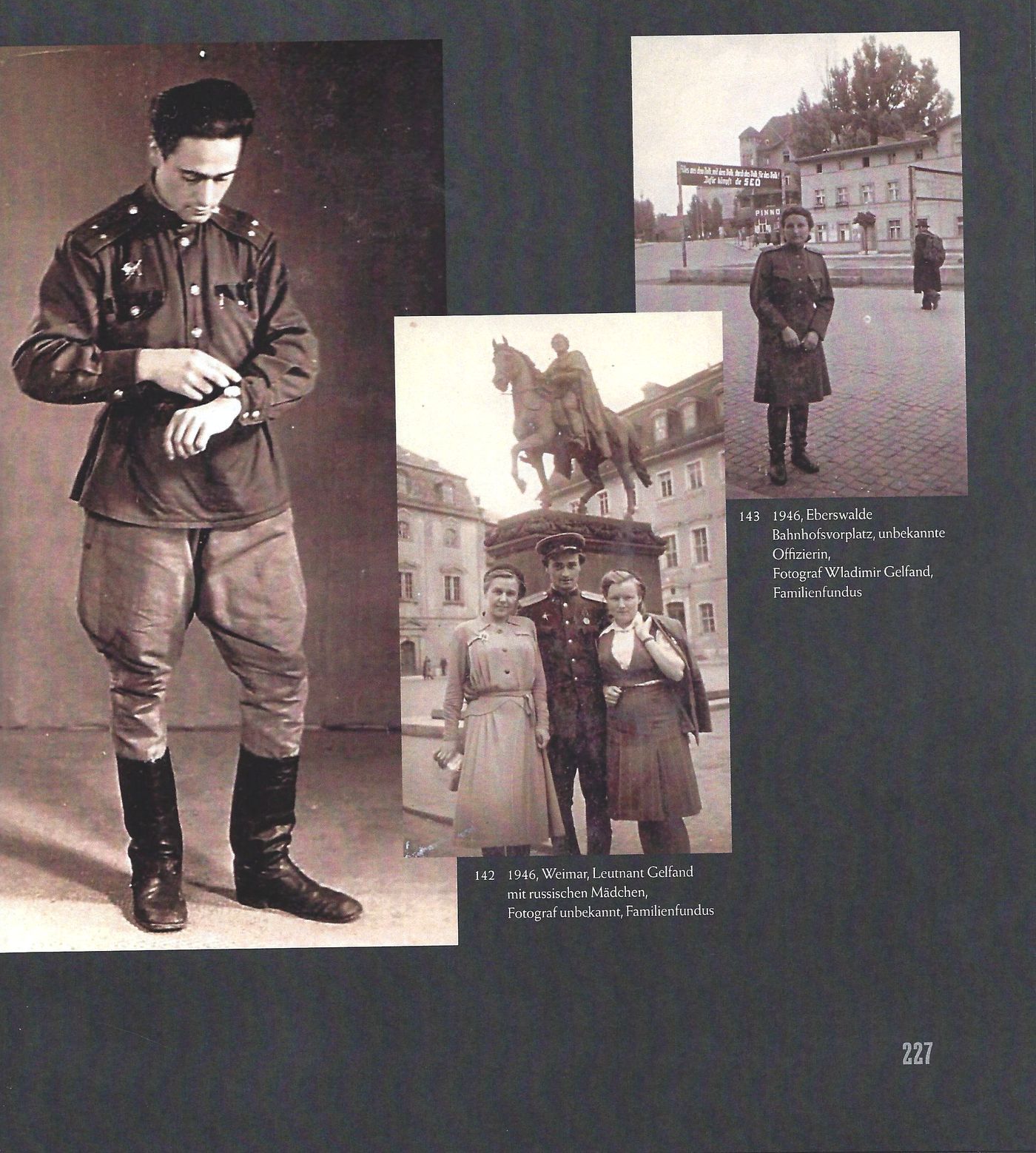
collection.” “1946, Weimar, Lieutenant Gelfand with Russian
girls, photographer unknown, family collection.” “1946,
Eberswalde, station forecourt, unknown female officer, photographer
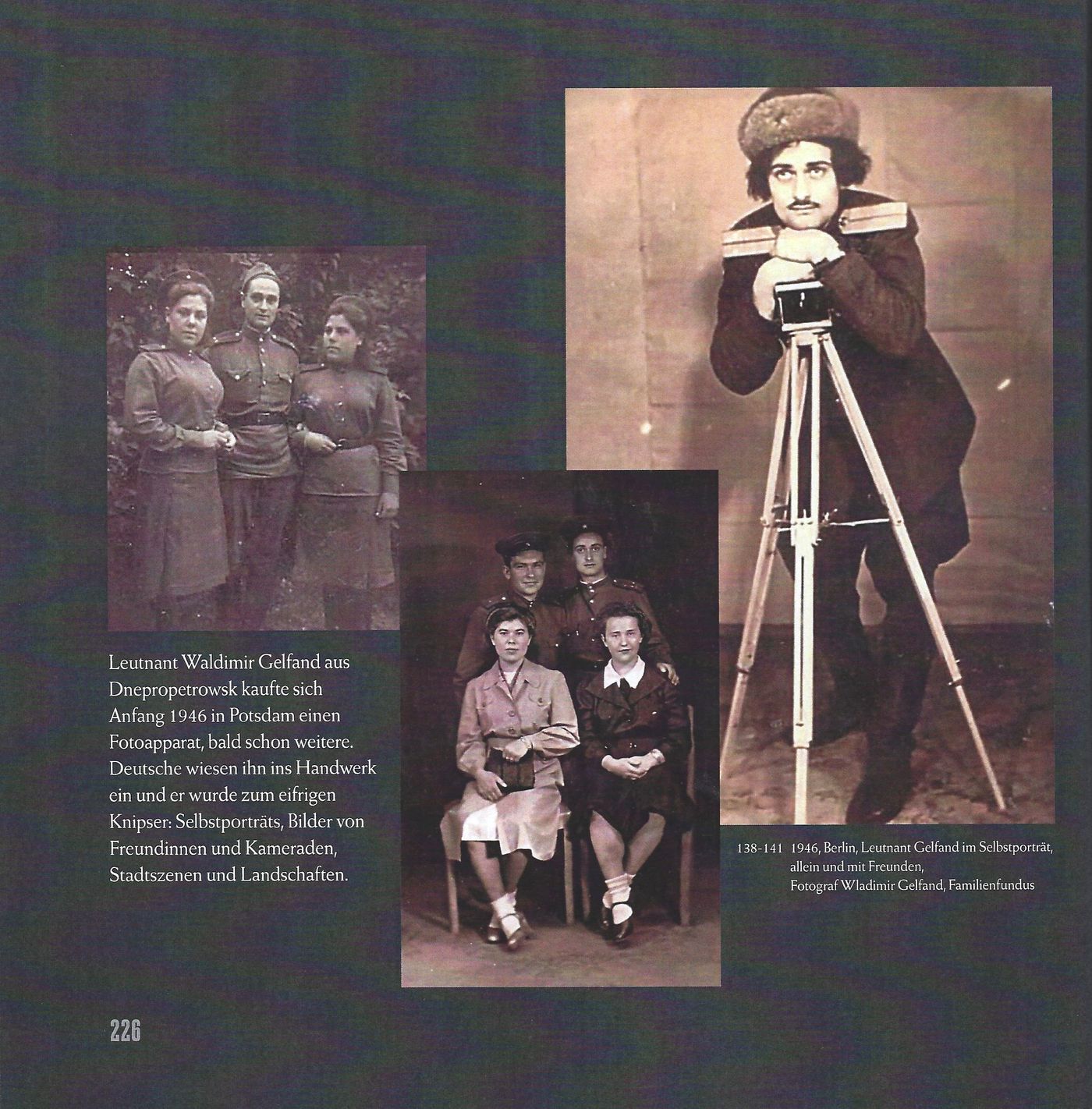
Vladimir Gelfand, family collection.” “Lieutenant Vladimir
Gelfand from Dnepropetrovsk bought a camera in Potsdam at the beginning
of 1946 and soon bought more. Germans taught him the craft and he
became an enthusiastic amateur photographer: self-portraits, pictures
of girlfriends and comrades, city scenes and landscapes.”
“1946, Berlin, Lieutenant Gelfand in self-portraits, alone and
with friends, photographer Vladimir Gelfand, family collection.”
“1946, unknown location, rest stop, photographer Vladimir
Gelfand, family collection.” “1946, Berlin area, Soviet
officer’s orderly, photographer Vladimir Gelfand, family
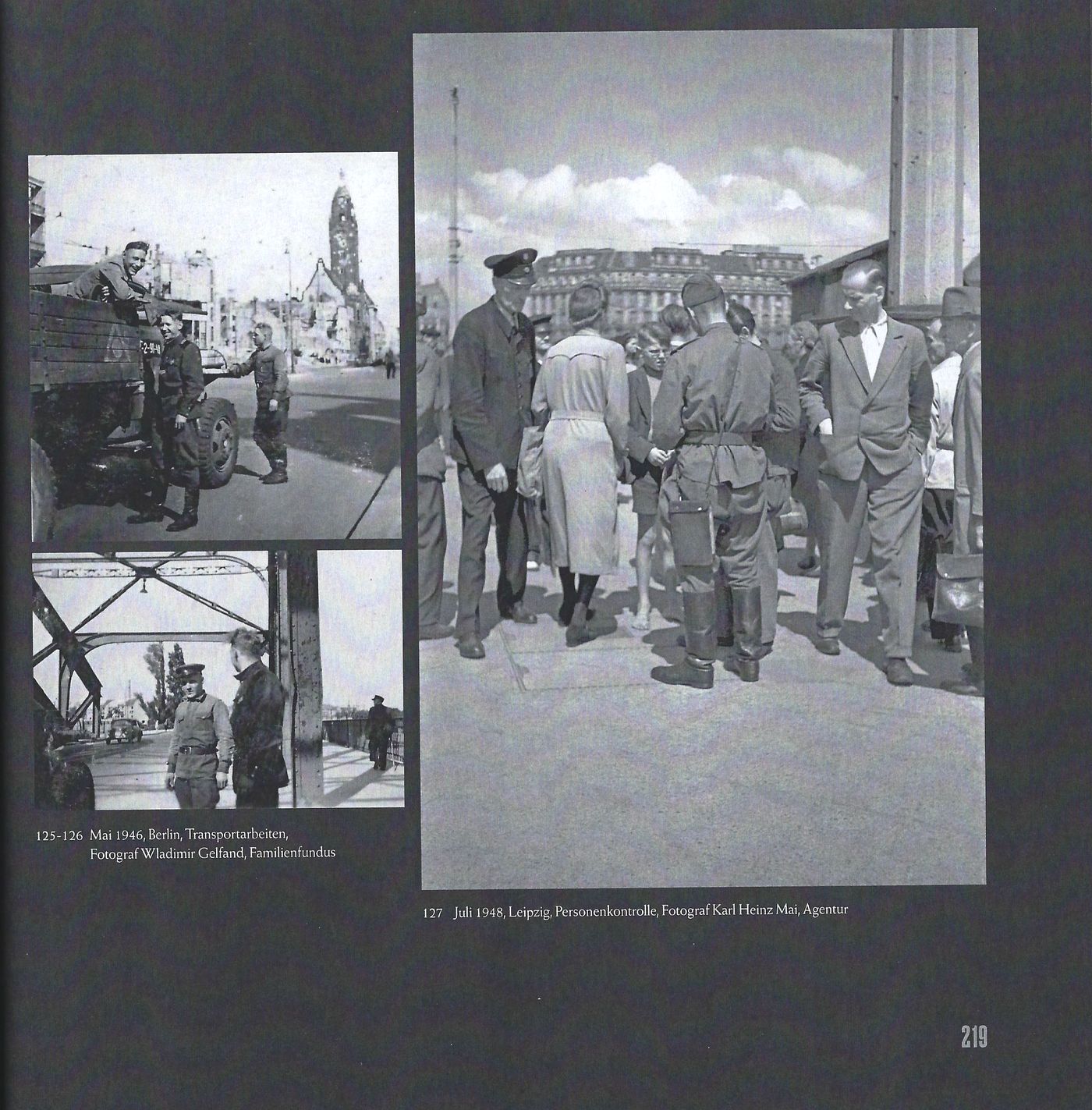
collection.” “May 1946, Berlin, transport work,
photographer Vladimir Gelfand, family collection.” “July
1948, Leipzig, identity check, photographer Karl Heinz Mai,
agency.”





 German
