


|
|
|
 |
Über die
Autoren: Magda Abraham-Diefenbach, geboren 1979, studierte in Torún Philosophie, Soziologie und Deutsch. Sie stammt aus der Kaschubei, lebt seit 2005 an der Oder und entdeckte die Region dies und jenseits des Flusses für sich als neue Heimat. Juliane Tomann, Jahrgang 1981, studierte Kulturwissenschaften in Frankfurt/Oder. Inzwischen wohnt sie in Berlin und arbeitet in einem Programm der Stiftung "Erinnerung, Verantwortung und Zukunft". Bernd Vogenbeck, Jahrgang 1979, studierte Kulturwissenschaften an der Europa Universität Viadrina. Als Gründungsmitglied des Instituts für angewandte Geschichte hat er in den vergangenen Jahren unterschiedliche Projekte zur Geschichte im deutsch-polnischen Grenzland durchgeführt. |
 |
KurzbeschreibungWo liegt die Neumark? Was ist dieZiemia Lubuska? Der Almanach Terra Transoderana betritt Neuland: junge Historiker aus Deutschland und Polen berichten kenntnisreich, unvoreingenommen und aus eigener Anschauung über Geschichte und Gegenwart der westlichsten polnischen Woiwodschaft, die im öffentlichen Bewusstsein kaum bekannt ist. Zwischen Brandenburg, Pommern, Großpolen und Schlesien wartet eine facettenreiche Kulturlandschaft auf ihre Entdeckung! Der Band ist der erste in der Reihe »Almanach. Europäische Grenzregionen neu entdecken«, die vom Institut für angewandte Geschichte e.V. an der Europa-Universität Viadrina in Frankfurt an der Oder herausgegeben und durch Felix Ackermann, Jan Musekamp und Bernd Vogenbeck betreut wird. |
|
PressestimmenUnd der Reiz dieses Buchesnun liegt auch darin, die Widersprüchlichkeit aufzuzeigen und nach Wegen zu suchen, um zwei zumeist getrennt bestehenden Perspektiven zu verstehen und vielleicht miteinander zu verbinden. (Kulturradio) |
 |
|
|
Terra Transoderana |
(Kulturradio) |
Magda Abraham-Diefenbach Juliane Tomann Bernd Vogenbeck |
 German
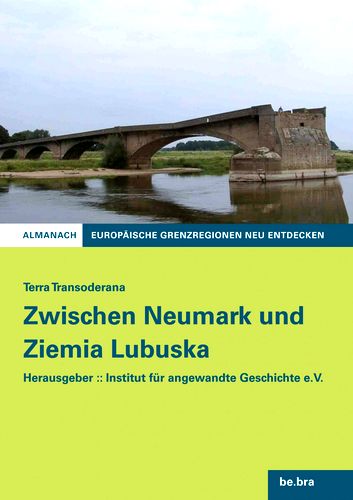
“Terra Transoderana: Between the Neumark and Ziemia Lubuska”
About the authors
Magda Abraham-Diefenbach, born in 1979, studied philosophy, sociology and German in Toruń. She comes from Kashubia, has lived on the Oder since 2005, and discovered the region on both sides of the river as a new home.
Juliane Tomann, born in 1981, studied cultural studies in Frankfurt (Oder). She later moved to Berlin and worked in a program of the Foundation “Remembrance, Responsibility and Future.”
Bernd Vogenbeck, born in 1979, studied cultural studies at the European University Viadrina. As a founding member of the Institute of Applied History, he has carried out a variety of projects on the history of the German-Polish border region.
Brief description
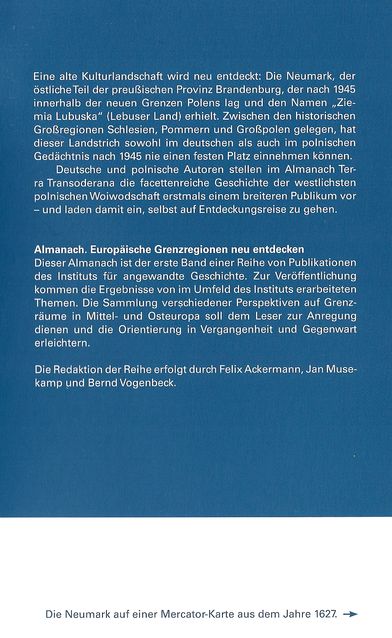
Where is the Neumark? What is Ziemia Lubuska? The Terra Transoderana almanac enters relatively unexplored territory. Young historians from Germany and Poland report knowledgeably, without prejudice and from personal experience on the history and present of Poland’s westernmost voivodeship, a region still little known in the broader public consciousness. Between Brandenburg, Pomerania, Greater Poland and Silesia lies a richly varied cultural landscape waiting to be discovered.
The volume is the first in the series “Almanac: Rediscovering European Border Regions,” published by the Institute of Applied History at the European University Viadrina in Frankfurt (Oder) and edited by Felix Ackermann, Jan Musekamp and Bernd Vogenbeck.
Press
“The attraction of this book also lies in showing contradictions and searching for ways to understand two perspectives that usually exist separately — and perhaps to connect them.” Kulturradio
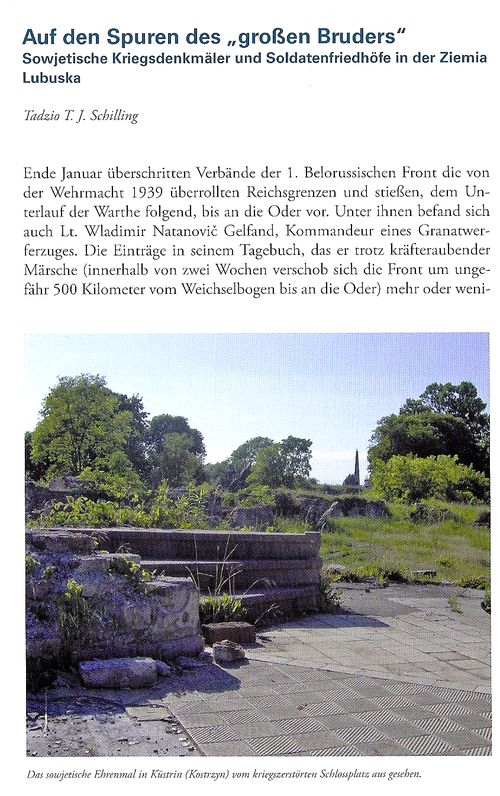
In the Footsteps of the “Big Brother”
Soviet military monuments and soldiers’ cemeteries in Ziemia Lubuska
Tadzio T. J. Schilling
At the end of January, formations of the 1st Belorussian Front crossed the borders of the territories seized by the Wehrmacht in 1939 and pressed westward. Among the participants was Lieutenant Vladimir Natanovich Gelfand, commander of a mortar platoon. The diary he kept regularly despite exhausting marches is full of pride and anticipation of victory. But it also records incompetence, dishonesty and narrow-mindedness, sometimes extending into the officer corps. Brutality toward Soviet soldiers themselves and the horrors inflicted on the German population also found their way into his notes.
Such private memories did not fit easily into the mythologized image of the Great Patriotic War represented by many official monuments and memorial plaques. The essay therefore considers not only heroic narratives but also quiet, alternative memories that were not always reflected in official commemoration.
© be.bra wissenschaft verlag

