



Istvan Santha Published 2016 |
|
 |
||
 |
||
 |
||
 |
||
 |
||
 |
||
 |
||
 |
||
 |
||
 |
||
 |
||
 |
||
 |
||
 |
||
 |
||
 |
||
 |
||
 |
||
 |
||
 |
||
 |
||
 |
||
 |
||
 |
||
 |
||
 |
||
 |
||
 |
||
 |
||
 |
||
 |
||
 |
||
 |
||
 |
||
 |
||
 |
||
| |
||
 |
||
| |
© Istvan
Santha
© Elhallgatva
 Hungarian
The primary aim of my study is to bring the Russian discourse on the problem of mass sexual violence committed by the Red Army, including against minors, into the discussion. This is preliminary work within social anthropology in Hungary, where research into rural history is now beginning.
Second, I examine the possibility of applying different methodological approaches to the materials collected during my own research. How were the personalities of Red Army soldiers formed? How, and after what events, did they arrive in Hungary? What state ideology guided them? What were their personal motives? What experience had they acquired during the war? Questions such as these prompted me to begin the investigation using specific concepts and a preliminary analysis of methodological possibilities.¹
After the introduction I describe the types of sources and their specific characteristics, then turn to the relevance of the subject. The international context is then considered together with methodological proposals. I analyze the principal factual material under three themes. After discussing the role of state ideologies, I move to the question of personal motivation and then, by clarifying two key terms, interpret the interests that stand behind applied approaches to the sources. The synthesis summarizes the preliminary experience of research in Hungary and describes the point at which Russian and Hungarian sources meet, which I hope creates an opportunity to interpret the traumatic events that occurred in Hungary.
In the reflections below I would like to highlight several aspects that played a key role in shaping my anthropological approach to the subject. I first encountered the topic of memory of the front on the internet, and it continues to be actively present in the lives of people in rural regions. During the socialist period it remained unnoticed because representatives of the Hungarian political system carefully ensured that the political situation with the Soviet occupiers would not be aggravated. Recently, however, there seems to have been a noticeable shift of emphasis.
I express my sincere gratitude to János Bednárik, Krisztián Gergely Horváth and József Ö. Kovács for their valuable comments on the study. In the present political atmosphere an opportunity is emerging to conduct a discourse about the front. At the same time, sexual violence remains taboo: people still do not speak about it openly, either on their own initiative or in the presence of others.
¹ I hereby express my gratitude to János Bednárik, Krisztián Gergely Horváth and József Kovács for their valuable remarks on the study.
It should also be noted that memory of the front, and the subtopic of sexual violence, are closely connected to the present. On the one hand, silence surrounding the subject prevented it from becoming part of official history. This does not mean, however, that it is not still alive today, for example in the memories of individual people. On the other hand, all oral-history research has the characteristic that stories about the past are shaped in the present. It is therefore unsurprising that this method can first and foremost provide insight into contemporary society.
Thus one of the main questions of my research is where in history we live today, what the present structure of society is — which social groups can expect understanding and sympathy in the discourse that is now beginning — and only secondarily what the structure of society was in the immediate postwar period.
Ideally, moreover, the social organization of the community being studied should influence the structure of a text that presents that society through the ethics and aesthetics of the community, as well as the way in which the researcher organizes material when explaining the subject. Today socialism seems to have entirely receded into the past. People nevertheless prefer to remain silent about it. We should not lose sight of the fact that some may consider silence, and refusal to yield to circumstances, the best way to defend their right to freedom — in contrast to socialist times, when they had to answer questions.
This work should be understood as a search for a path and a place from which the material collected during preliminary research can be interpreted. The broader context is provided by my research project aimed at describing the social life of the region’s inhabitants and forms of social organization. The subject of this study can be interpreted within this larger project, which continues to play an important role in local life not as part of official history but as living and largely unprocessed individual experience.
I first read Alaine Polcz’s book in the 1990s as an individual psychological experiment concerned with the trauma caused by rape. In January 2015, at the beginning of preliminary fieldwork, I realized that the events described unfolded in Dél-Vértes. The front is a collective fate: every woman has her own story of her ordeal at the front and of how she tried to escape violence. This reading is also supported by the example of Alaine Polcz when her book is read in its local context.
The subject has become steadily more popular: every year more studies are published, while the same or similar subtopics and categories recur in the reports. Drawing on different Hungarian and foreign sources, authors reach conclusions that correspond to international and domestic trends, following similar lines of reasoning according to their political and methodological positions. In this respect the present study is no exception.²
In this situation it becomes important to identify who introduced each subject, subtopic and category into Hungarian public discourse. I will continually draw the reader’s attention to this in the course of the study.
The pioneering and systematic research of Andrea Pető and the works describing it should be mentioned here. Like many others in Hungary, I began familiarizing myself with the subject on the basis of her recommendations and research.³ I am aware that my dominant social position as a man cannot be wholly adequate for a study based on women’s statements. I had no illusions about this and did not try to change it in the course of the research. I also knew that women have the right to remain silent when questioned by a man, thereby sustaining a culture of silence. At the same time, this research configuration can itself be worked with as a kind of phobia that must be overcome.
It is important to note that, living with my family in the region during the research, I participated in the everyday life of local residents, shared their fate and accepted personal risks connected with my activity and behavior. Perhaps it was not accidental that it was no secret locally that my wife is of Russian origin and has German, Polish and Jewish roots; this did not strengthen my dominant position in the community either. I also regard it as important that in previous research I had gained experience with egalitarian organizational strategies while living among Evenki hunter-gatherers in Eastern Siberia, and that experience became integrated into my personality and influenced my worldview.⁴
A) Vladimir Gelfand’s diary⁵ covers the entire period of the Second World War. It therefore gives us an opportunity to gain insight into the personality⁶ of the “Russian” soldiers who fought in the Red Army throughout the war.
² Even if my more distant objective is not illustration.
The emotional history of the occupation of Eastern and Central Europe has as its context defense against foreign attacks, a process that began even before Stalingrad.⁷
B) The principal value of A Woman in Berlin⁸ lies in the fact that it is an anonymous text. West German society of the 1950s allowed it to be published, but the author did not wish to reveal her identity because of the pressure of German society at the time. She therefore did not have to fear the book’s effect on her private life.
In both cases the ability to write plays a key role, in contrast with Svetlana Alexievich’s approach,⁹ in which subjects tell rather than write down their stories. In the latter case there are more dilemmas and uncertainties over whether something should be said and how fortunate one might be in saying it. Although A Woman in Berlin was published anonymously, Gelfand’s diary was discovered only after his death and, although it was not anonymous, for a long time it could not be published as a book in Russia.
In both cases the diaries are regarded as authentic personal sources whose context is the Second World War and the time at which the diary was written; in the case of A Woman in Berlin there is only the possibility of later authorial editing. The possibility of editing also exists in Gelfand’s case, because it is known that his son took care of his father’s intellectual legacy, omitted some parts and reworked others before publication. Despite these reservations, the two diaries can be compared.
Edited Interviews (Oral History)
Alexievich publishes her interviews divided into chapters, each preceded by a philosophical essay. Each interview is based on several hours of audio recordings, although the total number of recordings may reach into the thousands, and the author uses only part of this material to illustrate her approach. Most of the documentation was collected in the second half of the 1970s and was continuously supplemented by additional information. The 2015 edition makes it possible to trace changes in the political atmosphere, while Gelfand, as a Red Army officer of Jewish origin, offers an observer’s perspective on phenomena within the Red Army.
⁷ Gelfand was a Red Army officer of Jewish origin, which makes it possible to view processes within the Red Army from an observer’s standpoint. We must not overlook that not only Russians but representatives of other peoples of the Soviet Union and allied countries fought in the Red Army. The significance of these cultural differences has still not been adequately assessed. For example, the Russian military memorial in Dél-Vértes was erected on the site of a mass grave of Russian soldiers in the castle park. To indicate the scale of the fighting: 114 Russian and 50 German soldiers died during three months of fighting in the area. Thirteen memorial plaques on the concrete base of the monument contain the names and details of nineteen identified dead. The spelling and personal names indicate that many of those buried were not ethnically Russian but were of Jewish, Tatar, Caucasian and Persian (Tajik) origin.
We cannot ignore the fact that the Red Army included not only Russians but representatives of other peoples of the Soviet Union and friendly countries. The importance of these cultural differences remains insufficiently appreciated. The Russian military memorial in Dél-Vértes, for example, was built over one of the mass graves of Russian soldiers in the castle garden. To indicate the scale of the fighting, 114 Russian and 50 German soldiers died during three months of battles in the area.
The thirteen memorial plaques mounted on the memorial’s concrete pedestal record the names and details of nineteen identified dead. Their spelling, style and personal names indicate that a substantial number of those buried were of non-Russian origin — Jewish, Tatar, Caucasian and Persian (Tajik). Alexievich did not merge testimony from different years or edit interviews conducted at different periods into a single layer. By coincidence, the 1985 documentation and the later texts — reflections on the circumstances of the original publication — are treated separately and illustrated with excerpts from interviews. This makes it possible for an interested reader to follow political changes and observe how witnesses respond to particular events.
Although Alexievich’s interviews can be regarded as personal confessions, the example of the diaries shows that confessions obtained in this way cannot be separated from the interviewer’s personal interests, and we must constantly keep that influence in mind.
Research Work: Oral History and Participant Observation (Dél-Vértes)
Only a small number of people remain in the village under study who are connected to the period through personal experience. There are also people who, although too young to have participated in the events, absorbed the values, emotional attitudes and accepted forms of communication of the time through personal ties to witnesses. In this case real fieldwork is not simply interviewing, as some sociologists and many anthropologists sometimes assume. An important difference is that the emotional shades used by members of the community are very difficult to recognize and disentangle directly during fieldwork, especially when the researcher was not a participant in the events.
The Second World War and the myth of victory still have major significance and are regarded in Russia as an indisputable fact. On the one hand, the myth of the Second World War can be mobilized in support of contemporary wars. On the other hand, conflicts such as Afghanistan and Chechnya helped preserve this myth.¹⁰ The continuation not only of old wars but also of new ones periodically enters public discussion and sooner or later becomes part of Russian practice.¹⁰ When circumstances demand it, as in Ukraine or Syria, personal experience of the Second World War and other conflicts can be used as a military ideology among the Russian population, embodying an all-Russian myth of war. This is probably why Russia cannot allow the myth to be undermined.¹¹ State leaders, officials and cultural figures carefully monitor this process.
¹⁰ For more detail, see Pető 2015a.
After the presentation, question-and-answer session, autographs and an improvised photo session requested by readers, I also managed to ask a question. When I asked how he regarded research into violence committed by Russian soldiers, he exclaimed: “And what is that compared with what the Hungarians did at Voronezh?”
For more detail see Pető 2015a. Andrea Pető had already spoken about the breaking of the Red Army’s halo (Pető 1999). The issue came to the attention of the Hungarian public in the early 1990s through Alaine Polcz’s novel Asszony a fronton and Sándor Sára’s film A vád (1996). The motif also appears in Pál Závada’s two latest novels,¹² and rape plays a central role in his most recent novel.
In recent years demand for documentaries on the subject has increased. Fruzsina Skrabski’s film Silent Outrage appeared in 2013. Erdélyi’s Everyday Life of War (parts 1–2, 2015) deals with the wartime experiences of residents of Celldömölk. As noted in the introduction, Andrea Pető’s research introduced the subject into scholarly circulation in the 1990s,¹³ and it remains one of the hallmarks of Hungarian social research. Since 1999 she has published several important articles in Hungary and abroad devoted to different aspects of the topic. Her systematic research has helped keep it on the agenda of Hungarian public life. By considering historical and feminist methodological frameworks and applying comparative analysis — for example Budapest and Vienna — she has established a place for studying the subject in Hungary.
Since the early 2000s the Episcopal Archives of Székesfehérvár have published two volumes¹⁴ touching on social aspects of the subject. Two collections of documents published by Tamás Krausz and Éva Mária Varga in 2013 should also be mentioned. The first archival collection bears the title Hungarian Occupation Troops in the Soviet Union, 1941–1947, while the latter is an independent volume, Hungarians in Soviet Captivity, 1941–1956 (2010). The book Legal Occupation, edited by L. Balogh Béni and prepared by the Hungarian National Archives, appeared in 2015 and is devoted to Soviet troops in Hungary in 1944–1947.
Special mention should be made of the work of Krisztián Ungváry, who in two books based on Hungarian and German archival sources examines the behavior of “Russian” soldiers during the siege of Budapest. The author attempts briefly to describe the behavior of the invading Soviet armies.¹⁵ In addition to assessing the responsibility of Hungarian troops for their treatment of populations in occupied territories, he devotes particular attention to the activities of partisans.¹⁶ It is therefore unsurprising that study of this subject is among the aims of the History Research Group organized under the auspices of the Hungarian Academy of Sciences and the Committee of National Remembrance.
¹² One of these is Our Alien Bodily Image, the other Natural Light (both published by Magvető, the first in 2008 and the second in 2014).
The personal diary analyses of Gergely Kunt must also be mentioned.¹⁷ His research forms an important link for understanding international trends. In addition to Russian-language publications that appeared after the beginning of the war in Ukraine, the problem of violence by American soldiers came to the fore in Europe with publication of German diaries.¹⁸ Alongside German sources,¹⁹ Austrian research discussed in Andrea Pető’s work should also be noted.²⁰ On the basis of analysis of relations between Soviet occupation troops and Austrian women, Márta Mészáros made the 2014 documentary The Invisible Generation.²¹ The subject is particularly relevant because our research is in its final phase and is based on scholarly data collected among people who suffered directly or indirectly. Comparable in-depth research has not yet been conducted in Hungary.
The relevance of the topic can also be traced in East Asia.²² There, relations between countries formerly under occupation and Japan remain complicated by the institutionalized system of military brothels that existed during the Second World War. South Korea and the Philippines officially demand moral redress for the forced recruitment of their daughters and women into brothels to satisfy the sexual needs of occupying forces.
As a social anthropologist, my aim in this research is to show how people in different periods and places relate to a particular historical era and its events. I also seek to provide insight into the organization of contemporary society through the prism of the Second World War and to show how residents of the Hungarian village of Dél-Vértes relate to those events today.²³
¹⁷ For example, Gergely Kunt, 2012, “Images of the Stranger and the Enemy among Adolescents during the Second World War in the Context of Socialization,” in Zsuzsanna Bögre, András Keszeg and József Kovács, eds., Boundaries of Identities: Traumas, Taboos, and Stories of Experience since the Beginning of the Second World War, Budapest: L’Harmattan, pp. 275–286.
Second, I believe the approach tested in my research can best be compared with that of ecological anthropology. I applied an ecological-anthropological approach to interpreting events connected with a community that has lived in the local environment for centuries. The basic premise of my approach is that active living beings inhabiting an ecotype, including humans, have a specific network of cooperative relationships and symbiosis.²⁴ Events in Hungary are difficult to explain in isolation; they can be interpreted only by taking into account tendencies characterizing a wider environment.
Although research so far has mostly covered countries in a similar situation,²⁵ through which the Red Army also passed, I seek to broaden the analytical framework by including in the interpretation tendencies observed in Russian society in connection with the Second World War. I also have the opportunity to analyze Russian history, which makes it possible to apply a linear, chronological approach even when Hungary itself is not directly involved, because the Soviet advance affected other countries as well.
All this makes it possible to conclude that my approach is analogous to the study of Hungarian Dél-Vértes²⁶ and of other local communities. Nevertheless, I consider it important to examine the specific features of the local environment of Dél-Vértes in order to identify its unique characteristics. We should then turn to the opportunities offered by new methodologies.
Standpoint theory is an anticolonial²⁷ methodology²⁸ for describing natural and social conditions and can be understood as a form of feminist critical theory.²⁹ On the one hand, it gives primary attention to locality,³⁰ which is important for us because, like the ecological approach, it creates space for local particularities. On the other hand, the theory emphasizes differentiation,³¹ making it possible to interpret many parallel points of view while recognizing that not everyone lives the same kind of life. Rape of minors, for example, is not reflected in Russian statistics.
²⁴ A statistical approach can likewise be ruled out, since Russian statistics reveal no data on mass sexual violence committed by Russian soldiers during the Second World War, including against minors. Mark Harrison studied statistical data on the Soviet economy in 1940–1945. He considered not only material losses but also human losses, yet did not discuss the practical functioning of the Soviet army (Harrison 1996). This does not mean that statistical data cannot be obtained indirectly from other, non-Russian sources; see Krisztián Horváth’s study in the present volume. On conclusions based on statistical estimates for this subject, see also Pető 1999.
The theory also emphasizes an approach based on differences, allowing multiple parallel opinions to be interpreted simultaneously because people do not all live under identical conditions or have identical life experiences.³² Central to the theory is the category of “knowledges,”³³ which are formed from different experiences and help shape the worldview both of an individual and of the surrounding community.³⁴ From the standpoint of the theory, research makes it possible to understand how the dominant society thinks and how it is structured.³⁵ Traditionally, study of the question of visibility³⁶ is regarded as one of the most important directions of political research that can be pursued by means of this theory,³⁷ when the aim is to understand the practical functioning of power.³⁸ The name of the theory is connected with identifying a particular group and considering its “standpoint,”³⁹ which also makes it possible to take ethical and moral aspects into account.⁴⁰
Among scholars of standpoint theory, the work of Donna Haraway is important.⁴¹ She was a student of Gregory Bateson, a scholar regarded as one of the early masters of ecological anthropology. Theorists of standpoint theory place Haraway’s work within philosophy of science. In addition to knowledge localized in a particular environment,⁴² it is important to avoid explanations built on binary oppositions and to approach the concept of “representation” critically.⁴³ ⁴⁴ Haraway stresses the importance of a scientific position based on situated partiality rather than supposedly neutral objectivity; the observer’s position should be clear, intelligible, transparent and assessable.⁴⁵ Another aim of her work is responsible adaptation of linguistic terminology,⁴⁶ enabling authors to write⁴⁷ about minority social groups.⁴⁸ ⁴⁹
³² Harding 2004, p. 8.
In my view, the importance of using standpoint theory does not lie in automatically accepting its ideas uncritically, with the researcher abandoning his or her own position or fully identifying with another. Rather, the methodological approach makes it possible to clarify one’s own perspective on the subject under investigation. Second, sexual violence is one of the central themes of the original theory, which gives particular relevance to this study.⁵⁰
Another new methodological approach is subaltern studies, associated particularly with Spivak. Because examples such as being heard⁵¹ and suicide⁵² serve as symbolic points of departure⁵³ for followers of this approach, parallels in our case are very direct, for example in the subject of sexual violence. We therefore need to take these metaphors seriously⁵⁴ if we want to gain access to the substance of the problem.
Spivak takes the caste system as a basis: even if a member of a lower caste has something to say, if his or her social position is not accepted and no one listens, this does not produce change.⁵⁵ The only way to achieve change from within the system⁵⁶ in a political environment with complex values,⁵⁷ such as colonial India, is suicide. In Spivak’s example the person is a young woman of a low caste.⁵⁸ Such an act can evoke sympathy among people trapped in a similarly hopeless situation.⁵⁹ On the one hand, the typical subaltern figure in Spivak is an indigenous woman within a Hindu system;⁶⁰ on the other, Soviet parallels in a postcolonial context⁶¹ have already been discussed by Spivak.⁶² It should be noted that this current assumes individual participation and focuses on domestic sexual violence rather than on the possibility of collective or mass action.
⁵⁰ MacKinnon 2004, p. 170. It should be noted that this approach assumes individual involvement and focuses on family or domestic sexual violence without taking into account the possibility of group or mass action (MacKinnon 2004, pp. 169–180).
⁶³ As a result of the Russian-Ukrainian war, a Russian-language discourse gradually formed around the problem of rapes committed by Soviet soldiers. The first major articles were published in Germany by emigrants from Russia. They were based on research published in German and supplemented with original Russian-language sources.⁶⁴ In addition to content that was unusual for the Russian environment, the articles attracted exceptionally active commenting.
For example, of some 40,000 comments on one article, roughly half claimed that the events described had never happened, while the other half considered it important to say that “everyone got what they deserved.” A small group of commenters, however, acknowledged the possibility that such cases had occurred and emphasized their significance for contemporary Russian society.
Another article deliberately adopted a particular method: in one sentence it listed hundreds of specific cases from Germany and Poland, giving the date and place, describing what happened, and identifying the active participants and passive victims.⁶⁵
One of the best-known contemporary Russian writers⁶⁶ commented on her website on an estimate that as many as two million women were raped by Russian soldiers in Germany, saying that in her opinion this meant that two million descendants of Russians now live in Germany. The comment provoked an explosive response: more than ten thousand people reacted within hours. A substantial portion of the responses used this interpretation as a basis for even more radical nationalist statements. Others — several hundred — rejected it and, from a variety of positions, including women’s, intellectual, liberal and humanist perspectives, demanded further comment from the writer.⁶⁷
Besides introducing the subject into social discourse, internet articles have additional importance as a means of drawing attention to important fundamental research.⁶⁸
A German film has recently been made from the book A Woman in Berlin, with well-known Russian actors playing Red Army soldiers.⁶⁹ On viewing it, one gets the impression of a rather pro-Russian interpretation.⁷⁰
⁶³ On this subject see Andrea Pető’s study (Pető 2015b), which was unknown to me while I was preparing the manuscript.
Although we understand that this is a complex question with an extensive social discourse, it must be noted that the Second World War remains a sensitive subject in Germany as well. This helps explain why the diary is treated as one of the available avenues for Russians and why an acceptable way of reading it was fixed in the film. The film presents a Russian story according to which women living in liberated territory were themselves searched intimately by Russian soldiers and offered their company and themselves.
Pető has already responded to this story, which became widespread throughout Russia. In her synthetic study published in 1999 Andrea also mentions that antifascist, internationalist, Marxist and communist women in the Austrian capital — in other words, women sympathetic to the Reds — could engage in similar behavior.⁷¹ Examples of such cases certainly existed, but on the one hand they were exceptional and can be regarded as striking anomalies, while on the other they do not explain mass violence by Soviet soldiers.
Gorelik makes the same point, stressing that farms in dispersed Austrian settlements, where houses stood several kilometres apart, were particularly suitable settings for violence,⁷² ⁷³ because under such conditions no one becomes a witness and no one can interfere with disorder. Another disturbing element in the film is the gradual development of the upward career of a prostitute.⁷⁴
The reader may associate this with ways of organizing business in Russia. A model for such social organization is the criminal world — the Russian mafia⁷⁵ — in which everyone must have a “roof” or protector,⁷⁶ providing absolute protection to subordinates, for which, in the author’s view, they owe sacrificial and unconditional loyalty.⁷⁷
The book brings together findings from both films.⁷⁸ The two conclusions are closely linked. First, German women voluntarily offer themselves to Russians. A second nuance is that, in the form of a quasi-prostitute career, they seek Russian officers of ever higher rank and power who can protect them from violence by other Russian soldiers.⁷⁹
In conditions of general hunger and supply difficulties, women were therefore compelled to seek the company of Russian officers because it was the key to success — a continuous supply of food — not only for themselves but also for those around them,⁸⁰ until the officer tired of his protégée or was transferred elsewhere. In this way, the careers and power of Russian officers had a decisive influence on life in Berlin.
This appears most clearly in a scene where a rural woman in Berlin asks acquaintances for food and lodging. They explain that nobody here gives food away for nothing because everybody has to work for it. She is advised to look for a Russian protector.⁸¹
When things in Berlin seemed to be improving and life began to normalize, finding a new protector became more difficult, while the old ones fell away.⁸² At that time women preferred work in Red Army labor brigades, where they had to care for Soviet soldiers in return for compensation. This point is instructive because German women had to perform the daily tasks previously performed by Russian women in the Red Army — washing, cooking, cleaning, and so forth.⁸³
Here a synchronization becomes possible: if we speak not of victors and defeated people but of women and men, we can talk about them on equal terms.
Alexievich’s book contains additions to this interpretation. For women who served in the army during the Great Patriotic War, male duties were not the only normal ones. They also had to carry out vital tasks — agricultural labor, factory work, driving tractors and so on⁸⁴ — while the men fought at the front. In addition, they had to perform tasks that in peacetime were carried out exclusively within the family.
For us it is important that Russians and Germans, as well as other foreigners, proved capable of finding points of contact in this shared experience.
The social position of Hungarian women can be compared with these findings. This will become important later when studying the phenomenon of the “front woman” — a woman fighting at the front — and the PPZh, the “field wife,” or possible wife for the duration of the front.
Alexievich’s family stories begin with Belarusian and Ukrainian grandparents whose lives were connected with the Second World War. Her maternal grandfather died somewhere on Hungarian soil, at a place that is unknown. The narrative of the war had decisive importance in her life from an early age.
In the mid-1970s she began recording interviews with participants in the war who had served in the Red Army. Over the years she collected around a thousand interviews. Alexievich was interested not only in concrete facts but in how women arrived at the point of speaking openly about this difficult period of their lives.
Although the manuscript prepared in the 1970s was ready for publication, no Soviet publisher dared issue it. The manuscript became the basis of a successful seven-part documentary film.⁸⁵ The stories of selected interviewees, originally recorded during the war, were recorded again and supplemented with visual material. The book was finally published with the advent of glasnost and perestroika in Minsk in 1985. Over time it sold two million copies and became a genuine Soviet bestseller.
More and more interviewees approached Alexievich, and some of those who had spoken earlier shared additional details with greater courage. Meanwhile the Soviet Union collapsed. Finally, in the early 2000s she returned to the subject.
⁸¹ Anonyma 2006, p. 171.
The writer had to rework her book and expand the subject of the original text with new details, while also publishing portions censored from the first edition and adding conversations with the censor. Publication of certain fragments had been prevented not only by external censorship but also by the author herself; this too is considered in a separate chapter.
The original edition essentially corresponded to the male myth of the Second World War. Yet even there one can sense the boundaries of the myth — what is hidden behind them, and whether there is another kind of knowledge that cannot be spoken or thought about. Perhaps it is not accidental that the fates of the interviewees and the contents of the book resemble the fate of the original manuscript, which fell under the same political pressure, and that none of them could dominate the general atmosphere.⁸⁷
Among the censored fragments were passages that might have threatened the inviolability of the male myth of war. One describes a stay in a village where one heroine was given clean women’s clothing, after which her monthly “troubles” began. How many times must such things have happened in hopeless wartime situations!⁸⁸
Another excluded confession came from a wounded man who, not having seen his wife for a long time, asked a nurse to unbutton her coat and show him her breast. He died that same night, and the nurse later regretted that she had not kissed him.⁸⁹
After a battle one night, one heroine dragged a wounded figure to the riverbank only to realize that she had “rescued” a large fish. She felt deeply ashamed that she had not used her strength to save a human being.⁹⁰ In other cases prisoners were killed out of personal revenge.⁹¹ A passage describing changes in animals’ behavior as a result of war was also omitted from the original version.⁹²
Likewise excluded was a man’s account of mass violence by Russian soldiers against defenseless women and of the shame they felt in front of female nurses serving at the front.⁹³ There was also a short story about prison life in which groups of escapees took a boy with them and, when food ran out, killed and ate him.⁹⁴
The book also contains a rhymed passage from the non-dialogic section of Závada’s latest novel,⁹⁵ in which a sister cannot imagine what she is to do with her brother.
⁸⁷ “Sudba” — fate — is the corresponding Russian term.
In one episode the sister testifies to her brother’s participation in the torture and killing of local residents.⁹⁶ No public case was recorded either of a mother killing her own children because she lacked the means to support them.⁹⁷ The following stories were removed by the writer herself as a result of self-censorship.
One is about a small boy who asked invading Russian soldiers to kill his mother because she loved a German.⁹⁸ Another part, excluded from the first edition, described how children who had grown up in a German environment were disliked by their peers because they had been socialized through German examples.⁹⁹
The main text also omitted the story of a grandmother who chased partisans for kilometres after they drove away her only cow, shouting that without its milk the family could not survive.¹⁰⁰ Another story says that the first thing the Germans did was dissolve the collective farms and distribute the land.¹⁰¹
Also omitted was the story of a mother returning from the front who asked her daughter to leave the shared family home because she feared that nobody would marry her sisters if people learned that one of them had gone to the front.¹⁰²
A fragment about executions of Soviet soldiers was not included in the volume because it described the abduction of Russian people and the rape of Russian girls.¹⁰³
From the perspective of the present study, it is extremely important that Russian reports about sexual violence also appeared among the censored and self-censored sections. The omitted cases can be treated as a possible context for interpreting rape. They give some idea of the range of topics, including sexual violence, that were unacceptable for public discussion in Soviet-Russian society.
Moreover, taken together, these fragments represent another female myth of the Second World War. Along with Alexievich’s self-reflection in the 2015 edition, they point to the structure of Russian society at the time, the practical fate of women, and their place in Soviet and post-Soviet society.¹⁰⁴
Alexievich’s book suggests that myths of war belong not only to men but to women as well. My own prejudice in approaching the book was that women’s stories would provide a deeper understanding of the Second World War as a whole and illuminate areas touched only superficially in male narratives.
This criticism applies only to the generalizing effort of Alexievich’s introductory chapters, where women are set in opposition to male society. In essence, she offers nothing fundamentally new there but constructs an oppositional ideology. When one reads the book, however, no single female myth emerges; instead the narratives convey the diversity of women’s experience. Just as there is no single truth for men, there is no single truth for women: there are many individual stories of the war.
⁹⁶ The sister was glad that her brother died and that the problem was thereby resolved. Alexievich 2015, pp. 30–31.
I began studying Vladimir Gelfand’s diary, written between 1941 and 1946, expecting that it was not only from women’s stories that one could obtain a different¹⁰⁵ picture of the war — for which Alexievich’s book provides an exhaustive collection of examples — but also that there was a different image of men, one not dominant in the Russian male myth of war, represented in the diary of a man of Jewish origin.¹⁰⁶
My preliminary expectations were reinforced by the fact that since 2004 no Russian publishing house had undertaken publication of this volume, while individual chapters of the diary had appeared in Germany and Sweden.¹⁰⁷ A Russian-language study¹⁰⁸ praising the work highlighted two key points: the author documented everyday life in the Red Army, including antisemitic practices and rapes committed by Soviet soldiers.
Initially I expected the book to reflect the antisemitic atmosphere in the Red Army, expressed in how a person of Jewish origin understood his own participation in and avoidance of such collective events as the rape of foreign women.
The book is a genuinely representative collection of testimony about antisemitically minded Russian officers and soldiers.¹⁰⁹ German forces, for example, conducted open anti-Jewish propaganda in Russian in occupied territories,¹¹⁰ claiming that Jews and communists were their common enemies. Red Army soldiers scarcely distanced themselves from such views.¹¹¹ Gelfand also reports that Jews were persecuted not only by Russians and Germans but also by Poles.¹¹²
According to Gelfand, rape was not characteristic of German behavior during occupation of Soviet territories: the Germans concentrated on exterminating the Jewish population,¹¹³ while communists dealt only with agitators.¹¹⁴ At the same time, Germans took revenge for killed German soldiers by executing even random local passers-by, regardless of who they were.¹¹⁵
Among Russians, rape of the local population was not especially characteristic of the first phase of the war,¹¹⁶ although the situation changed over time. After Stalingrad Russians — not only soldiers but women too — could breathe somewhat more freely. Even so, one cannot yet speak of mass violence by Russians immediately after Stalingrad.
The principal enemies, apart from Germans, were Russian and Romanian deserters from the front.¹¹⁷ Hangings took place for looting, murder and rape.¹¹⁸ Immediately after Stalingrad, the everyday life of Red Army soldiers centered on finding shelter and food,¹¹⁹ while attitudes toward women remained traditionally harsh.
The diary contains a short section of two and a half pages in which a brother returning from the front and a sister who had remained at home without protection meet but cannot find a common language. Verbal dialogue is blocked on both sides. Stalingrad became the turning point when Russians began to believe in victory.¹²⁰ A euphoric mood prevailed.¹²¹ This is especially noticeable in descriptions of everyday life in Poland¹²² and Germany¹²³ after occupation of those territories.
Gelfand does not directly describe mass rape but transmits the accounts of others.¹²⁴ He describes in detail the worlds of officers and enlisted men and the hierarchy between them.¹²⁵ He also uses his own example to illustrate the process of alcohol abuse among soldiers and its consequences, which is particularly important for our subject of violence against women.¹²⁶
On the other hand, Gelfand shows that treatment for venereal disease among men was regarded as a sign of masculinity during wartime.¹²⁷ One can see this problem gradually becoming part of a broader infection within the Red Army. In particular, he speaks openly about his relations with women.
¹¹³ Gelfand 2015, p. 280.
He never regards his own approach to women as cruel.¹²⁸ He separates physical force from love and does not deceive himself: love seems possible to him only after the war, when he returns home. In his accounts, the possibility of rape does not take the form of collective action but remains a series of individual attempts.
My research relies on two Hungarian authors. Alaine Polcz’s book Asszony a fronton¹²⁹ was one of the first, perhaps the very first, Russian-language publications to describe violence committed by Red Army soldiers. Today it is available for free download in Russian on the Military Literature Archive website.¹³⁰
Liberals may argue that the book’s approach to life and death leaves room for discussion of universal human values and human failings, providing a genuine path away from ideas of collective guilt of Soviet soldiers and judicial retribution. Polcz’s book is a study of the boundaries between humanity and evil, humanism and dehumanization.
Through Polcz’s narrative we can enter the topographical and temporal dimensions of stories told by elderly people living in the present, within what I prefer to call an “infrastructure”¹³¹ whose basis is the fact that her narrative is framed by two settlements belonging to a single information and communication system in the southern mountains.¹³²
When Alaine Polcz tells her individual story of suffering in chronological order, she periodically and unconsciously enters the space occupied by stories of local elders. Of course, the stories of elders still alive today are not Polcz’s stories, and Polcz’s memoirs are not about today’s elders. Some of them, however, may personally have witnessed the same events, visited the same places and met the same people.
It is a continuous serial narrative whose plot rests on an individual life story and on local infrastructure. Polcz is an individualist. In constructing her story, she repeatedly and unconsciously weaves her own individual plotline into the infrastructural field of the narratives of the “great old people” of the South. In my view, psychologically—
¹²⁸ Dubina 2015, p. 445; Gelfand 2015.
Reading becomes a reading of the region’s history, and vice versa. A third major strength of the book is that, through the central theme — the trauma — of rape, Alaine Polcz is able to describe the Russian person and forms of Russian social organization she experienced: hierarchy versus equality; the question of how military order can be created in an instant out of apparent chaos; and how Russians always have some chance of escaping from the Germans.¹³³
The author of A Woman in Berlin makes similar attempts at social description.¹³⁴
The second Hungarian-language work that will appear in the forthcoming issue is Pál Závada’s novel published in 2014. In Natural Light¹³⁵ the author interweaves excerpts from real diaries into a coherent family mythology. Here we find a short fragment of about two and a half pages in which a brother who has returned from the front and a sister who remained at home without protection meet but cannot relate to each other. Verbal dialogue is blocked on both sides.
Ideology¹³⁶
In prewar Soviet society ideology displaced reality — one need only recall Stalinist repression and the absurdity of the conscription system. With the beginning of the Second World War, however, much of reality became unmistakable, and many tasks had to be solved beyond the limits of normal human strength. Paradoxically, people were in many respects enthusiastic about these changes.¹³⁷
Before the war one cannot speak of the Soviet Union as completely isolated. In everyday life, for example, people used objects of foreign origin, including German ones.¹³⁸ The strong presence of German culture is also shown by the fact that even during the war German continued to be taught in schools and universities as a foreign language.¹³⁹
¹³³ Polcz 2013, p. 130.
In Gelfand’s interpretation, the Second World War represented a stream of first-rate European goods flowing into Russia. Occupied European countries actively assisted the Germans.¹⁴⁰ After the Battle of Stalingrad, Russian soldiers supplemented their individual outfits with European clothing and equipment — German loden cloth, a waistcoat, a pen, a Romanian diary, and so on.¹⁴¹
Among the inhabitants of Dél-Vértes were people who personally had experience of Russians. Three former First World War prisoners of war who had been held in Russia and spoke Russian well lived in the village. With the arrival of the Russians, knowledge of the language became important: one of the men, a communist, willingly acted as a leader or intermediary for them.¹⁴²
Sympathizers with left-wing ideas could be found not only among peasants but among the aristocracy as well.¹⁴³ At the beginning of the war, only Russian state ideology functioned as a motivating framework. At that time not every family yet had its own personal victim for whom revenge could be taken.¹⁴⁴ State ideology chiefly affected those living in the central interior, unlike people in direct contact with the front or in occupied territories, who from the outset had personal experience of encountering the enemy.
The enemy mentioned by Gelfand in his diary was not always viewed negatively because of what he did.¹⁴⁵ On the other hand, the appearance of Russian armed forces often caused greater panic among local inhabitants than the appearance of Germans.¹⁴⁶ Ideology was transmitted through posters, newspaper articles and inspirational songs,¹⁴⁷ which visually and rhythmically fixed its content in people’s minds.
Gelfand reacted sensitively to German ideology because Russian-language agitation directed toward territories retaken by the Russians promoted identification of a common enemy — the Jews.¹⁴⁸
Anti-Russian Hungarian ideology in Dél-Vértes portrayed Russians as embodiments of Asian barbarism.¹⁴⁹ These writings rarely say much about Hungarians themselves, although it is always interesting to ask what Red Army soldiers knew about Hungary and with what motivation — what concrete ideology — they entered the country.
¹⁴⁰ Gelfand 2015, p. 43.
Two ideological aspects stand out in this connection. The first shows that Russian officers knew that the Hungarians had not gone over to the Russian side, which was explained by their inability to be masters of their own situation after the German occupation.¹⁵⁰
The second concerns sexual violence in Hungary. Examples of sexual violence by Russians can easily be found even in “friendly” countries undergoing political transition. When Red Army soldiers entered Hungary, they entered territory that in legal terms was still enemy territory. This helps explain the level of sexual violence, although it was substantially lower than in German territories.¹⁵¹
Another ideological category also appeared, which I provisionally call mixed German-Russian ideology. Re-analysis of the examples reveals a paradoxical situation. On one hand, Stalinist victory ideology¹⁵² during the war mixes in individual life stories with Stalinist ideology before and after the war:¹⁵³ victims of prewar repression and officers who survived German captivity found themselves back in the Gulag after the war and remained there until Stalin’s death.¹⁵⁴
Another example is a Russian officer who fell in love with a German woman and expressed the intention of marrying her.¹⁵⁵ Finally, it should be noted that in the early stages of the war Russian soldiers respected German servicemen for their high level of discipline and organization,¹⁵⁶ because the German army was professional.
Initially state ideology encouraged armed resistance, combat, and defense of the motherland. The Motherland — Rodina — is a complex concept full of emotion, encompassing an entire philosophy with powerful symbolic content that could be mobilized ideologically.¹⁵⁷ A German soldier, for example, was not to be allowed to die with his face toward Russian soil because as a foreigner he had come onto that soil in order to conquer it.¹⁵⁸ A Russian man had the right to touch the earth by virtue of his Russian mother.¹⁵⁹
After Stalingrad the central place of the Motherland was yielded to Victory, which became an immensely powerful rhetorical force.¹⁶⁰ This created a dangerous situation for local populations unfamiliar with the contradictions and limitations of the slogan: everything could and should be done for victory.
Ideological elements and personal motives became mixed, and together — especially upon entering enemy territory — created an atmosphere of euphoria.¹⁶¹
¹⁵⁰ Gelfand 2015, p. 331.
Russian soldiers faced a single goal: to win, reach Berlin, see the enemy, experience the suffering of the enemy people on their own soil and humiliate them.¹⁶² They were understandably shocked and enraged when from time to time they saw signs of normal life in Germany,¹⁶³ such as women sitting in a courtyard drinking coffee while the soldiers themselves marched forward bleeding,¹⁶⁴ or when entire communities — old people, women and children — lived in fear of the Russians.¹⁶⁵ They wanted to see the suffering of the enemy,¹⁶⁶ while no one was there to see their own suffering. In these counterexamples an underlying motive appears: “Then what was all this for?!”¹⁶⁷
State ideology mixed with personal motives. Although hatred was shaped ideologically — for example in contempt for captured German soldiers¹⁶⁸ — many other elements were filled with personal motivation.¹⁶⁹ Many soldiers had relatives also serving in the Red Army or loved ones living in occupied territories and combat zones. The death of family members and people close to them affected each person personally, and these personal motives generated a desire for revenge.¹⁷⁰
Reading Gelfand’s diary, I expected it to show the birth, growth and escalation of personal motives and the way state ideology and personal impulses became intertwined. Gelfand can be described as a compulsive writer: he corresponded actively with his family every day and kept a diary. His family members fled the front, and one aunt survived the siege of Leningrad.¹⁷¹
Perhaps because of their Jewish origin, escaping in time was literally a question of survival, so we hear of no losses among his closest relatives between 1941 and 1946. Gelfand’s high degree of individualism, and the fact that he had to pass through the war largely alone, prevented him from mourning fallen comrades and potential girlfriends for long.¹⁷²
We can therefore conclude that even the most detailed self-reflective documents do not provide a complete picture of the configuration of personal motives. The diary creates the impression that personal motives ultimately return to the ideological level, so that ideological considerations dominate questions of motivation connected with the enemy.¹⁷³
At the same time, studying Gelfand’s diary does not allow us to exclude the existence of Red Army soldiers who lacked a decisive personal motivation for revenge based on events in their own lives.
¹⁶⁶ Alexievich 2015, pp. 30, 319.
Other sources show ideology and personal motivation intertwined in practical terms as well. One of Alexievich’s interviewees reported that he kept both the official telegram announcing his father’s heroic death and a newspaper article calling for collective revenge until Berlin was taken;¹⁷⁴ together they formed the personal and ideological basis of the war — and of revenge — and of what he felt entitled to do.
If Alexievich at first constructs another myth — a female one in which women supposedly play only a background role — she later refines this image. After some time women understood that they could not remain merely present along the male path at the front. Because the end of the war kept being postponed,¹⁷⁵ they could not indefinitely perform male roles calmly, nor did they know how, or wish, to keep pushing their femininity into the background.¹⁷⁶ But this was a dangerous game, because as women they were of no interest to society and were given neither a voice nor space.
“War cannot be womanly.”¹⁷⁷ The masculine world surrounding women at war was bounded by many norms and taboos: they were not supposed to fall in love,¹⁷⁸ remember or think about childhood,¹⁷⁹ playfulness,¹⁸⁰ tenderness, or children in general.¹⁸¹ From Alexievich one can conclude that a female world of feelings distinct from the male one also marks the boundary between masculine and feminine through phobias.
Overcoming some of those phobias required mobilization of ideology and personal motives — for example, in order to kill.¹⁸² For women, overcoming this task could be almost superhuman. This is also shown by the fact that after the war women often felt guilty for what they had done during the war. One woman, for example, had to look every day into the eyes of her mentally disabled daughter and connected the girl’s illness with her own killing during the war.¹⁸³ In her interpretation, a woman should not kill, because then the luck needed to give birth to a healthy child would turn away from her.¹⁸⁴
In general, the fate of a woman who had fought at the front was decided by society. We also know of a woman who after the war could no longer eat meat because it reminded her of the bodies of dead soldiers.¹⁸⁵
¹⁷⁴ Alexievich 2015, pp. 131, 268.
Another woman could not enter a forest after the war because during the extreme circumstances of war she had been forced to overcome a phobia, but could not do so in ordinary life.¹⁸⁶ There was another feeling that had to be overcome in war: suffering. People could not endure the thought of how they would go on living if they witnessed the death and suffering of close relatives, so relatives fought in separate units.¹⁸⁷
Although Alexievich constructs her female myth around the term “frontovaya baba” — roughly, a “front-line woman” — a different discourse exists in the contemporary Russian press, centered on the term PPZh, pokhodno-polevaya zhena, a “campaign/field wife,” a temporary wartime wife. Everything we learn from Alexievich about norms, taboos and the suppression of emotion belongs to the theme of the front-line woman; to this one can add that preserving bodily integrity was especially important for women in comparison with men.¹⁸⁸
The other discourse emerging in Russia appears to undermine Alexievich’s attempt to portray women who fought at the front in a positive light.
¹⁸⁶ Alexievich 2015, p. 78.
It is not accidental that the two camps use different terminology in their arguments. Although Alexievich is herself a child of the front, the other camp builds its discourse around PPZh, the “field wife.” According to the latter interpretation, this was part of Stalin’s strategy of mobilizing all available resources for victory. The patriotic feelings of young men and women were deliberately used and, interestingly, were themselves nourished by Stalinist state ideology.
As the turmoil of war dragged on, it became necessary to provide officers with something resembling normal life, and because this was a glaringly unequal situation,¹⁸⁹ daughters of rank-and-file soldiers became officers’ mistresses. The point is not that they lived without danger, but that officers were generally not directly on the front line.
For services to the Fatherland these so-called field wives received high state decorations.¹⁹⁰ Yet during the war they were often abandoned as mistresses. After the war PPZh women were subjected to public condemnation for their behavior;¹⁹¹ most were left to fend for themselves,¹⁹² and only exceptionally were they allowed to become the lawful wives of officers during or after the war.¹⁹³
There is only a very narrow passage between these two approaches. If we look carefully, we see that even Alexievich’s heroines expressed the view that an important factor in their decision to go to the front was the fact that most of men’s lives were taking place there.¹⁹⁴ We get the impression that for many of these women love occupied a central place during the war, either as a taboo or as a personal emotion.¹⁹⁵ Some were bold enough to suggest that during the war many women were their commanders’ mistresses.¹⁹⁶
Gelfand remained in Germany until November 1946, which gave him an opportunity to provide further information on the position and perception of Russian women in Germany. His diary indicates that Russian women were more desirable to Russian soldiers, both as mistresses and as possible future wives, than German women. Alexievich likewise concludes that a Russian officer was disapproved of if he fell in love with a German woman. Falling in love with a German man, and marriage in such cases, were categorically forbidden.¹⁹⁷
Gelfand also notes that women living under occupation¹⁹⁸ were automatically treated according to social norms applied to PPZh women and were not viewed as potential wives.¹⁹⁹ In summary, one can say that part of the reason for this entire situation was that the Red Army had no functioning system of military brothels, while officers’ private lives were normalized through the institution of the PPZh.
¹⁸⁹ Gelfand 2015, p. 272.
Even in this respect the position of individuals cannot be regarded as settled. There is a known example in which the evenings of two girls serving in the same unit were completely allocated among its members, so that each night they slept with different men from the unit.²⁰⁰ In general, there were not enough female volunteers who could be distributed — and then abandoned to their fate — within the Red Army. This is precisely why I turned my attention to the local population.²⁰¹
After episodes of mass violence that did not spare even minors, male soldiers were ashamed of their actions in front of female Russian soldiers.²⁰² The latter also sometimes witnessed these acts and mocked the suffering of local women, something they later regretted and came to sympathize with when they themselves encountered the social fate assigned after the war to the PPZh.²⁰³
Finally, it should be noted that although interpretation of the internal categories of “front-line woman” and PPZh is of fundamental importance and extremely useful for understanding sexual violence, we must admit that it cannot provide a completely clear picture of the phenomenon. The situation is complicated by the fact that every case is unique, exists on its own or remains unspoken, and every person and every affected party speaks in a different way — or remains silent.²⁰⁴
In Red Army units it was customary, after each victorious battle and in newly occupied settlements, for officers to grant soldiers three days of free looting.²⁰⁵ The same occurred in Csákvár and Dél-Vértes. Drinking alcohol, rape, vandalism and collecting property were part of this free looting.²⁰⁶
The gathering of foreign-made objects can be traced back to Stalingrad and was connected with shortages of equipment and material.²⁰⁷ Later these valuable objects could be exchanged relatively easily for food depending on circumstances.²⁰⁸ Such acquisitive behavior became increasingly pronounced as the war continued.²⁰⁹ Soldiers did not exclude the use of their own monetary allowances for these purposes.²¹⁰
²⁰⁰ Gorelik.
Increasingly, all of this formed the basis of exchange and business relations through which Russian people had an opportunity to encounter foreign culture and experience the taste of a higher standard of living.²¹¹ Russian soldiers understood perfectly well the value of these objects, which became enormously important after their return to the Soviet Union.²¹²
Another important element should be noted because it helped shape scenes of violence. The difference between German and Russian living standards²¹³ generally shocked soldiers of the liberating army and encouraged them not only to collect trophies and steal foreign property but also to destroy it.²¹⁴ ²¹⁵ ²¹⁶
Excessive alcohol consumption by Russians played a major role in this,²¹⁷ and many reports of it survive from Hungary. In Csákvár, for example, immediately before the Russians arrived, representatives of the Esterházy family destroyed all alcohol they could find in the castle, including hectolitres of wine more than a hundred years old, in an attempt to prevent excessive destruction.²¹⁸
Despite these precautions, the local population was shocked by looting and destruction committed by Russians and by what they experienced as brutal and unpredictable behavior.²¹⁹
Both themes are present in Alexievich,²²⁰ although neither was emphasized in the first edition because of censorship. Her text also contains the motif of violence by partisans against the Russian population.²²¹ A similar phenomenon appears in the case of an intellectually educated Russian soldier who participated in rape but later looked at himself with estrangement and could not understand how he had been capable of doing such a thing.²²²
Rape of minors was connected with the fact that, in a particular place and at a particular time, there were not enough adult women²²³ to satisfy the sexual demands of Russian soldiers.
²¹¹ Gelfand 2015, pp. 513–514, 537, 555, 722.
It also occurs to him²²⁴ that the rape he experienced was compensated by a donation of food.²²⁵ Gelfand did not directly participate in mass rape, but he knew about it because German women who had suffered told him themselves.²²⁶ He did not regard his individual approach to Polish and German women as cruel.²²⁷
The author of A Woman in Berlin, like Alaine Polcz, describes her own experience and interprets similar experiences of others. At best, both women were outraged not so much by the behavior of Russian soldiers as by the insensitivity of other witnesses who, in order to save themselves, abandoned them as sacrifices to the Russians.²²⁸
In this region Alaine Polcz reports events in Csákvár,²²⁹ while one of the Counts Merán mentions traumatic events that took place in the chief forester’s house in Zámoly when the Russians arrived there.²³⁰ ²³¹ We have no direct information about events in Kápolnapuszta. All males over fifteen were killed there. We have only indirect indications of what happened to women at the time.
Memory of the Second World War remains alive in the village of Dél-Vértes. Local people organize commemorations, give lectures and unveil monuments. They either participate with complete agreement or observe with mixed feelings. Some topics are discussed, while others remain taboo.
Everyone has his or her own family story of the period, and references to particular events may arise during family gatherings — for example while slaughtering a pig or harvesting — or even in public places, such as while waiting at a mobile shop or buying bread. Yet it is unlikely that anyone will begin telling a story until they are sure who is present and whether an outsider — for example someone who is not a close relative — can be present for the conversation.²³² To become a full member of such an audience, one needs to know the origins, ethnic and religious affiliations and motives of the other participants.
²²⁴ Gelfand 2015, pp. 482–483, 572–573.
A recently observed phenomenon is that some people record their wartime experiences on tape or keep diaries as a way of processing memory, opening an opportunity for deeper understanding of the processes of remembering and perception. Even here it is noticeable that while people consciously avoid written discussion of taboo topics, including sexual violence, they may reflect on them live and publicly before a suitable, receptive and understanding audience.
This suggests that the depth and moral considerations of public and private communication are not stereotypically fixed. Speaking something into a tape recorder or video camera and writing it in a diary involve similar moral questions. A sensitive subject may become inappropriate in public live speech under a high level of moral scrutiny; a witness may avoid reliving an incident in a diary but reflect on it orally, saying for example that “it was terrible to hear someone else being raped.” Among witnesses, sympathy for the victim develops; among uninvolved listeners, by contrast, the emphasis may shift toward an abstract judgment of Soviet soldiers’ behavior: “they were animals, not people.”
The events of the period led not only to isolation but also to unexpected encounters. Alongside general wartime and front-line tendencies there were local particularities. The Vértes region, with its dense forests, multiethnic history and neighboring German and Hungarian villages, continued to function as a distinctive communication zone in which strictly separated territories could occasionally come into contact.
Members of a Soviet “partisan”²³³ outpost representing enemy forces and Hungarian military deserters from the village could, for example, live together for months in a hunting lodge. At other times viable systems of relationships were temporarily broken, as when neighboring settlements became isolated by the front and lack of information led to tragedies or the depopulation of entire settlements such as Kápolnapuszta.
What does it mean to live together without knowing, and without being able to find out, exactly who one is living with? The only thing known is that everyone, like ourselves, has secrets. Secrets are often formed within families and between generations.²³⁴ With the death of older relatives they remain unresolved forever; it is no longer possible to learn them and there is no one left to ask. Suspicions concerning blood ancestry can cause profound suffering and tension even among the closest relatives.
²³³ The word “partisan” has different meanings in different semiotic contexts in the region, and those meanings can overlap in certain situations. Before the first official appearance of Soviet forces, local people used the word for Soviet reconnaissance troops. The Soviets, in turn, sometimes regarded local inhabitants as partisans, because they saw — and punished — every form of local resistance as a possible element of partisan warfare. A further local interpretation makes it possible to reconcile the two approaches by using “partisan” in the sense of “free, unattached elements, bands.” Thus, from the Soviet point of view Hungarian military deserters and, from the Hungarian point of view, Soviet troops sent forward as punishment could occupy the same semiotic space.
Sometimes husband and wife
do not tell each other the truth; they merely hint at its existence in
difficult situations, revealing pieces here and there. Local culture is
united by the ability to listen. Anyone who wishes to become a full
member of society must learn how to listen.²³⁵
Finally, regarding the structure of Soviet violence in the village, we know of both mass violence and violence against minors. It must be emphasized that memories of relations with the Soviets are not exclusively descriptions of cruelty. Violence is also known to have been committed by German and Hungarian soldiers, often ending in murder. In the case of German soldiers it could be mass and in places institutionalized, analogous to the Korean example mentioned above. Such events, where possible, remain shrouded in even deeper secrecy and have been almost forgotten.
In conclusion attention should be drawn to the characteristic role of the forest in the region. It created opportunities for non-public, hidden acts of sexual violence, a motif that played a decisive role in individual life stories.
The importance of silence is reinforced by the fact that direct accounts of Soviet violence, particularly from victims, can be found only rarely. There is no single truth or generally accepted historical consensus; there are only frameworks.
Every story is shaped in accordance with the narrator’s current political and personal interests characteristic of the relevant period. Descendants of aristocrats, later Party functionaries, former Volksbund members, former Arrow Cross members, descendants of kulaks, poor people from large families, and the dispossessed all have different motives.
The moral messages of possible stories leave little room for lack of restraint or lack of character, while later harsh, voluntary revenge continues to be highly valued. A hoped-for form of protection, particularly from the Russian officer already mentioned, can be seen in a case where a Soviet officer regularly slept with a female relative who over time became willing to do so. This meant practical protection and food for other members of the family living together with her in one room²³⁶ for several months.
Nobody condemned this self-sacrificing woman. On the contrary, throughout her life she enjoyed the silent respect of the witnesses.
²³⁵ At this point the roles of “a person living in the community” and “a researcher in the community” diverge. If we want to live in a community, we must learn to listen well and correctly — not to ask questions about taboo subjects. For the researcher, however, subjects may arise that are difficult to approach from the position of a mere observer; in such cases situations of data collection must be actively and consciously managed.
Sexuality was associated with intimacy in everyday village life. It is understandable that the need to provide help amid daily public rapes caused deep harm to people. They truly did not know how to deal with what was happening and had no means of helping the victims. Helplessness, and the fact that they involuntarily became passive witnesses and victims of crimes, still causes powerful emotions. Not only rape but possibly the murder accompanying it could take place in public.
One known case involved a Soviet soldier raping a woman in front of more than twenty villagers. After an officer was informed, he simply shot the soldier in front of witnesses, leaving the villagers with what seemed an insoluble problem: what to do with the body. The public action itself then had to be hidden and silenced.²³⁷
Only within the narrow circle of a family living together do such stories — not public even between husband and wife — sometimes break through during periodic serious discussions, expressed in remarks such as: “you would have been a fine fellow if the Russians had not taken you away from yourself.”
Suicide²³⁸ apparently became an acceptable choice in similarly hopeless situations. When girls asked their mother what they should do after they could no longer endure a series of assaults by Russian soldiers, the mother advised them to jump into a well. One of the girls tried to do so, but family members’ vigilance prevented the tragedy.
After the war local women were officially given an opportunity to have abortions in the event of unwanted pregnancy, but not all dared use it: one expression on the page is rendered as “he would sooner make himself a steak with a comatose woman,” while some did not want an abortion at all: “the Russian was such a handsome, handsome officer.”
A difficult fate awaited the “Russian” children born as a result of violence. In our conversations mothers tried to avoid discussing the circumstances of their children’s conception. The later fate of these children depended on paternal and maternal kinship²³⁹: some fathers considered it natural to accept the situation, while others could not.
Childless related couples sometimes offered a solution and even agreed to leave the community so that their presence would not provoke unrest. Only recently has it become possible to question the fathers of some of the children. The subject remains extremely sensitive. Searching for reassurance often disturbs peace within families, while doubts affect relationships among relatives. Fear still surrounds the topic as a whole.
At the same time one can hear voices²⁴⁰ arguing that tragedies suffered by community members should be understood as events affecting everyone, events against which one could not consciously protect oneself. It was simply a matter of luck if somebody — even only in his or her own story — managed to escape, and members of society who suffered should be met with compassion.
²³⁷ The choreography of the Dél-Vértes case strongly resembles the plot of Sándor Sára’s film The Accusation (1996): on witnessing violence, one family member kills a Soviet soldier; the soldier’s companion escapes; peasants fail to hide the body properly; Soviet officers take revenge and hand girls over to the soldiers.
A Culture of Listening²⁴¹
For Alexievich, women were not the only people condemned to fear-saturated silence imposed by society. Soviet officers as a rule could not return from captivity because before capture they had sworn to take their own lives. They were expected to seek an opportunity for suicide rather than face interrogation. Officers who returned from German captivity were therefore regarded with suspicion.
The state, and of course society, played a key role here.
Most such officers were sent to the Gulag after the war and released only in 1953 after Stalin’s death. It is understandable that many preferred to remain silent for the rest of their lives about what they had experienced during the war.
Pál Závada’s novel Natural Light can serve as a kind of model of a culture of silence. One scene, extending over two and a half pages, presents a dialogue illustrating the impossibility of communication between a brother and sister.²⁴² Their two points of view are almost irreconcilable, expressed as communicative silence. Although from a scholarly point of view the transformation of the characters’ thoughts through interior monologue may be debatable, the literary device that reflects the silence of dialogue contains a deeper meaning.
The daughters’ sexual experiences were extremely difficult to comprehend in the setting of a Hungarian village.²⁴³ The same was true of the agonizing experience of rape by Russian soldiers, which was difficult to share with a person whose role was to defend his sister’s honor.²⁴⁴ This feature of Závada’s work prompts reflection.
Few people could share the experience of male and female worlds because it was difficult to reconcile that experience with family and social relationships and with traditional norms of communication and behavior. As Alexievich observes, “war has neither a woman’s smell, nor a woman’s face, nor a woman’s voice.”²⁴⁵
Retrospectively we can interpret this as an awareness that this aspect of war produced a culture of silence. In the present situation it appears not only as the hierarchical relationship described by Spivak and Haraway but also as a generalized speech norm for groups occupying higher positions in the hierarchy — for example men who served in the Red Army.
There are problems such as mass violence and wartime violence against minors about which sufferers, witnesses and participants remain silent. Witnesses preserve the silence. There are only a few exceptions—
²³⁷ The choreography of the Dél-Vértes case strongly resembles the plot of Sándor Sára’s film The Accusation (1996): on witnessing violence, one family member kills a Soviet soldier; the soldier’s companion escapes; peasants fail to hide the body properly; Soviet officers take revenge and hand girls over to the soldiers.
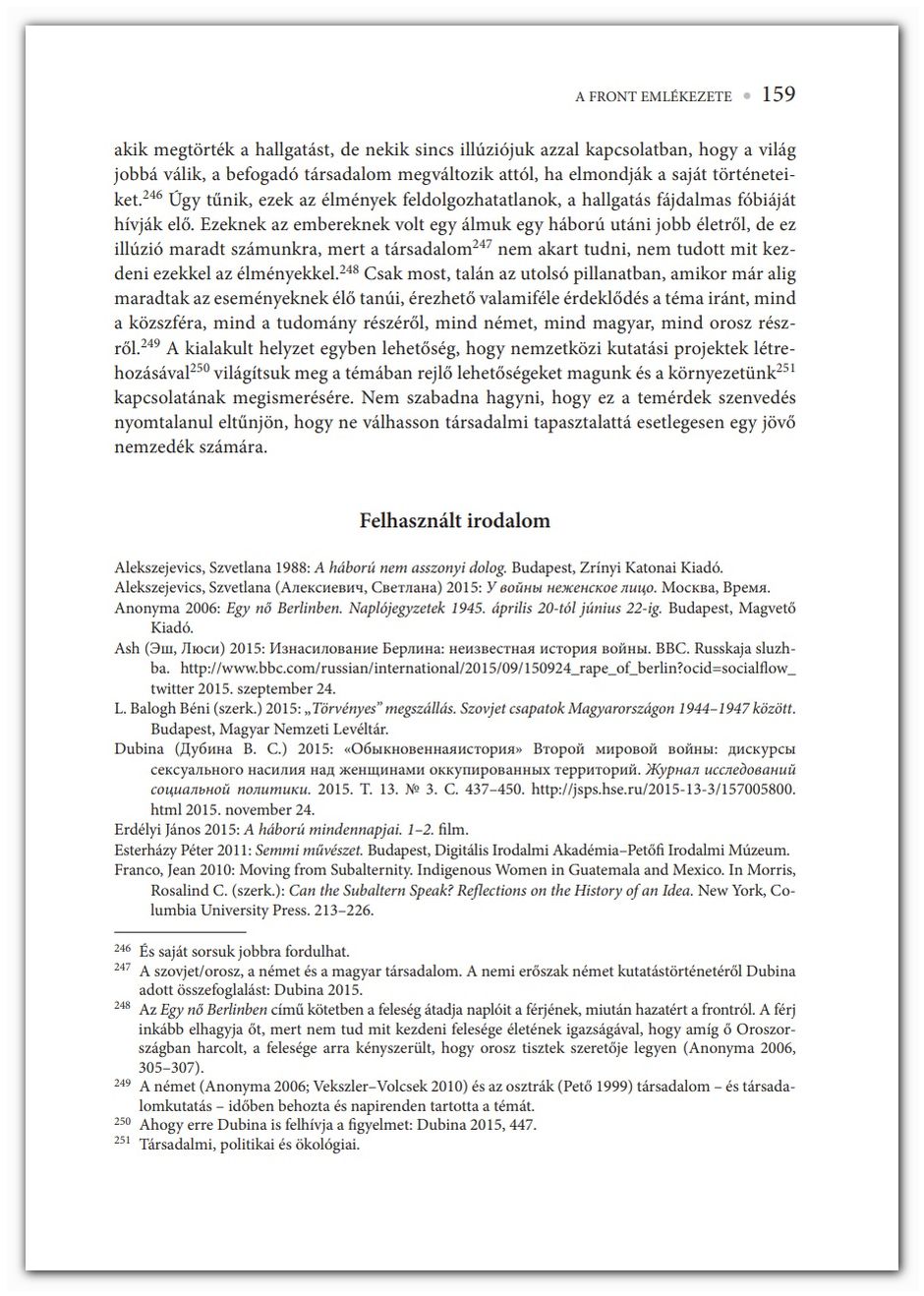
—people who broke the silence but have no illusion that the world will become better because of it, or that the receiving society will change if they tell their stories.²⁴⁶ These experiences remain unprocessed and constitute a painful phobia of silence.
These people dreamed of a better life after the war, but for us that dream remained an illusion because society²⁴⁷ did not want to know and did not know how to deal with these experiences.²⁴⁸
Only now — perhaps at the last possible moment, when almost no living witnesses remain — is a certain interest in the subject appearing both in state institutions and in scholarly circles, German, Hungarian and Russian.²⁴⁹ This creates an opportunity to illuminate the potential of the subject²⁵⁰ for ourselves, our surroundings²⁵¹ and the environment in which we live.
We must not allow this enormous suffering to disappear without trace, so that its lessons do not vanish from the social experience available to future generations.
²⁴⁶ Their own fate might also improve.
