New Literary Observer. Book: Kozlov, Kozlova
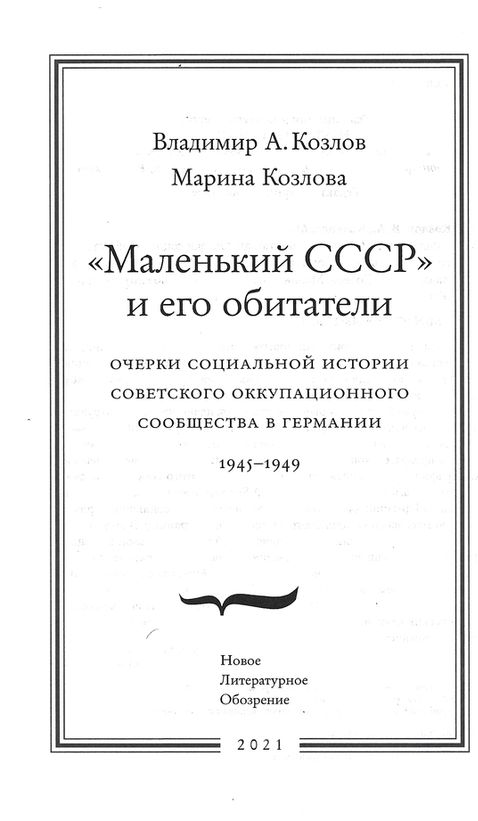
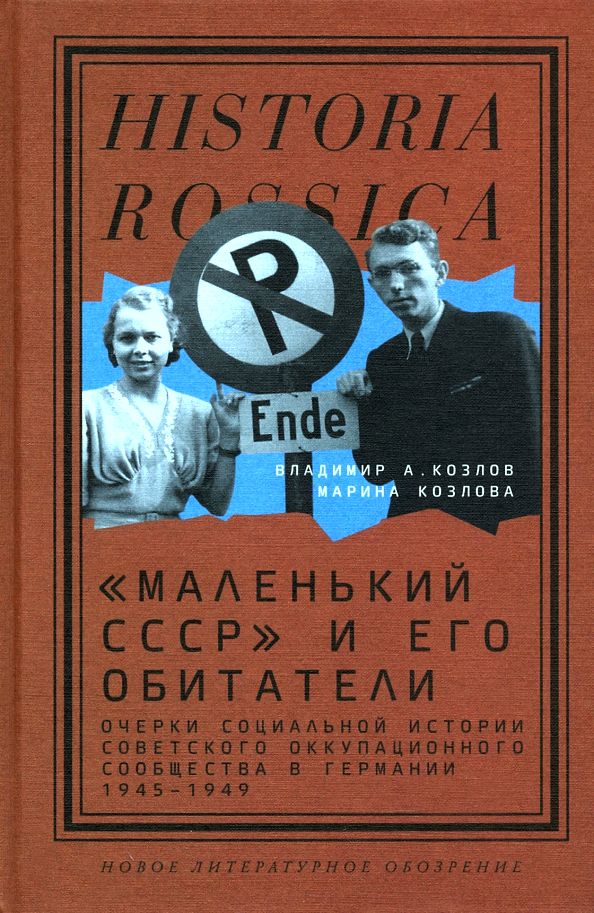
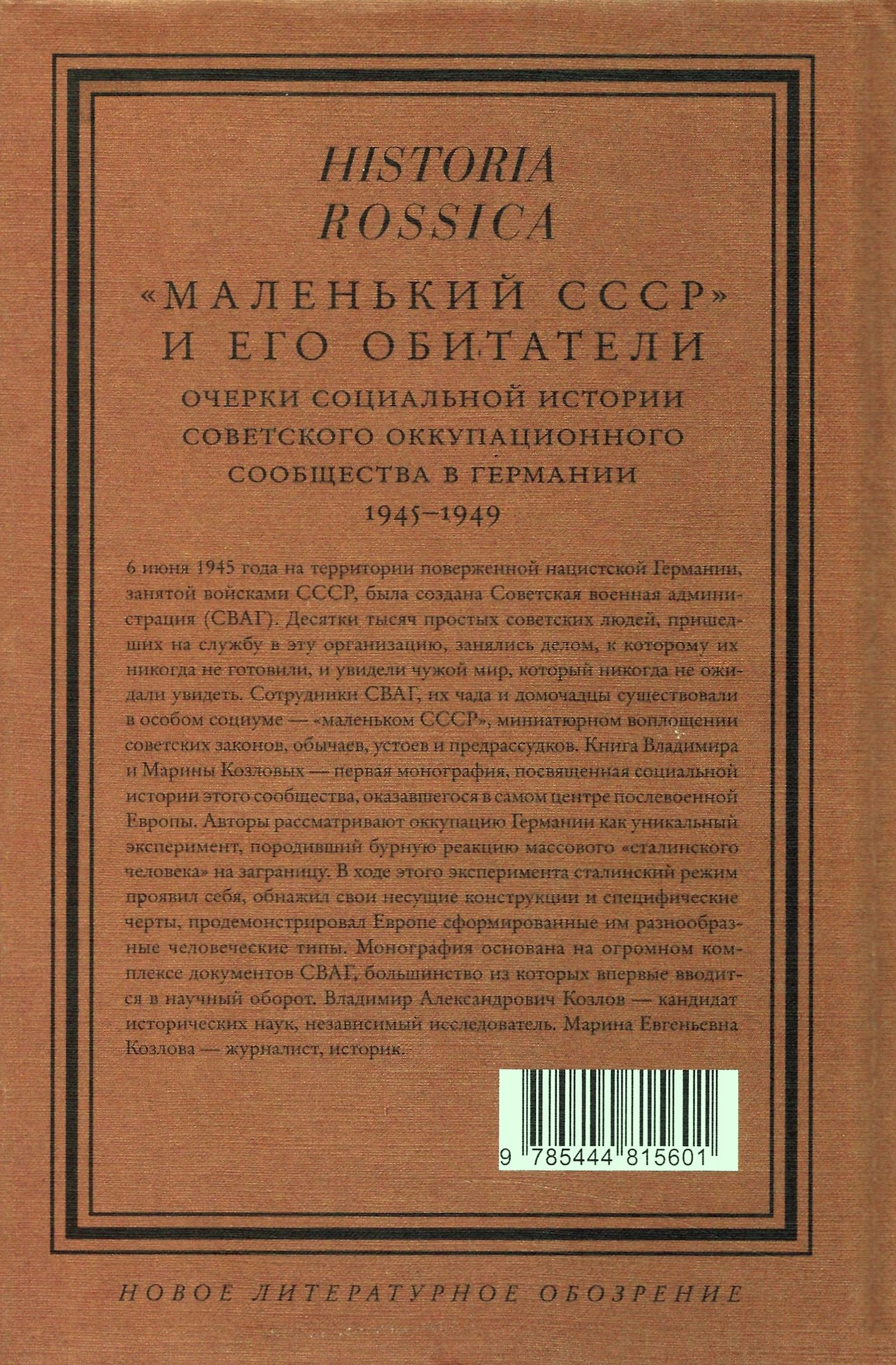
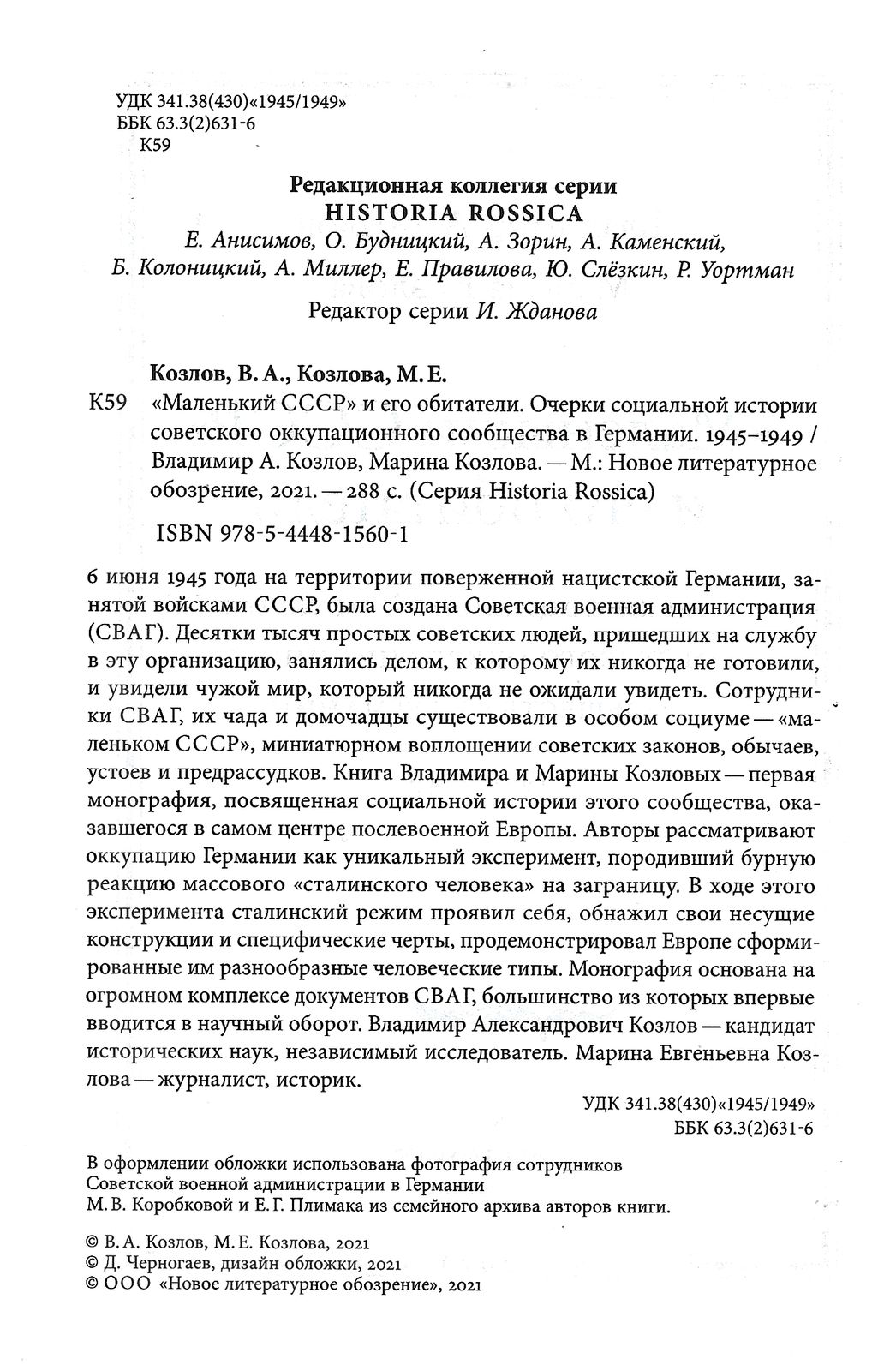
“Little USSR” and Its Inhabitants: Essays on the Social History of the Soviet Occupation Community
Authors: Vladimir Kozlov, Marina Kozlova
Publisher: New Literary Observer
Length: 288 pages
Print edition: 762 rubles
ISBN: 978-5-4448-1560-1; ISBN: 978-5-4448-1627-1
Weight: 382 g
Dimensions: 222 × 145 × 17 mm
Print run: 1,000 copies
Publication date: August 23, 2021
Language: Russian
Edition: Hardcover
Series: Historia Rossica
ASIN: B09DCRY4VH
Kindle
Price: $5.66
Publisher: New Literary Observer (August 12, 2021)
Language: Russian
File size: 1316 KB
Text-to-Speech: Not enabled
Enhanced typesetting: Enabled
Word Wise: Not Enabled
“Dear Wife, I Am Sending You a Parcel”: How Trophies from Occupied Germany Were Delivered to the USSR
Search results in the book
“Hands Must Be Clean…” — p.
159. “…under these conditions,” wrote in his diary
Vladimir Gelfand, an officer inclined toward reflection and
self-analysis, “…”.
“Hands Must Be Clean…” — p.
162. “…a large-scale sweep of the SZO territory, because
of which Gelfand had to postpone a trip to collect photographs,
opened…”.
“Flea-Market Trading as a Dilemma”
— p. 975. “…813. In the cited diary entry by V.
Gelfand one can clearly see a certain embarrassment on the part of the
Stalinist person…”.
“STALIN’S MAN ON A RENDEZVOUS WITH
EUROPE. IN PLACE OF A CONCLUSION” — p. 1087. Gelfand, V.
Diary 1941–1946. Moscow: ROSSPEN, 2016. http…
“STALIN’S MAN ON A RENDEZVOUS WITH
EUROPE. IN PLACE OF A CONCLUSION” — p. 1098. Gelfand, V.
Diary 1941–1946. Moscow: ROSSPEN, 2016. http…
“STALIN’S MAN ON A RENDEZVOUS WITH
EUROPE. IN PLACE OF A CONCLUSION” — p. 1184. Gelfand, V.
Diary 1941–1946. http://militera.lib.ru/…
Müller M. 100; Gelfand V. 46, 47, 258; Ger…
Vladimir A. Kozlov, Marina Kozlova
“Little USSR” and Its
Inhabitants: Essays on the Social History of the Soviet Occupation
Community in Germany, 1945–1949
To our parents — participants in and witnesses of the Great War
FROM THE AUTHORS
The Soviet occupation community, which by the will of
fate and on orders from above arose in the very center of ruined
postwar Europe, was a unique and extraordinarily interesting
phenomenon. Tens of thousands of ordinary Soviet people, together with
their children and households, were sent after the war to serve in the
Soviet Military Administration in Germany (SMAD). They took up work for
which they had never been prepared and encountered a foreign world they
had never expected to see. The “little USSR” that emerged
in the occupied territory became a peculiar sociocultural experiment in
which the Soviet regime revealed itself, exposed its key traits and
distinctive features, and displayed to the world the various human
types, modes of action, and behavioral algorithms it had formed. SMAD
personnel — the reader will still have to become accustomed to
this neologism — carried the story of their German life in their
memories for many decades after returning home. Some former senior
officials of SMAD even managed to share their recollections, albeit in
the spirit of memoiristic socialist realism. Yet the history of the
Soviet Military Administration itself sank for decades into the gloom
of secret archives inaccessible without special clearance.
Today those archives are largely open. Dozens of
historians have studied, and continue to study, the history of the
Soviet occupation zone and SMAD. Yet not a single book has so far been
written about the unique social phenomenon of the Soviet occupation
community itself.
Few contributors to the authoritative body of
scholarship on the Soviet occupation have shown any interest in the
personality of the ordinary SMAD official or tried to sketch a
collective portrait of him. Although he did not occupy a high post, it
was precisely this official who, according to his own understanding
— or lack of it — carried out or failed to carry out orders
from above and governed occupied Germany as best he could. One would
have to be very naive to believe that where high politics was involved,
little depended on the personal and professional qualities of the
Soviet bureaucrat — or even on the sergeants and soldiers serving
in military commandant’s offices. Only by examining how the
personalities of those who implemented policy, their modus operandi and
modus vivendi, affected the work of the occupation authorities and
ultimately the results of Stalin’s grand policy on the German
question can we explain the course and outcome of Sovietization and, in
the longer perspective, the eventual fiasco of Soviet policy in East
Germany.
Let us accept as self-evident the observation of the
German historian Elke Scherstjanoi that documents from the SMAD
collections, like other archival materials of Soviet origin, have had
practically no conceptual or empirical impact on the social and
cultural history of the Soviet occupation zone. As for a social history
of SMAD itself, such a history does not yet exist. Scherstjanoi’s
ten-page article, containing, as she herself puts it, “some
thoughts” that may prove useful to future researchers of the
Soviet occupation community, naturally does not fill the gap.
When, ten years ago, we first began archival research
into the history of the “little USSR,” it never occurred to
us that an historian, in the heat of polemic, might turn “long
and painstaking work in the archives” into a kind of refuting
argument on the grounds that “archival documents often reflect
not the norm of everyday life but deviations from it.” Having
questioned the accuracy of Sheila Fitzpatrick’s claims about
Soviet people in the 1930s — it was she who was reproached for
“painstaking work in the archives” — her opponent
chose not to burden himself with details and evidence and confined
himself to an ironic remark. This polemical device would not have
particularly troubled us had the respected author not puzzled readers
with his invocation of the “norm of everyday life,” which,
it seems, he is not especially inclined to seek in archives. Where,
then, should one look for it? Perhaps in the “precedent
texts” of the Stalinist era? The philosopher and sociologist N.
Kozlova included among such texts both artistically weak socialist
realism and the Short Course on the History of the CPSU(b), as well as
The Book of Tasty and Healthy Food. Such texts present exemplary
practices, distant shores of Soviet life entirely alien to everyday
reality, enticing people with promises of future happiness while for
the time being displaying the absurd template of a correct bookish
life. What, then, is the historian to do? Turn away from living reality
because it contains too many “deviations,” perhaps even
trying not to notice them? Return to the ceremonial world of Stalinist
ideology, since ideology too was part of everyday life? Approach
declassified archival documents with caution for fear of making the
wrong discoveries?
We certainly do not suffer from archival fetishism,
still less do we believe in “truth from the safe,” although
our principal sources were hidden for more than fifty years in the
special collections department of the State Archive of the Russian
Federation (GARF). In this book the reader will encounter published
memoirs and diaries of participants and eyewitnesses, our own family
stories about the lives and work of one author’s parents in the
apparatus of the Political Adviser to SMAD, literary works belonging to
the more honest variety of socialist realism, propaganda texts from
Stalin’s time, and even several films from a long-vanished era
that are important for understanding the subject. But the most
important, new, and interesting material still came from the
collections of the Soviet Military Administration held in GARF.
The SMAD documents contain ample material for
studying the ordinary norms of life in the Soviet occupation community
— precisely norms, not deviations. What we regard as the norm
differs radically from what authors dissatisfied with
“deviations” call normal. For us, a norm is not an
ideologically elevated picture of reality but established trends in
everyday life, even if the rulers of the USSR regarded such trends as
anomalies, knew how to write beautifully in newspapers about their own
norms, and used power to reinforce their propaganda myths. The
authorities’ normative aspirations will also be part of our
inquiry. But first and foremost we will try, with all the “motley
rubbish” of occupation life, to enter the current debate over how
deeply Stalinist people were permeated by official ideology and how
constrained they were by its discourse.
While working with archival documents, we encountered
many interesting, vivid, and distinctive people. There was N. I.
Staroselsky, the military commandant of the Prenzlau district, deeply
concerned for the success of the work and conscious of responsibility
“before history for everything we are doing here.” There
were enthusiasts such as N. F. Paskhin, head of the agricultural
department of the SMAD administration in Saxony-Anhalt, who spoke
several languages and, on his own initiative and at his own risk,
published a German-Russian dictionary, Agriculture and Forestry, for
practical use. Among SMAD personnel were those who easily adapted to
foreign civilization, turning the pursuit “of personal profit
into a peculiar fetish,” and others, such as Officer Gnatyuk, who
languished in Germany and persistently sought to return home.
We sympathized with Captain Kosyrev, who did not want
to part with army life and believed that instead of commanding a
battalion or even a regiment he was forced to sit in the duty office
and resolve “all sorts of questions.” “Everyone
demands something, whoever feels like it,” the captain
complained, “and all this politics simply will not fit into my
head.” In this book we will try to tell the story of several
years in the lives and work of these and many other SMAD personnel:
where they came from, how they entered the military administration,
what they thought about their superiors and the Germans, how they
governed those Germans, what modes of conduct they preferred, what they
believed in, and what they doubted.
In our work we sought a kind of conceptual and
factual close-up of late Stalinism. First of all, this concerns the
very nature of the phenomenon. Should this historical
“event” be regarded as the continuation of a long era
interrupted by the war and then attaining its highest, mature form
after the war? Or, following Juliane Fürst and her coauthors,
should it be treated as a self-contained historical phenomenon? The
postwar period in the USSR, as in the history of any other country
emerging from ashes and ruins, is naturally associated with a
“return to normality.” But to what extent was this postwar
cultural and historical event merely a restoration of the prewar
Stalinist system, shaken, transformed, and thrown out of balance by the
war? As Robert Dale has rightly argued, in the Soviet Union the end of
the war brought not so much release from wartime obligations and
restrictions as new demands and goals — not a demobilization of
social life, but rather its remobilization. The war and the myth it
created, Dale argues, made it possible to restart the Soviet project
and breathe new life into official ideology by offering new
possibilities for changing society.
It is important to understand how receptive the SMAD
society — a miniature copy and model of the larger USSR, reshaped
first by repression and then by war — was at the grassroots level
to the authorities’ restorative efforts, and how capable it was
of restarting itself in a German environment alien to Soviet people.
The “little USSR” that arose on German territory produced
forms of normality within which the cultural preconditions of the
Thaw-era conflict between future Stalinists and future members of the
Sixties generation quietly matured. The protagonists of the Thaw and
their future antagonists both emerged “from the same
greatcoat” — the era of late Stalinism. Historians have
long noticed the sense of liberation that arose during the war among
the generation of victors and persisted for some time after the war
ended. Yet they are still searching for a definition of the phenomenon.
It has been described as de-ideologization, spontaneous
de-Stalinization, even “neo-Decembrism.”
We are not inclined to become drawn into this dispute
over terminology. We do, however, believe it possible to conduct a kind
of “field study” of the postwar cultural transformations
within the Soviet occupation community in Germany. For this purpose it
seems appropriate to rely on terms coined by the authorities
themselves: the authorities labeled — or branded — the new
phenomena at which they directed criticism and repression as
“kowtowing before the West” and
“cosmopolitanism.” Historians are left “only”
to see the unimagined reality concealed behind the malicious invective
of party propaganda.
Our central question is this: to what extent did SMAD
employees feel personally unfree while living within a repressive
ideological field? How constrained or unconstrained were they when they
had to think “not out loud” or express themselves in formal
and informal settings? By placing Stalinist people in circumstances
unusual for them, history not only revealed new facets of Soviet
everyday life but, in a certain sense, created a distinctive occupation
subculture whose former members carried pieces of it back to the USSR
together with their German trophies.
© New Literary Observer Publishing House
© V. A. Kozlov, M. E. Kozlova









 Russian