


 |
 |
||
|
24. April 2025 "LA CAPITULATION ALLEMANDE DE MAI 1945" 24. April 2025 "KAPITULACJA NIEMIECKA W MAJU 1945 R." 27. April 2025 "КАПІТУЛЯЦЫЯ ГЕРМАНІІ Ў МАІ 1945 ГОДА" 02. Mai 2025 "DIE DEUTSCHE KAPITULATION IM MAI 1945" 02 мая 2025 "КАПИТУЛЯЦИЯ ГЕРМАНИИ В МАЕ 1945 ГОДА" 08 травня 2025 "КАПІТУЛЯЦІЯ НІМЕЧЧИНИ У ТРАВНІ 1945 РОКУ" May 08 2025 "THE GERMAN SURRENDER IN MAY 1945" |
|||
Віртуальна екскурсія музеєм:Екскурсія постійною експозицією (верхній та нижній поверхи) |
КАПІТУЛЯЦІЯ НІМЕЧЧИНИ У ТРАВНІ 1945 РОКУ |
||
 |
||
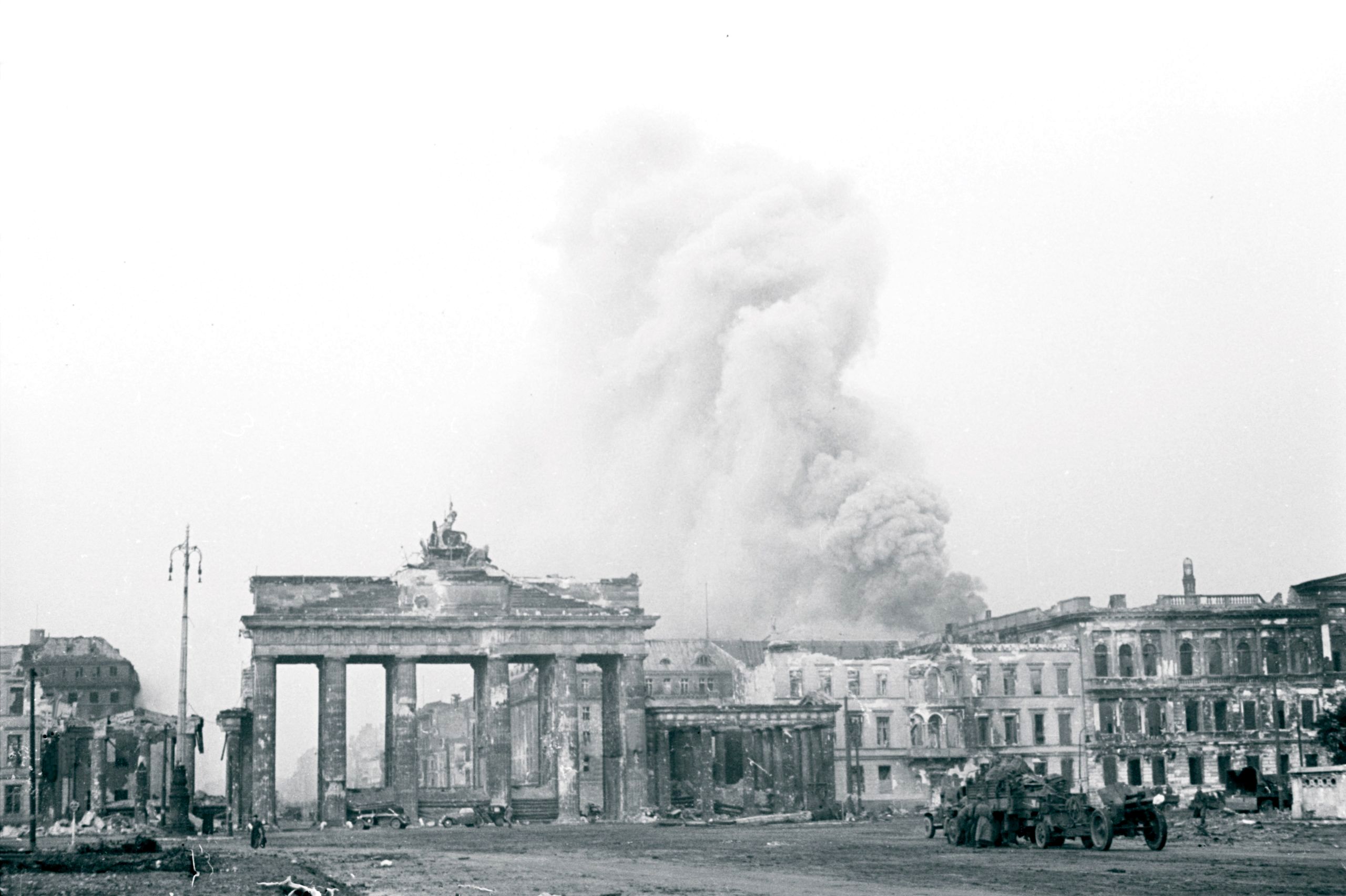
| Бранденбурзькі
ворота, Берлін, 2/3 травня 1945 р. Фото: Іван Шагін, Музей Берлін-Карлсхорст |
||
КІНЕЦЬ ВІЙНИДруга світова війна в Європі завершилася беззаперечною капітуляцією німецьких військ у травні 1945 року, що означало остаточний крах нацистської тиранії. Головною метою союзних держав, об’єднаних у боротьбі проти Німеччини, було повне військове та політичне знищення «Третього рейху». Військова поразка Німеччини почала проявлятися прискореними темпами влітку 1944 року. 22 червня розпочався масовий наступ Червоної Армії, від якого війська вермахту на Східному фронті вже не змогли оговтатися. Двома тижнями раніше, 6 червня, західні союзники провели найбільшу морську операцію з висадки військ на узбережжя Північної Франції. Німеччина змушена була вести війну на два фронти. З жовтня 1944 року бойові дії вже велися на території Німеччини. 25 квітня 1945 року американські та радянські війська зустрілися біля Торгау на Ельбі. Берлін був зайнятий Червоною Армією. В середині квітня розпочалася Берлінська операція. Після запеклих вуличних боїв, які забрали численні життя з обох сторін, столиця Німеччини капітулювала 2 травня 1945 року.
|
||
 |
||
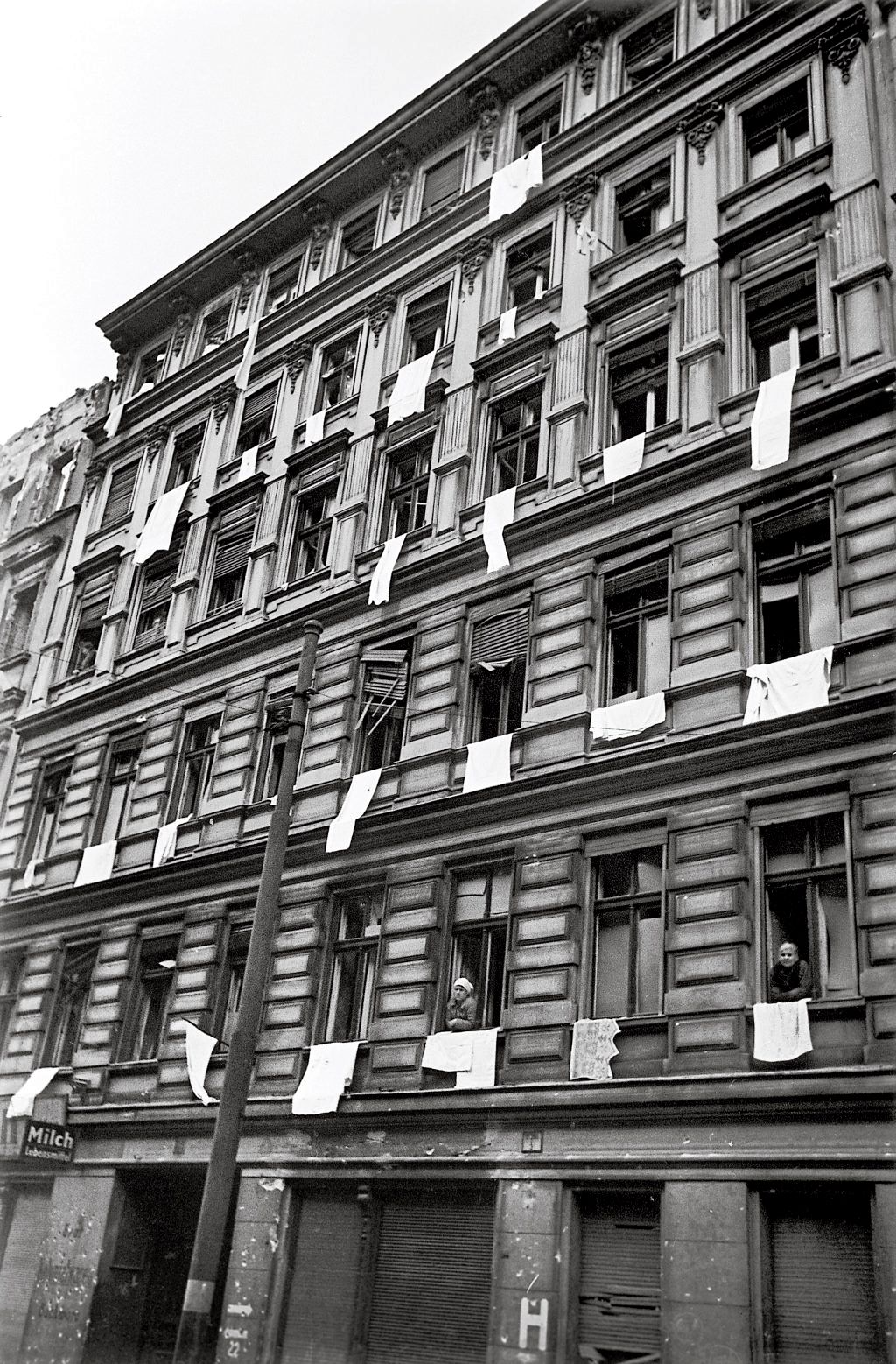
| Білі
«прапори» на вікнах з простирадл, рушників тощо як
знак капітуляції. Берлін, квітень/травень 1945 р. Фото: Аркадій Шайхет, приватний архів Марії Шотікової |
||
 |
||
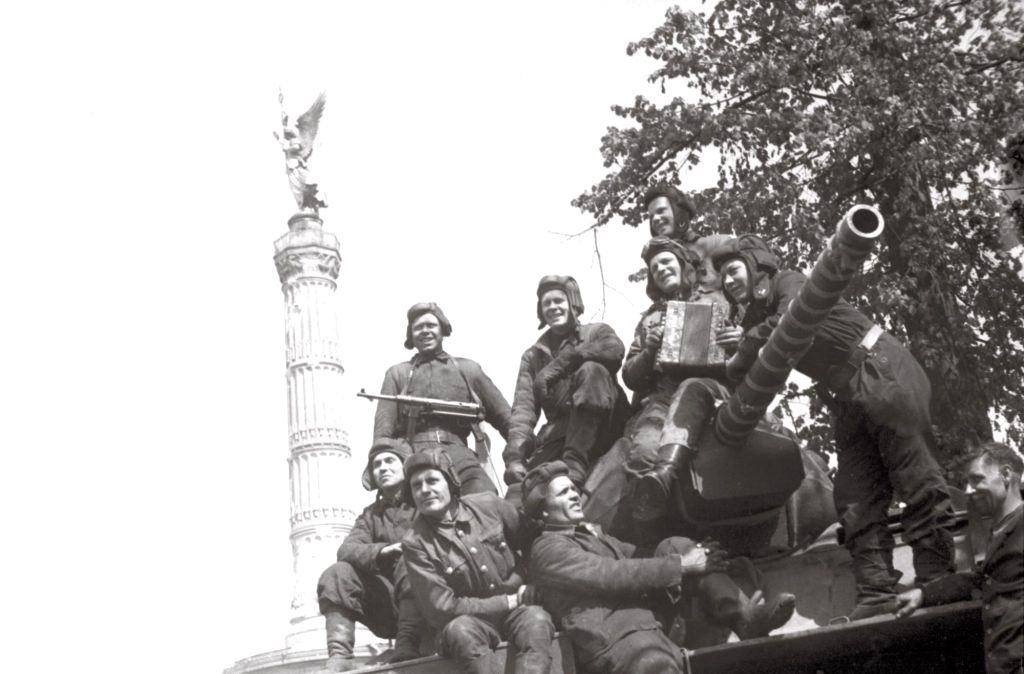
| Групове
фото з колоною перемоги: радянські танкісти після капітуляції Берліна,
Берлін-Тіргартен, початок травня 1945 р. Фото: Тимофей Мельник, Музей Берлін-Карлсхорст |
||
ЗАКІНЧЕННЯ ВІЙНИ В БЕРЛІНІ21 квітня радянські війська перетнули східний кордон Берліна і почали наступ у напрямку до центру міста. У межах кільця міської електрички (S-Bahn) вони зустріли запеклий опір. Десятиденні вуличні бої призвели до великої кількості жертв. Близько 80 000 солдатів Червоної армії загинули у битві за Берлін. З німецького боку загинуло приблизно 20 000 солдатів і 30 000 мирних жителів. Уже 24 квітня генерал-полковника Берзаріна було призначено радянським комендантом Берліна. Спочатку його штаб розташовувався в офіцерському казино інженерного учлища в Карлсхорсті. На початку травня він зі своїм штабом переїхав до Фрідріхсфельде. Берзарін негайно організував тимчасове постачання продуктів і відновлення інфраструктури. Крім того, він займався створенням нової міської адміністрації та відродженням культурного життя. Своїми наказами він намагався зупинити насильство, пограбування та зґвалтування, які чинили радянські солдати. Військовим комендантам, призначеним у різні райони міста, допомагали комуністи-емігранти, які прибули з Москви в складі так званої групи Ульбріхта. На початку липня всі чотири держави-переможниці зайняли свої сектори в Берліні. |
||
 |
||
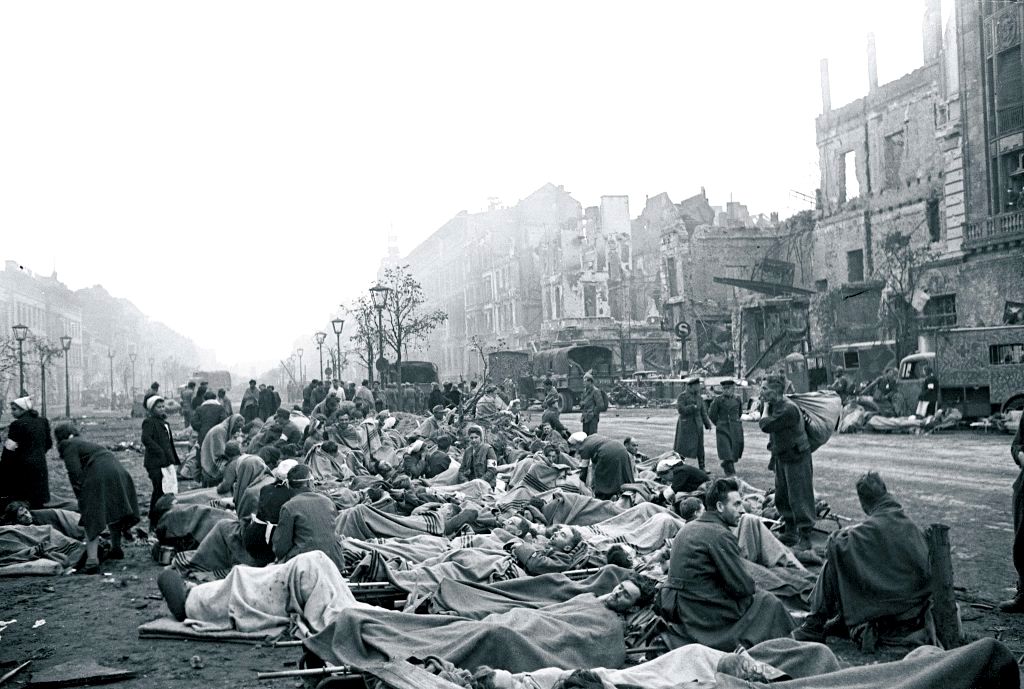
| Поранені перед
готелем Адлон, Берлін, 2 травня 1945 року У готелі «Адлон» була лікарня швидкої допомоги. Коли він загорівся від мародерства радянських солдатів, радянські та німецькі медики евакуювали поранених на вулицю. Фото: Іван Шагін, Музей Берлін-Карлсхорст |
||
 |
||
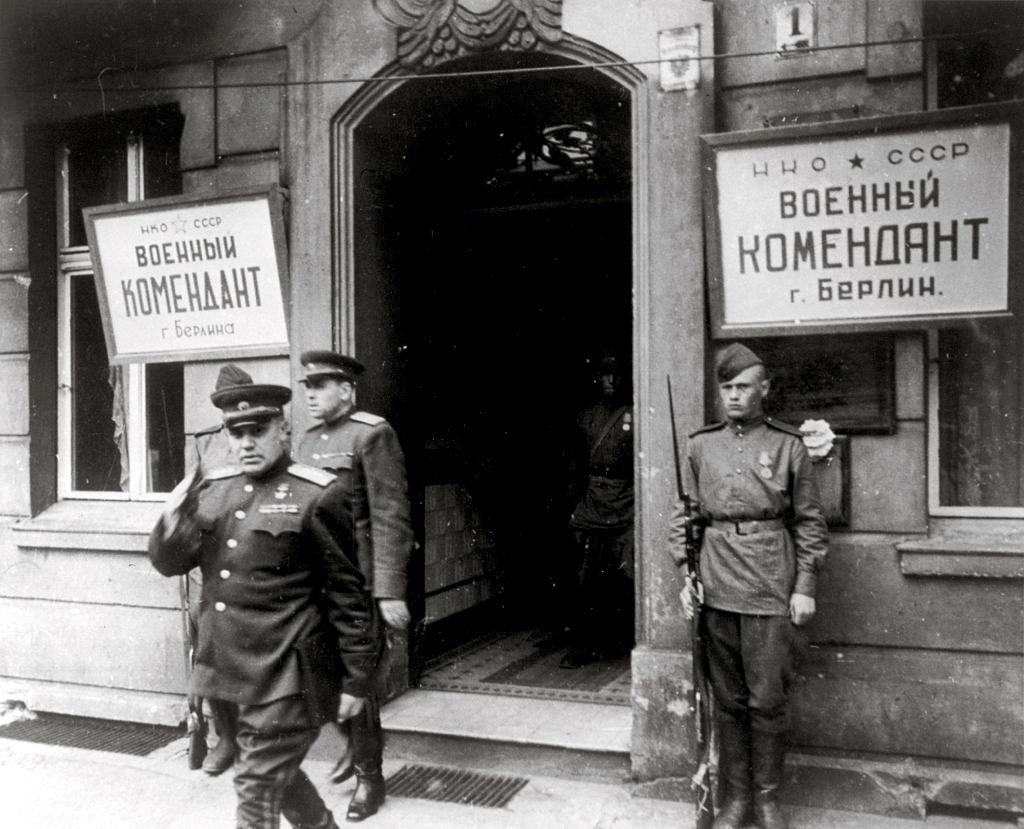
| Командувач
радянського міста генерал-полковник Берсарін залишає штаб,
Альт-Фрідріхсфельде 1, Берлін, травень 1945 року Фото: Jewgenij Chaldej, Фотоархів bpk, Берлін |
||
ПЕРШЕ ПІДПИСАННЯ КАПІТУЛЯЦІЇ В РЕЙМСІАдольф Гітлер покінчив життя самогубством у Берліні 30 квітня 1945 року. Перед цим він призначив грос-адмірала Деніца своїм наступником. Через безвихідність військової ситуації Деніц спробував здійснити капітуляцію лише перед Великобританією та США. З цією метою він направив начальника штабу оперативного керівництва верховного командування вермахту генерал-полковника Йодля до ставки західних союзників, яка розташовувалася у французькому місті Реймс. Однак американський генерал Ейзенхауер сприйняв це як спробу підірвати єдність союзників і наполіг на негайній та беззастережній капітуляції перед усіма союзними військами. Деніц був змушений погодитися на те, щоб рано вранці 7 травня в Реймсі було підписано загальну капітуляцію німецького вермахту. У додатковому протоколі всі учасники погодилися, що процедура підписання має відбутися повторно, а капітуляція повинна бути ратифікована на вищому командному рівні. Наступного дня, з метою негайного припинення воєнних дій, американський президент Трумен і британський прем’єр-міністр Черчилль оголосили про капітуляцію Німеччини. Вона набула чинності на всіх фронтах 8 травня 1945 року о 23:01 за центральноєвропейським часом.
|
||
 |
||
| Підписання
капітуляції Німеччини, Реймс, 7 травня 1945 р. Начальник штабу оперативного керівництва верховного командування вермахту генерал-полковник Йодль (у центрі, передній план), начальник штабу ставки західних союзників генерал-лейтенант Сміт (за столом на задньому плані, третій зліва), радянський представник генерал-майор Суслопаров (п’ятий зліва) і представник французької армії генерал-майор Севез (другий зліва). Фото: невідомо, Фотоархів bpk, Берлін |
||
 |
||
| Пообіцяйте
повторити акт капітуляції Федеральний архів – військовий архів, Фрайбург i. бр. |
||
ДРУГЕ ПІДПИСАННЯ КАПІТУЛЯЦІЇ В БЕРЛІНІПовторне підписання Акта про капітуляцію стало найважливішою частиною загальної капітуляції Німеччини, оскільки в Реймсі її підписали генерали, які не мали достатніх командних повноважень у вермахті. Англійці, перш за все, побоювалися, що тим самим німецьке вище військове керівництво могло б спробувати уникнути відповідальності за поразку у війні, як це вже сталося після закінчення Першої світової війни. Ратифікація капітуляції відбулася в радянській ставці в Берліні. Представник радянського верховного командування маршал Жуков розмістив свій штаб в уцілілих будівлях колишнього військово-інженерного училища вермахту. Сюди він і запросив представників союзних держав-переможниць, до яких приєдналася також і Франція. У це місце доставили також головно-командувачів різновидів німецьких збройних сил. |
||
 |
||
| Місце підписання беззастережної капітуляції – офіцерське казино колишнього військово-інженерного училища № 1 вермахту в Берліні-Карлсхорсті, 8 травня 1945 року. Фото: Тимофей Мельник, Музей Берлін-Карлсхорст | ||
ПРИБУТТЯ ДО ТЕМПЕЛЬГОФАВпрдовж 8 травня 1945 року всі учасники акту капітуляції прибули до аеропорту Темпельгоф. З боку союзників, першим вранці прибув радянський державний секретар Вишинський. Опівдні за ним прибули британський маршал авіації Теддер та командувач американськими стратегічними повітряними силами генерал Спатц. У другій половині дня прибув також генерал Жан де Латр де Тассіньї, головнокомандувач французької армії. Німецьку делегацію доправили американським літаком із Фленсбурга, куди на початку травня відступив останній уряд Третього Рейху на чолі з гросадміралом Деніцем. Радянські солдати зустріли всіх гостей в аеропорту Темпельгоф і провезли їх через зруйнований центр міста до майже неушкодженого віллового району Карлсгорст.
|
||
 |
||
| Вищі
командири німецького Вермахту після прибуття в аеропорт Темпельгоф,
Берлін, 8 травня 1945 року. Фото: Іван Шагін, Музей Берлін-Карлсхорст |
||
 |
||
| Міст
Обербаум і Шпайхер, Берлін, 30 квітня 1945 року Фото: Тимофей Мельник, Музей Берлін-Карлсхорст |
||
 |
||
| Реконструйований
маршрут делегацій від Темпельгофа до Карлсхорста Графіка: Крістін Кітта |
||
ПІДГОТОВКА ДО ПІДПИСАННЯТерміново була пілготовлена велика зала колишнього офіцерського казино інженерного училища. Окрім основних учасників, зібралося багато журналістів, представників штабів союзників, перекладачів та допоміжного персоналу. Однак церемонія затрималася на кілька годин. Необхідно було підготувати російський варіант документа, який до того існував лише англійською мовою. Під час перекладу точилися суперечки щодо стилістичних формулювань, хоча зміст документа, підписаного напередодні в Реймсі, залишився без змін. Узгодження через радіозв’язок додатково затягнуло процес. Крім того, на передній стіні зали бракувало французького прапора. Були встановлені лише радянський, британський і американський прапори, тому французький довелося імпровізувати з наявних тканин. Зрештою, підготовка завершилася лише опівночі. |
||
 |
||
| Вид
на зал капітуляції, Берлін-Карлсхорст, 8 травня 1945 р. Фото: невідомо, музей Берлін-Карлсхорст |
||
 |
||
| Делегація
верховного головнокомандування вермахту прямує до місця підписання
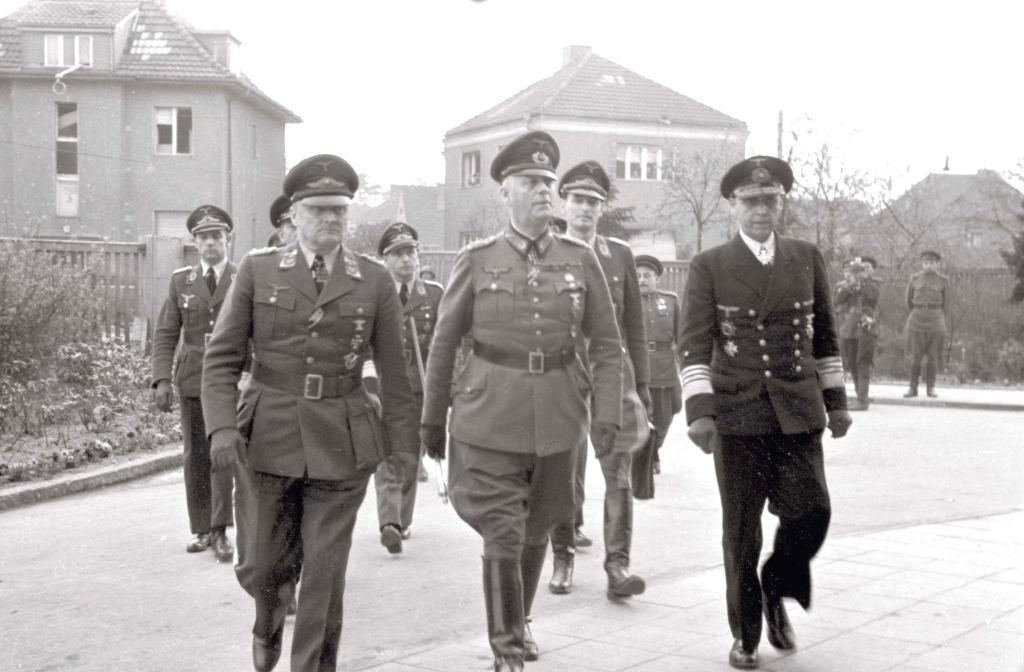
капітуляції, Берлін-Карлсхорст, 8 травня 1945 року. Командувачі видами німецьких збройних сил генерал-полковник Штумпф (ліворуч), генерал-фельдмаршал Кейтель (у центрі) і генерал-адмірал фон Фрідебург. Фото: Тимофей Мельник, Музей Берлін-Карлсхорст |
||
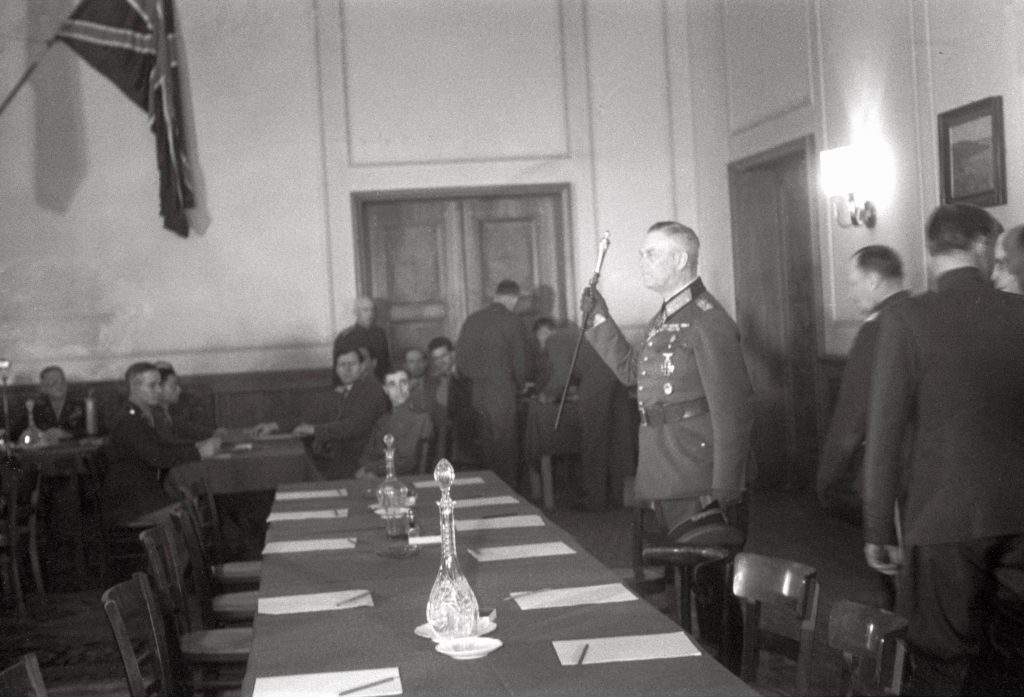
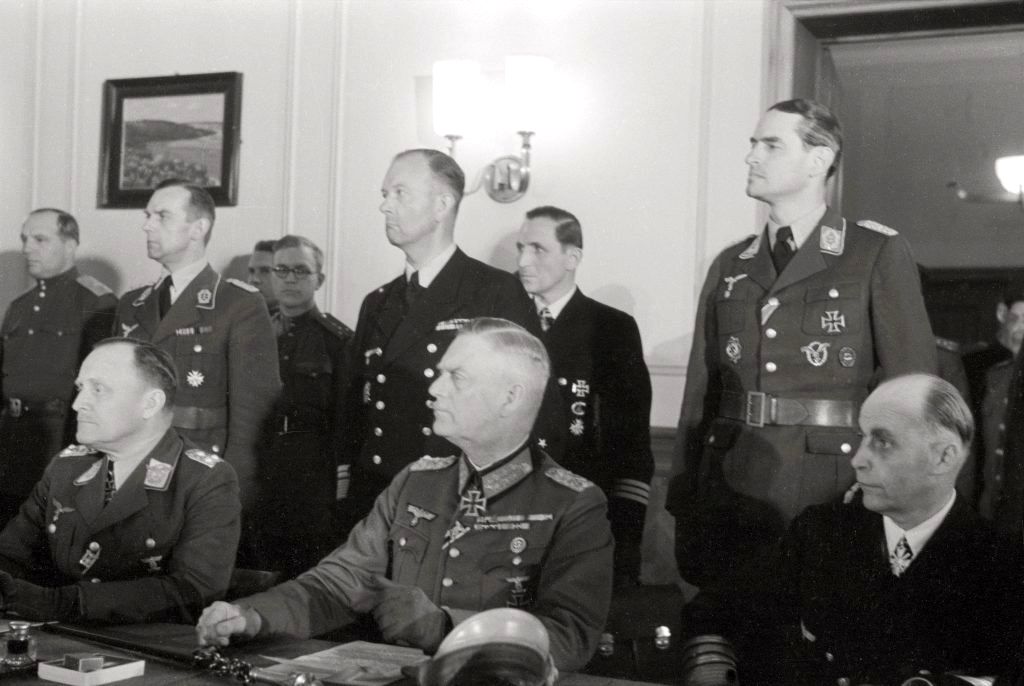
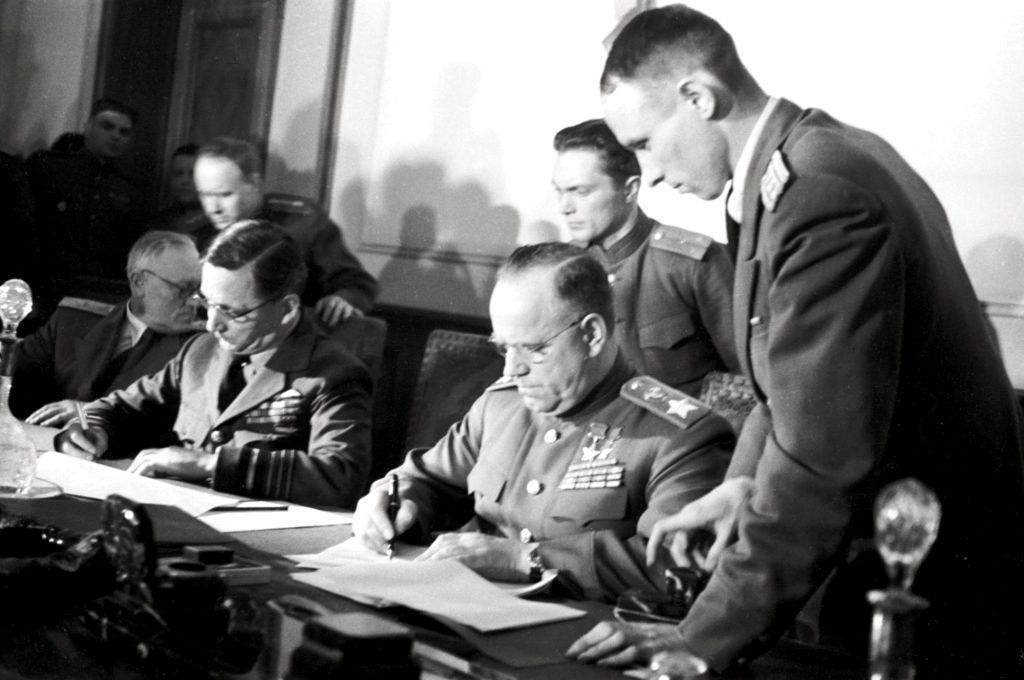
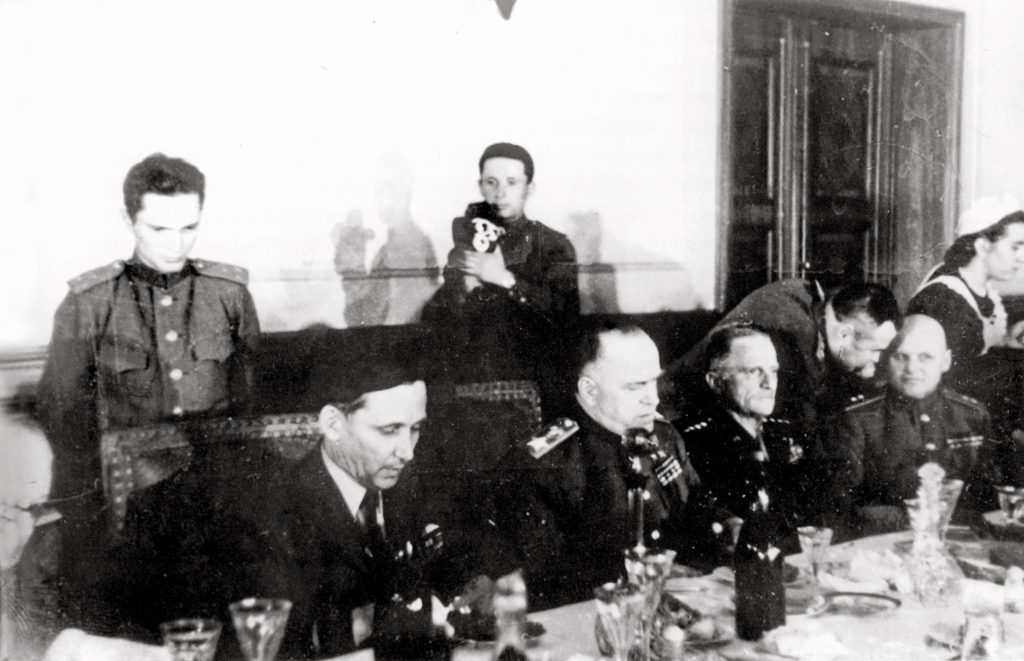
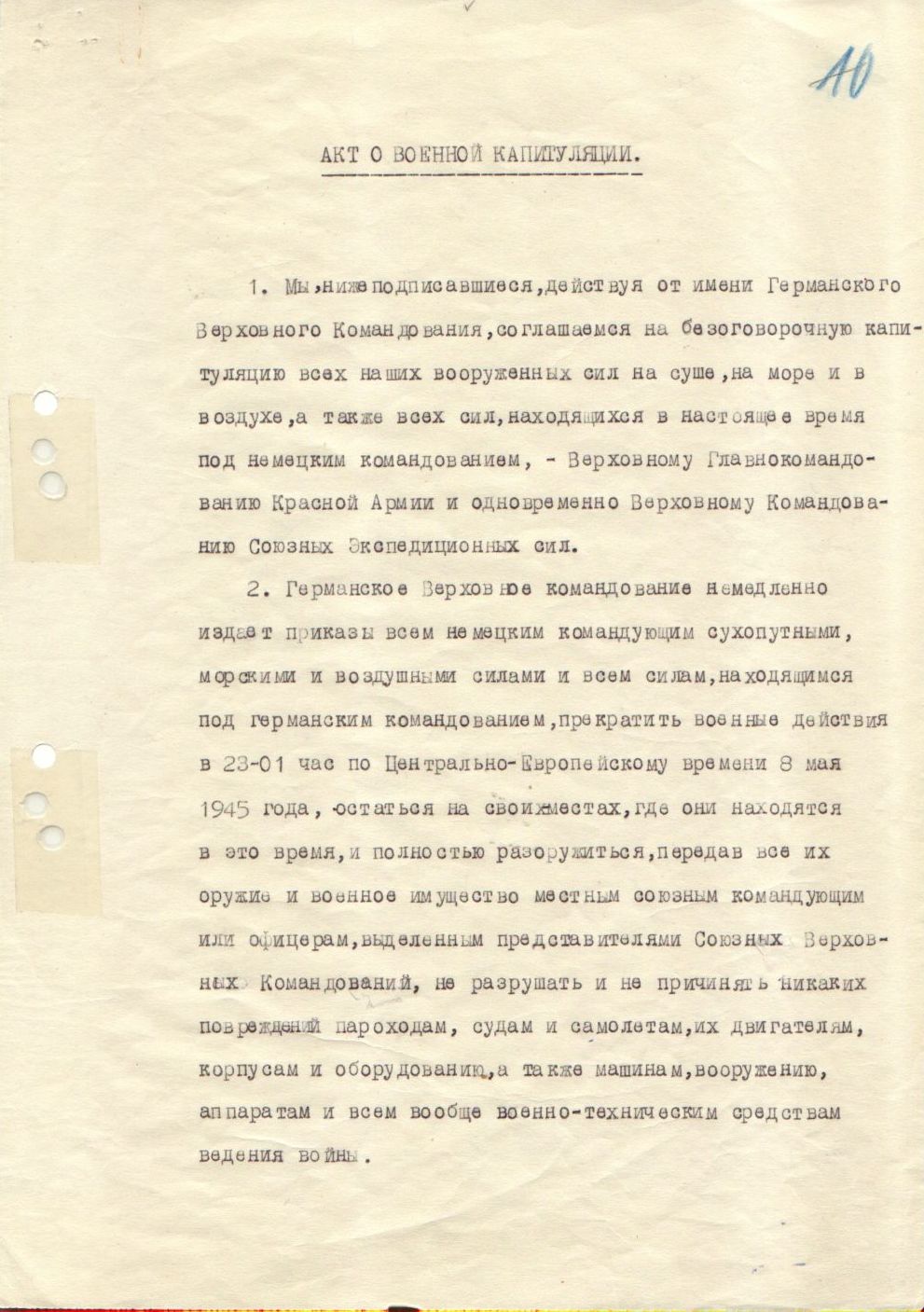
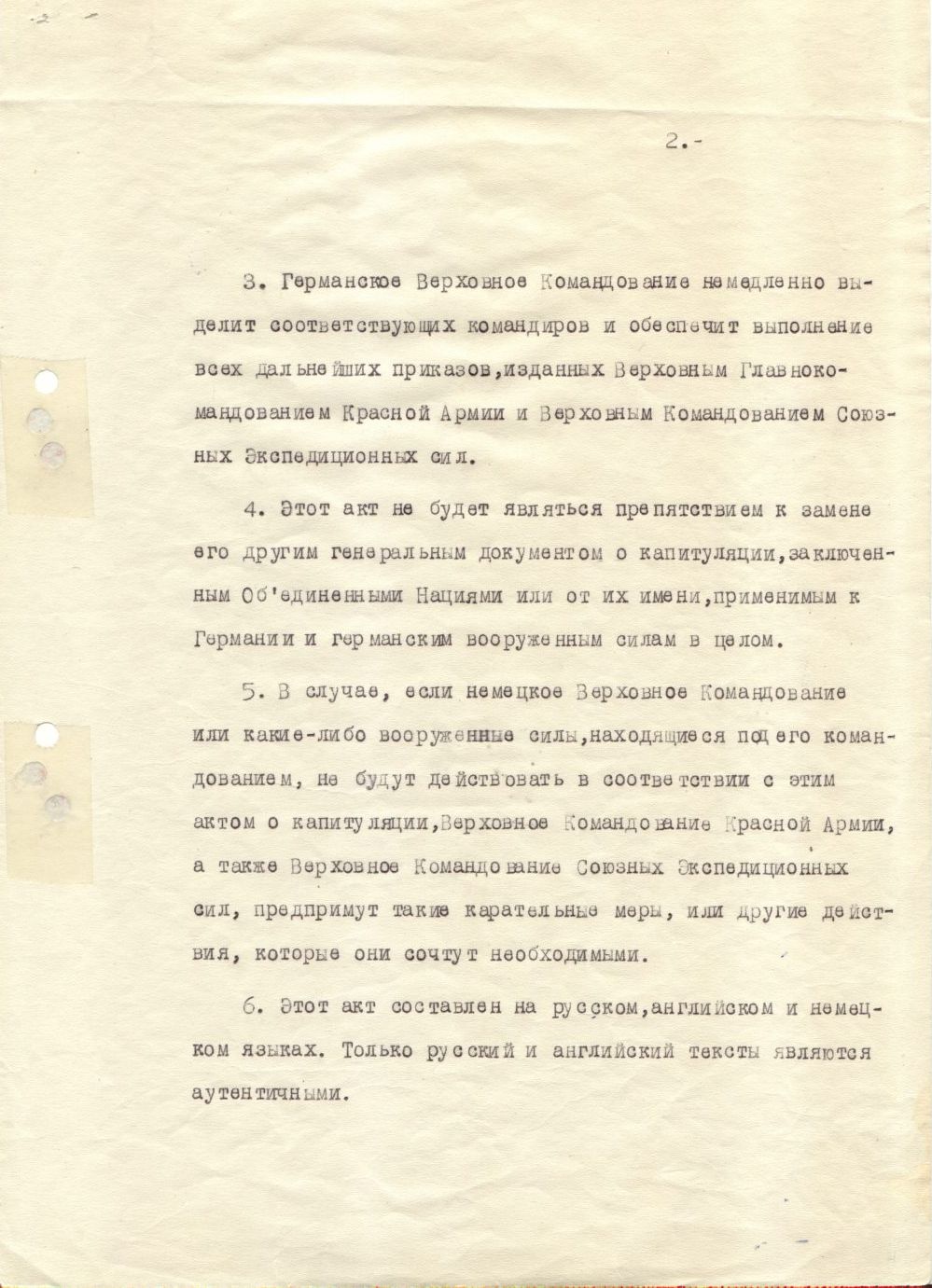
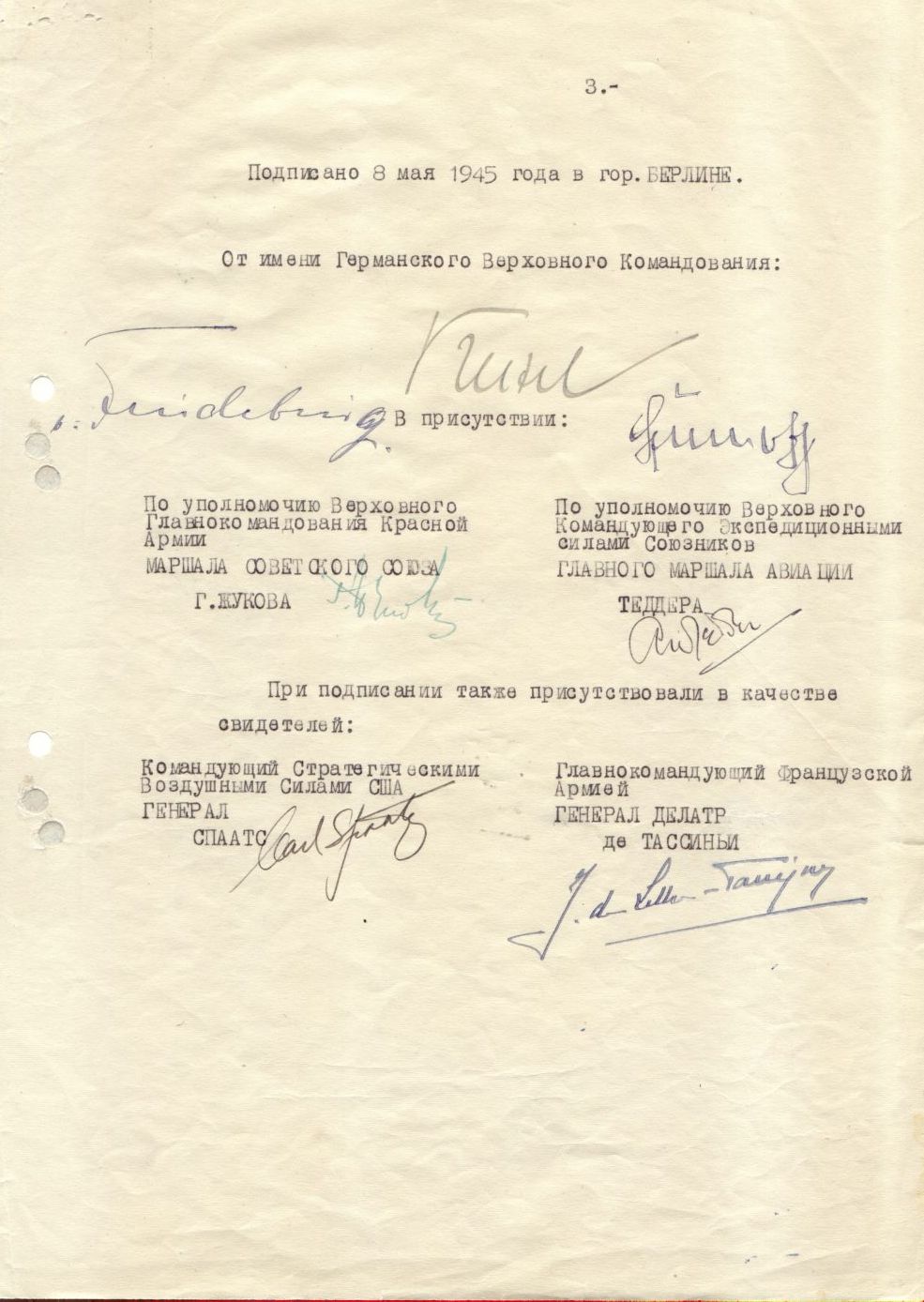
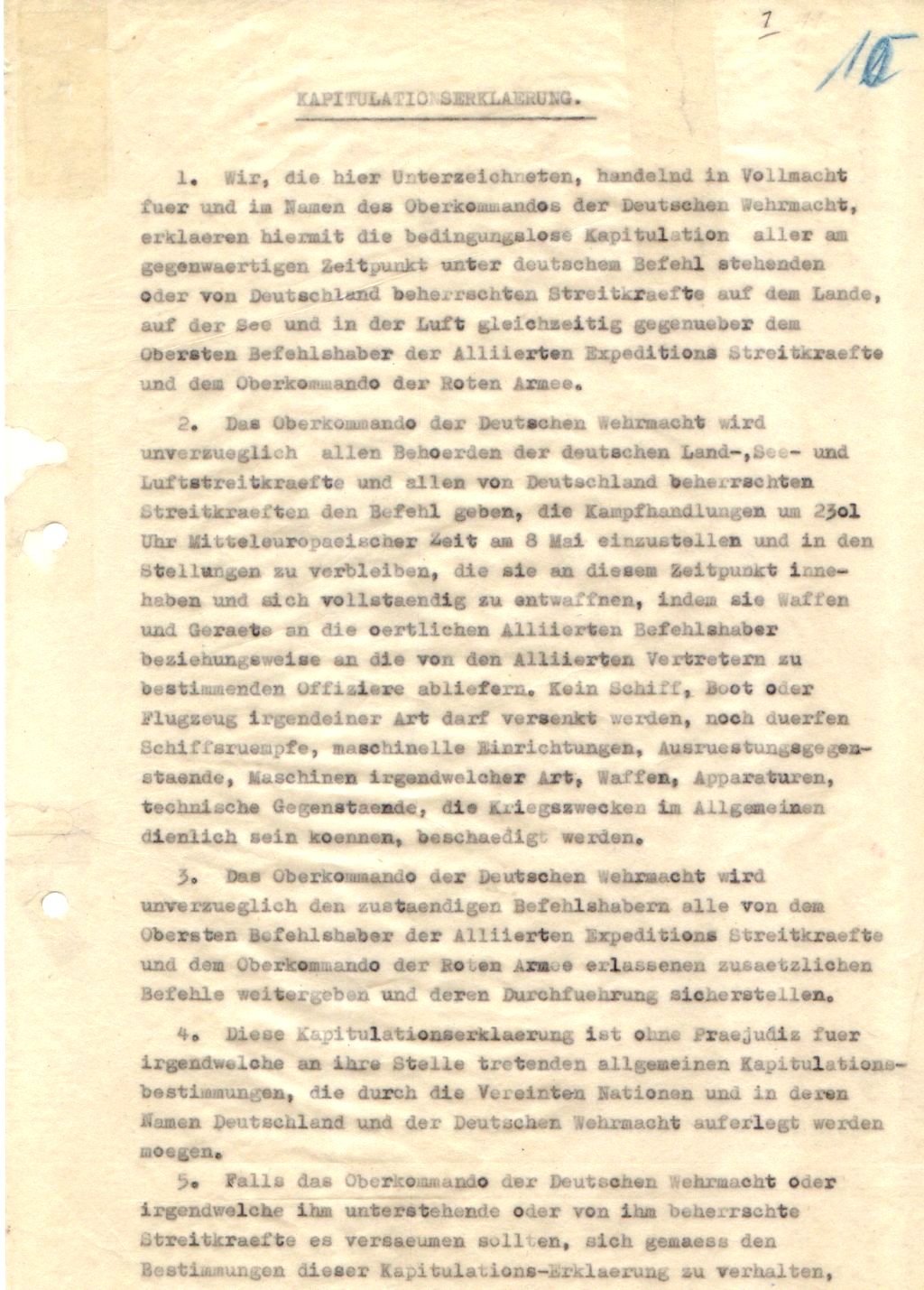
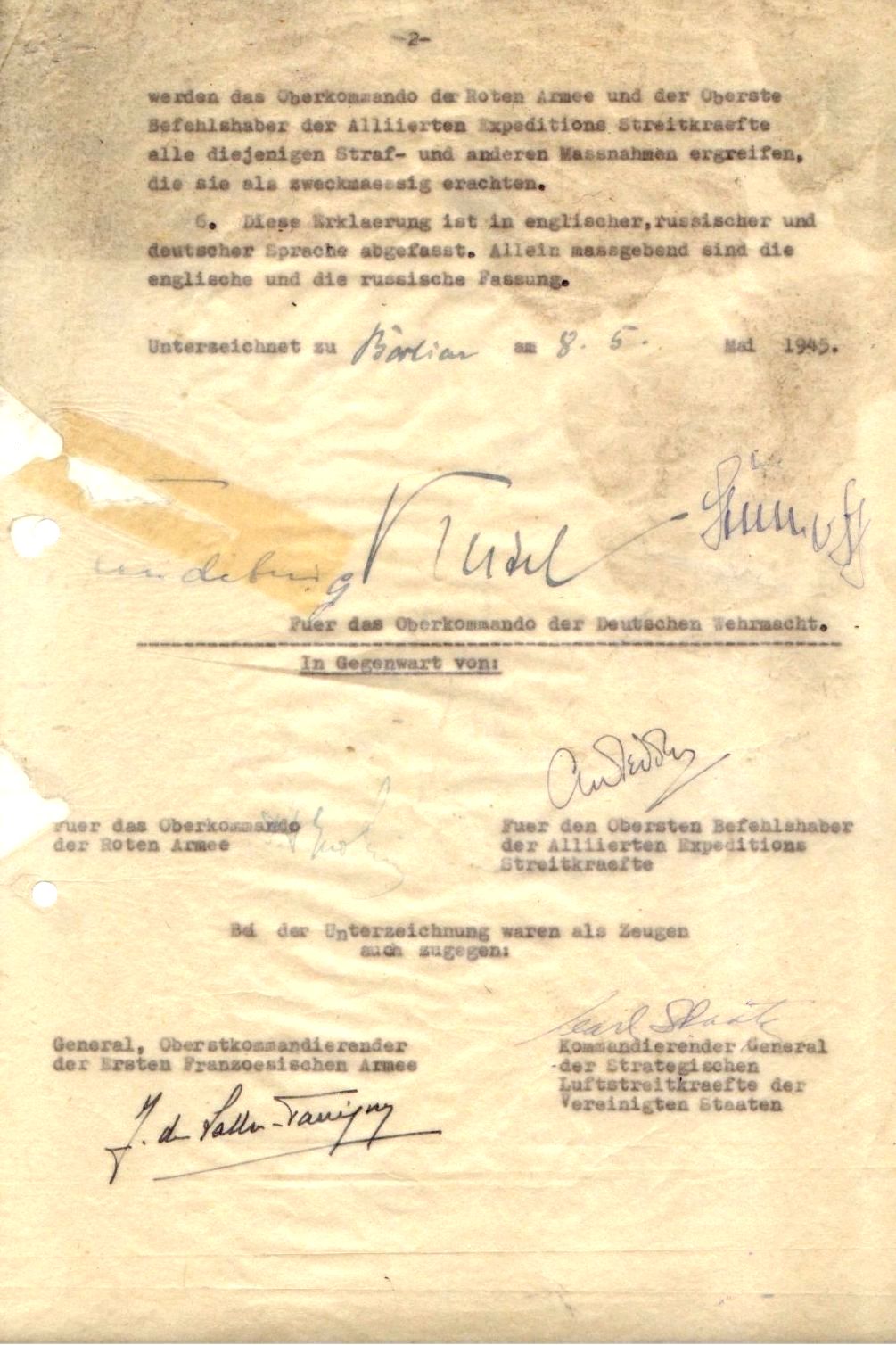
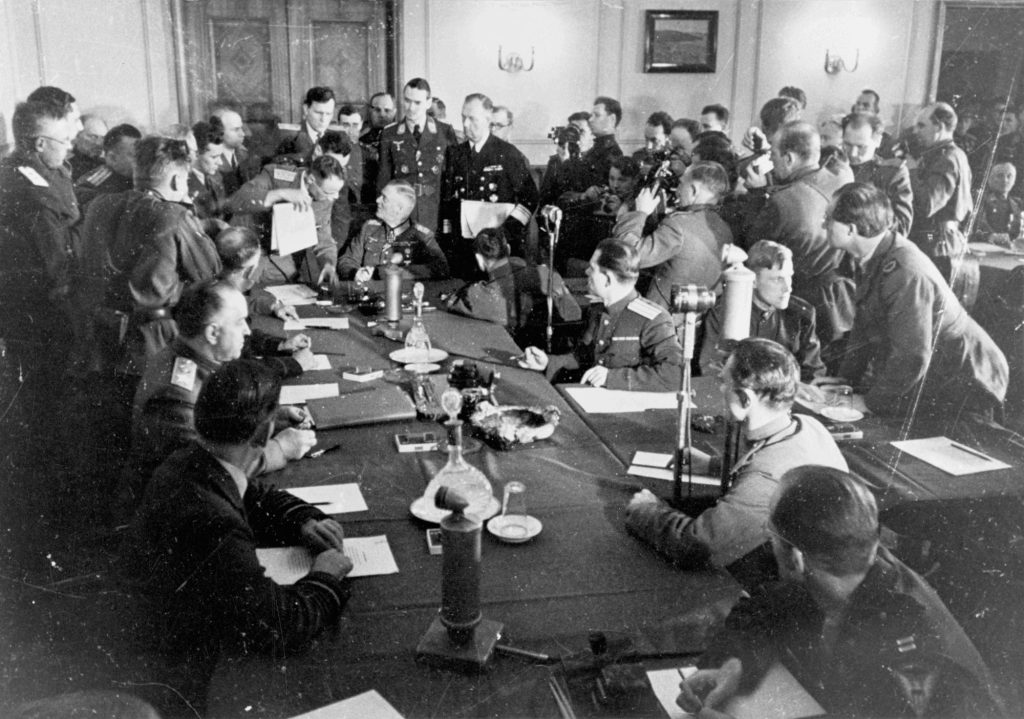
АКТ ПРО КАПІТУЛЯЦІЮ ВІД 8/9 ТРАВНЯТільки близько опівночі всі зібралися для участі у нетерпінні очікуваної церемонії підписання. 9 травня близько 00.45 годин командувачі німецькими сухопутними силами, ВМФ і люфтваффе: генерал-фельдмаршал Кейтель, генерал-адмірал фон Фрідебург і генерал-полковник Штумпф (як представник командувача люфтваффе фон Грейма) підписали Акт про капітуляцію. Кейтель був одночасно командувачем верховного головнокоман-дування вермахту (ОКВ). На закінчення свої підписи під датованим 8 травня 1945 року документом поставили від імені західних союзників маршал авіації Теддер і маршал Жуков від імені радянського командування. Як свідки Акт підписали американський генерал Спаатс і французький генерал де Латтр де Тассіньї. Уся церемонія тривала не більше 45 хвилин. Політичних декларацій не було. Процедура звелася тільки до конкретного підписання самого Акта. Після того, як німецька делегація залишила залу, Жуков виголосив коротку промову. Наступний потім банкет тривав до ранку.
|
||
 |
||
| Німецька
делегація вступає в зал, Берлін-Карлсхорст, 9 травня 1945 року.
Генерал-фельдмаршал Кейтель вітає присутніх своїм маршальським жезлом. Фото: Іван Шагін, Музей Берлін-Карлсхорст |
||
 |
||
| Командувачі видами німецьких збройних сил. За столом (зліва направо): генерал-полковник Штумпф, генерал-фельдмаршал Кейтель, генерал-адмірал фон Фрідебург. Фото: Тимофей Мельник, Музей Берлін-Карлсхорст | ||
 |
||
| Акт
скріплюють своїми підписами маршал авіації Теддер і маршал Жуков. Фото: Тимофей Мельник, Музей Берлін-Карлсхорст |
||
 |
||
| Під
час банкету: за столом (зліва направо): маршал авіації Теддер, маршал
Жуков, генерал Спаатс. Фото: невідомо, музей Берлін-Карлсхорст |
||
АКТ КАПІТУЛЯЦІЇ |
||
 |
||
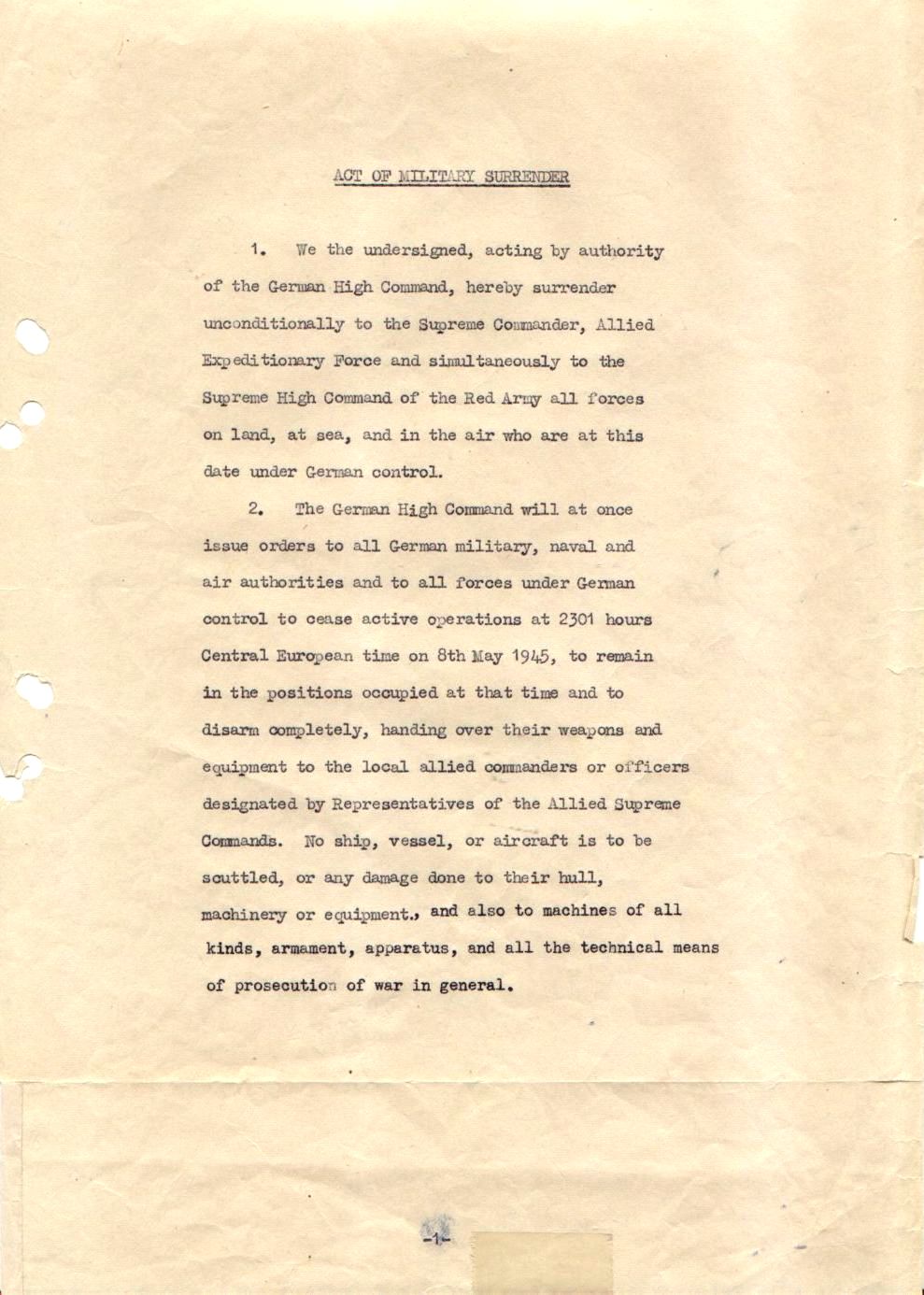
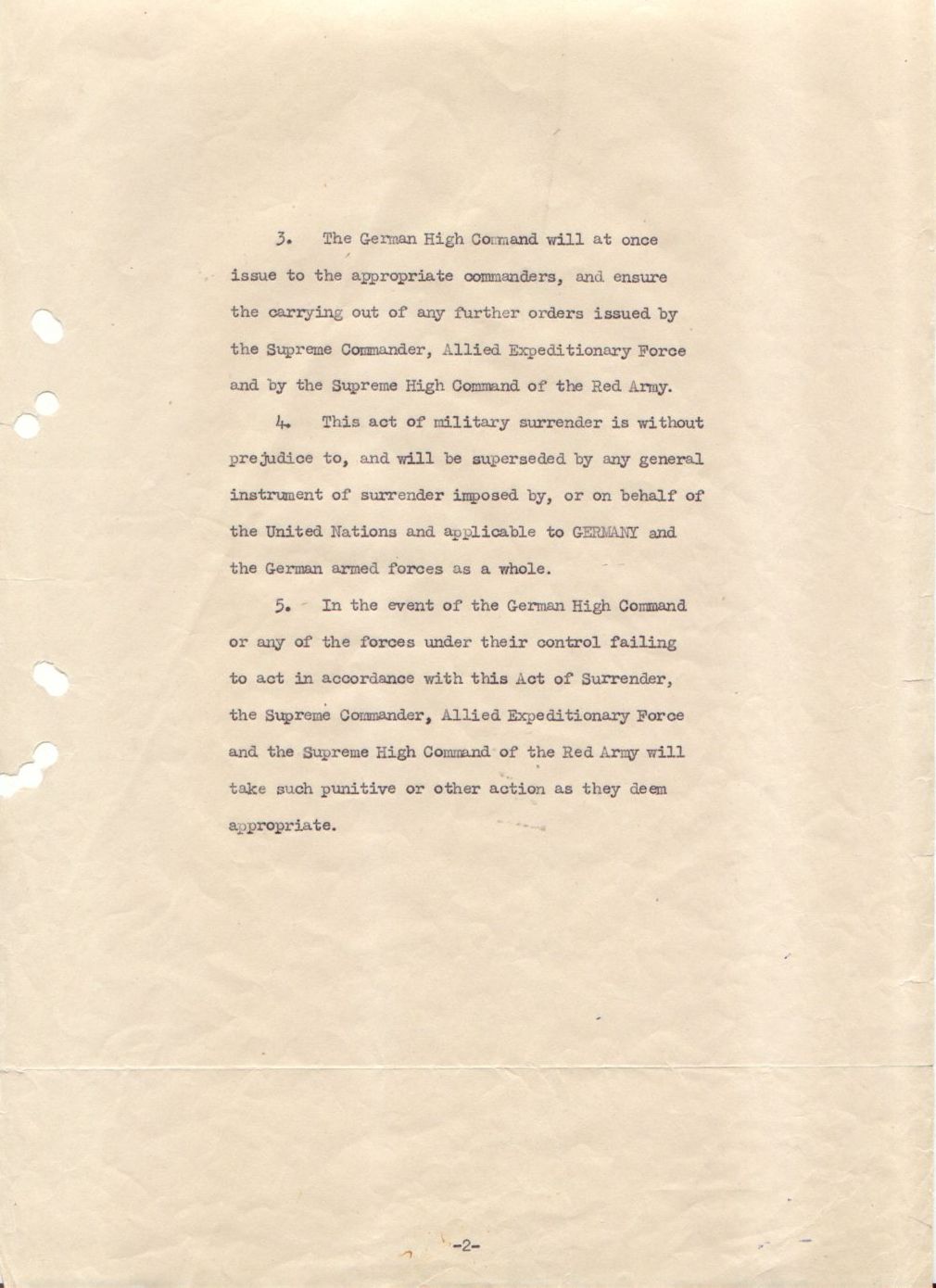
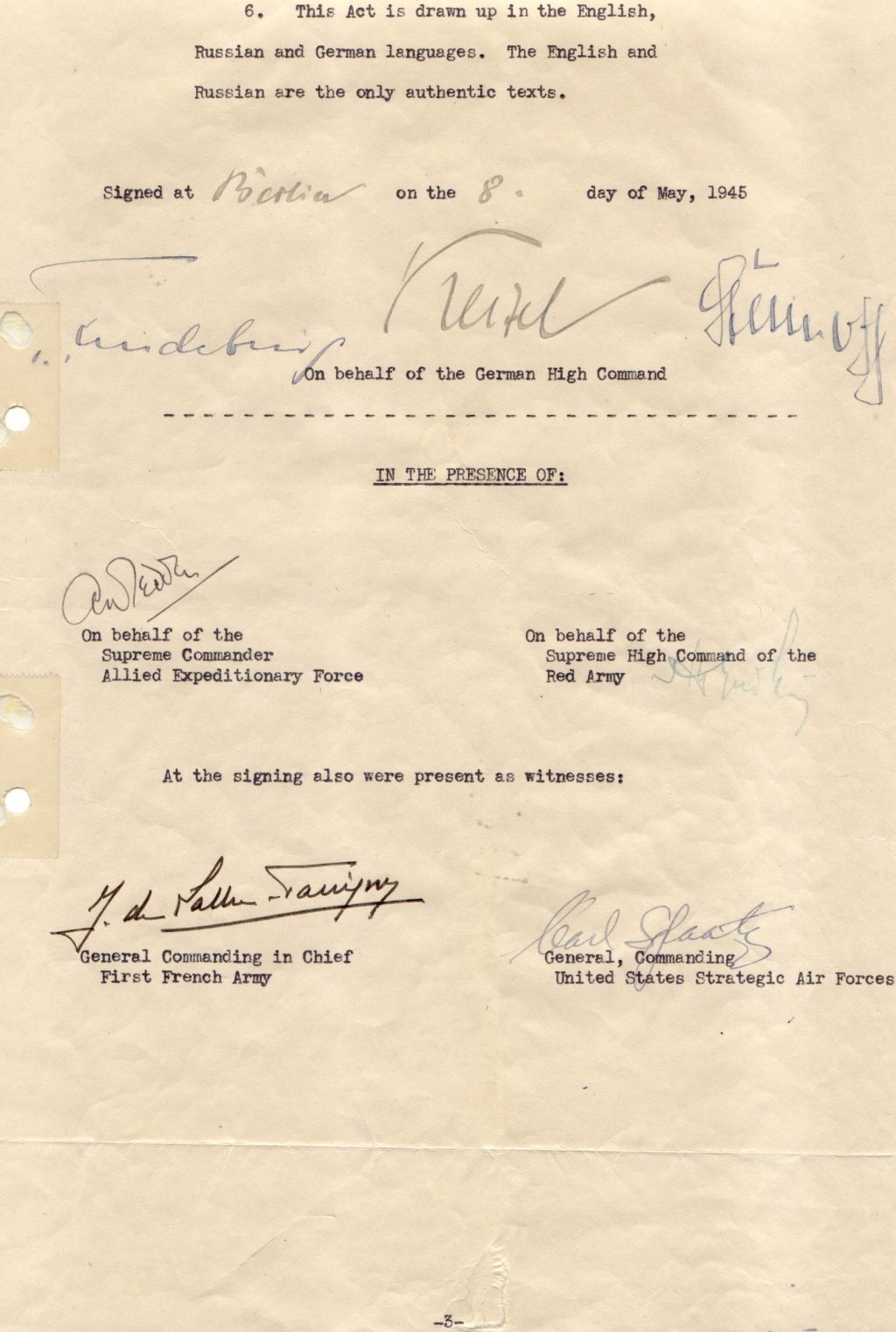
| Акт
капітуляції. Копії англійською, російською та німецькою мовами були
підписані в Карлсхорсті Федеральний архів – військовий архів, Фрайбург i. бр. |
||
 |
||
 |
||
 |
||
 |
||
 |
||
 |
||
 |
||
СПОГАДИБожеволіють фотографи й кінооператори. Підхоплюються на столи, навалюються животами на плечі генералам та знімають, знімають, знімають… Один із наших кінооператорів довгою ручкою свого апарата зачіпає по голові якогось американського адмірала. Адмірал, вочевидь, звичний до метушні кореспондентів, добродушно посміхається й махає рукою: «О’кей!». Але наші незвичні до цього розпорядники мало не виволакують бідолаху-оператора із залу. З: Костянтин М. Симонов. «Різні дні війни», Берлін/НДР, 1988, том II, стор. 805 Кейтель швидко піднявся, спрямувавши на нас недобрий погляд, а потім опустив очі і, повільно взявши зі столика фельдмаршальський жезл, невпевненим кроком попрямував до нашого столу. Монокль його впав та повис на шнурку. Обличчя вкрилося червоними плямами. … Після підписання акта Кейтель встав з-за столу, вдягнув праву рукавичку і знову спробував блиснути військовою виправкою, але це в нього не вийшло, і він тихо відійшов за свій стіл. З: Георгій К. Жуков, Спогади і роздуми, Москва 1969, стор. 668 Зникає так, немов усі надовго затримали повітря в грудях і разом випустили його. Загальний полегшений, розслаблений видих. Капітуляцію скріплено, війні – кінець. З: Костянтин М. Симонов. «Різні дні війни», Берлін/НДР, 1988, том II, стор. 807 За годину ми повернулися до зали, де було підписано капітуляцію, і виявили чудово сервіровані столи для грандіозного бенкету, а це означало щонайменше ще шість годин. Поруч із кожним прибором стояли пляшки: червоне вино, біле вино, шампанське, горілка і коньяк – така смертельна доза, яку тільки можна було собі уявити. Не дивно, що були великі втрати, спричинені алкоголем. Я був радий, що серед них не виявилося жодного британського представника. Переклад спогадів: Артур Теддер, With Prejudice. The War Memoirs of Marchal of the Royal Air Force Lord Tedder, Лондон, 1966, стор. 686
|
||
 |
||
| Фотографи
документують підписання капітуляції фельдмаршалом Кейтелем,
Берлін-Карлсхорст, 9 травня 1945 року Фото: Georgi Petrussow, Федеральний архів, зображення 183-J0422-0600-002 |
||
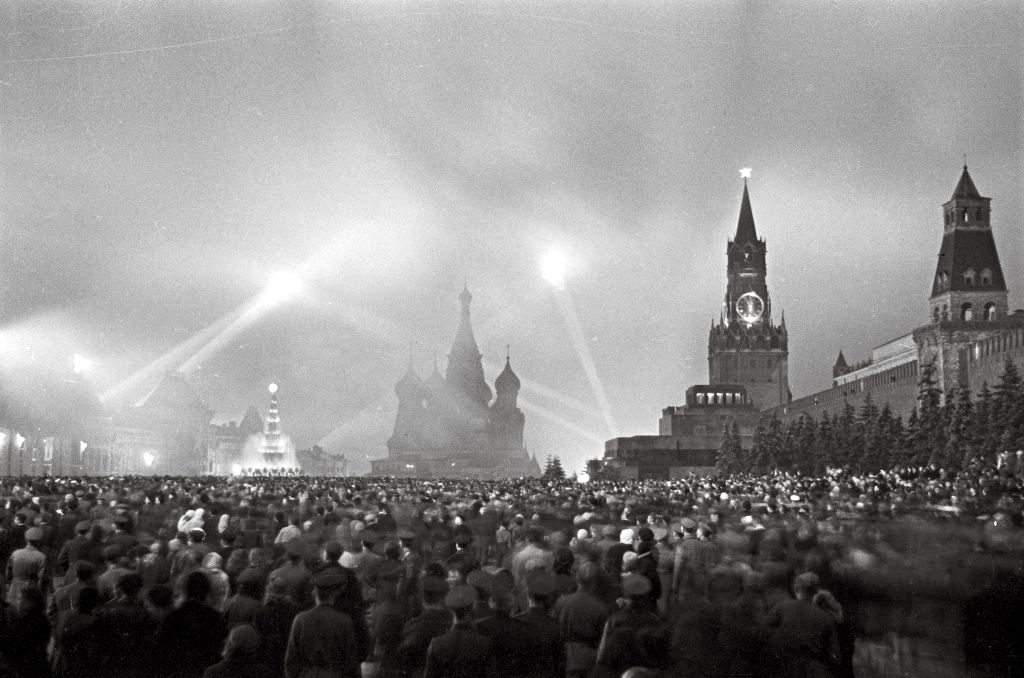
РЕАКЦІЯ ГРОМАДСЬКОСТІКапітуляція німецького вермахту в травні 1945 року означала закінчення війни в Європі. Друга світова війна загалом завершилася тільки після капітуляції Японії 2 вересня 1945 року. Після оприлюднення німецької капітуляції 8 травня люди в усьому світі святкували перемогу над німецьким фашизмом. У багатьох містах це вилилося в стихійні масові тріумфування на вулицях, як, наприклад, у Москві 9 травня, де про капітуляцію було повідомлено тільки після її підписання в Берліні-Карлсхорсті. Настрій у багатьох німців був скоріше пригніченим, зважаючи на злидні, що настали, і острах помсти з боку переможців. Водночас і для німецького населення капітуляція знаменувала собою також завершення націонал-соціалістичної тиранії, війни і руйнувань. Офіційне закінчення війни в Європі, однак, не означало закінчення страждань. Збройні конфлікти у Східній Європі тривали до 1950-х років, переважно проти радянської гегемонії. Наслідки війни були величезними для всього континенту. Багато регіонів було спустошено. Голод і скрута панували майже скрізь. Війна забрала 60 мільйонів жертв. Лише Радянський Союз втратив понад 27 мільйонів людей, у тому числі близько 14 мільйонів цивільних. Якщо матеріальні втрати протягом наступних років були поступово заповнені, то фізичні та психологічні наслідки Другої світової війни продовжують чинити свій вплив на суспільства та людей й досі.
|
||
 |
||
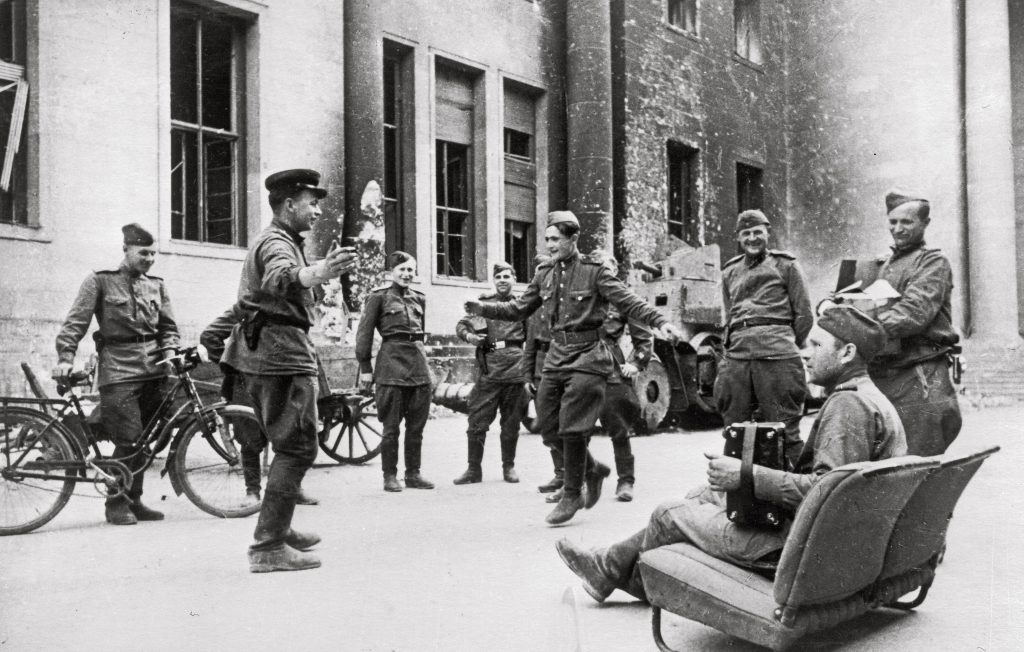
| Імпровізоване
свято, влаштоване радянськими солдатами на подвір’ї
імперської канцелярії на ранок після підписання капітуляції, Берлін, 9
травня 1945 р. Фото: невідомо, Фотоархів bpk, Берлін |
||
 |
||
| Народна
радість на Красній площі, Москва, 9 травня 1945 р. Фото: Тимофей Мельник, Музей Берлін-Карлсхорст |
||
 |
||
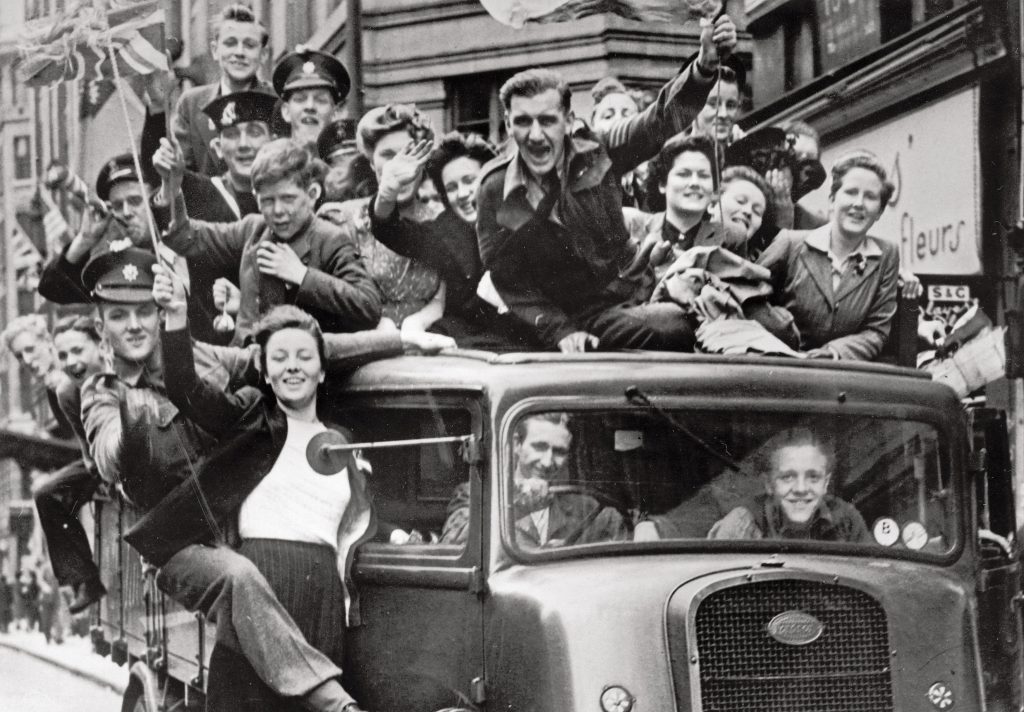
| Лондонці,
які святкують день перемоги, 8 травня 1945 р. Фото: невідомо, Фотоархів bpk, Берлін |
||
| «Учора вранці сталася
незабутня подія. Німці погодилися на повну, беззастережну капітуляцію.
Про це коротко, але в урочистій формі опубліковано в газетах». Запис у щоденнику від 10 травня 1945 р. З: Володимир Гельфанд, Німецький щоденник 1945-1946. Записки червоноармійця, Берлін, 2005, стор. 85 «8 травня, рівно через три роки після знищення гетто в Желудоку, ми отримали гарну звістку про те, що війна закінчилася і німці капітулювали. Усі були дуже схвильовані, але тільки не ми – кілька біженців, які потрапили в місто. Для нас і всередині нас поступово розгорталася трагедія. Ми безцільно штовхалися серед людей, які святкували. Я особисто був украй стурбований. Чи доведеться мені взагалі побачити хоч когось із моєї родини в живих? Я не отримав жодної відповіді на свої листи, які я невпинно писав, а тим часом уже минуло чотири місяці з моменту звільнення моєї батьківщини. Мої побоювання наростали з кожною миттю». Моше Бейрах, Із гетто в ліси. Розповідь єврейського партизана 1939-1945. Франкфурт/М., стор. 184 «Одного вечора, через кілька днів після нашого повернення, почалася стрілянина, як у найгірші часи. Мене аж тремтіння пробрало з голови до п’ят. Усю війну я трималася чудово, завжди залишалася спокійною, завжди збирала лише найнеобхідніше, коли ми вирушали в підвал. А зараз я подумала – фронт повертається. Німці повертаються. Знову все повториться з початку. Без розбору я покидала речі в рюкзак. Не можу висловити, як погано мені було. І тут хтось закричав із двору: «Росіяни влаштували феєрверк!». З усього, що тільки могло стріляти, вони палили в повітря – це був феєрверк – феєрверк з нагоди настання миру». Спогади однієї з мешканок району Пренцлауер Берг, цитується за: Антоніа Майнерс, Берлін 1945. Хроніка в ілюстраціях, Берлін 2005, стор. 70
|
||
 |
||
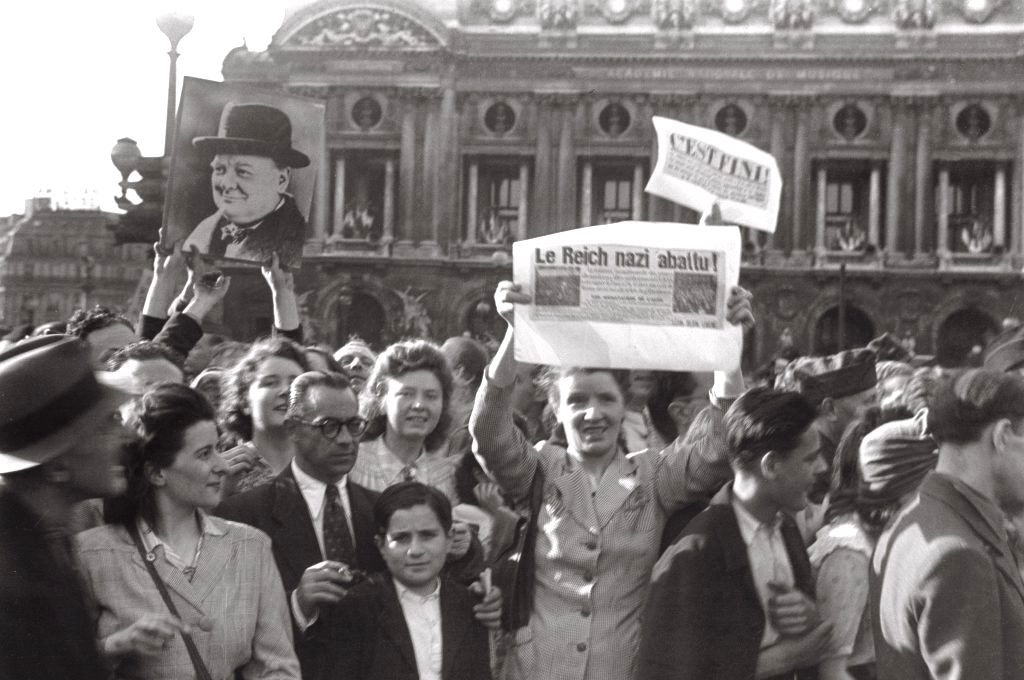
| Святкування
перемоги у Франції, 8 травня 1945 р. Фото: невідомо, akg images, Берлін |
||
 |
||
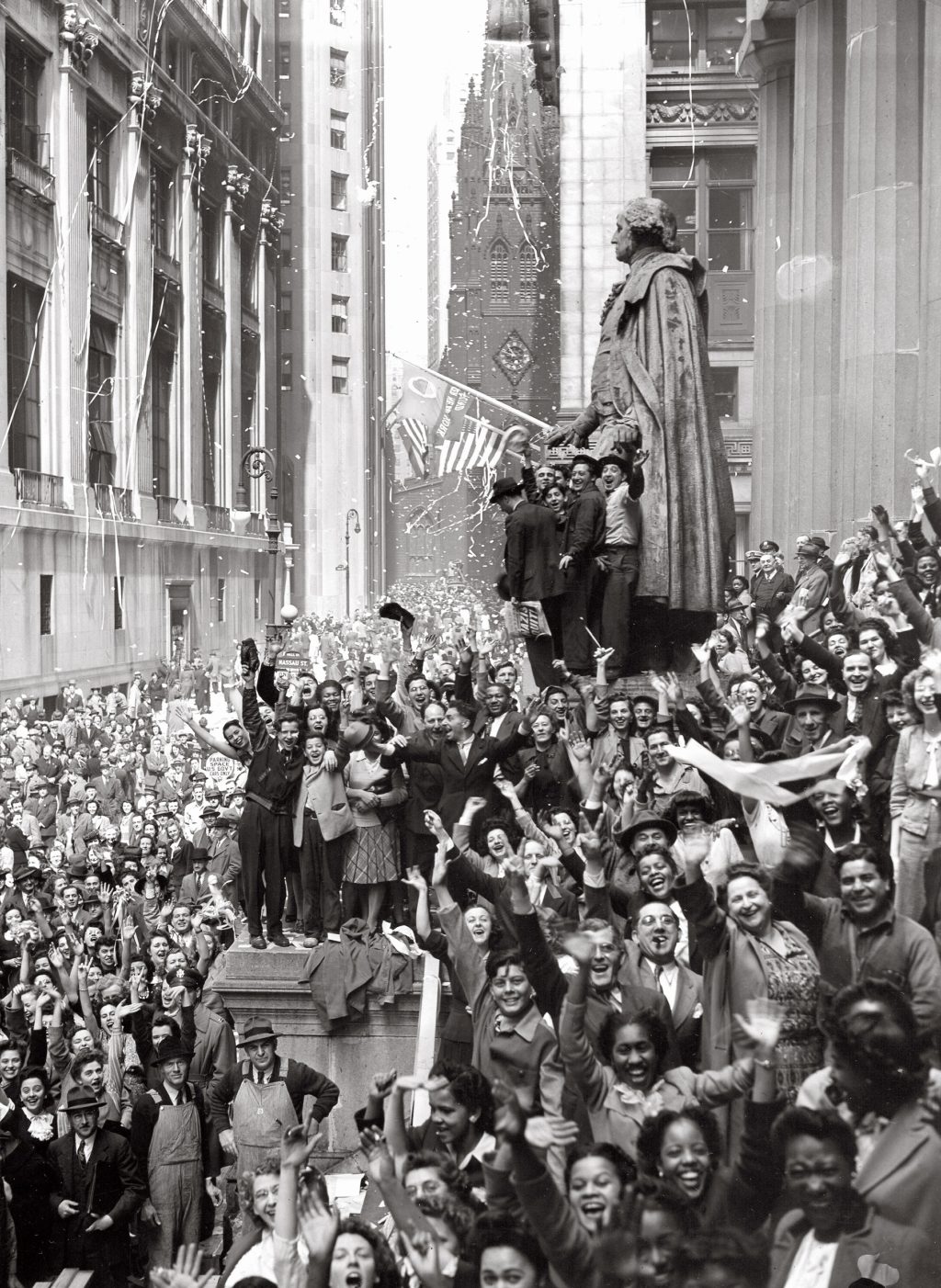
| День
перемоги в Нью-Йорку, 8 травня 1945 р. Фото: невідомо, akg images, Берлін |
||
ЛЕГЕНДИ ТА ФАКТИПісля 1945 року «холодна війна» вплинула на оцінку підписання обох актів про капітуляцію в Реймсі та Берліні-Карлсхорсті. При цьому кожна зі сторін висловлювала свій власний погляд на історію. Дезінформація та легенди наполегливо відстоюються і до сьогоднішнього дня. 7 травня в Реймсі німецький вермахт нібито капітулював тільки перед західними союзниками, а 8 травня в Карлсхорсті – перед радянськими збройними силами. Обидва акти були підписані перед обличчям представників усіх союзників, тобто перед англійською, американською та радянською сторонами в присутності представників Франції як свідків. У Реймсі було підписано не капітуляцію, а тільки попередній протокол. Справжня капітуляція відбулася лише 8 травня в Карлсхорсті. Капітуляція в Реймсі була правомірною. З цим був згоден і Радянський Союз, про що замовчувалося під час «холодної війни». Відмова Сталіна визнати капітуляцію в Реймсі та його протест нібито призвели до повторної церемонії підписання в Карлсхорсті для громадськості. Ще в Реймсі німецька делегація підписала додатковий протокол про те, що капітуляція має бути ратифікована верховним головнокомандуванням вермахту в особі командувачів видами збройних сил. Насамперед англійці наполягали на тому, щоб підпис начальника штабу оперативного керівництва ОКВ генерал-полковника Йодля, який не мав достатнього статусу, було підтверджено особами, що володіли відповідними командними повноваженнями. Підписання капітуляції після опівночі відбулося начебто внаслідок розбіжностей між союзниками з приводу змісту тексту. Перенесення на північ наміченого на другу половину дня 8 травня підписання відбулося через технічні причини: у Реймсі документ підписали тільки англійською мовою, а його подальший переклад російською мовою був неповним. Підписання відбулося близько 00.45 за центральноєвропейським літнім часом. За західноєвропейським часом було 23.45, а за московським – уже 02.45. Дата оголошення капітуляції в Москві 9 травня відповідала там офіційному часу закінчення війни. КАРЛСХОРСТ
ЯК МІСЦЕ ДЛЯ МУЗЕЮ
|
||
 |
||
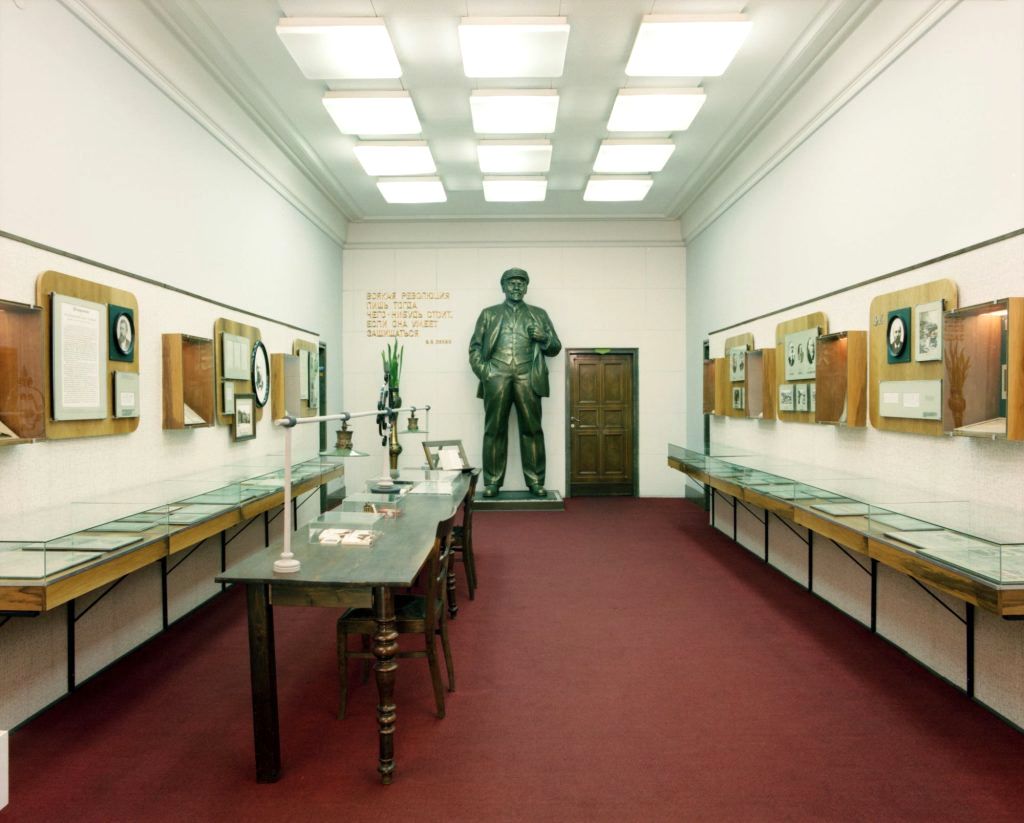
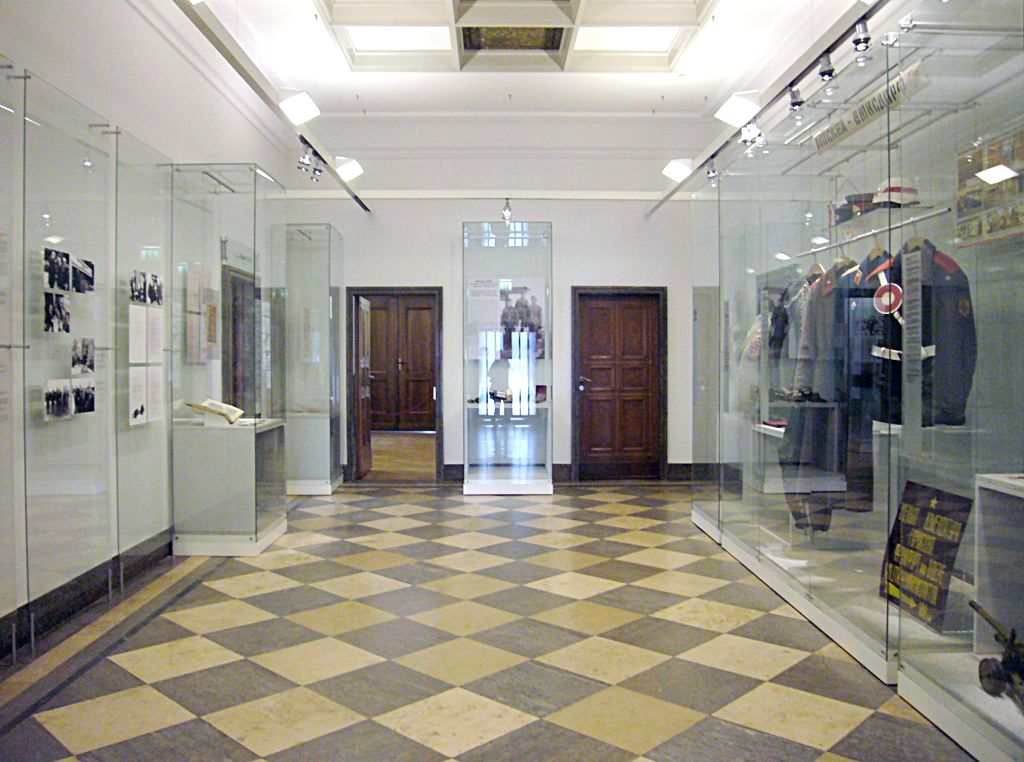
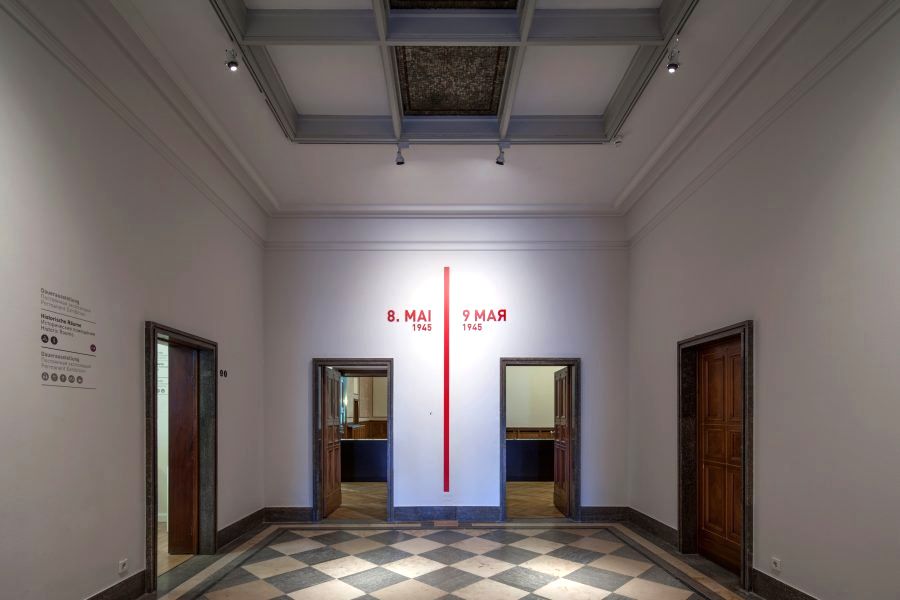
| Фойє
музею, 1967, 1995 та 2013 роках Фотографії: Юрген Квербах (1991/92), Марґот Бланк (1995/96), Томас Брунс (2013), Музей Берлін-Карлсхорст |
||
 |
||
 |
||
 |
||
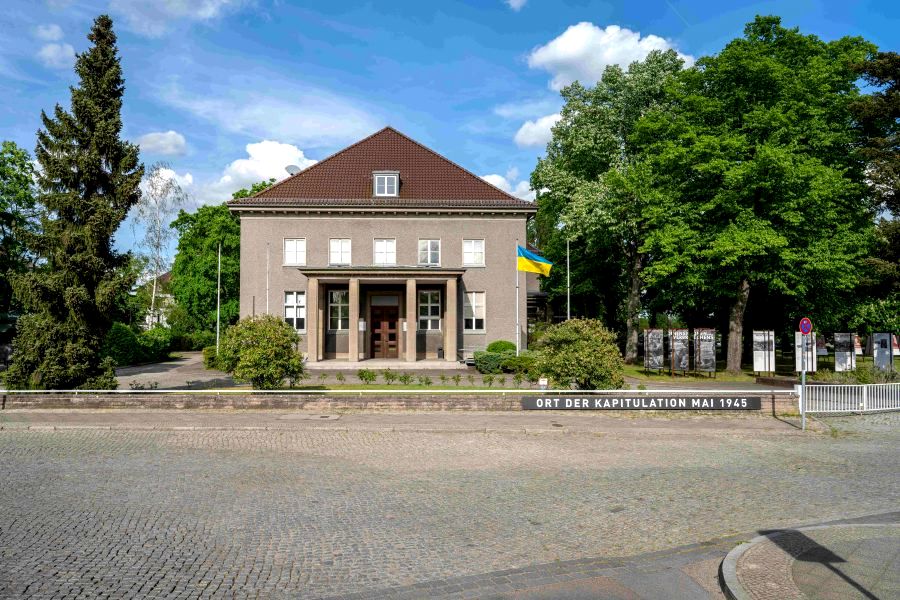
| Будівля
музею, травень 2022 року Фото: Гаррі Шнітгер, Музей Берлін-Карлсхорст |
||
ВИХІДНІ ДАНІМузей
Берлін-Карлсхорст |
||
Virtual tour of the museum:Tour of the permanent exhibition (upper and lower floors)) |
THE GERMAN SURRENDER IN MAY 1945 |
||
|
||
| Brandenburg
Gate, Berlin, May 2/3, 1945 Photo: Ivan Shagin, Museum Berlin-Karlshorst |
||
THE END OF THE WARWorld War II ended in Europe with the surrender of the German Armed Forces (the Wehrmacht) in May 1945. It marked the conclusive collapse of the Nazi’s despotic rule. Complete military and political defeat of the “Third Reich” was the overriding war goal of the forces allied against Germany. German military defeat rapidly accelerated in summer 1944. On June 22, the Red Army initiated a major offensive from which the Wehrmacht on the Eastern Front was not able to recover. Two weeks before, on June 6, western Allied troops had landed in northern France in a gigantic operation. The Germans were then faced with a war on two fronts. Starting in October 1944, warfare took place on German territory. On April 25, 1945, U.S. and Soviet units met at the river Elbe near Torgau. Berlin was seized by the Red Army. In mid-April the so-called Battle of Berlin began. After bitter street fighting with many casualties on both sides the German capital surrendered on May 2, 1945.
|
||
|
||
| White
»flags of surrender« consisting of sheets, towels,
and similar textiles, Berlin, April/May 1945 Photo: Arkadiy Shaykhet, Marija Shotikova private archive |
||
|
||
| Group
photo with the Victory Column: Soviet tank crewmen after the surrender
of Berlin, Berlin-Tiergarten, early May 1945 Photo: Timofey Melnik, Museum Berlin-Karlshorst |
||
THE END OF THE WAR IN BERLINOn April 21 Soviet units crossed Berlin’s eastern border and advanced toward the city center. Inside the suburban railway line circling the city they encountered stubborn resistance. The ten-day house-to-house fighting resulted in a high number of casualties. The dead in the battle of Berlin amounted to some 80,000 Red Army members, and on the German side some 20,000 soldiers and 30,000 civilians. Already on April 24 Colonel General Bersarin was appointed Soviet state commander of Berlin. His first headquarters were the officers‘ mess of the Karlshorst army engineering college, but in early May he and his staff relocated to Friedrichsfelde. Bersarin immediately organised a provisional food supply and the repair of infrastructure. He also saw to the establishment of a new city administration and cultural life. In his commands he attempted to prevent attacks, looting and rape by Soviet soldiers. The military commanders who had been appointed in the individual city administrative districts were assisted by exile communists, the so-called Ulbricht Group, who had been flown in from Moscow. In the beginning of July the four victorious powers took over their respective sectors in Berlin. |
||
|
||
| Wounded
in front of the Hotel Adlon, Berlin, May 2, 1945 There was an emergency military hospital at the Adlon Hotel. When it was set on fire by plundering Soviet soldiers, Soviet and German medical staff evacuated the patients onto to the street in front. Photo: Ivan Shagin, Museum Berlin-Karlshorst |
||
|
||
| The
Soviet state commander, Colonel General Bersarin, leaving the
commandant’s office at Alt-Friedrichsfelde 1, Berlin, May 1945 Photo: Yevgeny Khaldei, bpk Bildagentur, Berlin |
||
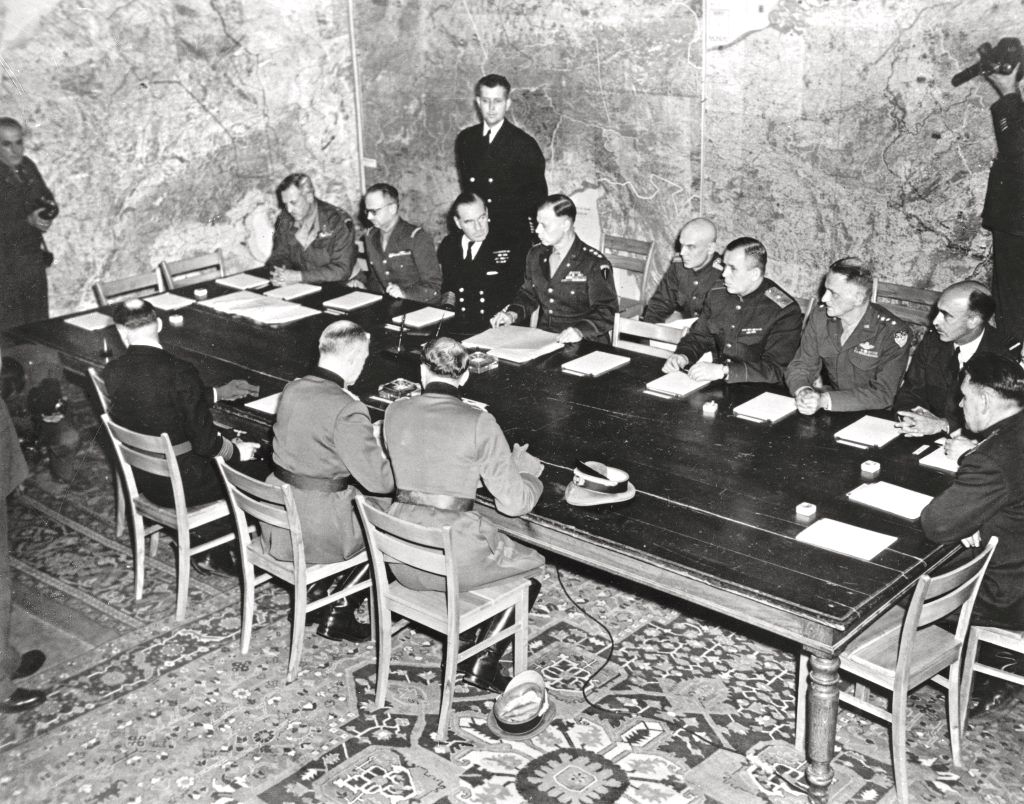
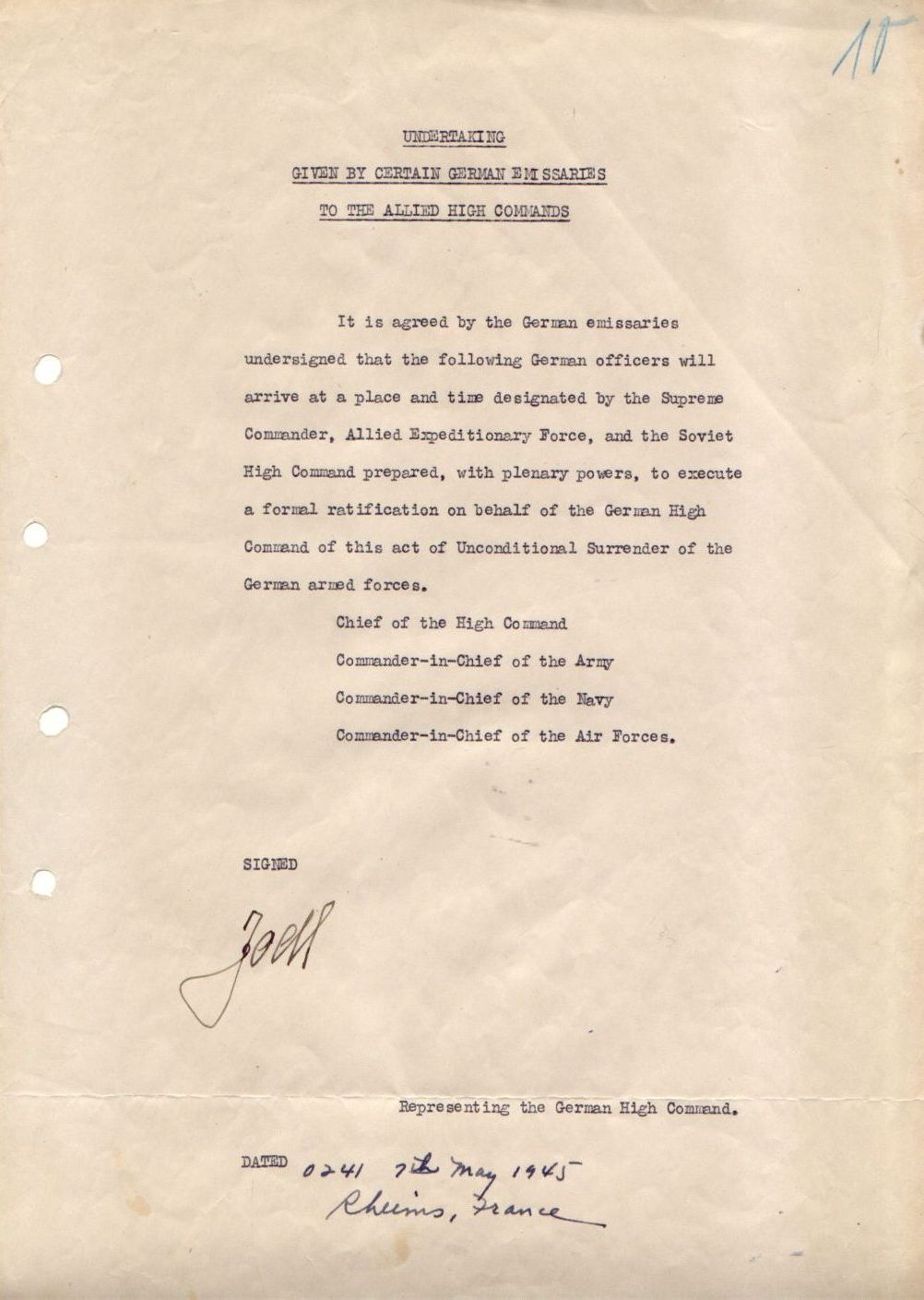
FIRST SIGNING OF THE SURRENDER IN REIMSAdolf Hitler committed suicide on April 30, 1945 in Berlin. He had previously appointed Grand Admiral Karl Dönitz as his successor. In view of the hopeless military situation, Dönitz attempted to negotiate a partial surrender to Great Britain and the USA. He sent Colonel General Alfred Jodl, Chief of the Operations Staff of the Armed Forces High Command, to Allied headquarters in the French city of Reims. However, U.S. General Dwight D. Eisenhower regarded this as an attempt to rupture the agreement among the Allies and insisted on an immediate and unconditional surrender to all Allied troops. Dönitz had to give way, and in the early morning hours of May 7 the unconditional surrender of the entire German Wehrmacht was agreed in Reims. In an additional protocol, all participants agreed that the surrender was to be ratified by higher-ranking German military officers in a second act. In order to assure an immediate cease-fire, U.S. President Harry Truman and British Prime Minister Winston Churchill announced the surrender on the next day. It went into effect on all fronts on May 8, 1945 at 23.01 Central European Time.
|
||
|
||
| Signing
the German surrender in Reims, May 7, 1945: the Chief of the Wehrmacht
Operations Staff, Colonel General Jodl (centre, front) with the Chief of Staff at Allied Headquarters, Lieutenant General Smith (3rd from left on the far side of the table), the Soviet liaison officer, Major General Susloparov (5th from left) and the French Army representative, Major General Sevez (2nd from left) Photo: unknown, bpk Bildagentur, Berlin |
||
|
||
| German
agreement to ratify the act of surrender Bundesarchiv-Militärarchiv, Freiburg i. Br. |
||
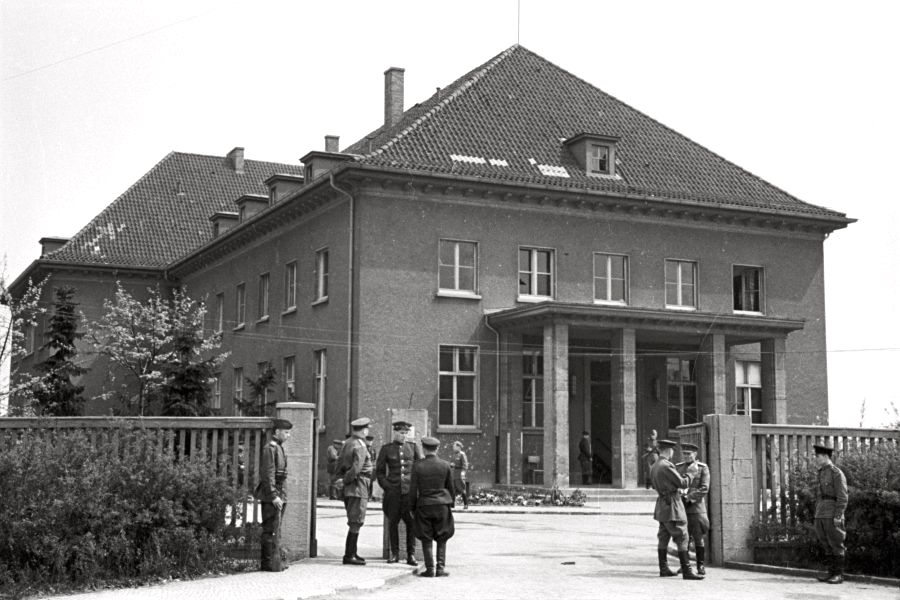
SECOND SIGNING IN BERLINThe second act of surrender was formally the more important part of Germany’s complete surrender. This was because in Reims the signing on the German side had not been performed by generals with actual power of command over the Wehrmacht. For that reason, especially the British feared that the German military leadership could try to shift the blame for the lost war – as it had in fact done at the end of World War I. The surrender was ratified at Soviet Headquarters in Berlin. As the representative of the Soviet High Command, Marshal Georgiy Zhukov had set up his staff headquarters in Karlshorst, an eastern district of Berlin, in an undamaged former Wehrmacht “pioneers” (engineering) school. To this location he invited the representatives of the victorious Allied forces, which now also included France. The Commanders in Chief of the three branches of the German Armed Forces were also summoned to Berlin. |
||
|
||
| Former
Officers’ mess of the Wehrmacht’s Pionierschule 1
and site of the unconditional surrender in Berlin-Karlshorst, May 8,
1945 Photo: Timofey Melnik, Museum Berlin-Karlshorst |
||
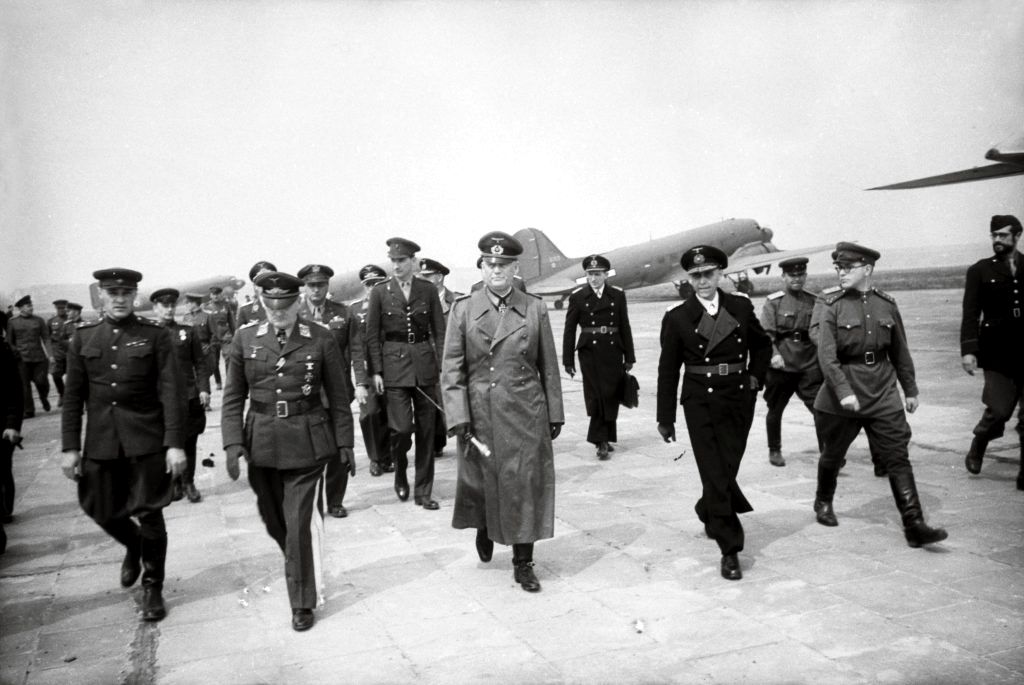
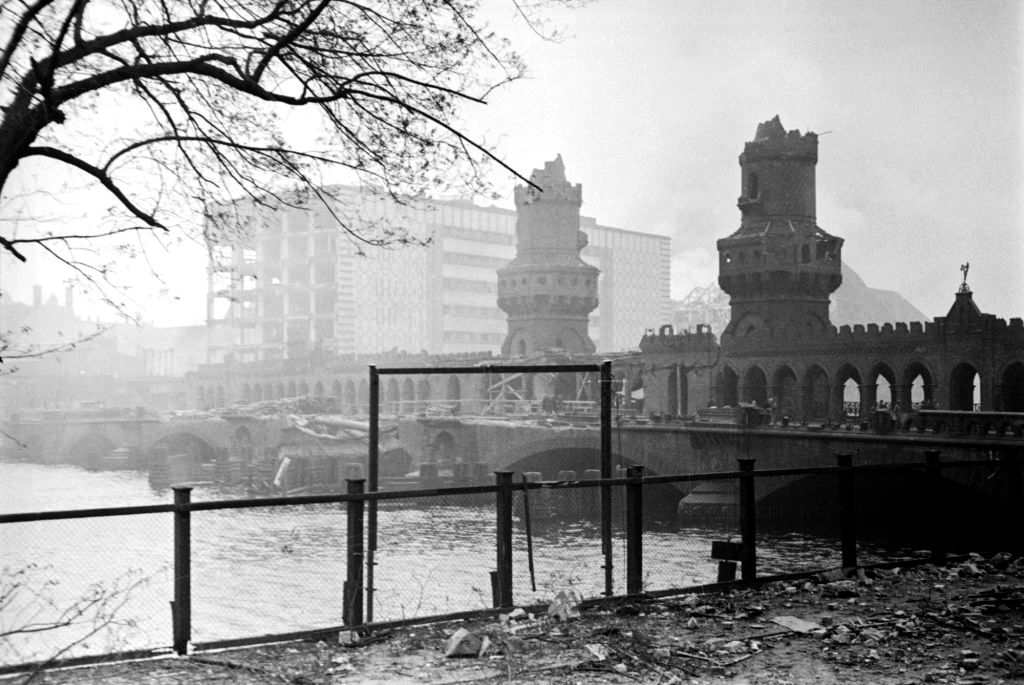
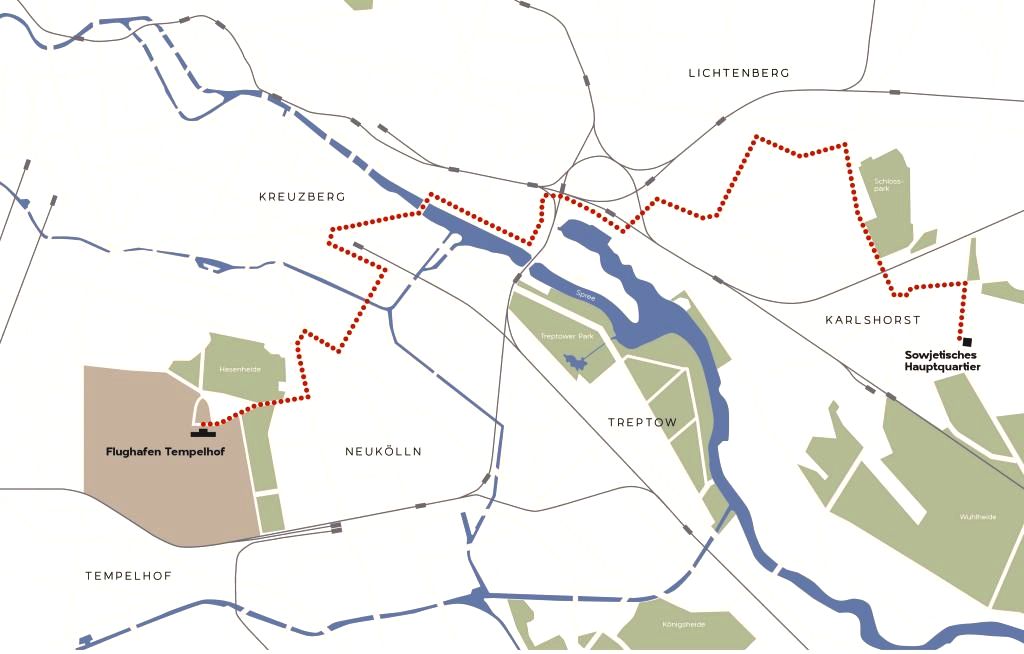
ARRIVAL IN TEMPELHOFOn May 8, 1945 all those who participated in the act of surrender met at Tempelhof airport. On the side of the Allies, Soviet State Secretary Wyschinski landed first in the morning. At noon followed British Air Marshal Tedder and the commander of the American long-distance flight forces, General Spaatz. During the afternoon General Jean de Lattre de Tassigny, the commander-in-chief of the French Army also arrived. The German delegation was flown in with an American aircraft from Flensburg, where the last government of the German Reich under Admiral of the Fleet Dönitz had withdrawn. Soviet soldiers received all the guests at Tempelhof airport and brought them across the destroyed inner city to the virtually undamaged residential area of Karlshorst.
|
||
|
||
| The
Supreme Commanders of the German Wehrmacht after arriving at Tempelhof
Airport, Berlin, May 8, 1945 Photo: Ivan Shagin, Museum Berlin-Karlshorst |
||
|
||
| Oberbaum
Bridge and warehouse, Berlin, April 30, 1945 Photo: Timofey Melnik, Museum Berlin-Karlshorst |
||
|
||
| Reconstructed
route of the delegations from Tempelhof to Karlshorst Graphic: Christine Kitta |
||
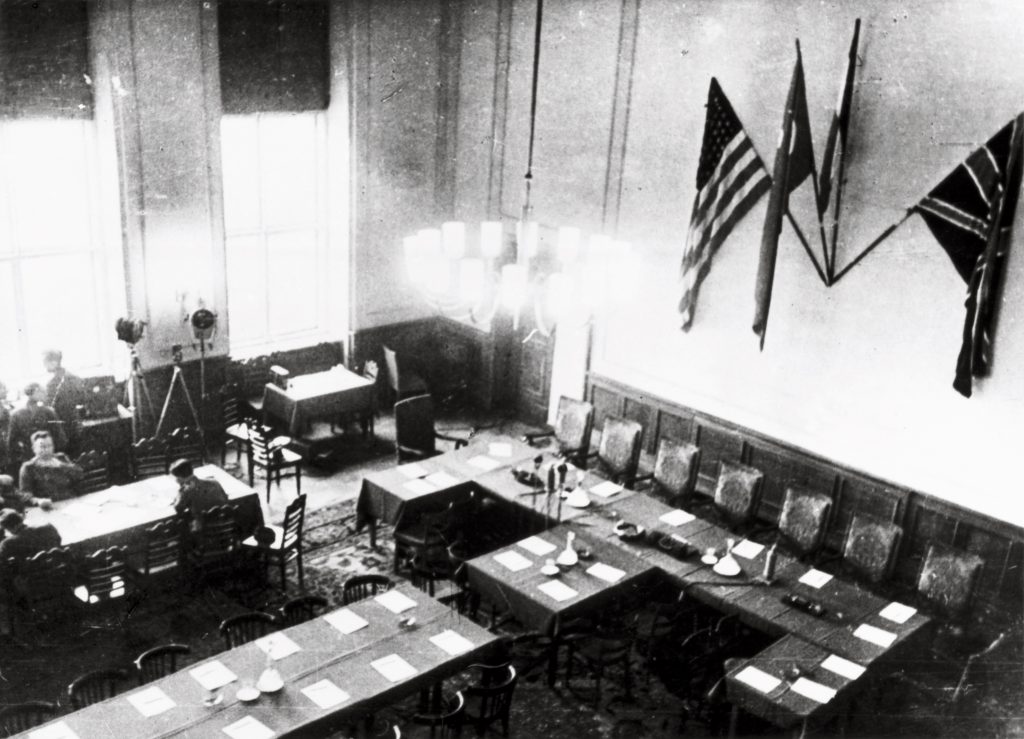
PREPARATION FOR THE SIGNINGAt short notice the formal hall of the former officers‘ mess of the army engineering college had been prepared for the event. In addition to the primary participants, numerous journalists, members of the alliied military staffs, translators and temporary workers were present. The ceremony was however delayed by several hours. A Russian version of the document, which until then was only available in English, had to be prepared and there was debate about stylistic modifications. The necessary coordination via radio further delayed this process. The content of the document signed the day before in Rheims remained however unchanged. In addition, a French flag was missing at the front end of the hall. Only the Soviet, British and American flags had been put up so a French flag had to be improvised and augmented with available cloth remnants. In the end, it was midnight before all preparations could be completed. |
||
|
||
| View
of the surrender room, Berlin-Karlshorst, May 8, 1945 Photo: unknown, Museum Berlin-Karlshorst |
||
|
||
| The
delegation of the German High Command is led to the building where the
surrender took place, Berlin-Karlshorst, May 8, 1945 The Commanders in Chief of the German Wehrmacht (from left to right: Colonel General Stumpff, Field Marshal Keitel, General Admiral von Friedeburg). Photo: Timofey Melnik, Museum Berlin-Karlshorst |
||
ACT OF MILITARY SURRENDER ON 8/9 MAYIt took up to around midnight for all parties to gather for the anxiously awaited signing. On May 9 around 0.45 a.m. the German Commanders in Chief of the Army, Navy and Air Force – Field Marshal Keitel, General Admiral von Friedeburg and Colonel General Stumpff (who represented Supreme Commander Field Marshal von Greim) – signed the surrender document, which was dated May 8. Keitel also had the High Command over the German Armed Forces (OKW). Then Air Marshal Tedder and Marshal Zhukov signed the document for the Western Allies and the Soviet High Command, respectively. U.S. Air Force General Spaatz and French General de Lattre de Tassigny signed as witnesses. The entire ceremony took about 45 minutes. No political statements were made. There was only the matter-of-fact signing. After the German delegation had left the room, Zhukov delivered a brief speech. The banquet which followed lasted well into the morning hours. |
||
|
||
| The
German delegation enters the hall, Berlin-Karlshorst, May 9, 1945 Field Marshal Keitel raises his baton in greeting. Photo: Ivan Shagin, Museum Berlin-Karlshorst |
||
|
||
| The
Commanders in Chief of the Wehrmacht (seated from left: Colonel General
Stumpff, Field Marshal Keitel, General Admiral von Friedeburg) Photo: Timofey Melnik, Museum Berlin-Karlshorst |
||
|
||
| Air
Marshal Tedder and Marshal Zhukov sign the document of surrender Photo: Timofey Melnik, Museum Berlin-Karlshorst |
||
|
||
| At
the banquet. Seated from left: Air Marshal Tedder, Marshal Zhukov,
General Spaatz Photo: unknown, Museum Berlin-Karlshorst |
||
SURRENDER DOCUMENT |
||
|
||
| Surrender
document. In Karlshorst, copies of the document were signed in English,
Russian and German. Bundesarchiv-Militärarchiv, Freiburg i. Br. |
||
|
||
|
||
|
||
|
||
|
||
|
||
|
||
MEMORIES„The photographers and cameramen go crazy. They jump up on the tables, pressing their bellies against the shoulders of the generals and shoot, shoot, shoot … One of our cameramen brushes against the head of an American admiral with his camera. The admiral, obviously accustomed to the hectic activities of correspondents, laughs good naturedly and waves him aside: ‘Okay!’ But our stewards, who are not used to such behavior, would really prefer to show the poor fellow the door.“ Translated from: Konstantin M. Simonow, Kriegstagebüche, 2 vols., Berlin/DDR 1988, vol. II, p. 805
„With a hostile glance at the presidium Keitel quickly rose from his seat; he then lowered his eyes, slowly picked up his marshal’s baton from the table and approached our table with hesitant steps. His monocle fell off, swinging from its cord, and his face was covered with red spots. … After signing, Keitel rose, put on his right glove, and attempted to assume a strict military posture. He could not manage it, and quietly returned to his table.“ Translated from: Georgi K. Shukow, Erinnerungen. und Gedanken, 2 vols., Berlin/DDR 1983, vol. II, p. 363
„And suddenly all the tension in the room dissipates. It disappears as if everyone had been holding his breath for a long time and then at the same moment finally let it flow out of his lungs. A general sigh of relief and exhaustion fills the room. The surrender is confirmed, the war over.” Translated from: Konstantin M. Simonow, Kriegstagebüche, 2 vols., Berlin/DDR 1988, vol. II, p. 807
„An hour later we returned to the room where the surrender had been signed, to find it all fully laid out for a large-scale banquet – and that meant six hours at least. There were bottles beside each plate – red wine, white wine, champagne, vodka, and brandy – as lethal a loading as one can imagine. It was not surprising that there were a number of alcoholic casualties. I was glad to note that none of them was British.“ From: Arthur Tedder, With Prejudice. The War Memoirs of Marshal of the Royal Air Force Lord Tedder, London 1966, p. 686
„The banquet ended in the morning with singing and dancing. Here the Soviet generals were simply unbeatable. In the end I, too, could not resist, felt young again, and performed a Russian folk dance.“ Translated from: Georgi K. Shukow, Erinnerungen und Gedanken, 2 vols., Berlin/DDR 1983, vol. II, p. 364
|
||
|
||
| Photographers
document the signing of the act of surrender by Field Marshal Keitel,
Berlin-Karlshorst, May 9, 1945 Photo: Georgij Petrusov, Bundesarchiv, Bild 183-J0422-0600-002 |
||
REACTIONSThe surrender of the German Wehrmacht in May 1945 meant the end of the war in Europe. But World War II itself ended only with the surrender of Japan at the beginning of September 1945. After the German surrender was announced on May 8, people worldwide celebrated the victory over German Fascism. There were spontaneous parades of jubilation in many cities. Such was the case on May 9 in Moscow, where the surrender was announced only after the signing in Berlin-Karlshorst. The official end of the war in Europe, however, did not mean the end of the suffering. Armed conflicts continued in Eastern Europe well into the 1950s, primarily against Soviet hegemony. The consequences of the war were enormous across the entire continent. Many regions were devastated. Hunger and hardship prevailed almost everywhere. The war claimed 60 million victims. The Soviet Union alone lost more than 27 million people, including approximately 14 million civilians. Although the material damage could be repaired little by little over the course of the following years, the physical and psychological impact of World War II affects people and societies up to the present. |
||
|
||
| Improvised
victory celebration by Soviet soldiers in the inner courtyard of
Hitler’s Chancellery, held the morning after the surrender
was signed, Berlin, May 9, 1945 Photo: unknown, bpk Bildagentur, Berlin |
||
|
||
| Celebrators
on Moscow’s Red Square, May 9, 1945 Photo: Timofey Melnik, Museum Berlin-Karlshorst |
||
|
||
| V-E
Day in London, May 8, 1945 Photo: unknown, bpk Bildagentur, Berlin |
||
|
“Yesterday morning something unforgettable happened. The Germans agreed to a complete, unconditional surrender. This was reported briefly but solemnly in the newspapers.” Diary entry for May 10, 1945 by Vladimir Gelfand, of the Red Army. Source: Wladimir Gelfand, Deutschland-Tagebuch 1945–1946. Aufzeichnungen eines Rotarmisten, Berlin 2005, p. 85
“On May 8 we got the good news that the war was over and that Germany had surrendered, precisely three years after the destruction of the ghetto in Žaludok. Everyone was very excited, except for us, the few refugees in the city. For us and in us a tragedy slowly unfolded. We walked around aimlessly among the celebrators. I myself was extremely worried. Would I find any of my family alive at all? I had received no answers to the letters I had written during all that time, and in the meantime four months had already gone by since the liberation of my homeland. My fears increased with every moment.” Moshe Beirach, a Jewish partisan. Source: Aus dem Ghetto in die Wälder. Bericht eines jüdischen Partisanen 1939–1945, Frankfurt a.M., p. 184 f.
“A few days after our return, shooting broke out in the evening just as in the worst days. My whole body began to tremble. All during the war I had held out wonderfully, always staying calm, only packing what was absolutely necessary when we fled to the cellar. Now, I thought, the war front is here again. The Germans are coming back. It is all going to start again. I threw whatever I could get hold of indiscriminately into my backpack. There are no words to describe how terrible I felt. Then someone called up from the courtyard: ‘The Russians are staging fireworks!’ They were firing in the air with whatever they had to shoot with – fireworks – peace fireworks.” Memories of a woman from Prenzlauer Berg, quoted in: Antonia Meiners, Berlin 1945. Eine Chronik in Bildern, Berlin 2005, p. 70 |
||
|
||
| Victory
celebrations in France, May 8, 1945 Photo: unknown, akg images, Berlin |
||
|
||
| V-E
Day in New York, May 8, 1945 Photo: unknown, akg images, Berlin |
||
LEGENDS AND FACTSAfter 1945 the Cold War influenced the assessment of the two acts of surrender in Reims and Berlin-Karlshorst. Each side cultivated its own view of the historic events. Misinformation and legends have been persistently retained up to the present time. The German Wehrmacht surrendered to the Western Allies on May 7 in Reims and to the Soviet Armed Forces on May 8 in Karlshorst Both acts took place before representatives of all the Allies, in other words, the British, U.S. and Soviet Armed Forces, with representatives of the French Armed Forces serving as witnesses. No surrender was signed in Reims but rather a preparatory protocol. The actual act of surrender took place on May 8 in Karlshorst. The surrender in Reims was legally binding. The Soviets also saw it that way, but kept quiet about it during the Cold War. Stalin’s refusal to recognize the Reims surrender and his official protest led to a second ceremony in Karlshorst for the benefit of the public. Already in Reims, the German delegation signed a supplementary protocol which specified ratification of the surrender by the commander in chief of the Wehrmacht and the supreme commanders of the three branches of the armed forces. Particularly the British insisted that the signature of the Chief of the Operations Staff of the Armed Forces High Command, Alfred Jodl, an officer without the power of command, be reinforced by the signatures of those with the power of command. Disputes among the Allies about the wording of the text led to a delay in signing until after midnight. The delay in signing from the afternoon of May 8 to midnight had technical reasons: in Reims only an English language document had been signed. The transmission of the Russian translation was initially incomplete. The signing took place at about 0.45 a.m. Central European Summertime. According to Western European Time it was 23.45; according to Moscow time it was already 2.45 of the next morning. May 9, the date on which the surrender was announced in Moscow, is considered there as marking the official end of the war in Europe. KARLSHORST AS A MUSEUM LOCATIONIn 1967 a museum opened at the historic location of the end of the war. After 1945, the Soviet military had continued to use the former officers‘ mess. The so-called surrender museum had primarily in mind members of the Soviet military who were stationed in the German Democratic Republic. But it was also open to the general public. With the departure of Soviet/Russian troops, the Federal Republic of Germany and the Russian Federation agreed in 1994 to retain the museum’s location, but to fundamentally revise its content. The new museum opened in May 1995. It was supported by a registered society in which the initial membership consisted of German and Russian institutions. In the following years the World War II museums in Ukraine and Belarus were added. Ever since Russia massively expanded its war against Ukraine in breach of international law on February 24, 2022, the museum has been confronted with principle questions: What could be an acceptable institutional foundation in the future? Which conceptual and substantive adaptations are required? A critical analysis of these questions continues with high priority. |
||
|
||
| The
museum foyer, 1967, 1995 and 2013 Photos: Jürgen Querbach (1991/92), Margot Blank (1995/96), Thomas Bruns (2013), Museum Berlin-Karlshorst |
||
|
||
|
||
|
||
| View
of the Museum building, May 2022 Photo: Harry Schnitger, Museum Berlin-Karlshorst |
||
IMPRINTMuseum
Berlin-Karlshorst |
||
© Museum Berlin-Karlshorst