

 Russian
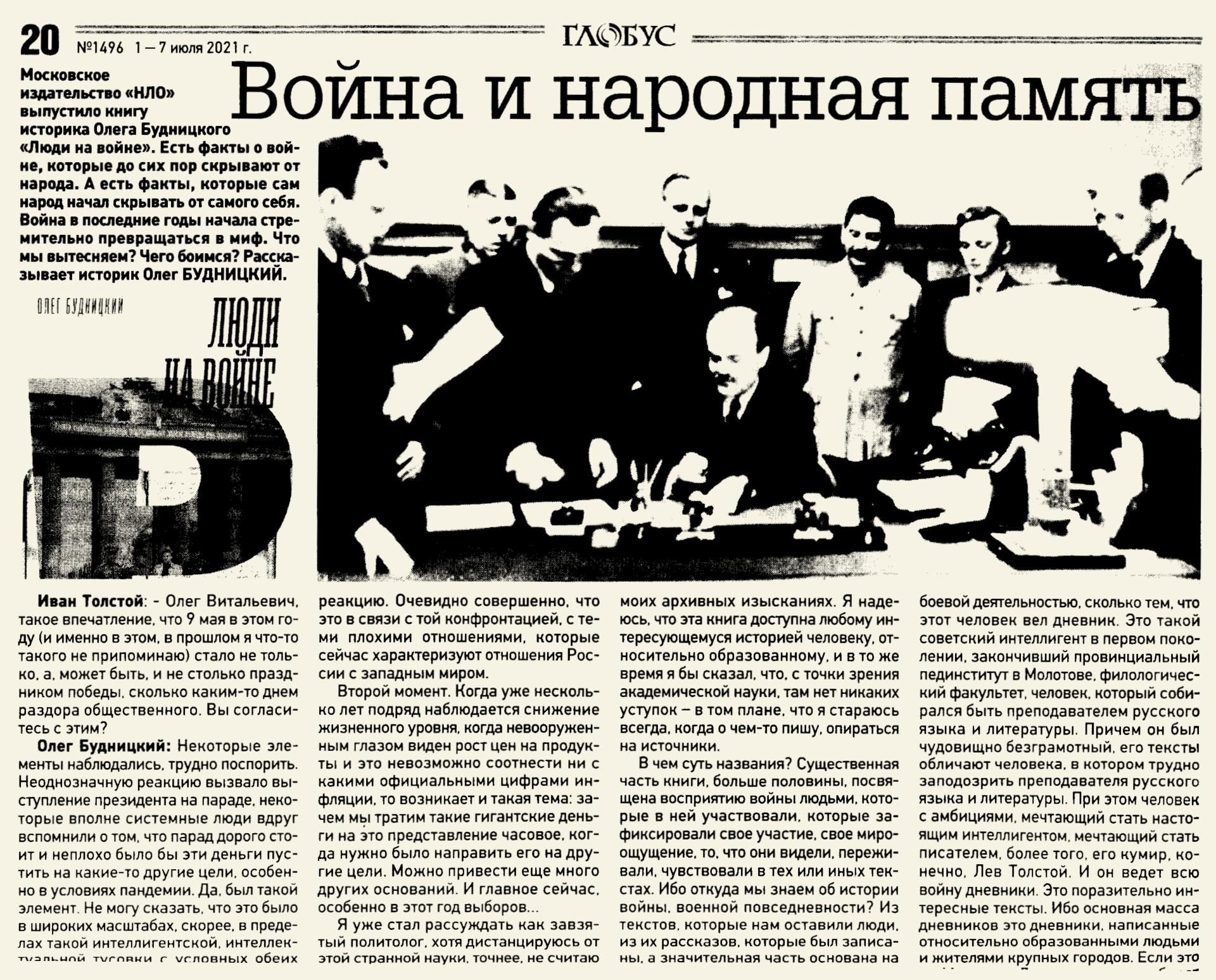
War and Public Memory
Globus newspaper, No. 1496, 1-7 July 2021, pp. 20-23
The Moscow publisher NLO has released historian Oleg Budnitsky’s book ‘People at War’. There are facts about the war that are still being concealed from the public. And there are facts that people themselves have begun to hide from themselves. In recent years, the war has rapidly been turning into a myth. What are we repressing? What are we afraid of? Historian Oleg Budnitsky discusses these questions.
Ivan Tolstoy: Oleg Vitalyevich, it seems that this year 9 May - and this year specifically; I do not remember anything quite like it last year - became not only, and perhaps not so much, a celebration of victory as a day of public discord. Would you agree?
Oleg Budnitsky: There were signs of that; it is hard to dispute. The president’s speech at the parade drew a mixed response. Some thoroughly establishment-minded people suddenly remembered how expensive the parade was and suggested that the money might be better spent on other things, especially during a pandemic. Yes, that element was there. I cannot say it was widespread; it was more a matter of intellectual and educated circles on both notional sides.
Ivan Tolstoy: Leaving aside the state and the establishment, let me ask about what you called intellectual circles, or perhaps the educated milieu. Why are there disagreements here? Within living memory, was there not a certain unity of outlook? Not complete unity, perhaps, but a common direction, a shared attitude towards this day, however complicated that attitude might have been. Nevertheless, I have the impression that there was some unity. This year there is confusion and discord. People quarrel and fall out over differing attitudes to this day that they consider inappropriate.
Oleg Budnitsky: That is fairly easy to explain. I would recall Mikhail Pokrovsky’s famous statement that ‘history is politics projected into the past’. Admittedly, Pokrovsky applied this to bourgeois historians. In reality, however, when politicians or amateurs discuss history, it almost always involves politicisation, relating the past to the present and drawing direct extrapolations. Russia’s relations with the West, broadly understood, are currently quite strained, and it is no coincidence that the president’s speech does not mention the Allies at all. Moreover, it says that during the decisive battles the Soviet people fought Nazi Germany alone. That provoked a strong reaction. It is quite clearly connected with the confrontation and poor relations that now characterise Russia’s relationship with the Western world.
A second point: when living standards have been declining for several years, when rising food prices are plain to see and cannot be reconciled with any official inflation figures, another question arises. Why are we spending such enormous sums on this hour-long spectacle when the money ought to have gone to other purposes? Many other reasons could be given. And the main thing now, especially in this election year…
I have started talking like an inveterate political scientist, although I distance myself from that strange discipline; indeed, by and large I do not regard it as a science. I hope political scientists will not take offence… Once those in power began to regard the notional opposition as an enemy rather than a normal part of life, and once no form of dialogue could be seen between that opposition and the authorities, any event, including a historical one, became material for polemics. These polemics actually have nothing to do with historical realities. Everyone imagines a war of their own and finds in it whatever suits them and whatever can be used against the other side. That is how I would put it in the broadest terms.
Ivan Tolstoy: In that case, let us turn to your much-discussed book. I have not yet read printed reviews, but I am already hearing responses from readers, from people I know and on Facebook. It has an interesting title: ‘People at War’. Let us start with that. It is a very unacademic title, yet you are an academic.
Oleg Budnitsky: I do not claim that my book is an academic monograph; it is intended for a broad readership. At the same time, it is thoroughly scholarly in the sense that it is based on research. Some pieces are more accessible, some less so. Some draw on existing literature, while others are based on my archival investigations. I hope the book is accessible to any reasonably educated person interested in history. At the same time, I would say that it makes no concessions in terms of scholarly standards: whenever I write about something, I always try to base it on sources.
What does the title mean? A substantial part of the book, more than half of it, concerns how war was perceived by the people who took part in it and recorded their participation, their outlook, and what they saw, experienced and felt in various kinds of texts. Where does our knowledge of the history of war and everyday wartime life come from? From the writings people left us and the accounts that were recorded. Much of it rests on wartime diaries and interviews - then called ‘conversations’ - conducted by historians during the war itself, before an established narrative had taken shape, when people often said things they could not even have imagined recounting later.
What else do I regard as important sources about the actual experience of war, about the real war? Memoirs written not many years later, when there was a trend towards criticising and reassessing everything Soviet, but under Soviet rule, for the drawer, with no hope of publication. Those, too, are very important texts: someone writes knowing that the work will never see the light of day and can therefore entrust important thoughts and impressions to paper. Those were the sources I relied on above all. Hence these essays based on personal perceptions of war. I try to understand how people of that time felt in those particular circumstances.
That is where the title ‘People at War’ comes from. The people are very different: unknown, little-known or very famous. Few people, for example, have heard of Georgy Slavgorodsky. He began the war as a sergeant and ended it as a battalion commander, a major. He died shortly before victory, in late January 1945, and was posthumously awarded the title Hero of the Soviet Union. Yet what interests me is less his military service than the fact that he kept a diary. He was a first-generation Soviet intellectual, a graduate of the philology department of a provincial teacher-training institute in Molotov, who intended to teach Russian language and literature. His literacy was appalling: his writings hardly suggest a teacher of Russian language and literature. Yet he was ambitious, dreamed of becoming a true intellectual and a writer, and naturally idolised Leo Tolstoy. He kept diaries throughout the war. They are astonishingly interesting. Most diaries were written by relatively educated people and residents of major cities: if not Moscow or Leningrad, then Dnepropetrovsk or Kyiv. Here, however, was a man from the Don hinterland, near Millerovo, whom fate had brought to Molotov and who fought through almost the entire war.
There are very interesting things in those diaries. He had no ambition whatsoever to be a soldier, even though that was what he did best. He fought extremely well and, as he wrote of himself, ‘got carried away with the war again’. Not a game, but the actual war. Things went brilliantly for him: without any substantial military education, he became a battalion commander and a major, received various decorations, and was posthumously made a Hero of the Soviet Union. There are his observations on military service, everyday life, comrades and relationships with women. He dreamed of starting a family, of love, of simply drinking and relaxing with his comrades instead of fighting. Yet fate made him fight, and he remains in history as the man he became, Major Slavgorodsky.
The entries cover all kinds of things: the retreat of 1941, the Battle of Stalingrad, in which he took part, the offensives of 1944-45, and relations with civilians. It is an extraordinarily revealing text. I published it - or, more precisely, Alexander Borisovich Izyumsky published it at my suggestion, with my introduction. In this essay I tried to analyse what kind of man he was and what testimony about his time he left behind.
Ivan Tolstoy: If your book consists of personal records, or ego-documents, does that mean that its subjects have a local, narrow, small-scale perspective, that their horizons are limited to what they can see and that the book does not even raise the larger questions?
Oleg Budnitsky: First, it is precisely these individual perspectives, these fragments, that make up the larger picture. We have grown accustomed to viewing events from the standpoint of gods and heroes, marshals and generals, and party and government leaders. Yet real war, war on the ground, in the field, looks quite different from how it appears at headquarters, where a battlefield resembles a chessboard. What we see in marshals’ and generals’ memoirs, most of which were written not by the men themselves but by ghostwriters - what was called ‘literary recording’… I hope I will not be suspected of racism: the customary Russian expression for a ghostwriter is literally a ‘literary negro’, meaning someone who writes a work published under another person’s name. Here, by contrast, we see the actual fabric of events, what really happened and what it looked like. These small fragments form the mosaic of a complex picture of war.
But the book is not only about that; the title does not cover everything. ‘Events and People’ might have been more accurate, but the publishers thought it sounded less elegant, and I agreed. I write about major events that shaped the course of history. The book opens with Munich, in a chapter called ‘The Victors Lost in Munich’. The next chapter deals with the Molotov-Ribbentrop Pact. I analyse something that is often overlooked: who actually benefited from the agreement, what Germany ultimately gained and what the Soviet Union gained.
Ivan Tolstoy: That is very interesting. I would like to dwell on that subject.
Oleg Budnitsky: The evidence shows that it was a colossal mistake by Stalin. I quote the words of a figure from the French Revolution: ‘It is worse than a crime; it is a mistake.’ What was Stalin counting on? He expected to be the third party who benefits when two others fight. Like many military men and politicians, he was preparing for the last war. A clash with the Western powers was clearly coming: they had given guarantees to Poland. They had thought they could appease Nazi Germany in Munich and that somehow things would settle down. Instead, Hitler seized the whole of Czechoslovakia and wanted to attack Poland. Those guarantees came from the Western powers, not the Eastern ones; that is very important. Yet they had no real means of exerting influence. Think of the distance between Poland’s western border and Britain, which effectively had no land army, or France. Nevertheless, it was clear that there would be war in the West. Stalin believed it would be a protracted war like the First World War, that these capitalist countries would exhaust one another and thereby bring world revolution closer. Not to mention that the Soviet Union would be safe: while those imperialist predators fought one another, the USSR could remain secure and work on strengthening its defences.
What actually happened? This is not speculation on my part. Stalin said this to Georgi Dimitrov, the head of the Comintern, who wanted to know how he and the Comintern should behave. German National Socialism had been the enemy, and suddenly a non-aggression treaty had been signed with it and joint action taken against Poland. Dimitrov, like many others, did not understand how to act or conduct propaganda in these circumstances, so Stalin explained it to him. And what was the outcome? The war was neither a trench war nor a drawn-out one. It was a war of manoeuvre, lightning-fast, a blitzkrieg. France was defeated; Belgium and Holland were occupied along the way, and Norway before that.
What did Stalin gain in the end, and what did Hitler gain? Stalin acquired eastern Poland, western Ukraine and western Belarus, the Baltic republics, Bessarabia and northern Bukovina. Now compare that with what Nazi Germany acquired. I will not list everything, but it gained a whole series of developed European countries whose industries now worked for Germany. Moreover, Hitler acquired prisoners of war who could be put to work in German industry, releasing German men for service in the Wehrmacht. He acquired substantial ready-made stockpiles of military equipment and transport, and vastly greater access to mineral resources such as bauxite, the source of aluminium for aircraft. Hitler’s Germany became enormously stronger. I think there is no need to explain who benefited.
The fundamental principle of Russian diplomacy had always been to befriend the country beyond one’s neighbour. By the late nineteenth century, it had become clear in Europe that a strengthening Germany posed a real danger to both the Russian Empire and France, and that neither could cope with Germany alone. That was the basis of the Franco-Russian alliance of the early 1890s, when autocratic Russia allied with republican France. Emperor Alexander III stood bareheaded listening to the ‘Marseillaise’, for performing which in Russia one could be sent to the back of beyond. That principle of befriending the country beyond one’s neighbour was flagrantly violated. Then the nightmare that had haunted both the architects of imperial Russian foreign policy and the military came true: Germany defeated France, and the Soviet Union, as the Russian Empire was now called, found itself alone on the continent facing Nazi Germany.
Ivan Tolstoy: Oleg Vitalyevich, how did different sections of society react to all this? Russian émigrés, for example?
Oleg Budnitsky: Russian émigrés reacted in very different ways. Some waited eagerly and rejoiced. They were waiting for Germany to invade the Soviet Union. Are you referring to the Pact?
Ivan Tolstoy: Primarily to the Pact.
Oleg Budnitsky: Reactions to the Pact varied. I would say the dominant response was bewilderment. Moreover, they were, of course, deeply upset - especially those living in France - by the wave of hostility towards Russians that swept through the French authorities and society. The Soviet Union had signed an agreement with a potential enemy, and literally ten days later that enemy was no longer potential but very real. Persecution of the left and of communists began. They were disoriented: only a moment before, they had known that Nazism was the main enemy, and suddenly they were given an entirely different line. In France, communists faced fairly harsh persecution, now being associated with the country that had reached an agreement with Germany.
Another very interesting episode occurred when the USSR went to war with Finland in implementation of the agreements reached in August 1939 - I mean the secret protocols to the Molotov-Ribbentrop Pact. The reactions were striking: some categorically opposed this aggression by the Reds, while others thought that the Bolsheviks were serving Russia’s national cause by restoring the Russian Empire. Pavel Nikolayevich Milyukov, for example - who until then had been a principled opponent of Bolshevism - said that he felt sorry for the Finns but could not imagine Russia without Vyborg Province. There you have one response.
For some reason, Russian liberals are not regarded as nationalists in the enlightened sense of the word. That is quite wrong. The liberals of the early twentieth century were an imperial party. For them, including Vasily Maklakov, one of the figures in my book, annexing if not all of Finland then some territory that had passed to Finland after the Russian Revolution was entirely legitimate. They considered these Russian national interests more important than the temporary Bolshevik regime. The situation changed markedly after Germany attacked the Soviet Union. At that point, an absolute and irreconcilable dividing line emerged among the émigrés.
A substantial proportion of the émigrés, perhaps even a majority - although we cannot have precise figures, since no opinion polls were conducted - supported the attack and welcomed it, believing that Bolshevism would at last collapse. They asked to serve in the Wehrmacht. Alexei von Lampe, head of the Russian All-Military Union - the Germans had banned it, so it was renamed the Association of Russian Military Unions - wrote to Brauchitsch and then to Hitler: take us, we are ready to serve. But the Germans had absolutely no use for them. Hitler did not trust Russians of any kind, whether White, Red or Green. He believed they were Russian nationalists and would sooner or later turn against Germany anyway. That, incidentally, explains Hitler’s distrust of Vlasov and why he was only allowed to form the Russian Liberation Army at the end of 1944, when the opportunity had already passed. The Germans had no intention of permitting a Russian government as an alternative to the Bolshevik one, and they never did.
Ivan Tolstoy: What about their attitude towards General Krasnov?
Oleg Budnitsky: That is a somewhat different story. He was not a former Red, and there was also jealousy among the émigrés that the Nazis preferred the Reds - meaning Vlasov - to the Whites. The Nazis understood well enough that the country was now different, the Soviet Union. If they brought back, figuratively speaking, landowners, capitalists and Civil War heroes from the other side in their baggage train, just as the Bolsheviks said they would, that might provoke a negative reaction among Soviet people brought up on the film ‘Chapayev’. Krasnov was treated differently. There was a sizeable collaborationist element among the Cossacks, and he was appointed head of the Main Directorate of Cossack Troops. Krasnov participated in these Cossack formations fighting within the Wehrmacht, or at least lent them his name and served as their symbol. That was a somewhat simpler case.
Relations between Krasnov and Vlasov were, to put it mildly, unfriendly. Incidentally, von Lampe, whom I mentioned, met Vlasov and wrote to General Arkhangelsky, then head of the Russian All-Military Union. The Nazis had banned everything, but he remained its head in a kind of suspended animation, so to speak. Von Lampe wrote: I spoke with him; he is one of us, just like us, and thinks as we do, only he lacks culture and this and that… He clearly did not rate this peasant’s son very highly in terms of education or intellectual ability. But he is just like us; he thinks in the same categories. It is an interesting episode, although it did not lead to much affection. Nevertheless, former Whites also participated when Vlasov’s Committee for the Liberation of the Peoples of Russia was established in November 1944 and issued the Prague Manifesto. That is how it happened.
Others - and probably the most prominent figure here was General Denikin - categorically refused to collaborate with the Nazis. They believed that whoever held power in Russia, this was a war against Russia itself. Those who held firmly to that position included precisely the liberals and democrats who regarded themselves as Westernisers rather than patriots, unlike the conservatives and the right. The right was prepared to ally with Nazi Germany; the left was not. Even most of the centre-left opposed it categorically, and some took part in the Resistance.
Ivan Tolstoy: You mentioned the Prague Manifesto. There was a very interesting man in Prague who would become famous after the war, in Moscow in 1946, for his so-called ‘Long Telegram’: the American diplomat George Kennan. But we are talking about the war and pre-war years, not the post-war period. Kennan was in Prague. Is anything known about his attitude towards the Molotov-Ribbentrop Pact?
Oleg Budnitsky: Off the top of my head, I cannot say how George Kennan viewed the Molotov-Ribbentrop Pact. What I want to point out is that in 1939 he witnessed the Wehrmacht’s entry into Prague, the Nazi occupation of the city. And, showing a certain gift of foresight, he wrote that the Czechs’ future revenge would be terrible, or something to that effect. I quote this in the book. He was absolutely right: in May 1945, Czech revenge was terrible. Soviet political officers recorded how the Czechs dealt with Prague’s Germans, including civilians: putting them to agonising deaths, humiliating them in every way, forcing half-naked women to scrub the streets with toothbrushes, and so on. Such can be the long-term consequences of particular actions.
And that is without even mentioning the Sudeten question. The Sudeten Germans were expelled from Czechoslovakia with extreme brutality. The expulsions were accompanied by murder, robbery, rape and every kind of abuse of the Czech Sudeten Germans, who had never previously belonged to Germany but who, for the most part, had joyfully welcomed Hitler’s forces in 1938. In 1945, they had to leave places their families had inhabited for centuries in this terrible way. As Pyotr Stolypin used to say, ‘In politics there is no morality, but there are consequences.’ Yet when politicians forget morality, the consequences can be utterly dreadful.
Ivan Tolstoy: Whose other personal experiences do you describe in the book?
Oleg Budnitsky: I mentioned Georgy Slavgorodsky, but there is a completely contrasting figure: Vladimir Gelfand. A naive young man straight out of school, writing down everything, including things that a sensible person would probably never record even for himself: his amorous adventures in post-war Germany, for example, with all kinds of physiological details, or his painful recovery from gonorrhoea contracted after sleeping with another German woman. It is a unique diary: enormous in extent and beginning in 1941, in the weeks before the war. In my view, an extremely interesting text.
There is a separate chapter on front-line diaries in general, with brief accounts of their authors and excerpts from their writings. These are very interesting texts. People begin keeping diaries for different reasons, and the diaries vary in length.
Pavel Elkinson’s diary is very short but absolutely remarkable. It is literally a notebook, amounting in print to about one author’s sheet, perhaps a little less. He began it when his unit crossed the national border and wrote that he would never go abroad again, so he ought to record these impressions. It was a peculiar kind of military tourism. He was an artilleryman, a scout and a gunner. He went to Romania, Bulgaria, Yugoslavia, Hungary and Austria. The entries are extraordinarily interesting, including those about relations with women. The relationships were as uncomplicated as could be. In Hungary he wrote: ‘Every night the head of reconnaissance and I go after women.’ Given the peculiarities of Hungarian, a Finno-Ugric language, I do not know how they made themselves understood, but somehow they found a common language. Or in Austria: ‘Today we tried out what Austrian women are like.’ An intriguing little diary.
But Sergeant Elkinson’s amorous adventures are not the whole story. The diary captures wartime realities such as the extremely bloody fighting in Hungary, when four of his comrades die in a single day and he writes: ‘When will it be my turn?’ We know the war will end soon, but March 1945 is still a long way from the end, because people were dying even in the very last days. There are chapters on that painful, constantly debated subject of Lend-Lease. One is called precisely ‘Lend-Lease: Facts and Myths’. In it I examine what it was, what it gave the Soviet Union and that perennial question: could the Soviet Union have won the war without Allied assistance?
Ivan Tolstoy: Yes, that is a relevant point.
Oleg Budnitsky: I would put it this way: the anti-Hitler coalition won the war. Incidentally, that was what every Soviet textbook said, as far as I remember. It was because we were together that the war was won. Let me recall just one figure. People usually mention tanks and aircraft, which were certainly important. Alexander Pokryshkin, for example, shot down 48 of his 59 enemy aircraft while flying an American Airacobra fighter. His whole squadron flew those aircraft, as did the regiment he later commanded. But a third of all explosives - gunpowder and TNT - was supplied by the Allies. In other words, every third shell and cartridge fired by Soviet soldiers and artillerymen was loaded with imported powder or TNT. There is no need to explain the importance of that fact.
Ivan Tolstoy: There is another interesting detail about telephone cable.
Oleg Budnitsky: Yes, telephone cable, quite right, enough to circle the equator more than once. Telephone cable was very important, but supplies of high-frequency radio transmitters were even more important. Transport and communications had been the Red Army’s Achilles’ heel from the first days of the war. These problems were solved primarily through Allied supplies: massive deliveries of American Studebakers, Dodges and Willys vehicles, above all trucks, which contributed greatly to the Red Army’s mobility, as well as communications equipment and radio sets of various kinds. This substantially improved its fighting capabilities. And there was much else: aluminium exceeding the entire volume of Soviet production, and, of course, the famous American canned meat, which we somewhat ironically nicknamed the ‘second front’.
Without irony, however, we can confidently say that without food supplies several million more people would have died during our war, especially towards its end, in 1943-44. Why? Because vast territories and tens of millions of people had been liberated, while the retreating Nazis destroyed crops and food and pursued a scorched-earth policy. Soviet food production had also fallen enormously during the war: the men were in the army, agricultural machinery had been taken for military use, and much farmland was under occupation. It was a desperate situation, an acute food crisis. At the Soviet government’s request, food accounted for the greater part of Allied supplies by value at that time. Without it, in my assessment, many parts of the country faced a genuinely lethal famine.
What else is in the book? It is mainly about Soviet people, but one historical figure has interested me all my life: Winston Churchill. How did this backbencher of the 1930s, an outsider within his own party, become Britain’s prime minister in its darkest hour? What qualities enabled Churchill to become the greatest English hero of the twentieth century, perhaps in all British history? One chapter is called ‘Winston Churchill’s War’. I also devote a chapter to how and when the name ‘Great Patriotic War’ appeared.
Ivan Tolstoy: And how did it happen?
Oleg Budnitsky: When is the interesting question. It was first called ‘patriotic’ in Molotov’s speech of 22 June 1943. The author of the phrase ‘the Great Patriotic War of the Soviet people’ was Yemelyan Yaroslavsky: that was the title of his article published in ‘Pravda’ on 23 June 1941. Thus it was not a name that arose naturally or many years afterwards, as happened with the war of 1812, which only came to be called ‘patriotic’ in the 1830s and 1840s. Here there was an instruction handed down from above straight away, which proved quite successful, and gradually people began to perceive the war as patriotic; it became so. Stalin then mentioned the Great Patriotic War again in his speech of 3 July. I trace the evolution of terms such as ‘fatherland’, ‘patriotism’ and others in Soviet discourse.
It is hard to imagine that 1937, notorious above all for the Great Terror, was also the 125th anniversary of the war of 1812. Yet in Soviet literature of that time, in newspaper articles and theatrical productions, you will not find the term ‘Patriotic War’, because ‘fatherland’ was considered a bourgeois and aristocratic concept, not ours at all. The conflict was either ‘the war of 1812’ or ‘the war against Napoleon’. After a long absence, the term was rehabilitated in 1938 in Academician Tarle’s book ‘Napoleon’s Invasion of Russia’, and from then on it spread. An even more striking example can be given. In that same year, 1937, another curious anniversary was celebrated, not a round one: a certain number of years since the battle on Lake Peipus, the Battle on the Ice. ‘Pravda’ carried an editorial about it. It discussed all sorts of things and mentioned all sorts of names except one: Alexander Nevsky. Why? Because he was a saint of the Russian Orthodox Church and a prince, and in the Soviet understanding of the time he was unsuitable as a heroic liberator and defender.
Ivan Tolstoy: It is difficult now even to imagine that such a period existed.
Oleg Budnitsky: And how could anyone in 1937 have imagined that the following year Eisenstein’s film ‘Alexander Nevsky’ would appear, making Nevsky into a model Soviet hero? As Alexander Dovzhenko said quite openly at a conference of filmmakers, ‘He could easily have worked as secretary of the Pskov regional Party committee.’
When people debated whether a monument to Dzerzhinsky or Alexander Nevsky should stand on Lubyanka Square - as if a square cannot exist without a monument - they were, of course, arguing not about the real Nevsky, of whom we know almost nothing, but about Nikolai Cherkasov playing him in the famous film. Perhaps no other image of him exists any longer in the minds of Soviet or non-Soviet people.
Ivan Tolstoy: Speaking of myths, what is mythical about what we know, about the established public understanding of Stalin’s policy towards the Church during the war?
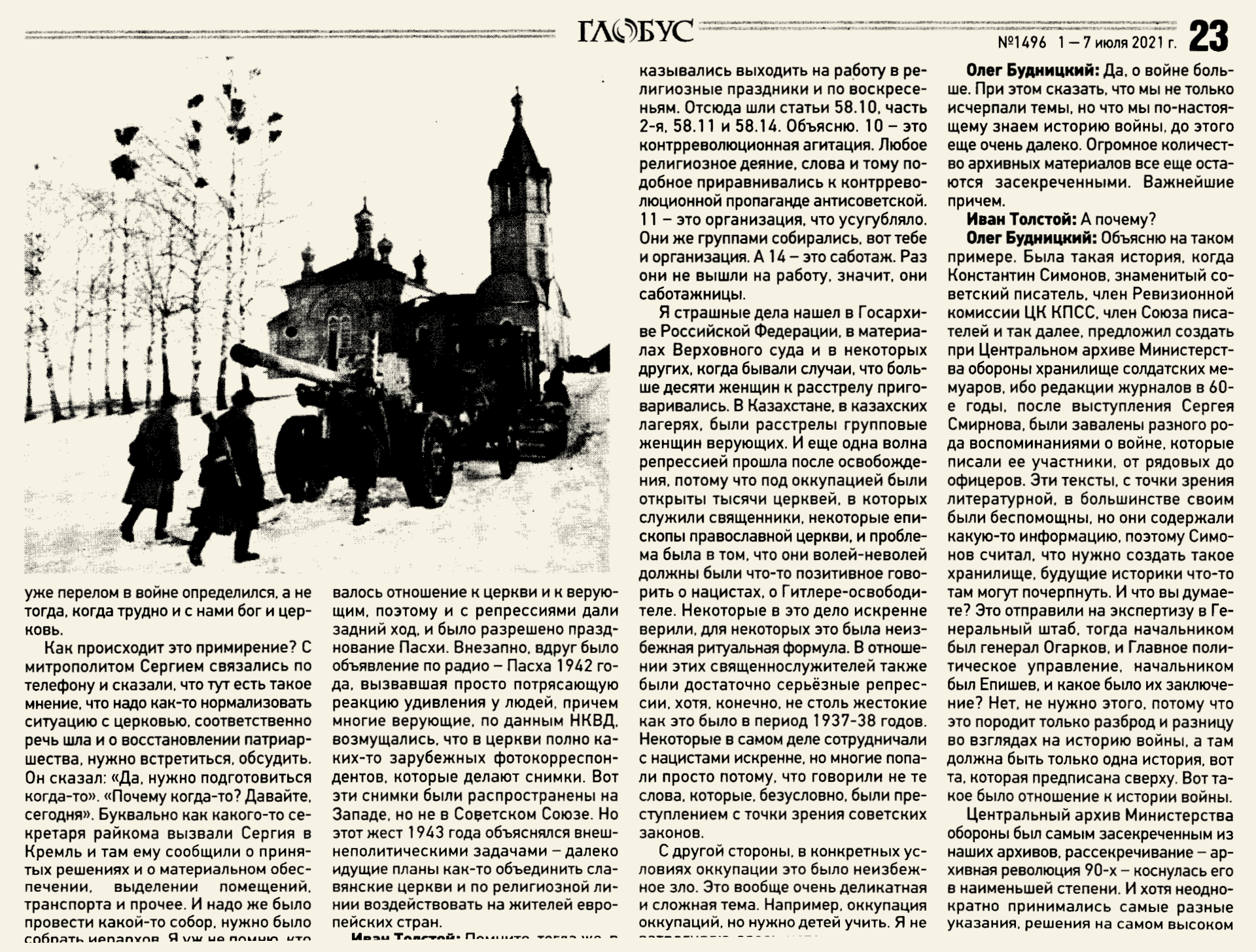
Oleg Budnitsky: What is mythical about Church policy? In my view, the myth is that certain age-old, popular values were supposedly recognised and reconciliation with the Church took place. Reconciliation requires two equal parties reconciling with one another. In this case the Church was simply used when it became necessary. Notice, too, that this reconciliation, the restoration of the patriarchate, took place in the second half of 1943, after the Battle of Kursk, when the turning point in the war had already been reached, rather than at the moment of hardship when God and the Church were said to be on our side.
How did this reconciliation take place? Metropolitan Sergius was telephoned and told that there was a view that relations with the Church should somehow be normalised. This also meant restoring the patriarchate, so a meeting and discussion were needed. He said, ‘Yes, we must make preparations sometime.’ ‘Why sometime? Let us do it today.’ Sergius was summoned to the Kremlin literally as if he were a district Party secretary, and there he was informed of the decisions already taken, the material support, the allocation of premises, transport and so on. A council had to be held, which meant gathering the hierarchs. I no longer remember which participant said this - I think it was Sergius himself: ‘You know, some of them will be rather difficult to assemble; they are far away,’ meaning that they were in prison. ‘Well, that is our concern,’ he was told, and those who could be gathered were promptly brought together for the council.
Sergius also compiled a list of hierarchs he wished to have released. They had been arrested and disappeared in 1937-38, when the Church suffered enormous losses. By 1939, only four metropolitans remained at liberty. There were twenty-five names on the list. Sergius did not know that twenty-four had long since been shot. The one remaining metropolitan, who was quite close to him, had been arrested in the summer of 1941, after the war began, for saying something considered inappropriate somewhere, and exiled to Kazakhstan. They never bothered to bring him back during Sergius’s lifetime - that reveals their true attitude - and only returned him from exile after the war and after Sergius’s death.
That was the true attitude. And, of course, this reconciliation with the Church is presented in the works of Russian historians, particularly Olga Vasilyeva, the minister of education, who, unlike other officials, is a genuine historian with perfectly sound scholarly work to her name. The principal objective was foreign policy. It was not just a matter of concessions to the Allies. Western public opinion demanded some normalisation of the USSR’s treatment of the Church and believers. Repression was therefore scaled back, and Easter celebrations were permitted. Suddenly there was a radio announcement: Easter 1942. It provoked an extraordinary reaction of surprise. According to the NKVD, many believers were indignant that churches were full of foreign photojournalists taking pictures. Those photographs circulated in the West, but not in the Soviet Union. The gesture of 1943, however, was driven by foreign-policy objectives: far-reaching plans to bring the Slavic churches together somehow and use religion to influence the inhabitants of European countries.
Ivan Tolstoy: Do you remember that in 1942 a propaganda book called ‘The Truth about the Church’ was published?
Oleg Budnitsky: ‘The Truth about Religion in Russia’ was a lavish edition, gold-embossed and printed on fine paper. Naturally, it was not freely, or even semi-freely, distributed in the Soviet Union. Yet to the enormous surprise of Western diplomats, Metropolitan Nikolai Yarushevich knocked at the gates of the embassies evacuated to Kuibyshev and personally delivered copies. It is an extraordinary story. Incidentally, of the four hierarchs who remained at liberty, two collaborated with the NKVD, or at least the NKVD regarded them as its agents: Nikolai Yarushevich and Sergius Voskresensky. One of those it considered an agent, Sergius Voskresensky, was a hierarch in the Baltic region, based in Riga. He refused evacuation and hid in the crypt of Riga Cathedral, then served there under the Germans. In 1944 he was killed by persons whose identity remains unclear. There are differing views on this; it is a complicated story.
The chapter on the treatment of believers is called ‘Repression against Believers during the Great Patriotic War’. It deals with people subjected to brutal repression during the war. Usually they were outside the Church led by Sergius; very often they were prisoners, and most often women, who were shot in groups simply because, for example, they refused to work on religious holidays and Sundays. Hence charges under Articles 58.10, Part 2, 58.11 and 58.14. Let me explain. Section 10 concerned counter-revolutionary agitation. Any religious act, utterance and so forth was equated with counter-revolutionary, anti-Soviet propaganda. Section 11 concerned organisation, an aggravating factor: they gathered in groups, so there was your organisation. Section 14 concerned sabotage. If they did not go to work, they were saboteurs.
In the State Archive of the Russian Federation, in Supreme Court records and elsewhere, I found appalling cases in which more than ten women at a time were sentenced to death. In Kazakhstan, in the camps there, groups of women believers were executed.
Another wave of repression followed liberation. Thousands of churches had opened under occupation, served by priests and some Orthodox bishops. The problem was that, whether they wished to or not, they had to say something positive about the Nazis and Hitler as liberator. Some sincerely believed it; for others it was an unavoidable ritual formula. Those clergy also suffered serious repression, though not as brutal as in 1937-38. Some had indeed collaborated with the Nazis out of conviction, but many were caught up simply because they had said the wrong things, which were unquestionably criminal under Soviet law.
On the other hand, in the concrete circumstances of occupation this was an unavoidable evil. It is an extremely delicate and complicated subject. Occupation or no occupation, children still had to be taught. I do not go into that history here, but even a mathematics teacher faced a problem: Hitler’s portrait hung in the classroom, and if he taught mathematics in Hitler’s presence, he was, in a sense, implicated in something of that kind. In most cases there was no repression over this, but we must understand the difficult situation of people who found themselves under occupation and simply continued doing their jobs. The director of the zoo in Rostov-on-Don, for example, did not evacuate. He stayed and continued his duties, believing that the animals were not to blame. After liberation he was expelled from the Party and dismissed, although he was not punished more severely. It was a paradoxical situation. The same applied to people working in sewage services, for example: in strictly legal terms, they served in the German occupation administration. That was the terrible predicament of some people in occupied territories.
Ivan Tolstoy: We will have to bring this to a close, although I would like to keep talking, listening to you and reading your evidently very interesting book. What conclusion can we draw, apart from saying that 9 May is a ‘holiday with tears in our eyes’?
Oleg Budnitsky: We will not put a full stop; we will put an ellipsis. More has been written about the war than about any other period, whether in world history, if we mean the Second World War, or in Soviet history.
Ivan Tolstoy: Even the Revolution?
Oleg Budnitsky: Yes, more about the war. Yet we are still very far from being able to say not only that we have exhausted the subject but that we truly know the history of the war. An enormous quantity of archival material remains classified, including material of the utmost importance.
Ivan Tolstoy: Why?
Oleg Budnitsky: Let me give an example. Konstantin Simonov, the famous Soviet writer, a member of the CPSU Central Auditing Commission, the Writers’ Union and so on, once proposed setting up a repository of soldiers’ memoirs at the Ministry of Defence’s Central Archive. In the 1960s, following Sergei Smirnov’s public appeals, magazine editors had been inundated with wartime recollections written by participants ranging from privates to officers. Most of these texts were inept as literature, but they contained information. Simonov therefore thought a repository was needed so that future historians could draw on it. What do you think happened? The proposal was sent for assessment to the General Staff, then headed by General Ogarkov, and to the Main Political Directorate, headed by Yepishev. Their conclusion? No, there was no need: it would only create confusion and differing views of the history of the war. There must be just one history, the one prescribed from above. That was the attitude towards the history of the war.
The Ministry of Defence’s Central Archive was the most secretive of our archives. Declassification, the archival revolution of the 1990s, affected it least of all. Although all sorts of directives and decisions have repeatedly been issued at the highest level to declassify everything relating to the war, in practice that often remains far off. Take the crucial records of the Red Army’s Main Political Directorate, which dealt with the troops’ morale, political attitudes, discipline and so on: the lion’s share is closed. Military tribunal records are closed; the FSB’s records, for example, are closed. Those are particularly important, because they regularly produced all kinds of summaries, reports and much else. The Presidential Archive has now been transferred to RGANI, the Russian State Archive of Contemporary History, yet many thematic files remain classified. Financial records, for example, are an extraordinarily interesting subject. And there are many other subjects too.
Thus, formally, 75 years have passed since the end of the war, and formally all this should be declassified and accessible, but in reality everything is moving extremely slowly. Many remarkable discoveries await us, both positive and less positive ones. But since victory in the war has become not merely history but an article of faith, not everyone wants the real history of that war to become accessible to historians and interested readers. Gradually, step by step, we are reclaiming our knowledge. Let us put an ellipsis; it is too early for a full stop. I hope more books will appear in which we learn very important details about the history of the war.
Ivan TOLSTOY
Radio Liberty
