


 |
 |
 |
|
| © DIE ZEIT 17.03.2005 Nr.12 |

Wodka,
Schlendrian, Gewalt
Das
Tagebuch des Wladimir Gelfand bietet interessante Einblicke in das
Innenleben der Roten Armee am Ende des Zweiten Weltkriegs
Wolfram Wette
© DIE ZEIT
 German
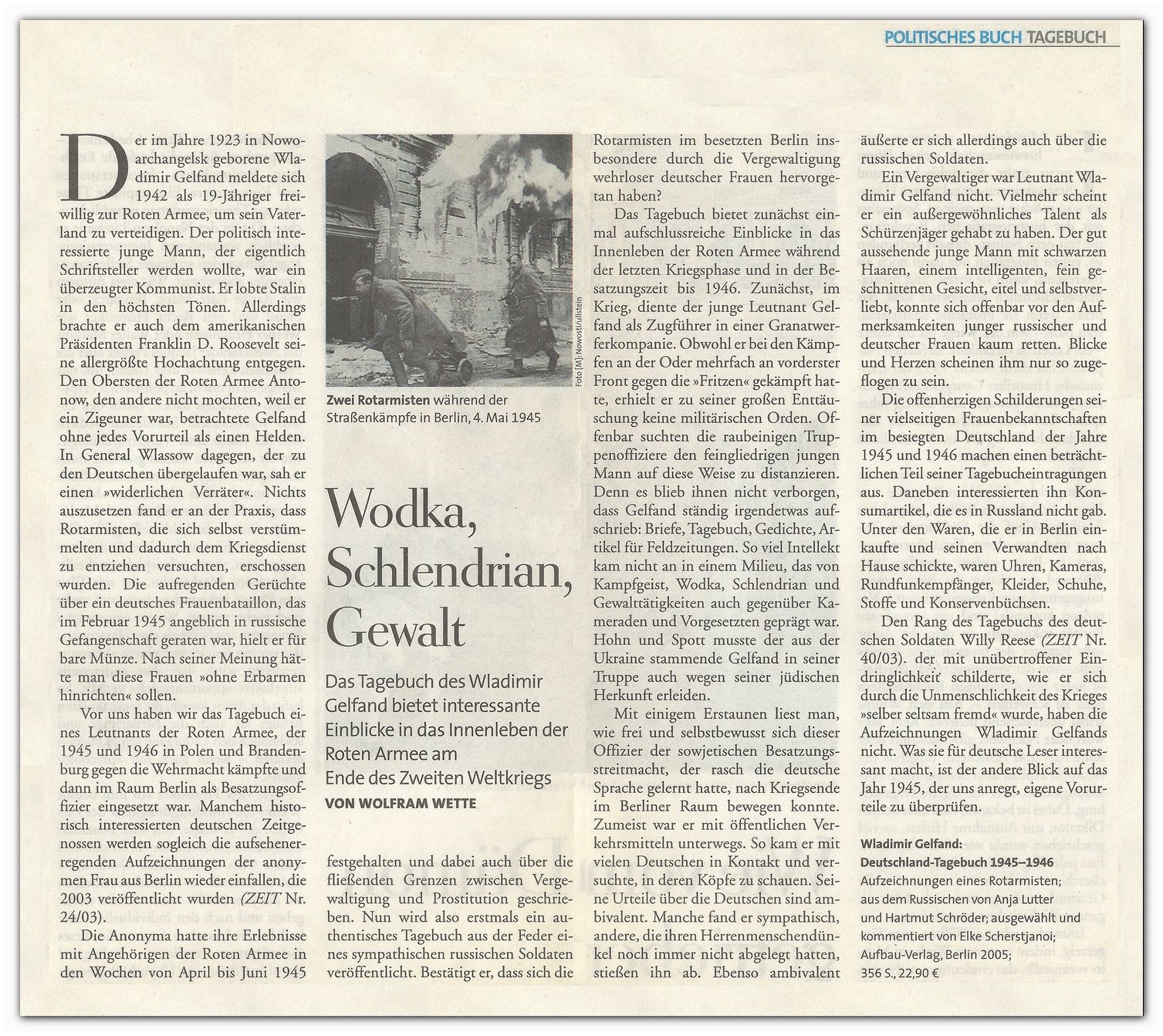
Born in 1923 in Novoarkhangelsk, Vladimir Gelfand volunteered for the Red Army in 1942 at the age of nineteen in order to defend his homeland. Politically active and dreaming of becoming a writer, the young man was a convinced communist who praised Stalin in the most enthusiastic terms. At the same time, however, he also celebrated the American president Franklin D. Roosevelt and expressed the deepest respect for him. Gelfand was not a man of simple prejudices: Red Army General Alexei Antonov, whom many disliked because of his Romani background, was a genuine hero in his eyes. General Vlasov, who went over to the German side, by contrast, appeared to him as a “vile traitor.”
Gelfand did not question the army’s brutal practices. Red Army soldiers who mutilated themselves in an attempt to avoid service were ruthlessly shot. He readily believed exciting rumors about a German women’s battalion allegedly captured by the Red Army in February 1945 and thought that these women should be “executed without any compassion.”
What we have before us is the diary of a Red Army lieutenant who fought against the Wehrmacht in Poland and Brandenburg in 1945 and who, after the end of the war, served as an occupation officer in the Berlin region until 1946. A German reader interested in history will immediately be reminded of the sensational anonymous diary “A Woman in Berlin,” published in 2003.
That unknown author described her experiences with Soviet soldiers from April to June 1945 and the blurred boundaries between violence, coercion and prostitution. Now, for the first time, we have an authentic diary written not by an anonymous victim but by a Soviet officer. Does it confirm the image of a Red Army that, after occupying Berlin, distinguished itself above all by brutality toward defenseless German women?
First and foremost, Gelfand’s diary offers rare testimony about the inner life of the Red Army in the final months of the war and during the first period of occupation. At the front he commanded a mortar platoon and took part in frontline fighting. Yet despite his courage, his efforts were not rewarded: decorations repeatedly passed him by, which caused him deep disappointment. It is possible that officers deliberately overlooked this young man, physically slight compared with many of the other soldiers, and preferred to keep him in the background.
His constant writing—letters, diary entries, poems and articles for field newspapers—did not make him more popular. In an environment in which fighting spirit, vodka, coarse amusements and brutality, including brutality toward one’s own comrades, were highly valued, intellectual refinement was more likely to irritate than to inspire respect. In addition, as a Jew from Ukraine, Gelfand was often the target of ridicule within his unit.
It is striking to read how freely and confidently this Red Army officer, who soon learned German, moved through Berlin during the first postwar months. He made active use of public transport, spoke with residents of the city, and tried to understand their thoughts and moods. His attitude toward Germans was contradictory: he found some pleasant, while others, who retained a sense of superiority, disgusted him. Yet he could be equally ambivalent about his own compatriots.
Lieutenant Vladimir Gelfand was not a rapist. On the contrary, he had a remarkable ability to win women’s affection. Young and attractive, with black hair and fine features, vain and self-confident, he received a great deal of attention from both Soviet and German women. Looks and sympathies seemed to come to him almost of their own accord.
The candid descriptions of his many romantic affairs in Germany in 1945–1946 occupy a substantial part of the diary. He was also fascinated by material goods that were unavailable in the Soviet Union. Among the things he bought in Berlin and sent home to relatives were watches, cameras, radios, clothing, shoes, fabrics and even canned food.
Vladimir Gelfand’s notes do not possess the same psychological depth as the diary of the German soldier Willy Reese, who wrote of how the war made him “strangely alienated” from human life. Their value lies elsewhere: they offer an alternative view of 1945 and force the reader to reconsider established assumptions about that period.
Vladimir Gelfand: Germany Diary 1945–1946. Notes of a Red Army Soldier. Translated from Russian by Anja Lutter and Hartmut Schröder; selected and annotated by Elke Scherstjanoi; Aufbau Verlag, 2005.