


|
||
 |
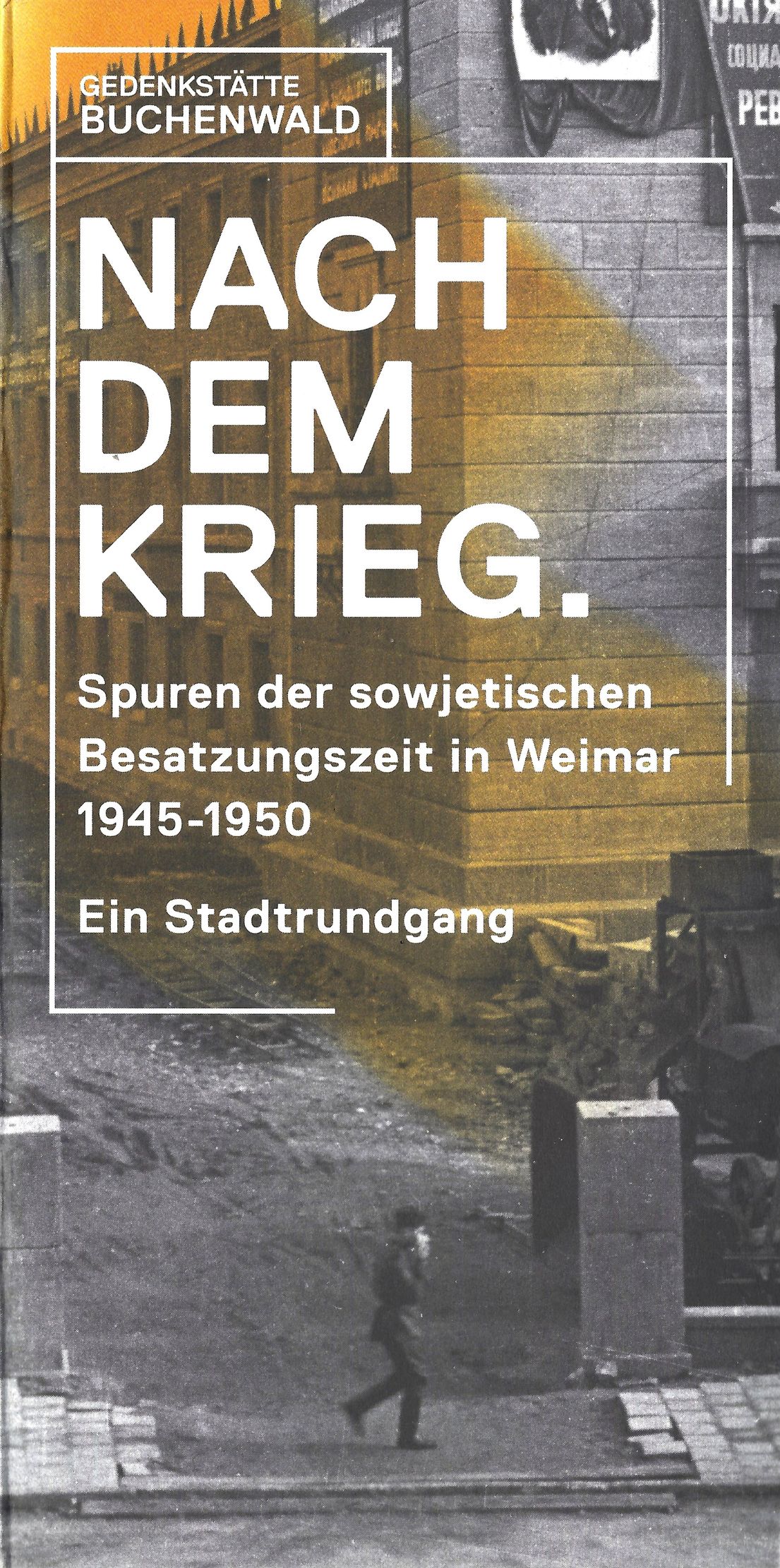
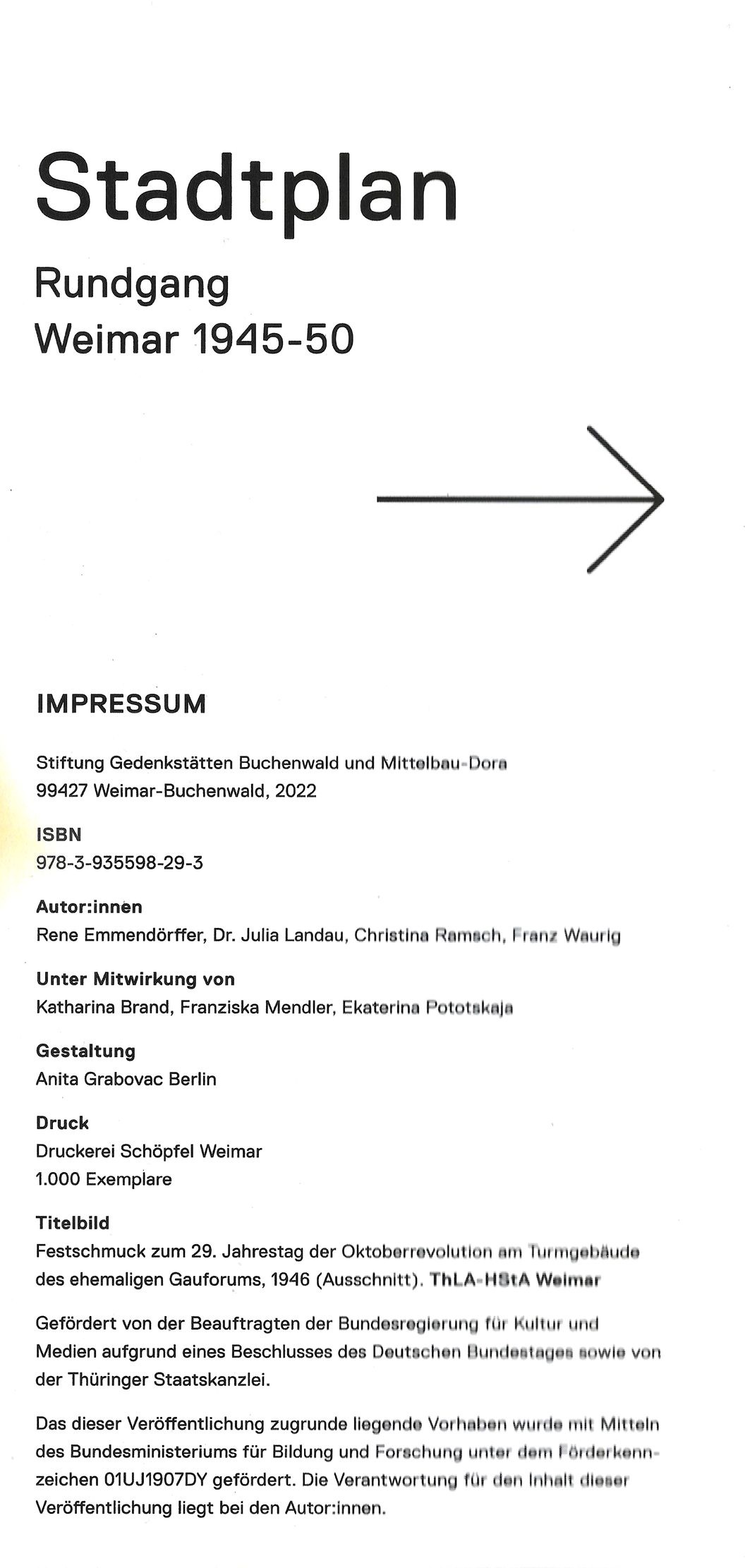
| Nach dem Abzug der US amerikanischen Truppen im Juli 1945 wurde Weimar zum Zentrum der sowjetischen Militärverwaltung für Thüringen und zu einem wichtigen Militärstandort An vielen Stellen in der Stadt finden sich bis heute Spuren dieser Zeit Sie erzählen von Macht und Repression, aber auch vom kulturellen Neubeginn und schwierigen Annäherungen nach dem Ende des Zweiten Weltkrieges. Der Stadtrundgang lässt einige dieser Spuren sichtbar werden. | ||
 |
||
| FOTO: FRANZ WAURIG, SGBUMD | ||
| |
||
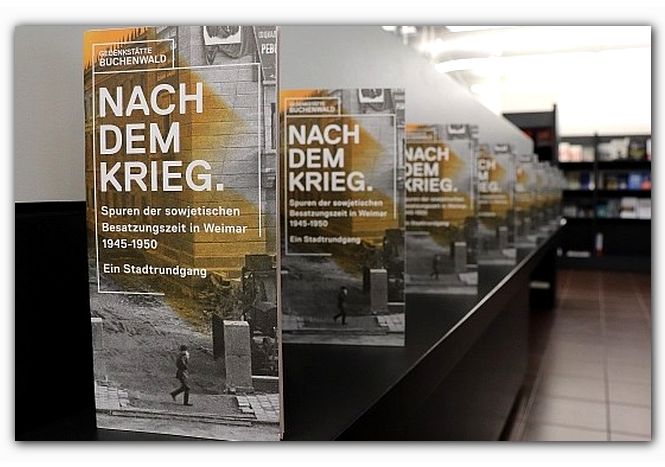
Nach dem Krieg. Spuren der sowjetischen Besatzungszeit in Weimar 1945-1950
02.11.2022
neue Stiftungspublikation erschienen Was hat ein Keller in der Falkstraße mit dem sowjetischen Geheimdienst zu tun? Wo befand sich das »Puschkinhaus«? Antworten auf diese und weitere Fragen gibt eine neue Broschüre der Gedenkstätte Buchenwald, die über Spuren der sowjetischen Besatzungszeit in Weimar 1945 bis 1950 informiert. Hervorgegangen ist das knapp 60–seitige Heft aus einem Stadtrundgang, den das Team des Teilprojektes »Gedenken ohne Wissen?« und die Kustodie zur Geschichte des sowjetischen Speziallagers Nr. 2 an der Gedenkstätte Buchenwald 2021 konzipierte. Die Autor:innen wählten neun Orte im Stadtgebiet aus, die mit der Militär- und Zivilverwaltung, aber auch mit Einzelgeschichten deutscher und sowjetischer Zeitzeug:innen in Verbindung stehen. Es geht um Macht und Repression ebenso wie um die schwierigen kulturellen Annäherungen und persönlichen Begegnungen nach dem Zweiten Weltkrieg. Begeben Sie sich auf Spurensuche. Ergänzungen und weitere Orte können Sie uns gern in einer Nachricht an kustodie2@buchenwald.de mitteilen. Die Broschüre ist im Onlineshop oder in der Buchhandlung der Gedenkstätte Buchenwald zum Einzelpreis von 3,90 EUR erhältlich. |
||
 |
 |
 |
 |
 |
 German
02.11.2022
A new publication by the Foundation has been released.
What does the cellar on Falkstrasse have to do with the Soviet secret services? Where was the “Pushkin House” located?
Answers to these and other questions are provided in a new brochure from the Buchenwald Memorial, which presents information about traces of the Soviet occupation in Weimar from 1945 to 1950.
The nearly 60-page booklet grew out of a city walk designed in 2021 by the team of the subproject “Memory Without Knowledge?” together with the curatorial department of the Buchenwald Memorial responsible for the history of Soviet Special Camp No. 2.
The authors selected nine places in and around the city associated with the military and civilian administration as well as with individual accounts by German and Soviet eyewitnesses. The brochure deals with power and repression, but also with complex cultural encounters and personal contacts after the Second World War.
Set out in search of the traces yourself. You can send additions and information about other places to us at kustodie2@buchenwald.de.
The brochure can be purchased for €3.90 in the online shop or in the bookshop of the Buchenwald Memorial.
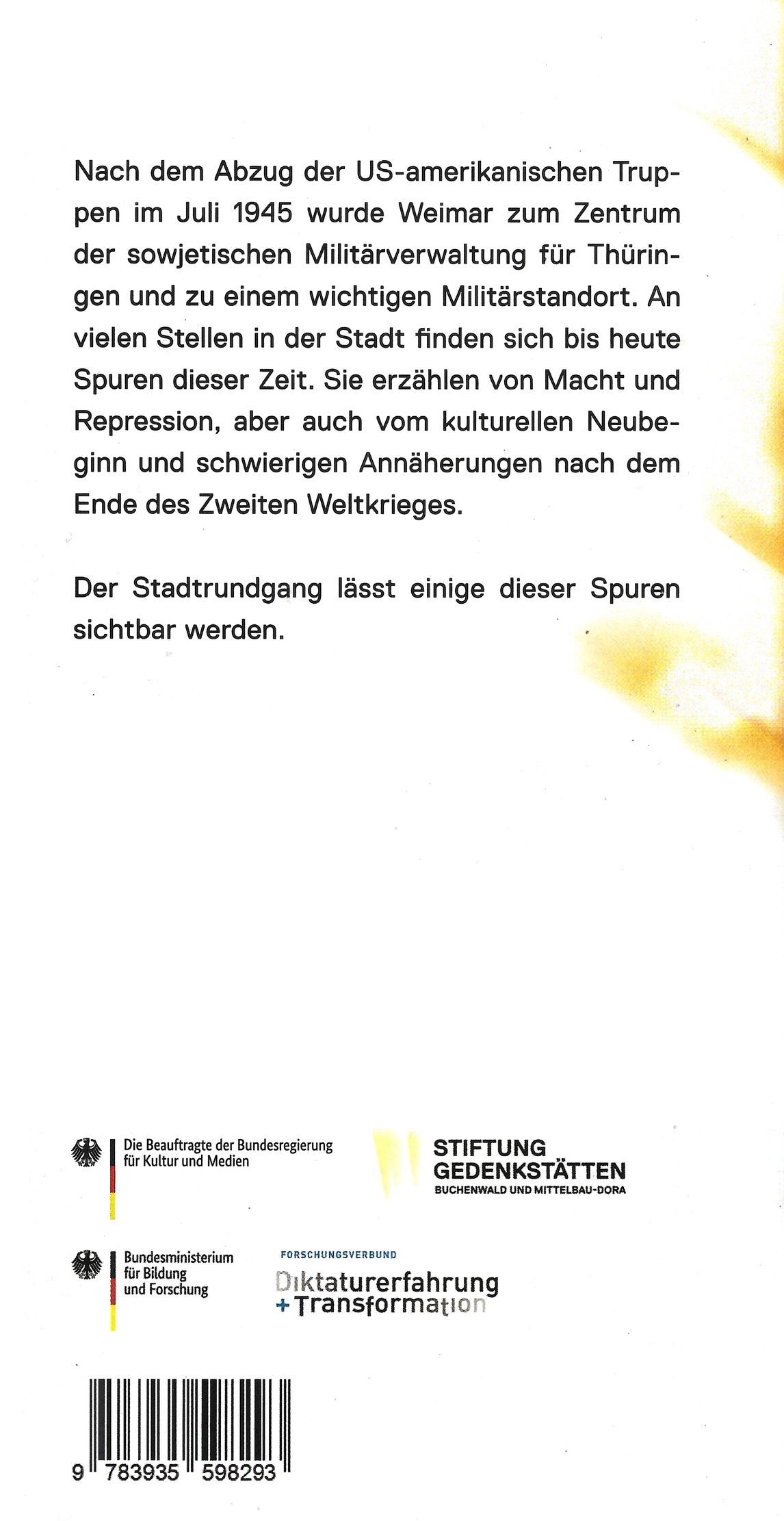
Cover: “After the War. Traces of the Soviet Occupation Period in Weimar, 1945–1950. A City Walk.”
Back cover: “After the withdrawal of U.S. troops in July 1945, Weimar became the center of the Soviet military administration in Thuringia and an important military location. Traces of this period can still be seen in many places in the city. The tour introduces them and, through selected approaches, also makes the end of the Second World War visible.”
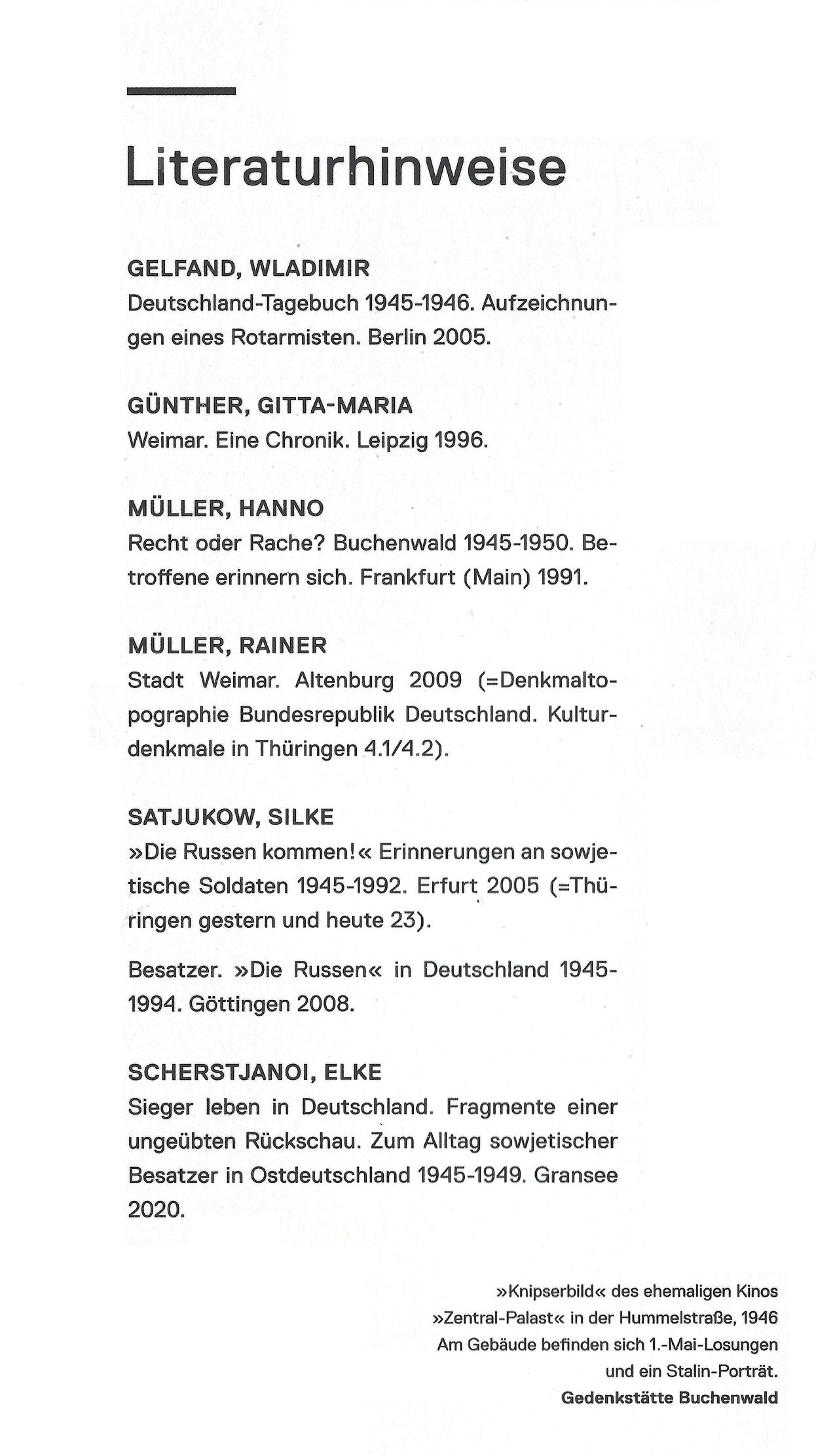
Map page: “City map — Weimar city walk 1945–50.” The remaining small-print publication details and bibliography are publishing and source information for the brochure.
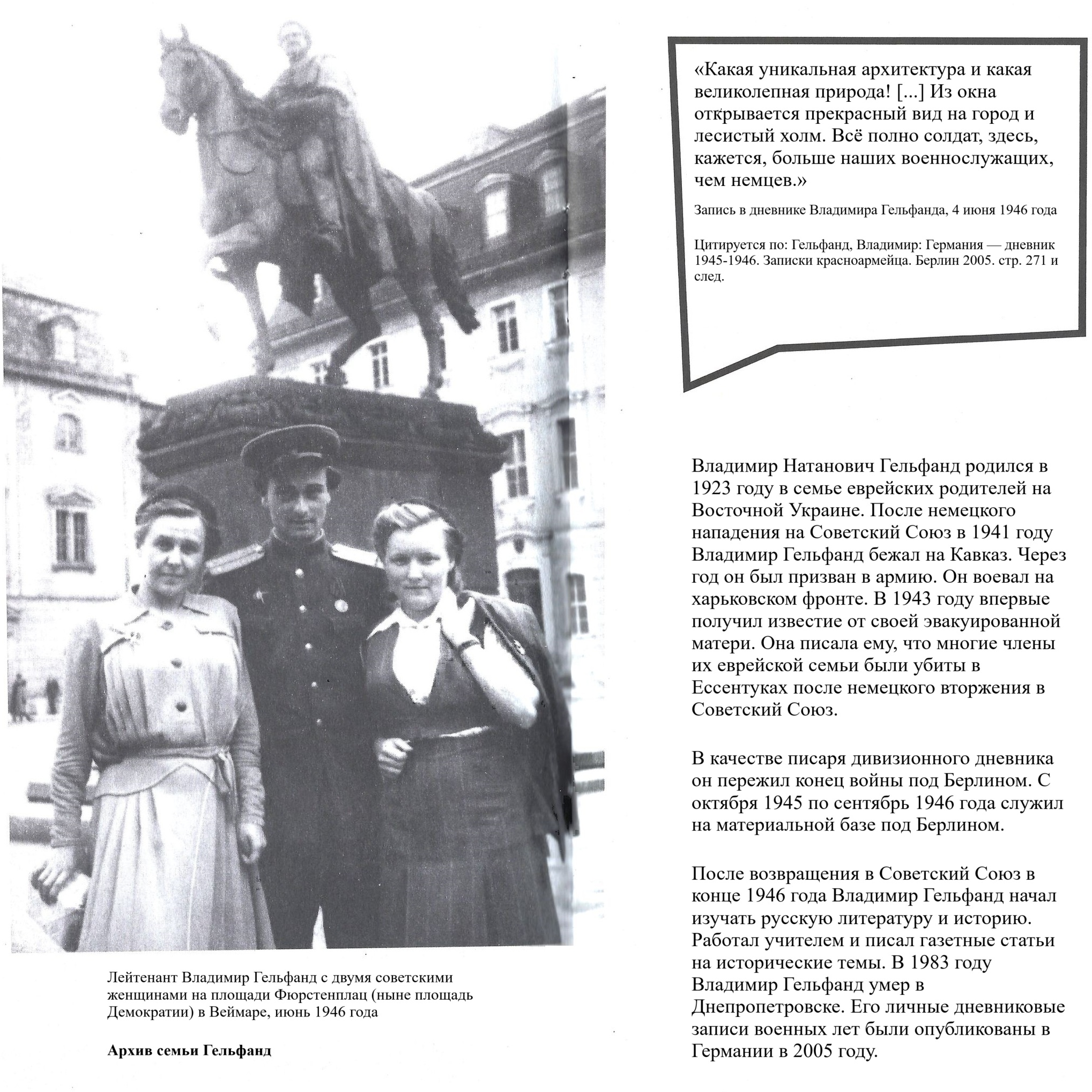
Text on the illustrated Russian-language page (English translation)
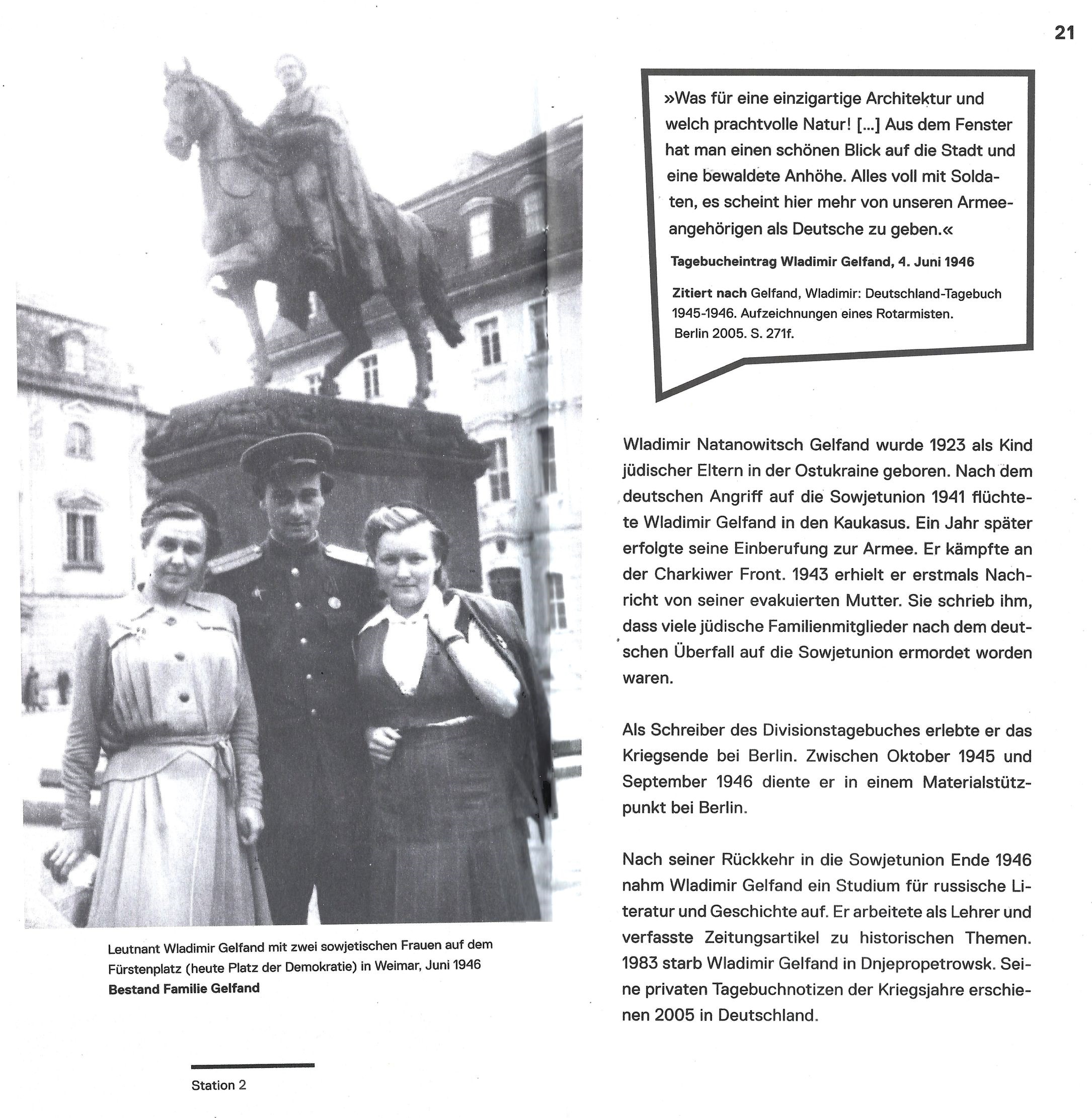
“What unique architecture, and what magnificent scenery! [...] From the window there is a wonderful view of the town and the wooded hill. There are soldiers everywhere; it seems that there are more of our servicemen here than Germans.”
From Vladimir Gelfand's diary, 4 June 1946. Cited in Vladimir Gelfand, Germany Diary 1945–1946: Notes of a Red Army Soldier, Berlin, 2005, p. 271 ff.
Vladimir Natanovich Gelfand was born in 1923 to Jewish parents in eastern Ukraine. After Germany attacked the Soviet Union in 1941, he fled to the Caucasus. A year later he was called up to the army and fought on the Kharkiv front. In 1943 he first heard from his evacuated mother, who wrote that many members of their Jewish family had been killed in Essentuki after the German invasion.
As a divisional diary clerk he witnessed the end of the war near Berlin. From October 1945 to September 1946 he served at a supply base near Berlin. After returning to the Soviet Union late in 1946, Gelfand studied Russian literature and history. He worked as a teacher and wrote newspaper articles on historical subjects. He died in Dnipropetrovsk in 1983. His personal wartime diary entries were published in Germany in 2005.
