


   ·
|
|
|
|
|
 |
Hans-Christian
Dahlmann,
Hamburg
|
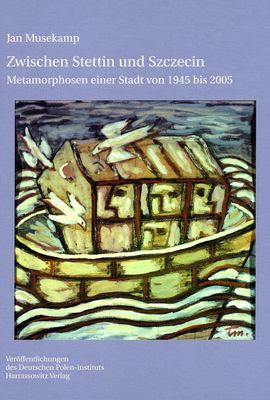
“Between Stettin and Szczecin:
Metamorphoses of a City, 1945–2005”
Brief description
In 1945 the German city of Stettin became the Polish city of Szczecin. After several months of uncertainty about the city’s future state affiliation, a new administration assumed control, with far-reaching consequences for the important port city. The population, once numbering roughly 400,000 German inhabitants, changed dramatically. Almost all remaining Germans were expelled, while Poles arrived from many different regions and began the work of reconstruction.
Jan Musekamp examines the strategies through which new myths and narratives were created in order to give the city’s new inhabitants a sense of connection to their surroundings. How were streets and urban spaces renamed? How was the cityscape transformed and how were selected memories of the past incorporated into it? How did Polish settlers make homes in houses left by German residents, and how did the two cultural legacies interact? Musekamp’s study, supported by the ZEIT Foundation Ebelin and Gerd Bucerius, received an award from the Ambassador of the Republic of Poland in 2008 for outstanding scholarly achievement.
Press
Jan Musekamp guides the reader through Szczecin while presenting his research. He refers to comparable studies of other cities, particularly Gregor Thum’s work on Wrocław, to which he returns several times.
Musekamp’s study of Szczecin is an illuminating example of how urban history is constructed and reconstructed. Monuments, renamings and myths reveal both radical breaks and continuities with earlier periods. The key question is the cultural appropriation of the city, examined here in the context of the Polish People’s Republic.
The book is lively and easy to read. Musekamp repeatedly links collective memory with concrete descriptions of the urban landscape. A map and a concordance of old and new street names make the material easier to follow, and the book almost invites the reader to visit Szczecin and walk along the traces described by the author. Musekamp’s study is therefore ideal reading for anyone interested in history, and there is probably no better place to read it than Szczecin itself. Hans-Christian Dahlmann, Hamburg
About the author
Jan Musekamp studied cultural studies and history at the European University Viadrina in Frankfurt (Oder), as well as in Toruń and Brno, with a focus on Eastern Europe. His research addresses forced migration, cultural appropriation and assimilation, border regions, and the history of transport networks in Prussia in an international context.
© Otto Harrassowitz, Wiesbaden 2010