



 |
 |

 Vietnamese
Tran Le — The Red Army, the Horror of Berlin’s Women in 1945
At the very end of the Second World War, just as Europe was being freed from fascist and Nazi rule, one of the darkest episodes of modern history unfolded. Women in Berlin became victims of mass rape committed by Red Army units entering Germany. In practice they had almost no way to escape or protect themselves.
German women in 1945 — archival photograph.
Many women tried to avoid rape by seeking the protection of senior Red Army officers and becoming their lovers, according to material published by the Hungarian history website mult-kor.hu.
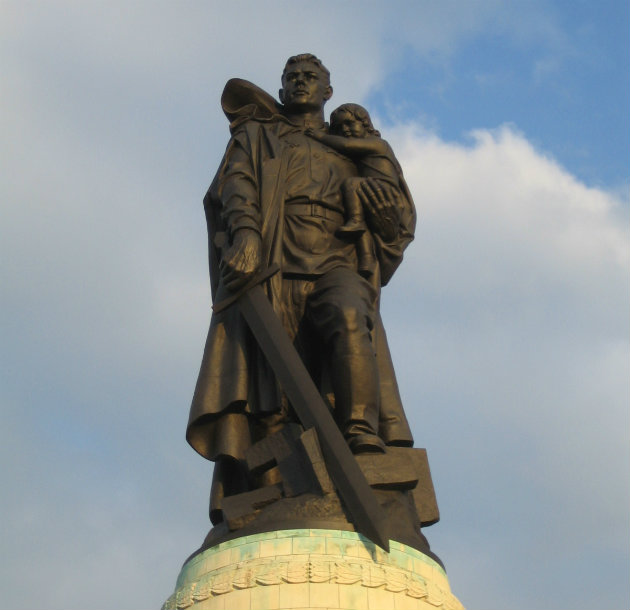
In Berlin’s Treptower Park stands a monument showing a Soviet soldier holding a sword in one hand and a child in the other, standing over a broken swastika. It is a memorial where the remains of about five thousand Soviet soldiers killed in the Battle of Berlin are buried.
Official figures state that around 80,000 Soviet servicemen died in the fighting for Berlin and more than 200,000 were wounded. The massive monument, almost shrine-like in scale, bears an inscription saying that the Soviet people saved European civilisation from fascist catastrophe.
There are, however, other interpretations. Some critics call the monument the “Tomb of the Unknown Rapist,” referring to mass sexual violence committed by Soviet soldiers during the advance on Berlin, both in the capital itself and on its approaches.
Many Russians reject these accusations as Western propaganda. Yet research published the previous March suggested that Soviet troops were not the only perpetrators: American and other Allied soldiers were also implicated in mass rape, with some estimates claiming that as many as 190,000 German women were raped by them in 1945.
Memorial to the Red Army soldier in Treptower Park.
Two diaries written between the spring and autumn of 1945 help us understand the horrors of that time. The first belonged to Lieutenant Vladimir Gelfand, a Jewish Red Army officer from central Ukraine. His diaries were found by his son Vitaly among the family papers.
“My father saw many terrible things on his way to Berlin,” Vitaly said. “He passed through many villages where the Nazis had left devastation behind. People had been killed, children too. Women’s bodies bore signs of rape.”
He adds that the hatred later released by many soldiers had been inflamed by aggressive propaganda: “Comrades! We are on German soil, in the lair of the fascist beast! The time for revenge has come!”
One of the most disturbing scenes in the diary comes when Gelfand meets a group of women on the outskirts of Berlin.
“With horror on their faces they told me what had happened on the first night after the Red Army arrived. One girl lifted her skirt and said: ‘More than twenty men — here.’ Then she burst into tears.”
What follows is even more shocking: “She begged me: ‘Stay with me. Sleep with me — only you — so that I can avoid being gang-raped.’” She was prepared to consent to sex with one man in the hope of protecting herself from collective sexual violence.
The second diary belonged to an anonymous German journalist in her early thirties. It was later published under the title A Woman in Berlin and became an international bestseller. The diary begins ten days before Hitler’s suicide and describes the daily struggle of the woman and her neighbours to survive in the cellar of a Berlin apartment building.
In one passage she reflects: “Better to be raped by a Russian than burned by an American bomb.” She also jokes about the stereotyped image of the enemy.
When the Red Army approached the building where the women were hiding, one of them tried to explain that only civilians were sheltering in the cellar. Moments later she herself became a victim of violence.
The diary was first published in 1959. It describes women trying to “get themselves a wolf” — their term for a senior Red Army officer whose protection could shield them from repeated rape. One woman entered a relationship with an officer from Leningrad; they even discussed literature and the meaning of life.
“Rape is not the main thing. The main thing is to get smoked meat, butter, sugar and canned meat,” she wrote in her diary.
After 1945, criticism of the official Soviet narrative of “liberation” was unacceptable in East Germany. In the West, guilt over Nazi crimes meant that the suffering of German women in 1945 was pushed out of public discussion for decades.
In 2008 a film based on A Woman in Berlin gave the subject new public attention. More and more women began to tell their own stories of what they had experienced at the end of the Second World War.
The full scale of these crimes may never be known, especially while archives remain closed and Russian legislation threatens penalties of up to five years’ imprisonment for what the authorities describe as “discrediting” the country or “blackening” the Soviet role in the Second World War.
Vitaly Gelfand acknowledges: “Soviet soldiers showed incomparable courage and self-sacrifice during the war. But that is not the whole truth.”