




© Sächsische Zeitung
 German
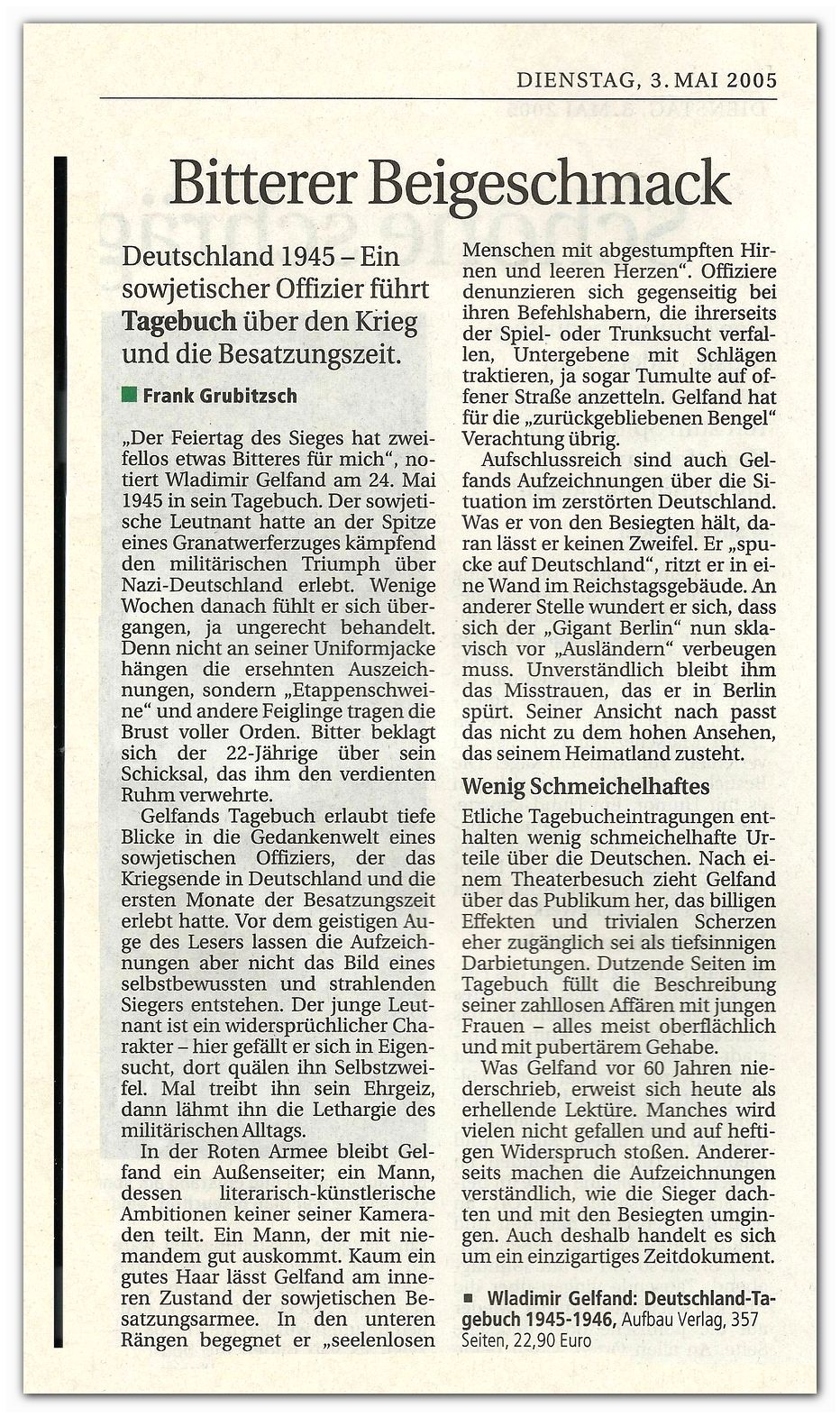
“The celebration of victory undoubtedly has something bitter about it for me,” Vladimir Gelfand wrote in his diary on 24 May 1945.
The Soviet lieutenant had been through much in the war, commanding a mortar platoon during the struggle that ended in victory over Nazi Germany. Yet a few weeks after the end of the fighting he felt that he had been unfairly passed over for decorations. His tunic remained bare while “rear-area heroes” and men he regarded as cowards walked around with chests covered in medals.
The twenty-two-year-old Vladimir complained bitterly about a fate that, in his eyes, had deprived him of deserved recognition. Gelfand’s diary offers a rare opportunity to look into the thoughts and emotions of a Soviet officer who experienced the end of the war in Germany and spent the first months of the occupation there. His notes do not portray a confident, radiant victor. Instead he appears as a contradictory human being, at one moment reproaching himself for selfishness and at another tormented by doubt. Ambition pulls him in one direction; the apathy of military routine drags him in another.
Within the Red Army, Gelfand remained an outsider. Neither his commanders nor his fellow soldiers shared his literary and artistic ambitions. Few showed him much warmth. In his notes he spared neither himself nor those around him. He described ordinary soldiers as “soulless people with dulled needs and empty hearts.” Officers, in his account, schemed and ingratiated themselves with superiors, while their commanders in turn gave themselves over to gambling and drinking. Subordinates settled disputes with their fists and disturbances broke out in the streets.
He despised “straggling hooligans,” yet at the same time he felt ashamed.
Gelfand’s observations on conditions in devastated Germany are equally revealing. He did not hide his sense of superiority over the defeated.
“I spit on Germany,” he scratched on a wall of the Reichstag.
Elsewhere he wondered why “giant Berlin” did not bow slavishly before foreigners. Yet he was also puzzled by the mistrust with which people in the city treated him. It seemed to him that Germans did not understand the respect that ought to be shown to his homeland.
Unflattering Judgments
Some diary entries are filled with sharp comments. After a visit to the theater he wrote disparagingly about the German audience, observing that “cheap effects and trivial jokes seem closer to them than profound and melancholy images.” Dozens of pages are devoted to his numerous romances — fleeting and superficial, narrated with youthful vanity.
What Gelfand wrote sixty years ago can now be read as a document of its time: vivid, contradictory and at points contentious. Some of his words will provoke rejection and protest, but that is also part of the diary’s value. It helps us understand what some of the victors thought and how they related to the defeated. That is why the diary remains a unique historical testimony.