



Produktinformation
|
|||

|
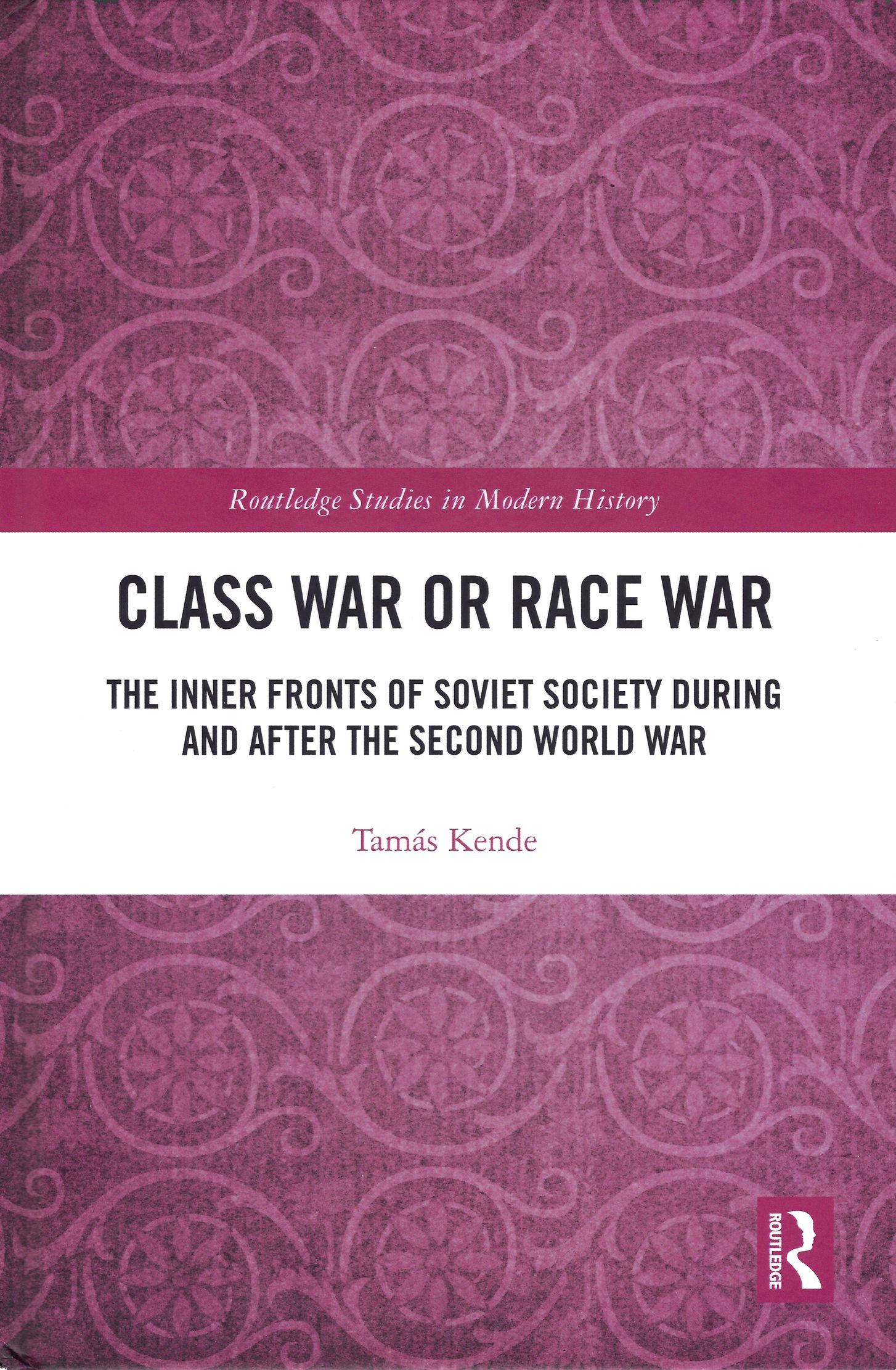
Class War or Race War is more than an anti-thesis of the master narrative regarding the Soviet state antisemitism. Kende not only refutes the originally anti-Communist myth of the systemic nature of (state) socialism, but tries to re-, and deconstruct, the origins of this myth.
With intensive use of historical documents, memoirs and the related historiography, the book attempts to make historical sense from the myth it intends to refute. Kende goes beyond the contemporary perceptions of the “Jewish question” and antisemitism, and with close reading of original documents, reconstructs the real frontlines of the Soviet society of the 1940s, which were not constructed along identity-political lines. The book reinvests the long-forgotten understanding of social classes in an allegedly classless and monolithic society. The spontaneous formations of the actual frontlines in the hinterland, or on the actual fronts (battlefields, in the Red Army) lacked the participants’ class consciousness, thus its occurrences in the form of conflict producing historical records were recorded as acts of antisemitism. As the book advocates, Jews could have been found on both sides of the inner frontlines of Soviet society during and right after WWII.
An insightful read for scholars of Soviet history that presents a bold and challenging interpretation of the regime and its flaws―both perceived and real.
 |
Routledge Studies in Modern
History Class War or Race War The Inner Fronts of Soviet Society during and after the Second World War Tamás Kende For more information about this series, please visit: www.routledge.com/ First published 2024 by Routledge 4 Park Square, Milton Park, Abingdon, Oxon, OX14 4RN and by Routledge 605 Third Avenue, New York, NY 10158 Routledge is an imprint of the Taylor & Francis Group, an informa business © 2023 Tamás Kende Names: Kende, Tamás (Historian), author. Title: Class war or race war : the inner fronts of Soviet society during and after the Second World War / Tamás Kende. Description: London ; New York, NY : Routledge, Taylor & Francis Group, 2024. | Series: Routledge studies in modern history | Includes bibliographical references and index. Identifiers: LCCN 2023031009 (print) LCCN 2023031010 (ebook) ISBN 9781032577333 (hardback) ISBN 9781032577388 (paperback) ISBN 9781003440765 (ebook) Subjects: LCSH: Antisemitism--Soviet Union. | Jews--Persecutions--Soviet Union. | Jews--Soviet Union--Social conditions. | Soviet Union--Race relations. | Soviet Union--Ethnic relations. Classification: LCC DS134.85 .K415 2024 (print) | LCC DS134.85 (ebook) | DDC 305.892/4047--dc23/eng/20230718 LC record available at https://lccn.loc.gov/2023031009 LC ebook record available at https://lccn.loc.gov/2023031010 ISBN: 978-1-032-57733-3 (hbk) ISBN: 978-1-032-57738-8 (pbk) ISBN: 978-1-003-44076-5 (ebk) DOI: 10.4324/9781003440765 Typeset in Galliard by SPi Technologies India Pvt Ltd (Straive)  Introduction Anti-Semitism as a window to the possible history This book also has its (pre-) history. Partially this history is that of the author, obviously. In 2015 I was approached by a friend, and colleague of mine, Péter Apor to participate in an international research project focusing on post-war anti-Semitic violence in Eastern Europe. By that time, I had written one monograph on the East European blood libels (18th–early 20th centuries), and a relatively fresh work on the cultural, and social history of the Communist Party membership in Hungary (1945–1956). As a historian, interested in violence and prejudice, I thought that as a result I could bring new newer and older revelations on the history of post-war social violence, and anti-Semitism, especially regarding the Soviet Union. This presumption of mine was elicited by the contemporary related historiography, as well as by the source material available to me. I have to admit that by the grandiose support of the Gerda Henkel Stiftung I have had the best 3 years of my life. As a prospective East European Marxist historian in our demanding times, I cannot be grateful enough for their generous support, for which I express my utmost gratitude. I am also grateful to the Jena-based Imre Kertész Kolleg which provided me with the means to complete this manuscript. Yet the topic of this book turned out to be not anti-Semitism, or the anti-Semitic violence of the Soviet Union in the 1940s–1950s, which topic was originally sponsored by the above foundation. “To talk about anti-Semitism in Eastern Europe is just as challenging intellectually, as to talk about the bad weather in Britain”, goes the saying. I would not talk about anti-Semitism itself either. Ahead of anything else, I have to admit, that despite the existence of various contemporary, or reliable retrospective sources on the occurrences of anti-Semitism in the Soviet Union, I could not (and what a disgrace, did not even intend to) illustrate the historical features of the systematically specific proverbial Soviet anti-Semitism. It was the intensive use of primary sources that prevented me from doing so. On the other hand, much had been said on this matter during the war, and right after it, not to mention the library-lengthy literature dedicated to the topic from the past six decades. However, tempting it was to join a decades old institutionalized tradition, in advance to bring up newer findings and old addenda, or just to recapitulate the intellectually second-hand statements historiography has made while following new trends in the light of a paltry amount of original archival sources, I decided to re-read the basic corpus of primary texts and sources, published, or unpublished memoirs, diaries, or simply reports issued by the contemporary authorities. This book is therefore not about anti-Semitism in the Soviet Union. Neither it is about the Soviet Union’s anti-Semitism. This book is rather about the very Soviet Union, during its greatest challenge, during its gravest crossing of the red line. To be honest, anti-Semitism in itself never interested me, even while writing my first book on blood libels. In the present work, like previously, I have used the incidents, having been taken for anti-Semitic ones, as a kind of window, through which one may possibly have a look at the possible history of the minds, the needs, and the deeds of historical people. One of my first critics wrote about an early study of mine that I avoid the unilineal perspective in my summary of the events that were, or may just have been taken for, anti-Semitic incidents. And indeed, if one puts together the party papers, police reports from the early war months, he can come to a conclusion that the anti-cosmopolitan, no doubt: anti-Jewish measures, and campaigns of the USSR in 1949–1953 were the outcome of a decade (s) long, and not least conscious deeds of the mythical “Russian”, or even anti-Jewish cadres or even cabal within the Communist Party of the USSR, using the allegedly “traditional Russian” anti-Semitism as a socio-cultural backing. This approach could have been fruitful in bringing a new (?) light on the authoritarian anti-Semitism of the Soviet system, but unfortunately I must admit that I do not believe in the anti-Semitic feature of the Soviet system at all. The sources that I used were the products of the sad (or, on the contrary: happy) fact that the same Soviet system was simultaneously an anti-anti-Semitic one, and consequently, a relatively high number of official sources were produced by the various representatives of the system with the aim to combat anti-Semitic “remnants” of the empire just in the making. The same goes for sources produced by the semi-official, semi-authoritarian Jewish Antifascist Committee’s contemporary documents (1941–1948), or the letters, notes written by Jewish, or Gentile citizens of the Soviet Union. And the official, as well as the semi-, or unofficial contemporary sources more often contradict each other in their tones, or judgments, than not. For a historian interested in the possible history, since it is the very contradictions, or conflicts that bring history to life, this itself is quite fortunate. The aforementioned tension is the peculiarity of the numerous ego-documents which I consulted during my work. Most of these ego-documents were written by Jewish authors who had read about, and learned about the proverbial Soviet systemic antisemitism. Most of them reflected on it in their memoirs. There is an institutionalized tradition in the related historiography which states the existence of a systemic antisemitism in the Soviet Union, and later on in other Communist states. This tradition, as I try to illustrate in Chapter 3. (Jewish Communism versus Bolshevik anti-Semitism or the Quest for the Right Adjective) is the product of the anti-Soviet, anti-Communist political propaganda of the 1960s and 1970s based on the misunderstanding of Hannah Arendt’s thesis on totalitarianism. Institutionalized political antisemitism in the 20th century was an extreme form of racism. No doubt, iIt is hard to talk seriously about the presence of institutionalized racism in the Soviet Union. Despite the underlying obvious distortions, temptations remain to not only to compare Nazism with Communism, but even to identify them on the grounds of the alleged Soviet systemic antisemitism. Following the bourgeois revolution in 1917, the previously oppressed and discriminated Russian Jewry were legally and politically emancipated. A fundamental myth of the new democratic regime (i.e. of the Provisional Government) was the criminally antisemitic nature of the Tsarist regime. The Provisional Government founded an extraordinary committee to investigate and prove legally the criminal nature of the Tsarist regime, and its organizing role in the pogroms and blood libel cases.1 The Bolsheviks continued this practice. Before 1945 there was just one institutionally anti-racist state on the globe and that was Soviet Russia. The new Bolshevik system for its unconditional internationalism, anti-racism, and the revolutionary biopolitical novelties was immediately labeled by its enemies with notorious Judeo-Bolshevism. Despite the zigzags, the “two steps back” the regime’s fundamental and, for decades, unique institutionalized anti-racism was given acknowledgement in the virtual Museum of the Revolution. When The Internationale was replaced with the new Soviet anthem written in 1944, it was the final step of a two decade-long process that turned the originally revolutionary, and, significantly, international regime into an inter-national (sic!) empire claiming its place under the sun in a new world order. The revolutionary system after its Thermidor, did not turn into a counter-revolutionary one, it “just” became anti-revolutionary. It was the case of the biopolitics also. The anti-revolutionary turn within the USSR was first detected by the Bolshevik regime’s left-wing internationalist socialist critics. As I illustrate in the description of the Kiev incident (Chapter 1: Perceptions of a pogrom), an emigrant Russian-Jewish socialist in New York also discovered the alleged Stalinist antisemitism. This contemporary discovery remained almost totally unnoticed in the West until 1953, and remained mostly ignored/shunned in the next decade. The Soviet Jewry, and the alleged systemic Soviet antisemitism gradually became issues of the Cold War by the second half of the 1960s.2 The Soviet Union’s biopolitical record, including its crucial anti-racism, and its treatment of the Jews was far from the black (and white) image which is the product of the post-Stalinist Cold War, and which continues, to date to uphold the institutionalized master-narrative of the related historiography. The significant turn in the USSR’s “Jewish policies” took place around the recognition of Israel. Even after 1948, political, institutionalized racism was not tolerated in the USSR.3 Neither in power, nor in the ranks of the opposition.4 Political antisemitism in the 20th century, and especially in the 1940s (and my book is about this period) was institutionalized racism. What were the historical forms (institutions) of political and institutionalized racism in the 1940s, and the 1950s? When by mentioning the 1940s, extreme institutions of the institutionalized racism as the gas chambers, the ghettos, mass murders, colonial wars, the institutionalized robbery called aryanization come to mind. Institutionalized racism, however, was not only manifest in these extremes, but was a way of life. Institutions of contemporary and historical racism included all kinds of segregation in schooling, in the army, on the buses, racist legislation, racist press and propaganda not to mention lynchings and pogroms etc. If one looks for a real historical context of the alleged racism of the USSR, he/she must take a look at contemporary American, French, or British history.5 The only historical comparative figure of the mythical Stalinist antisemite is Jim Crow.6 But instead of Jim Crow, the traditional experts of the subject compare (often identify) the mythical Stalinist antisemite with Hitler. Just like the most outstanding representative of this identity-centered historiographical school, Gennady Kostyrchenko does in his works which are still considered by many academicians as the embodiment of the sophisticated contemporary scientific discussion. If we read his most detailed multi-volume accounts7 on the Soviet state-sanctioned antisemitism, we can learn that latent, or everyday antisemitism did not disappear in the USSR despite the Soviet state’s manifest anti-antisemitism. All the political, (secret) police sources brought up by Kostyrchenko to illustrate the systemic nature of Soviet antisemitism in fact reveal the allegedly antisemitic system’s variously effective fight against all kinds of occurrences of antisemitism. According to the sources of Kostyrchenko,8 antisemitism and its occurrence were defined by contemporary authorities either as counter-revolutionary phenomena, or as signs of the Soviet system’s actual failures.9 Had antisemitism been the routine in the Soviet system, we would not be able to read the sources of Kostyrchenko since they could not have been produced systematically at all. A closer reading of the 252 sources reveals that they were cleverly but didactically edited by Kostyrchenko to illustrate and to evidence the proverbial Soviet state antisemitism, which proves that in fact Soviet antisemitism was not systemic at all. He consciously mixes up the sporadic sources on the everyday antisemitism with the authorities’ files documenting the regime’s variously effective fight against, and the regime's awareness of the political dangers of, antisemitism. That is the way the traditional Geistestgeschichte of antisemitism is written. At the same time, while documenting the well-known anti-Zionist, anti- “bourgeois nationalist” measures against the Soviet Jewish national elite, Kostyrchenko fails to put these measures into the very context of the Soviet history, or in the similar but far more bloody anti-Polish, anti-German, anti-Latvian, anti-Finnish, anti-Romanian spy-hunting measures of the 1937–1938 great terror, not to mention the late- and post-war period’s anti-Chechen, anti-Tartar, anti-Greek etc. measures of the Soviet system. His sources on the pre-war and war period prove the regime’s rather anti-antisemitic nature. The immediate postwar years’ sources again do not convince the reader about the historical existence of an institutionalized political racism. According to the traditions of the Russian socialists since 1905, antisemitism, and especially the anti-Jewish pogroms were considered reactionary tools of the counter-revolution.10 This viewpoint of Lenin was shared by Trotsky much before 1917.11 The SR Party had the same opinion.12 This political explanation of Russian pogroms became a global encyclopedic commonplace.13 If we want to understand the post 1917 Bolshevik policy toward antisemitism, we have to keep in mind this tradition which equaled antisemitism with anti-revolution. Andrei Vyshinsky, Stalin’s leading law theoretician, while quoting Stalin’s conversation with the representative of the Jewish News Agency in 1931, combined the pre-1917 Bolshevik Leninist tradition with the Realpolitik of the Stalinist Soviet Union: Anti-Semitism is profitable for the exploiters, a lightning rod as it were, bringing capitalism out from under the stroke of the toilers. (…) Hence, as logical internationalists, Communists cannot be but unreconciled and mortal foes of anti-Semitism. In the USSR it is most sternly prosecuted as a phenomenon profoundly inimical to the Soviet social order. Under the laws of the USSR, active anti-Semites are punished by death.14 Despite the state’s policies, antisemitism could not disappear in the USSR. But that was the case of criminality, prostitution or (the more difficult) wage work as well. One cannot say that prostitution (for example) was a systemic phenomenon of the USSR. Even during the war, when the USSR fought for life and death with the racist Nazi regime, it never ceased to pursue its anti-antisemitic policy. The state authorities always tried to prevent anti-Jewish atrocities, and the USSR made the most consequent public anti-Holocaust statements and made the greatest efforts to save the Jewish victims from the Nazi yoke, even in the Soviet evacuation.15 Was it good or bad to be a Jew in the non-occupied USSR during the war? I don’t know. It was just six million times safer. If one puts together the party papers, police reports from the war, one may come to the false conclusion that the anti-cosmopolitan, no doubt: anti-Jewish (but again: never racist) measures, and campaigns of the USSR in 1949–1953 were the outcomes of decades-long conscious deeds of a mythical “Russian” anti-Jewish cabal within the Communist Party. There ought to be an antisemitic conspiracy (or at least code) within the USSR’s leadership, at least according to the intentions of Kostyrchenko. It is still historically false to talk about the antisemitic feature of the Soviet system at all, even for the most uncritical followers of the otherwise outstanding Hannah Arendt. Hannah Arendt’s impact on the formation of the concept on the allegedly systemic Soviet (Communist) antisemitism can hardly be overestimated. It is more striking if we are aware of the fact that Arendt never studied the Soviet Union, unlike Nazi Germany, Fascism, or the Holocaust. In her most influential, but at the same time politically and ideologically highly biased anti-Communist16 works on the origins of the totalitarianism, Arendt concluded that Nazism and (the Soviet type model of) Communism were identically the same systems. Since antisemitism played a central role in the Nazi ideology, traces of a de genere coded Communist antisemitism had to be found by the uncritical followers of Arendt.17 While previously it had been argued that “Jewish” was the ultimate adjective to describe Communism,18 after Arendt, Communism had to become antisemitic, since it was thought to be equal in every sense with National Socialism; they were meant to be “two essentially identical systems”.19 Often without any references to Arendt, this statement became the basis of the post-Communist anti-Communist works on the subject. It was the case of the Russian post-Communist champion of the subject Kostyrchenko also, whose classical source publication is based on (and organized around) this Arendtian thesis.20 The Arendtian Kostyrchenko’s forerunners in the guild of historians were the propagandists of the Cold War.21 The uncritical recycling of the Cold War’s anti-Communist topoi is not the unique and bizarre particularity of the conjunctural post-Communist anti-Communist historiography of Eastern Europe. Serious Western historians use this topic uncritically while rewriting the history of the Holocaust,22 or of WWII,23 thus unwittingly relativizing the gruesome record of Nazism's and its local collaborators. To this very day, the anti-Communist anti-antisemitic narrative of the Soviet history constructed during the Cold War continues to engender serious looking academic works.24 The Nestor of Hungarian Jewish Studies, Géza Komoróczy wrote about the two possible functions of history writing. One he called “uplifting” history writing which is, “to mainly serve a given community’s togetherness and continuous subsistence.” He said, that besides uplifting there is a kind of critical history writing that, “holds discernment as most valuable and is critical of traditions.” He maintains that tradition is only to survive if it renews itself: “those to whom it is important, ceaselessly renew it and make it an organic part of the ever-changing circumstances.”26 With regards to modern history of East-European anti-Semitism and its Geistesgeschichte, the indebtedness of critical history writing is undisputed. Identity is history, but history is not identity. Not only as a historian, but as a son of a Holocaust survivor I learned very early to differentiate between institutionalized racism, personal insults or the manifestation of human folly. In this respect the uni-lineal Geistesgeschichte of Kostyrchenko and others does not belong among the brightest of “sophisticated critical discussion”. Their institutionalized concept is no doubt highly biased, and less historical. To call Kostyrchenko’s decades-long undertakings in the field “sophisticated discussion” is to deliberately mix up institutionalized collective tradition(-alism) serving certain community’s togetherness (i.e. identity, not to mention the hidden political agenda behind) with critical history writing. To state that the USSR was a place of institutionalized racism in the 1940s (and 1950s) implies an ignorance of institutionalized racism elsewhere in the world in the 1940s (and 1950s). No one has managed to bring up or produce historical data on segregated Jewish schools, or “just” mild spatial segregation from Soviet history, for obvious reasons. Not to mention real pogroms. Soviet citizens, and even Soviet cadres may have experienced personal anti-Jewish (or even antisemitic) sentiments but these produced (inner) tensions and conflicts for the system’s anti-racist fundamentals. And antisemitism (or even pogroms) as a code could be used by some contemporary Jews to identify and settle their own conflicts. It is not identity-centered narratives that bring history to life27 but conflicts which systemically produced cases and documents. That is why the “Jewish window” may be used to define the real historical frontlines of Soviet society in the 1940s. By our “sophisticated” traditions Soviet history ought to consist of permanent antisemitic measures and anti-Jewish pogroms. The lack of Soviet pogroms, and the lack of institutionalized Soviet racism in a global age of racist violence and institutionalized racism produces inner tensions in the identity-centered historians’ argumentation. The class-approach through the Jewish window seemed to me more decent insightful than the politically biased identity issue around a myth that was inherited from the Cold War. The lack of institutionalized racism in the USSR is a historical fact. Anything stating the opposite can’t be called sophisticated (academic) discussion. The uncritical recycling of an anti-Communist construction is understandable only from an (identity-) political viewpoint. But as an independent researcher experiencing a very critical attitude towards institutionalized identity-politics I don’t need others’ constructed identities while re-constructing myself each day as an intellectual. Our critical history writing must reflect on identity as a byproduct of the concrete political history of the Cold War, and at maximum as the subject of the history of ideas. If we are able to differentiate between institutionalized racism and personal human follies we may abstract from this unsophisticated Gesitesgeschichte in advance to be able to differentiate between real sophisticated discussions and identity-political manifestations. In my reading it is not the goal of critical history writingis to serve constructed (and never apolitical) traditions, but to question them. It is a rather exciting question why (?) the alleged systemic antisemitism of the USSR played such a crucial role for example in the identity of the (certain) American Jews since the Cold War, instead of the native and far from alleged historical occurrences of institutionalized racism (Jim Crow), or what political and indoctrinating role this mythical concept plays nowadays in Europe, Russia, horribile dictu in Israel etc? These questions would lead us to the very uses and misuses of the Geistesgeschichte. Or to the current uses and misuses of anti-Communism, for instance. I am convinced that history (as other social sciences) is a collective genre where one cannot have the final say, and where further questions must be always welcomed. My manuscript book was is intended to be a critical work in the genre of cultural history, cautiously raising the questions summarized above. Instead of reconstructing a mythical dead body, I therefore intended to write a living history of the USSR during, and right after the World War II, in years when the whole system and its fundamental memory-political basis seemed to have been in jeopardy. In those years the Soviet Union was fighting for survival not only on its ever-changing borders (front-lines), but was also leading a long-forgotten war for survival on its home-front too. This latter fight has produced plenty of sources, possibly revealing the system’s fragility, endangered by phenomena which reminded its leaders of late World War I pre-revolutionary months, a period filled with social, and even class tensions ready to erupt. It is almost an impossible task to reconstruct the nature of these home front tensions, of which anti-Semitism seemed to be the greatest one. But of course, in fact anti-Semitism in itself did not form a separate front-line of the inner war for survival of the USSR in the 1940s. It is even true, if we acknowledge, that numerous local battles were being fought inside the Soviet Union, during, and right after WWII around the Jewish question, or the issues of anti-Semitism. But in fact, in an inter-ethnic empire, ascendant Soviet Jewish nationalism, and the newly raised issue of the “Jewish question” could have been only two out of many national issues. A novelty my book has to offer, it is that it takes these local battles, or their often contradicting perceptions as a possible window, through which to present a potentially relevant observation of a possible social, cultural history of the USSR’S inner front-lines. For this, and other reasons, described in details in the chapter titled Jewish Communism versus Bolshevik anti-Semitism or the Quest for the Right Adjective, I was not much interested in the traditional Geistesgeschichte of Soviet anti-Semitism. Anti-Semitism, or the events contemporaries regarded at the time as anti-Semitic incidents offered me just a window through which the unwritten history of the USSR was clearly visible. The lack of the focus on possible regional differences between the Volga-region, Siberia, not to mention of Central Asian parts of the USSR may be perceived as a weakness of the book. The author is well aware that the USSR (as old and the new Russia) was never that centralized totalitarian state as textbooks make it out to be. I can just hope that this book will inspire new and real social-cultural historical researches that uses the “Jewish window”. Notes 1. Shchegolev, Pavel E. (ed.): Padenie tsarskogo rezhima: Stenograficheskie otchety doprosov i pokazanii, dannykh v 1917 g. v Chrezvychainoi Sledstvennoi Komissii Vremennogo Pravitel”stva. I–VII. Moskva – Leningrad, 1924–1927. 2. Kende, Tamás: Jewish Communism versus Bolshevik Antisemitism: The Quest for the Right Adjective. Cârstocea, Raul and Kovács, Éva (eds.): Modern Antisemitisms in the Peripheries: Europe and its Colonies 1880–1945. new academic press, Vienna – Hamburg, 2019. 67–95. 3. Matusevich, Maxim: Soviet Antiracism and its Discontents: The Cold War Years. Mark, James, Kalinovsky, Artemy M. and Marung, Steffi (eds.): Alternative Globalizations: Eastern Europe and the Postcolonial World, Bloomington, Ind.: Indiana University Press, 2 229–250. “Of all the ideological battles waged during the Cold War, none should have been easier for the Soviet Union to win than the struggle for the soul of the ‘Third World’. When it came to upholding the principles of antiracism and anticolonialism, the Soviets stood on solid ground…” op. Cit. 229. 4. Which is brilliantly illustrated by Brendan McGeever's groundbreaking monograph. McGeever convincingly argues that the Bolshevik system was upon its birth anti-racist. As the more than excellent monograph shows, the implementation of the anti-racist, anti-antisemitic doctrines did not and could not take place easily overnight. But it is clear, that after the Civil War, and the consolidation of the new regime, institutionalized anti-racism became a fundamental systemic element of Soviet Russia. McGeever, Brendan: Antisemitism and the Russian Revolution. Cambridge University Press, Cambridge etc., 2019. The author of this book sends his best regards to Brendan McGeever whom he had the privilege to meet personally a few years ago in Vienna. 5. What was undertaken impressively by the outstanding comparative legal historical monograph of John Quigley where the author doublechecked the (originally revolutionary) Soviet biopolitical innovations' impact on the Western laws, and their retroactions through the institutions of the international law on the late Soviet state. Quingley, John: Soviet Legal Innovation and the Law of the Western World. Cambridge, 2007, especially 115–124. 6. Woods, Jeff: Black Struggle Red Scare? Segregation and Anti-Communism in the South, 1948–1968. Louisiana State University, Baton Rouge, 2004. 12–48.; see also Seymour, Richard: Cold War Anticommunism and the Defence of White Supremacy in the Southern United States. PhD dissertation (London School of Economics). Etc. 7. Kostyrchenko, Gennady: ‘The Genesis of Establihment Anti-Semitism in the USSR: The Black Years, 1948–1953’ in. Gitelman, Zvi – Ro’i, Yaacov (eds.): Revolution, Repression, and Revival. The Soviet Jewish Experience. (Lanham, 2007), 179–192; Kostyrchenko, G.: Tainaya politika Stalina. I–II. Moskva, 2015; Kostyrchenko, G.: Tajnaya politika Khruscheva. Vlast’, intelligentsiya, evrejskij vopros. (Moskva, 2012); Kostyrchenko has edited the major source publications on the Soviet state anti-Semitism: Gosudarstvennyi antisemitizm v SSSR. Ot nachala do klu'minatsii. Moskva, 2005. The first quasi-academic monograph of Kostyrchenko on the (alleged) Geistesgeschichte and the unilineal political history of the Bolshevik antisemitism was published in 1994. The title itself resembles the belated recycling in the post-Communist era of the anti-Communist, and often biblical topoi of the Jewish martyrdom. Kostyrchenko, Gennady: V plenu u krasnogop faraona. Politicheskie presledovaniya evreev v SSSR v poslednee stalinskoe desyatiletie: Dokumental'noe issledovanie. Moskva, 1994. 8. Gosudarstvennyi antisemitizm. 9. While arguing along the systemic nature of the (alleged) Soviet antisemitism, even Kostyrchenko speaks on the (alleged) wartime antisemitism as a new disease of the system. Kostyrchenko, G.: Vvvedenie. 6. 10 . Lenin, V.I.: Pol’noe sobranie sochinenii. 5-e izd. Moskva., 1960. T. 14. 3; T. 12. 49–58; T. 13. 333–334; etc. 11. Trotsky, Leon: The Russian Revolution. (Selected and edited by F.W. Dupee) Doubleday, New York, 1959. 53–54. 12. Shelohaev, V. V. (ed.): Politicheskie partii Rossii. Konec 19 – pervaya tret’ 20 veka. Dokumental’noe nasledie. Partiya sotsialistov-revoljucionerov. Dokumentü i materialü. T. 1. 1900–1917 gg. Moskva, 1996. 185–186. 13. “Pogrom: This term denotes a periodic attack by violent disorderly mobs on a peaceful population, primarly Jews, that occured in prerevolutionary Russia after some disturbing event for which Jews were blamed by reactionaries or even by the government after the death of Alexander II. Colloqially, it is used for any mass attack on a minority“ Historical Dictionary of Russia. Lanham – London, 1998. 238.; “Pogrom: An attack on Jews properly, especially in the Russian Empire. Russian pogroms, which were condoned by the government, were particularly common in the years immediately after the assassination of Alexander II. in 1881, and again from 1903 to 1906, although mob persecution of Jews continued until 1917 Russian Revolution.” Encyclopedia of Russian History. From the Christianization of Kiev to the Break-Up of the USSR. Santa Barbara – Denver – Oxford, 1993. 318. etc. 14. Vyshinsky, A. Ya.: Law of the Soviet State. New York, 1948. 604. 15. Dumitru, Diana: The State, Antisemitism, and Collaboration in the Holocaust. The Borderlands of Romania and the Soviet Union. Cambridge University Press, New York, 2016. 16. See for example Tabinbach, Anson: Anti-Totalitatianism as Anti-Communism. Frei, Norbert and Rigoll, Dominik (hrsg.): Der Antikommunismus in seiner Epoche: Weltanschauung und Politik in Deutschland, Europa und den USA. Wallstein Verlag, Göttingen, 2017. 111–123. 17. Arendt, Hannah: anti-Semitism. Part one of The Origins of Totalitariansim. Harcourt, Brace and World, NY., 1968. (first published in 1951); Arendt, Hannah: The Burden of Our Time. Secker and Warburg, London, 1951. 18. Hannebrink, Paul: A Specter Haunting Europe: The Myth of Judeo-Bolshevism. The Belknap Press of Harvard University Press, 2018. Kende, Tamás: Jewish Communism versus Bolshevik Antisemitism. 19. Arendt, Hannah: The Burden of Our Time. 429. 20. “The dictatorships of Hitler and Stalin by their totalitarian essence were akin…” Kostyrchenko, G.: Vvedenie. Gosudarstvennyi antisemitizm. 6. 21. Kende, Tamás: Jewish Communism versus Bolshevik Antisemitism. 71–90. 22. Snyder, Timothy: Black Earth. The Holocaust as History and Warning. New York, 2015. 178–187. Snyder, the most influentiel contemporary historian of (East) Europe defines himself a pupil of Arendt. 23. Beevor, Antony and Vinogradova, Luba (ed. and translated by): A Writer at War; Beevor, Antony: Stalingrad. Penguin, London, 1999; Beevor, Antony: Berlin. The Downfall 1945. Viking, London, 2002. 24. Bemporad, Elissa: Legacy of Blood: Jews, Pogroms, and Ritual Murder in the Lands of the Soviets. (New York, 2019). 109–132. While trying to illustrate the continuous (Russian-Soviet) antisemitism's history, apart from one exception, Bemporad cites no concrete cases of pogroms in her book on the Geistesgeschichte of the topic. This exception is the Kiev case, for which she does not cite any primary source. For the absence of pogroms on Soviet soil after the consolidation of the Soviet regime, see Zeltzer, Arkadi: ‘Ethnic Conflict and Modernization in the Interwar Period: The Case of Soviet Belorussia’. In. Dekel-Chen, Jonathan, Gaunt, David, Meir, Natan M. and Bartal, Israel (eds.): Anti-Jewish Violence: Rethinking the Pogrom in East European History. Indiana University Press, Bloomington – Indianapolis, 2011. 174–185. 25. Arendt, Hannah: Eichmann in Jerusalem: A Reposrt on the Banality of the Evil. (revised and enlarged edition). Penguin Books, New York, 1994. 176. 26. Komoróczy, Géza, Történelmi események a gondolkodásban: felejtés, feldolgozás, felelősségvállalás [Historic Events in the Thought: Oblivion, Procession, Taking Responsibility] in: Komoróczy, Géza: Holocaust. A pernye beleég a bőrünkbe [Holocaust: Flue Dust Burns in Our Skins], Budapest, 2000. p. 162. 27. The best known and almost historical exception is Walke, Anika: Pioneers and Partisans: An Oral History of Nazi Genocide in Belorussia. Oxford University Press, Oxford – New York, 2015. Walke's book is based on oral history interviews and focuses on issues of identity and gender (and gendered identities), neglecting such minor questions as the class question. |
||
© Tamás Kende
© Routledge, Taylor & Francis Group