



 |
||
 |
||
 |
 German
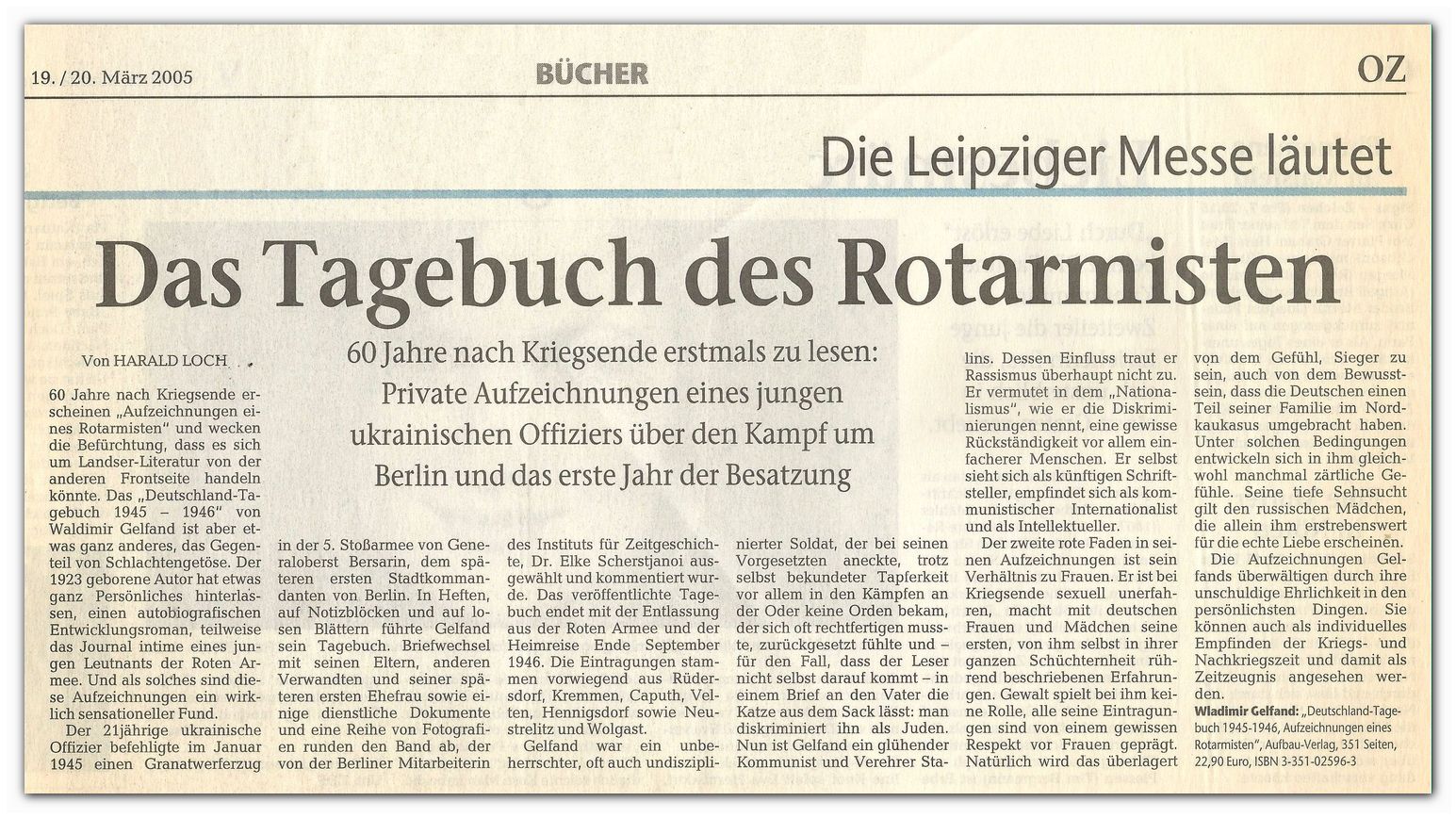
The Diary of a Red Army Soldier
Sixty years after the end of the war, private notes are published for the first time: the record of a young Ukrainian officer about the battle for Berlin and the first year of occupation.
When “Notes of a Red Army Soldier” appears sixty years after the war, one might fear yet another military memoir full of heroic stories. Vladimir Gelfand’s “Germany Diary 1945–1946,” however, is something entirely different—the opposite of a heroic battlefield chronicle.
Born in 1923, the author left behind much more than a collection of notes. The diary is a profoundly personal document, an autobiographical coming-of-age story that at times resembles the intimate journal of a young Red Army lieutenant. That is precisely what made the records such a remarkable discovery.
In January 1945, the twenty-one-year-old Ukrainian officer commanded a mortar platoon in the army of Colonel General Nikolai Berzarin, who would later become the first Soviet commandant of Berlin. Gelfand recorded events in notebooks, on scraps of newspaper, and wherever he could find space to write.
Correspondence with his parents, relatives and future wife, several official documents, and a number of photographs supplement the archive. The material was selected and annotated by Dr. Elke Scherstjanoi of the Institute for Contemporary History in Berlin. The diary ends with Gelfand’s discharge from the Red Army and his return home at the end of September 1946. Important entries were written in places including Rüdersdorf, Kremmen, Caputh, Velten, Hennigsdorf, Neustrelitz and Wolgast.
Gelfand was not a model soldier. He was often impulsive and undisciplined, which repeatedly displeased his superiors. Despite courage in battle, he never received the military decorations he expected. He was frequently pushed aside and felt rejected. If the reader does not already suspect why, Gelfand states it himself in a letter to his father: “I am discriminated against because I am a Jew.”
Even so, he remained a convinced communist and a devoted admirer of Stalin. He did not blame Stalin for racism. Instead, he explained antisemitism as “nationalism,” as he called it, and regarded it as a symptom of the “backwardness of ordinary people.”
He saw himself as a future writer and thought of himself as both a communist internationalist and an intellectual.
The second major thread of the diary is his relationship with women.
At the end of the war he was sexually inexperienced. He describes his first intimate relationships with German women and girls with visible uncertainty, almost as though he were trying to understand them while writing. His own diary does not portray him as using violence. On the contrary, his narrative repeatedly expresses respect for women.
Of course, this respect is complicated by his sense of being a victor and by the knowledge that Germans had murdered members of his family in the North Caucasus. Even so, he was capable of sincere and tender feelings for his German girlfriends.
For him, however, true love remained associated with the image of a Soviet woman. His deepest longing was directed toward that ideal.
Gelfand’s notes are striking for their almost innocent honesty in the most personal matters. They are at once an individual experience of war and the postwar period and a historically valuable eyewitness document.
Vladimir Gelfand: “Germany Diary 1945–1946. Notes of a Red Army Soldier,” Aufbau Verlag, 351 pages, €22.90, ISBN 3-351-02596-3.
Harald Loch