


 |
||
 |
||
 |
Neue Gesellschaft/Frankfurter Hefte 52
(2005), 7/8, S. 107-109 VOLKER ULLRICH „Von Siegern und Besiegten“ Wladimir Gelfands "Deutschland - Tagebuch 1945-1946" |
 |
 |
|
 |
 |
© NEUE GESELLSCHAFT/FRANKFURTER HEFTE

 German
Volker Ullrich
Of Victors and Vanquished
Vladimir Gelfand’s “Germany Diary 1945–1946”
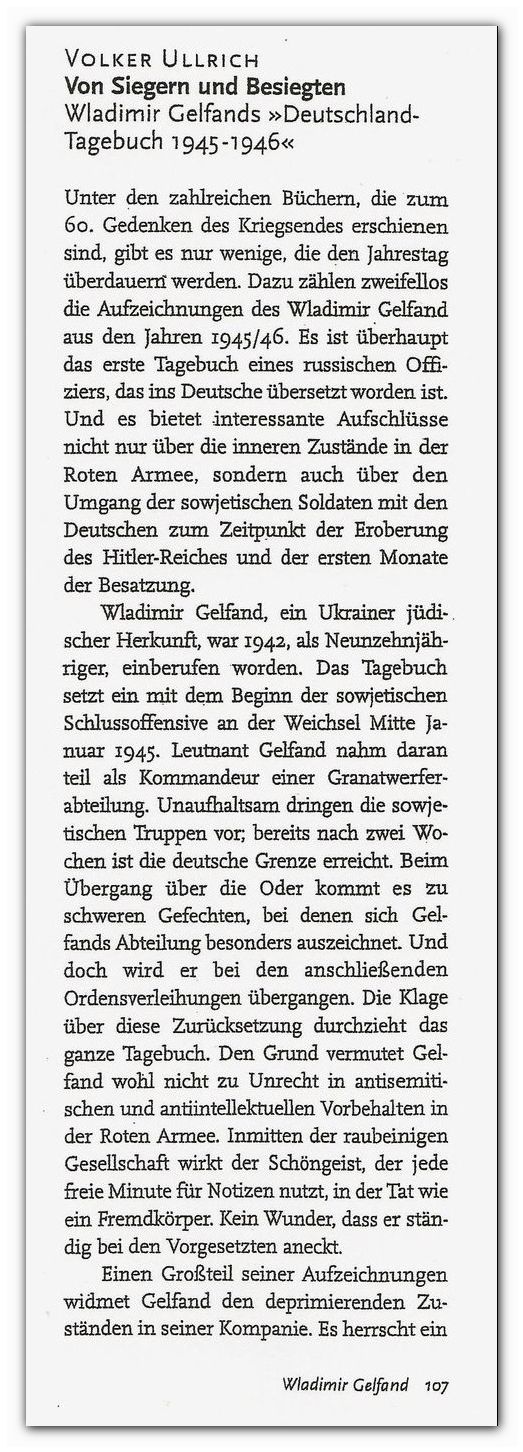
Vladimir Gelfand’s notes from 1945–46 are among the few diaries that will remain worth reading even after the sixtieth anniversary of the end of the Second World War. This is the first diary by a Red Army officer to be translated into German. It sheds light not only on internal conditions in the Soviet forces but also on the attitudes of Red Army soldiers toward Germans during the last months of the war and the first months of occupation.
Vladimir Gelfand, a Ukrainian of Jewish origin, was drafted in 1942 at the age of nineteen. The published diary begins in mid-January 1945, when the Red Army launched its decisive offensive against Nazi Germany after crossing the Vistula. Lieutenant Gelfand, a mortar-unit commander, took part with his unit in hard fighting, particularly during the crossing of the Oder. Yet despite his unit’s contribution, his name did not appear on the award lists. A sense of injustice runs throughout the diary. Gelfand attributes his misfortune to antisemitism and prejudice against intellectuals in the Red Army. In an environment marked by coarseness and brutality, a reflective man who reads, writes and keeps a diary can indeed appear an outsider. His independent nature repeatedly irritated his superiors.
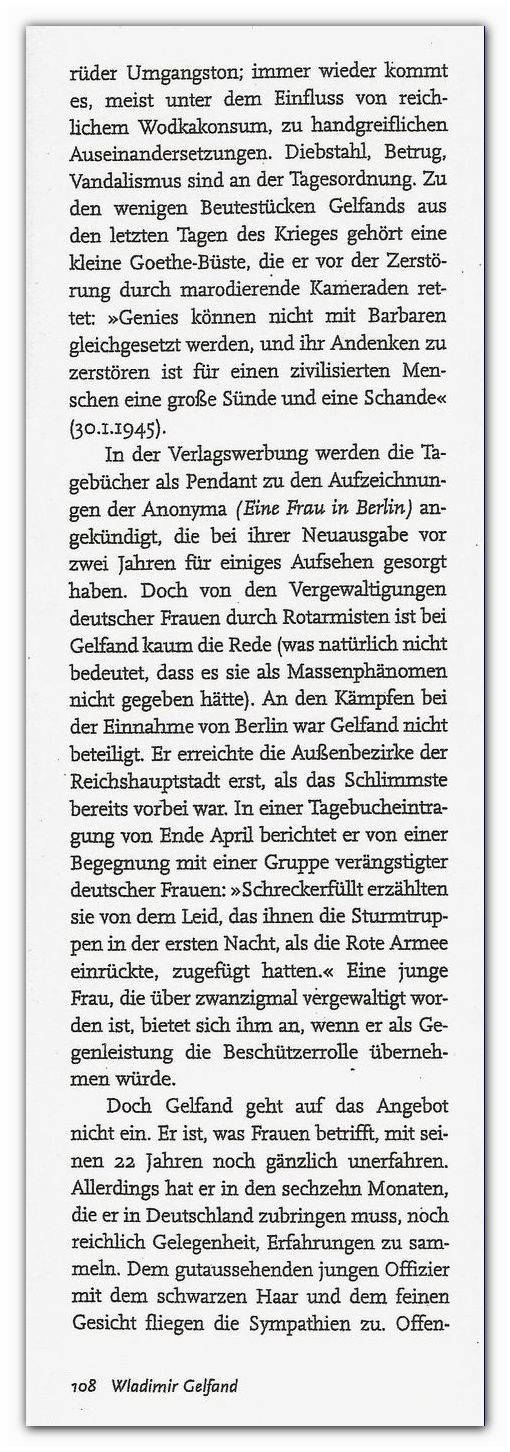
The notes concentrate above all on everyday army life, which is far from heroic. Theft, drunkenness, fraud and brutality accompany the soldiers on their way west. Gelfand makes no secret of his disgust at pointless vandalism. He saves a bust of Goethe that a comrade is about to destroy and writes: “Geniuses cannot be equated with barbarians, and destroying their memory is a great sin for a civilised person.” (30 January 1945)
The publishers promote Gelfand’s diary as a counterpart to the anonymous A Woman in Berlin, which had caused intense debate after its republication two years earlier. Yet the mass sexual violence committed by Red Army soldiers is scarcely discussed in his diary. This may be connected with the fact that Gelfand did not take part in the storming of Berlin; his unit entered the city after the principal fighting had ended. In a late-April entry he describes meeting a group of terrified German women: “They screamed; they told of the suffering that the forward units of the Red Army had inflicted on them during the first night after entering the town.” One woman, who had endured repeated rape, offers herself to Gelfand in return for protection. He refuses.
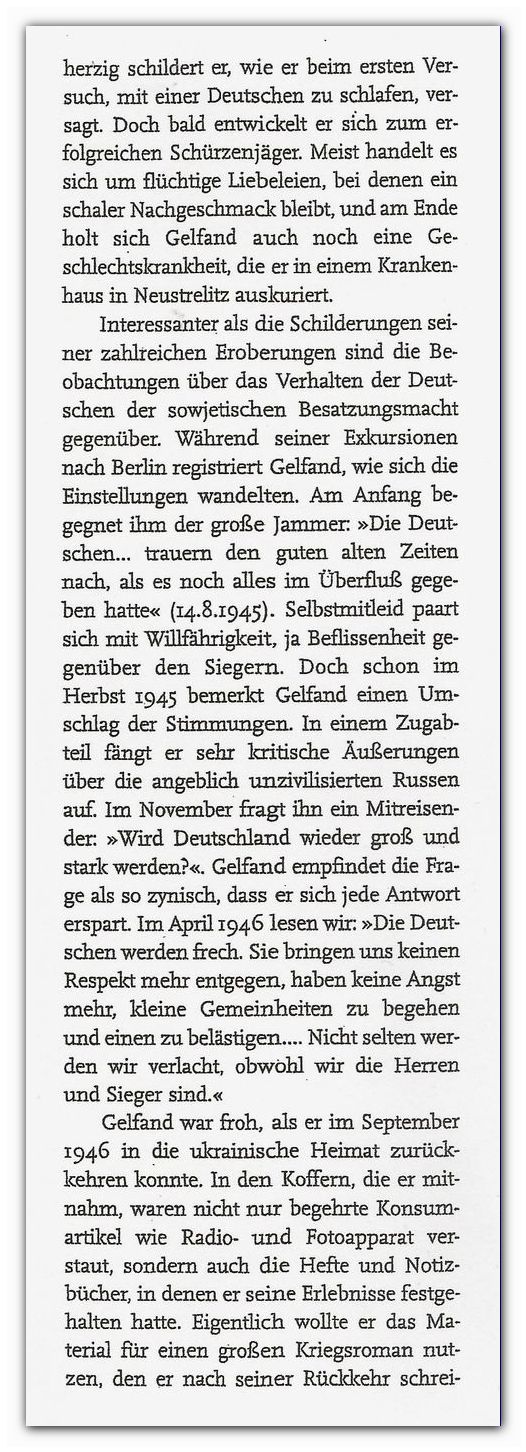
At the end of the war Gelfand is twenty-two and still inexperienced with women. During the sixteen months he spends in Germany, however, he has many opportunities to change that. The young, handsome officer with dark hair and fine features easily attracts attention. Initially uncertain, he soon becomes a successful seducer. Most of these affairs remain superficial and leave a bitter aftertaste; one eventually results in a venereal infection for which he is treated in a hospital in Neustrelitz.
More revealing are his observations of German behaviour under Soviet occupation. During journeys to Berlin he notices changing moods among the defeated population. At first he hears complaints and mourning for lost prosperity: “The Germans … lament the good old days when everything was still plentiful.” (14 August 1945) By autumn, however, he detects a return of concealed arrogance. On a train he hears talk of “uncivilised Russians,” and in November a fellow passenger asks him outright: “Will Germany become great and strong again?” He regards the question as so cynical that he prefers not to answer. By spring 1946 he concludes: “The Germans are becoming insolent. They no longer show us any respect; they are not afraid to play petty tricks on us and harass us … We are often laughed at even though we are the masters and victors.”
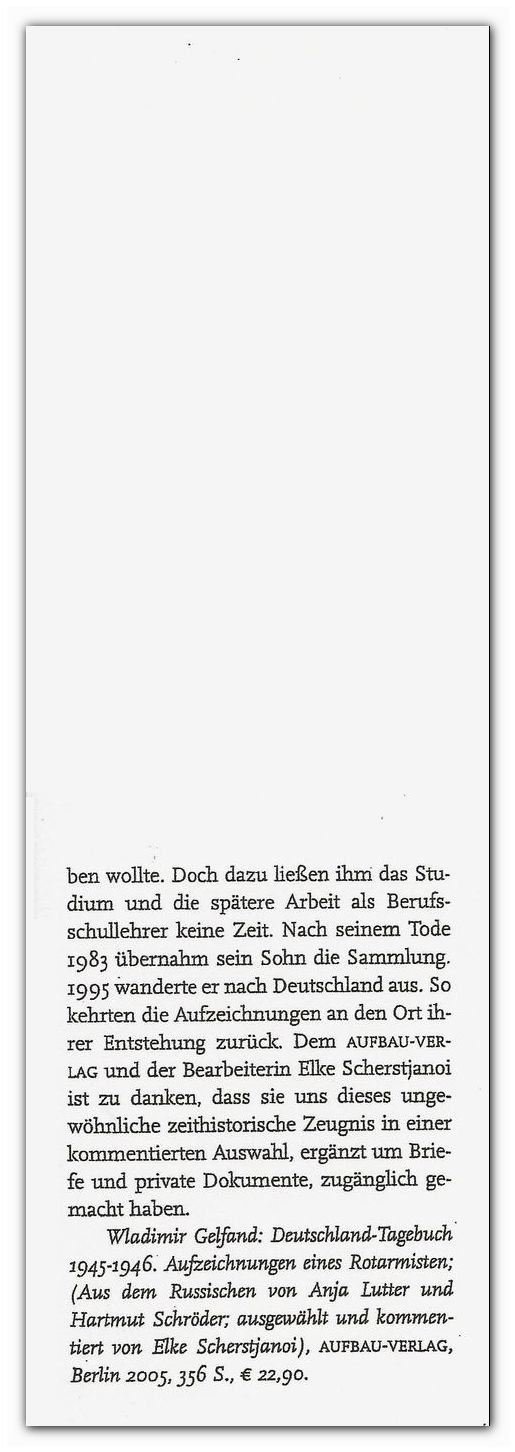
In September 1946 Gelfand returns home, relieved that his service is over. He takes not only consumer goods — a radio and a camera — but several notebooks filled with diary entries. He hopes to use the material for a large war novel. Study and work, however, leave him little time, and the literary project is never realised. Gelfand dies in 1983 without fulfilling that ambition. After his death, his son takes responsibility for the diaries. In 1995 he emigrates to Germany, bringing the notebooks back to the country in which they were written.
Thanks to Aufbau-Verlag and editor Elke Scherstjanoi, Gelfand’s diary appears as an annotated selection supplemented by letters and personal documents. This unusual historical source makes it possible to see Germany in 1945 through the eyes of a young Red Army soldier — not only as a victor, but as a person who observes, reflects and records his impressions with striking openness.