


 |
 |
|
 |
|
 |
|
 |
|
 |
© Leipziger Volkszeitung
 German
Anyone expecting the thunder of battle and hymns of victory from military literature “from the other side” can relax: “Notes of a Red Army Soldier” is something quite different. Sixty years after the end of the war, Vladimir Gelfand’s “Germany Diary” appears as a work that reads more like an autobiographical coming-of-age novel.
The Jewish-Ukrainian officer, then only in his early twenties, was ambitious, stubborn, romantic and inclined to see the world poetically, yet at times cold and detached. He left personal, candid and self-critical notes. His son Vitaly, who moved to Berlin in 1995, has now made the diary available to a broad public. What we hold in our hands is above all a document of a human life recorded against the background of war.
When Gelfand arrived in Germany, he commanded a mortar platoon in the 5th Shock Army under Colonel General Berzarin, the future first Soviet commandant of Berlin. In notebooks, on scraps of newspaper and in letters home, he recorded everything that occupied his mind. The diary ends with his return home.
But first we encounter the young man in March 1945...
Between 10 and 19 March 1945
“Two days later I received twelve letters—a record. Most were from Mama and Papa. The others were two each from Aunt Lyuba, Sema and Aunt Anya, and one each from Nina K. and Tina L. from B. in the A. region.
“Events in general are interwoven with the most varied phenomena. Yesterday, for example, whole clouds of English aircraft flew over us. They came in groups of thirty to fifty. The day was hot and sunny, almost like summer, and the sky was mottled white with aircraft glittering in the dark-blue air. Suddenly the heavens roared, white trails crossed it in every direction, and from all sides the calm, slender birds seemed to glide. It was a joy to watch their majestic flight in these days of our triumph. One lagged far behind the others. Karpinko pointed in another direction and we all saw a stork or crane slowly gliding through the air and laughed.”
16 March 1945
“Dear Papa! I am now answering your letter of 17 February for the third time. I am writing quickly because I know how impatiently you wait for my letters. Many thanks for your congratulations on our successes at the front. A few days ago, on 1 March, I celebrated my twenty-second birthday. I did so on the road and quietly, at a time when I was completely exhausted from marching.
“Spring is already here. The sun warms us and I am not cold. I am on the approach to Berlin. I firmly believe that I will get there and raise the flag of victory on one of the city’s tallest buildings.
“Stay healthy and do not worry—our meeting is not far away. Just look at how the spring sun shines: fortune smiles on us! I kiss you! Vova.”
20 March 1945, Morin — sketches for two short stories
“Who’s there? Come in!”
“Knock, knock—I heard it and woke up. Someone was knocking on the tarpaulin.
“‘Yes!’ I shouted, my head still under my coat. No answer came, and nobody entered the dugout. I thought I had imagined it and tried to fall asleep again, but then the same mysterious triple ‘knock-knock-knock’ woke me.
“‘Who’s there?’ I asked. Again no answer. What was I to think? Someone was probably playing a joke. Fine! In any case, I wasn’t going to open up.
“After a while—the pause was about as long as the first time—I heard the irritating ‘knock-knock-knock’ again.
“‘Come in already!’ I shouted impatiently, threw off my warm coat and ran outside. Nobody was there. Confused, I stopped and listened carefully.
“Suddenly I heard the noise again, the sound that had already woken me several times in the familiar way. Now there could be no doubt. Startled, I hurried back into my shelter. Bullets were whistling over my head, and there was that well-known ‘knock-knock-knock’: an enemy machine gun was firing in short bursts, sounding exactly as though someone were knocking on the tarpaulin stretched over the field shelter.”
“Oh God, God, God!”
“Senior Sergeant Andropov arrived. He had fallen behind during the march and had a whole series of adventures. For a while he had been with motorized riflemen; then he ended up with counterintelligence, which ‘looked after’ him for a time, before he was finally sent back to our battalion, though to a rifle company.
“Now he came to visit us, and I listened to his story with interest.
“During the fighting near a town called ‘Little Berlin’—probably Bernau—they suddenly found themselves face to face with a women’s battalion launching a counterattack. By then our troops had dug in well and calmly waited for the enemy to advance. When they noticed that the attackers were women, the soldiers’ hearts began to beat faster. Still, no order to open fire was given.
“The women advanced in skirmish lines: a first line, a second, a third, firing submachine guns. The fourth and final line consisted entirely of men. They remained quiet. The women grew bolder and fired persistently on our infantry. They came very close and seemed almost to have reached their objective. Then suddenly a powerful hail of bullets struck them from behind. From the flanks came the whipping song of our machine guns. The dead fell like sheaves, and the mixed ranks of ‘warriors’ slowly collapsed to the ground.
“Our machine guns continued firing from the flanks. Terrified and panicked, the women threw away their weapons and tried to find shelter in the streets of the town, only to fall into the secure hands of our soldiers. Our men received them with joy, hatred and triumph. The unfortunate ‘fighters,’ many of whom were no older than seventeen, opened their eyes wide and cried out: ‘Oh God, God, God!’
“One young female soldier lamented bitterly over and over again, ‘Oh God, God!’ and her beautiful eyes shone with emerald tears of repentance.
“The captured women were divided into three groups. There were, first, Russians—two of them married; second, women whose husbands or relatives served in the same unit and who identified themselves accordingly (‘My husband is an officer!’); and third, young girls.
“Only the third group was kept. The Russians, none older than nineteen, were reportedly shot after interrogation.
“The third group became ‘spoils’ distributed among houses and beds, and for several days things were done to them that cannot be put on paper. The German women were frightened and did not resist; they begged the younger men to sleep with them so that they might escape abuse by older soldiers.
“Andropov belonged to this fortunate age group as well. He chose the youngest and took her with him to sleep with her. But when he demanded that she satisfy his basic request, she shook her head and whispered shyly: ‘That isn’t good... I am still a virgin...’”
20 March 1945, Morin
At noon
“Rybkin called Karpinko and me to him. He was polite and well disposed. He asked us to sit down and began, somewhat hesitantly, to explain what he wanted.
“I was assigned to supervise all work on preparing the defensive positions, and for that purpose the entire personnel of the unit was placed at my disposal. I listened to what he had to say, returned to my place, reread my letters and thought about how I might answer them while I waited for the soldiers who had gone with Shikin to the bathhouse to wash.
“I am not vindictive. After Rybkin had been so courteous, I almost began to feel guilty about the report I had sent yesterday to the head of the political section—and also because the day before yesterday I had helped Karpinko prepare a similar report and send it there as well.”
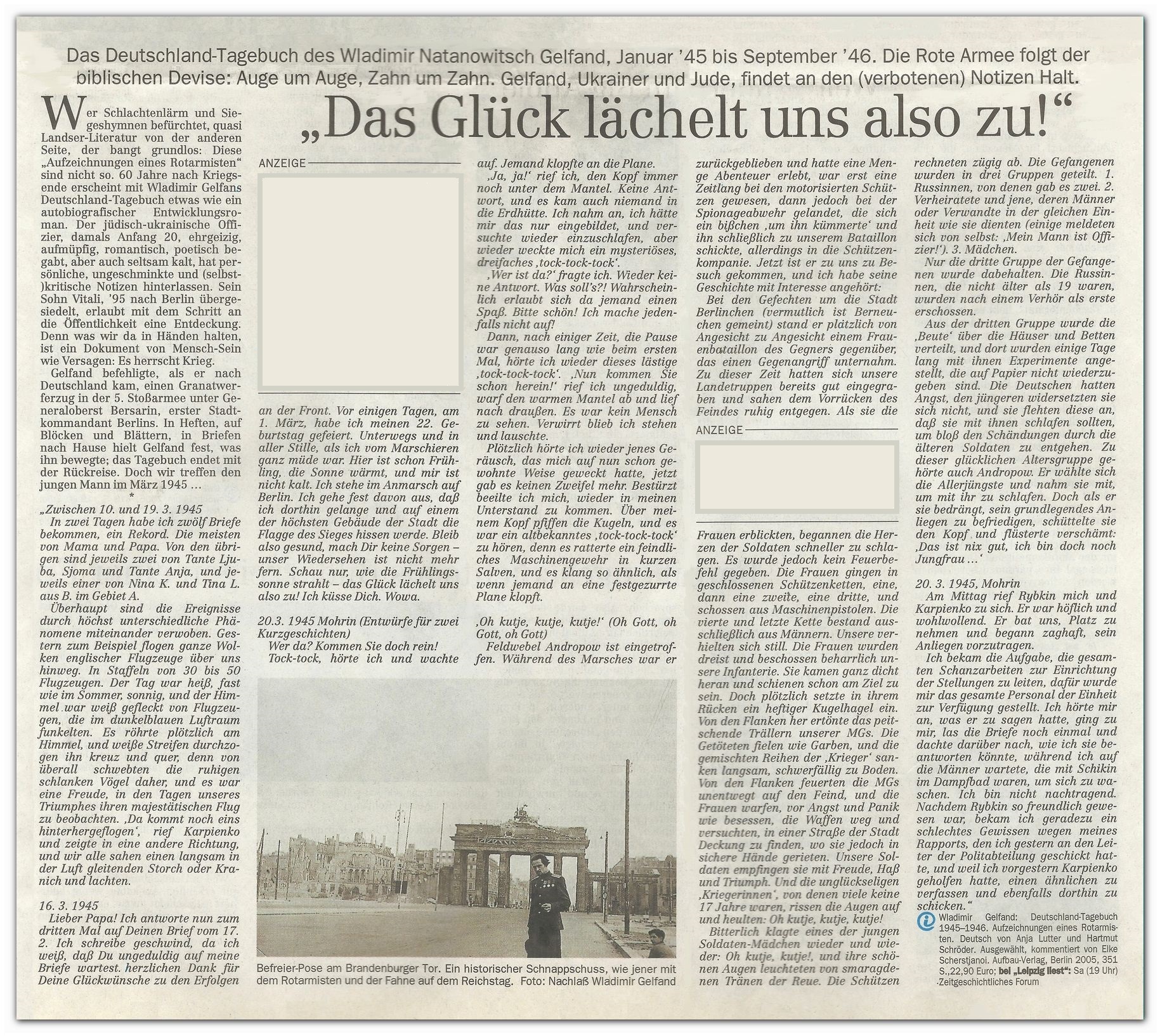
Photo: the estate of Vladimir Gelfand.
The pose of a liberator at the Brandenburg Gate—a historic photograph reminiscent of the famous image of a Red Army soldier with the flag on the Reichstag.