

|
|
Hugin & Munin |
||
|
|
||
| Februari 1/2007 S. 10-11 | ||
 |
||
 |

© Hugin & Munin 2007
 Swedish
A Red Army Soldier in Germany
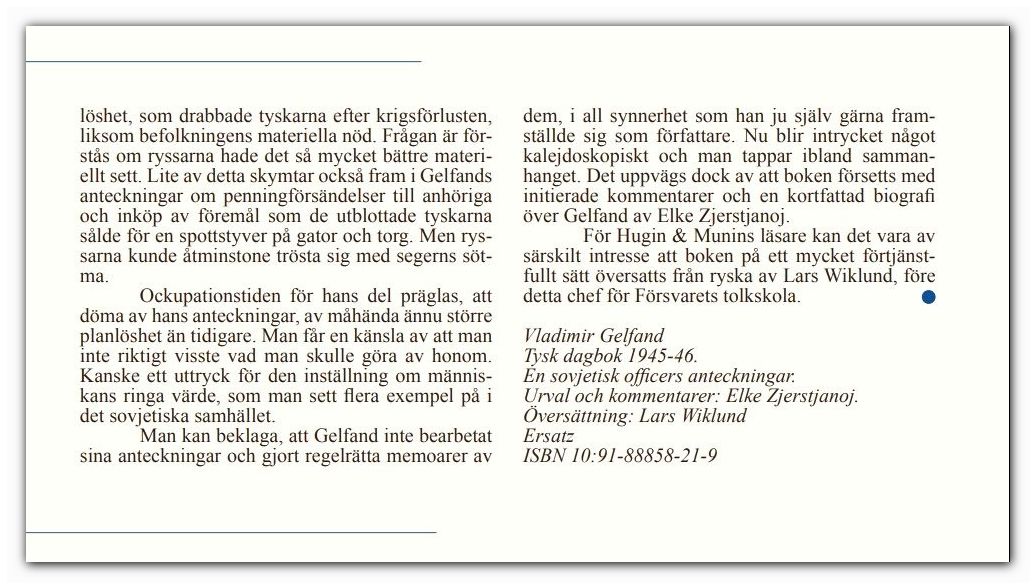
Text: Jan Erik Walter. Photos: Ersatz publishers.
The importance of the Second World War - or the Great Patriotic
War - in Soviet and Russian historiography can hardly be overstated.
This book provides an eyewitness account of the life of a Russian
soldier in Germany at the end of the war and immediately afterward.
Strong, brave, knowledgeable, self-sacrificing and a patriotic idealist - preferably also a young Communist or Party member. That was the image of the Soviet serviceman in the former Soviet Union, transmitted through literature, films and other mass media. It was an image whose truth our generation could not verify for itself until some of us had the opportunity to visit the Soviet Union during military service. We could then see that the Soviet soldier probably differed little from the Swedish one; in any event, he was no superman. To some extent this image began to change with the political changes under Khrushchev, which among other things produced films in the early 1960s that made us look at the subject differently, such as Ballad of a Soldier.
That is why the title German Diary 1945-1946: Notes of a Soviet Officer immediately aroused interest. Would the book answer questions about the conduct of Soviet soldiers not only in Germany but also in the "liberated" allied countries of Eastern Europe?
The book consists of reflections, experiences and letters recorded by Vladimir Gelfand. He was called up for military service in 1942. After years of fighting and retreats, but also military successes, Gelfand became commander of a mortar platoon in the 301st Rifle Division of the 1st Belorussian Front under General, later Marshal, Zhukov. This gave him the opportunity to take part in the campaign against the German capital, an experience that filled him with enthusiasm. By then he had been promoted to lieutenant and had become a full member of the Communist Party.
Gelfand did not, however, aspire to a career as a professional soldier. His interests were more literary, and as a convinced Communist he would have preferred Party work and writing, pursuits to which he could occasionally devote himself when circumstances allowed. His assignments were not always on the immediate front line, but that does not mean he was a coward. He took part in many battles and repeatedly faced danger to his life.
The first entry in the diary is dated 13 January 1945 and the last 27 September 1946. We follow him through Poland and onward into Germany. The entries cover both the assault on Berlin and his subsequent year of service as an officer in the occupation forces.
It is naturally especially interesting to see what passed through the mind of a young man in such turbulent times. Gelfand was only twenty-two when Germany capitulated. It is remarkable that he found the time to keep a diary, that paper was available and that he could find enough privacy to write. War, of course, consists not only of suffering and deprivation but also of periods of relative calm, sometimes lengthy ones.
Given his Party membership, it is striking that ideological questions occupy little space in his entries. He openly admits that he often came into conflict with superiors and fellow officers. He writes sharply about many of them and despises those whom, in his view, were good only at parade-ground inspections. He repeatedly complains that others receive medals while he receives none. Overall the diary conveys an impression of confusion, poor leadership and weak discipline in the Red Army. His setbacks - including the lack of decorations - may perhaps be explained by his difficult character. He says little about the possibility that his Jewish background contributed to his problems, although antisemitism in the Soviet Union became still more pronounced in the postwar period.
His view of the Germans is also interesting. Official Soviet propaganda had portrayed them as hated enemies, but there is no hatred in his diary. He is friendly toward German girls and deals freely with civilians in the occupied country without contempt. He consciously tries to behave correctly toward the defeated, unlike many of his comrades, as he himself notes. His personal experience and the internationalist ideals that attracted many Communist enthusiasts in the 1930s may have played a part. At the same time he feels a strong longing for his divorced parents and for his homeland. When Germans criticize Russia, he is always ready to defend it.
The book also offers a picture of the profound moral and human collapse and the illusions that affected Germans after defeat, as well as the material hardship in the country. One may nevertheless ask whether living conditions for Russians were much better. There are hints in Gelfand's notes when he describes sending money to relatives and buying goods from Germans selling possessions in streets and squares. The Russians, at least, could console themselves with the taste of victory.
Judging from his entries, the occupation period may have seemed even more pointless to him than wartime. One gets the impression that he did not know what to do with himself. Perhaps this reflects a more general human helplessness, of which many examples can be found in Soviet society.
It is a pity that Gelfand did not revise his notes and return to them regularly, especially since he proudly regarded himself as a writer. The diary therefore sometimes feels fragmentary and the broader context can be lost. This weakness is offset by extensive commentary and a short biography of Gelfand prepared by Elke Scherstjanoi.
Readers of Hugin & Munin may be particularly interested to know that the book was translated from Russian into Swedish to a good standard by Lars Wiklund, former head of the School of Translators.