


 |
 |
 |
|
|
|
|
|
 |
 |
 |
conqueror
© Neue Zürcher Zeitung |
 |
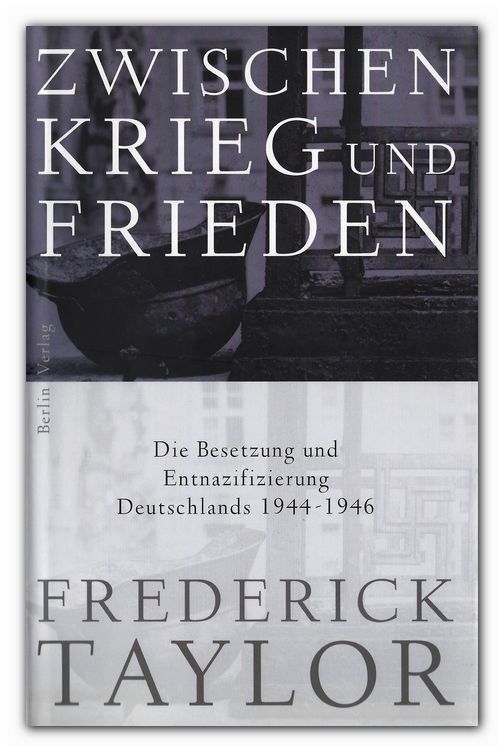
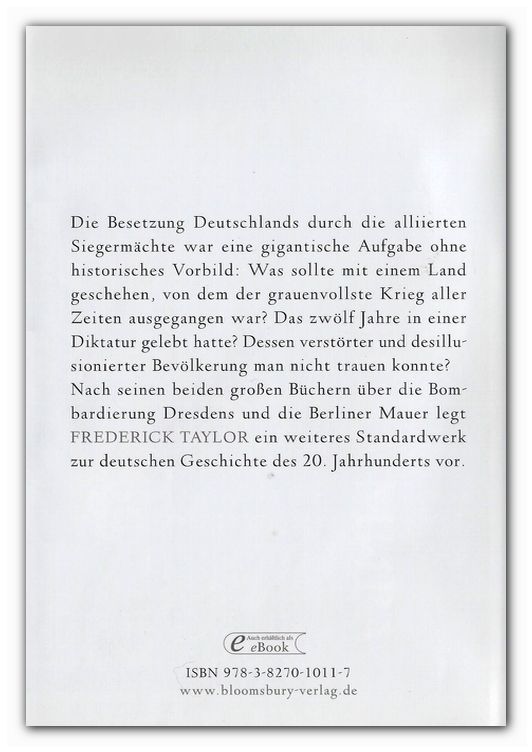
Frederick Taylor, “Between War and Peace: The Occupation and Denazification of Germany 1944–1946”
Brief description
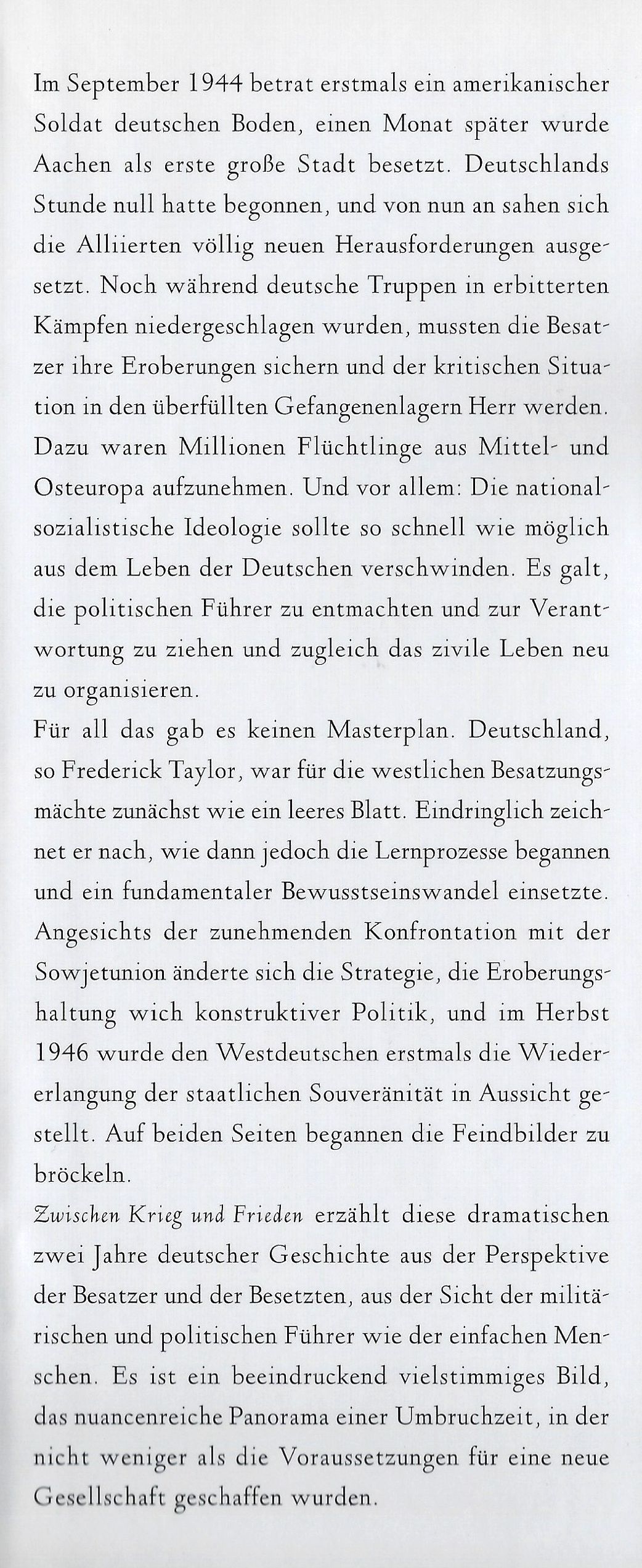
In September 1944 an American soldier set foot on German soil for the first time, and only a month later Aachen became the first major German city occupied by the Allies. Germany’s “zero hour” had begun, confronting the victorious powers with entirely new tasks.
Although the German armed forces had been defeated in bitter fighting, the gains still had to be secured, while the critical situation in overcrowded camps for internees and displaced persons had to be brought under control. Millions of refugees from Central and Eastern Europe needed accommodation.
Above all, National Socialist ideology had to be eradicated from German life as quickly as possible. The political leaders of the Third Reich had to be removed and brought to justice, while paralyzed civilian life had to be reorganized. Yet there was no clear, universally applicable plan for doing so.
Germany, in Frederick Taylor’s words, became a “blank slate” for the Western occupying powers. It was nevertheless during this period that the first attempts at re-education and reflection began, setting in motion a fundamental transformation of public consciousness.
In his book Taylor recounts these dramatic two years between war and peace through the eyes of both occupiers and occupied—soldiers, politicians, and ordinary people. The result is an impressively polyphonic picture, a carefully worked panorama of a time of upheaval in which the foundations of a new society were laid.
Press
British historian Frederick Taylor became known for his books on the Berlin Wall and the bombing of Dresden. In this new work he turns to Germany’s fate between 1944 and 1946, a period of radical rupture and the beginning of postwar reconstruction.
The book opens with Allied troops entering Germany and ends with U.S. Secretary of State James Byrnes’s speech in Stuttgart in the autumn of 1946. The speech was intended to awaken hope among Germans for a better future, and it did indeed provoke an almost enthusiastic response.
The book is especially accessible to a German readership. Taylor neither denies nor softens the crimes of the Nazi regime. When discussing hunger in postwar Germany, he recalls the starvation policies pursued by the Third Reich in occupied territories. Those policies had genocide as their goal; in his view, the difference in motives and circumstances after 1945 is obvious.
Even so, Taylor shows sympathy for German suffering. He describes the horrors experienced in the eastern territories, the brutality of the Red Army—as well as the respect some Soviet soldiers felt for their defeated enemy—along with looting and rape. He does so without losing sight of the historical context, for example by quoting a young German soldier.
He describes the expulsion of Germans in all its brutality, calling crimes committed in the Sudetenland “unimaginable.” According to his account, Czech soldiers forced German men to dig graves and stand in front of them before shooting them and covering the bodies with lime. One German witness remembered: “When I saw that, I cried. A woman then told me: ‘Don’t cry—after all, that is exactly what the Germans did to the Jews.’”
Taylor’s “Between War and Peace” does not claim academic novelty. Its aim is different: to reach a broad readership. He writes vividly and in detail, with close attention to the human dimension of events. Like many British historians, he knows how to keep in mind a reader who wants not merely to learn but also to be drawn into the story. That is an unquestionable strength of the book.
© Deutschlandradio Kultur
In his characteristically restrained but persuasive Anglo-Saxon manner, Frederick Taylor explains how the Allies viewed Germany once it was finally under their control: as an “empty object,” a “blank slate.”
“Everything that had previously existed in the structure of the state and in political life,” he writes, “was regarded by the conquerors as hopelessly corrupted and therefore something to be eliminated.” Destroying the old order seemed an obvious necessity. What might replace those “evil structures,” however, remained unclear and, at first, secondary.
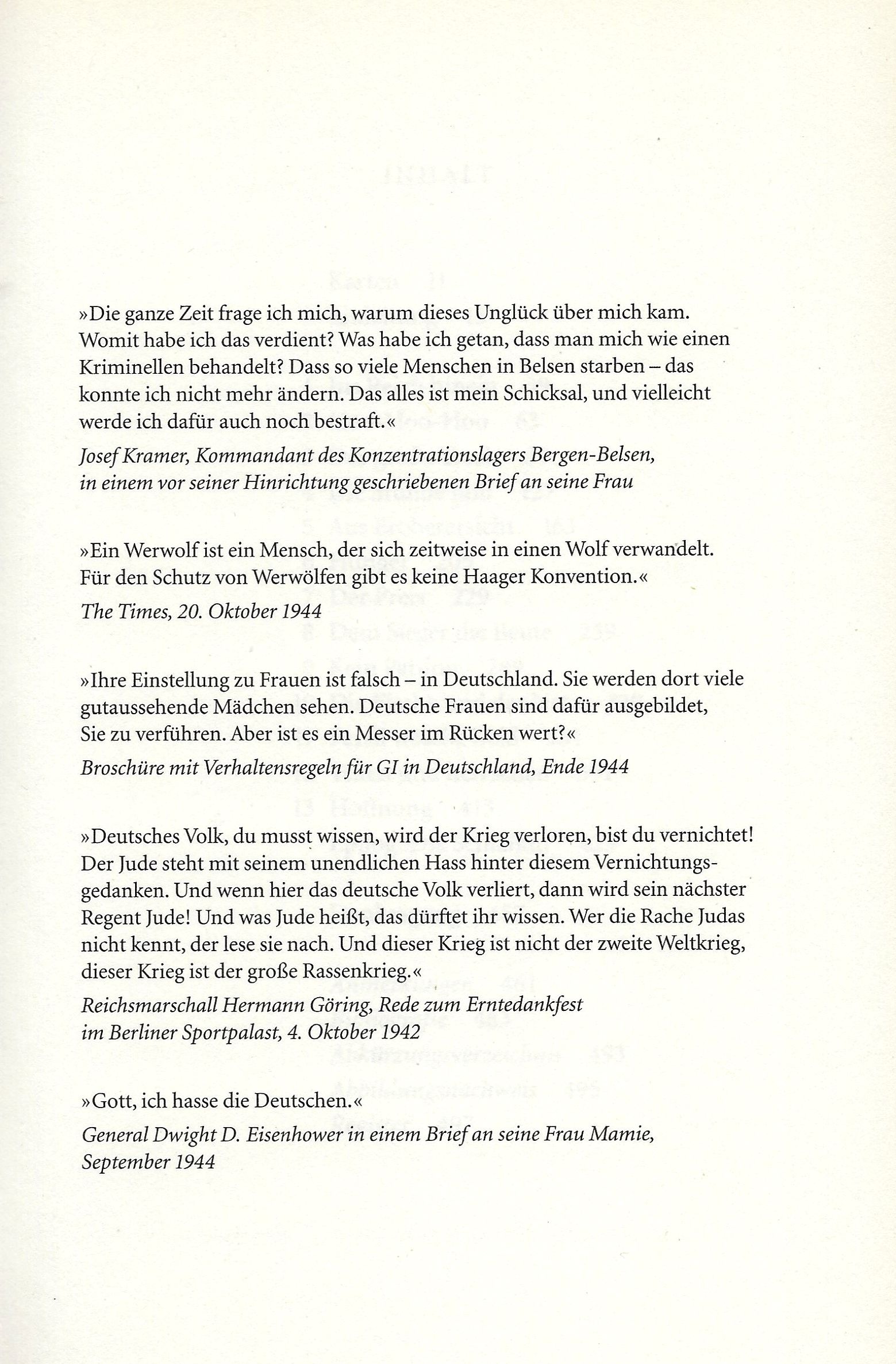
The occupying authorities first had to focus on the most urgent tasks: ensuring security—the fear of the mythical “Werewolves,” underground Nazis, remained alive for a long time—and beginning Germany’s political “cleansing.”
Taylor shows impressively how the image of the “conqueror”—the English term itself sounding unacceptable to German ears—gradually evolved into that of the “victorious soldier” and then into the representative of a new, constructive occupation policy.
The two years covered by the book—from September 1944 to October 1946, when the Nuremberg Trial of the major war criminals ended—were dramatic for victors and defeated alike.
The final months of the war were especially hard on Germany’s civilian population. They left many people—though, as Taylor stresses, by no means everyone—wishing to see the end of the Reich and the fall of the regime. The same can be said of Allied soldiers on both the western and eastern fronts.
The tens of thousands of Allied dead during the last months and weeks of the war, beginning in the summer of 1944, together with the liberation of the concentration camps and growing knowledge of other Nazi crimes, make it all the more remarkable that Germany was not subjected to an even harsher system of occupation and repression.
© Neue Zürcher Zeitung
About the author
Frederick Taylor studied modern history and German studies and is a Fellow of the Royal Historical Society. His books “Dresden: Tuesday, 13 February 1945” and “The Wall: 13 August 1961 to 9 November 1989” have been translated into several languages and became international bestsellers. He lives in Cornwall.
© Berlin Verlag