


 |
|||
 |
|||
| 31.03.2023 |
| Open
to the weather, lacking even primitive sanitary facilities, underfed,
the prisoners soon began dying of starvation and disease |
||
|
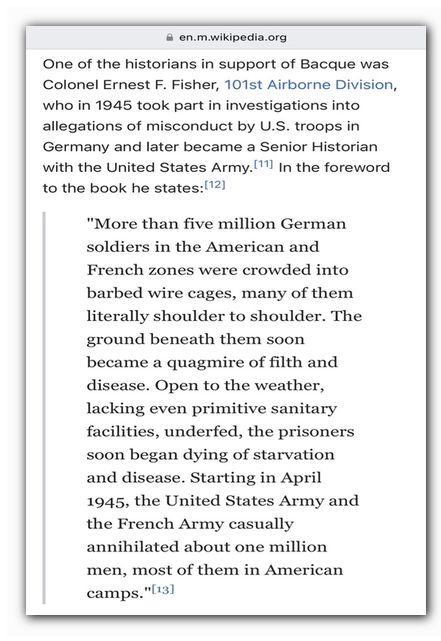
- succinctly stated by Col. Ernest F. Fisher, a former senior historian with the United States Army –‘More than five million German soldiers in the American and French zones were crowded into barbed wire cages, many of them literally shoulder to shoulder. The ground beneath them soon became a quagmire of filth and disease. Open to the weather, lacking even primitive sanitary facilities, underfed, the prisoners soon began dying of starvation and disease. Starting in April 1945, the United States Army and the French Army casually annihilated about one million men, most of them in American camps.’ Nytimesdotcom: By STEPHEN E. AMBROSE “The reason for the notoriety is the author's conclusion that Gen. Dwight D. Eisenhower, as head of the American occupation of Germany in 1945, deliberately starved to death German prisoners of war in staggering numbers. Mr. Bacque charges that "the victims undoubtedly quite likely over a million. Their deaths were knowingly caused by army officers who had sufficient resources to keep the prisoners alive. Eisenhower's method, according to Mr. Bacque, was simple: he changed the designation of the prisoners from "Prisoners of War" (P.O.W.), required by the Geneva Convention to be fed the same rations as American G.I.'s, to "Disarmed Enemy Forces" (D.E.F.), which allowed him to cut their rations to starvation level. Mr. Bacque says the D.E.F. were also denied medical supplies and shelter. They died by the hundreds of thousands. Their deaths were covered up on Army records by listing them as "other losses" on charts showing weekly totals of prisoners on hand, numbers discharged and so forth. So outraged is Mr. Bacque by his discovery of this heinous crime that he has been quoted in a wire service interview as saying Americans "should take down every statue of Eisenhower, and every photograph of him and annul his memory from American history as best they can, except to say, 'Here was a man who did very evil things that we're ashamed of.' " Questions immediately arise. If there were a million dead, where are the bodies? Did Eisenhower have such vast power that he could order starvation on a mass scale and keep it a secret?” (unlike Americans, the concentration camps had hospitals, Bacque also details American records that are missing, destroyed, or still classified). In the book “Crimes and Mercies”: “And now he uncovers evidence that as many as five million Germans may have starved to death while under Allied government after the war.” In the book “Crimes Unspoken”: “860,000 women who, on my conservative estimate, were raped by Allied soldiers between 1944 and 1955. As many women were raped more than once, the total number of cases is much higher. The question of friend or foe was secondary. On their way to Germany, the Americans raped the wives of allied British and French, and also freed slave labourers and concentration camp inmates – just like the Soviets, who had already inflicted a wave of raping on the countries liberated by them.” Mediumdotcom: “The rape of women across Europe was ubiquitous. The American soldiers raped around 200,000 German women. The wives of American soldiers, accompanying their husbands to Germany, had to dress in military uniforms to avoid being raped. “Americans look on the German women as loot, just like cameras and Lugers.” — The New York World Telegram” “Crimes Unspoken”: illegitimate occupation children in the West, 55 per cent were fathered by Americans, 15 per cent by French, 13 per cent by British, 5 per cent by Soviets, 3 per cent by Belgians and 10 per cent by other nationalities. rape was so common in spring 1945 that women are said merely to have asked one another, ‘How many times have they done you?’ The legal situation in post-war Germany made it almost impossible for the German police to investigate rape and prosecute the perpetrators. In the first years of the occupation, a German policeman would not have been able to report anything even if he had burst in on an American gang rape. He could not have intervened, let alone arrested the soldiers, because the military police were responsible for crimes against the German population.
In Bamberg That evening, the engineer’s wife Betty K. was roused by loud knocking at the corridor door. When she opened the door, her eighteen-monthold child in her arms, she was confronted by two huge negro soldiers, who pushed her aside and entered the apartment. After they had turned all the rooms upside down, they assaulted the woman and, according to her own statement, raped her three times. The woman’s father was restrained the whole time by one of the negroes and then shot to death. Rudolf Albart, author of a war diary. priests (German) reported numerous sexual assaults by the French and, above all, the Americans. In Bavaria, as well, the problem was not over in summer 1945. The locals continued to complain of ‘breaches of the peace by US soldiers. Freudenstadt and Stuttgart achieved sad notoriety on account of mass rapes by the French army. The State Ministry of the Interior reported on 19 June 1946 on the abuse of two boys by two American soldiers in Upper Franconia. The GIs had forced the thirteen-year-olds to perform oral sex. The offence was listed in the files as ‘sexual offence with children’ and not as ‘rape’. During the Second World War, all armies committed this war crime, and all populations suffered in differing degrees; French women were raped by German and American soldiers, Polish women by German and Soviet soldiers, and so on. GIs and Red Army soldiers, British and French, Belgians, Poles, Czechs and Serbs took advantage of the conquest and occupation of Germany first to plunder and then to rape. Russian or Moroccan rapists as compared with white Western liberators, who, as has now become clear, followed precisely the same script of plunder and rape. As the historian Walter Ziegler writes, the subject of rape by Americans ‘was marginalized, like the numerous shootings, because of the later close friendship with the USA and the atrocities committed by the Soviets’. The Russians raped, the Americans distributed candy – this was the preconception that prevails to this day. “In a village near Magdeburg The officer had begun to speak, when a German man came from the neighbouring village and through an interpreter said that a Russian soldier had raped his twelve-year-old daughter. The man pointed to the soldier. I then witnessed for the first and hopefully the last time a man being beaten to death. The high-ranking officer kicked and trampled the man to death entirely on his own. The Russian officer’s warning turned out to be true. In her memoirs, Leonie Biallas graphically describes what happened. A 16-year-old girl who bled to death as a result of the rapes. Some women deliberately stuck to (russian) officers so as to escape the ‘stinking lice-ridden’ ordinary soldiers. Such was the case with the mother of Ruth Irmgard Frettlöh. The girl saw her leave a shed with a commandant – smiling. The picture remained etched in her memory and for decades clouded her relationship with her mother. It was only much later that she discovered that her mother had only been so nice to the rapist so as to protect her daughter. The Soviets did not only assault German women. They also raped the Soviet slave labourers, Jews recently released from concentration camps and opponents of the Nazi regime. Ruth Andreas-Friedrich, the pro-Russian resistance fighter, wrote in horror in her diary on 6 May 1945: For four years Goebbels told us that the Russians would rape us. That they defile and plunder, murder and burn. Propaganda, we said appalled, and looked forward to the arrival of Allied liberators. We didn’t want to be disappointed now. We couldn’t have stood it if Goebbels had been right. We had been in opposition for twelve years and now for once we wanted to be on the right side. But this wish was not to come true. She could not possibly be in favour of what was happening now. She was dismayed and bewildered. Wherever she went, she found the same misery: theft, looting, violence. The victorious army set upon the women of Berlin with uninhibited avidity. We visited Hannelore Thiele, Heike’s friend and classmate. She was huddled up on her couch. She barely looked up as we entered the room. ‘I want to kill myself’, she wept. ‘I can’t live like this.’ ‘Was it really so bad?’ I asked cautiously. She looked at me miserably. In Klein-Machnow, Ruth Andreas-Friedrich met Inge Zaun, an 18-year-old who had been completely innocent in sexual matters: Now I know everything. Sixteen times over. ‘How can you defend yourself’, she mused dully and indifferently, ‘when they hammer on the door and fire off their rifles indiscriminately? New ones, different ones every night. When they took me for the first time and forced father to watch, I thought I would die. If a Russian appeared at the door, the women and girls escaped through the windows. Among the abused victims were 13-year-old children. One girl was so badly injured during a rape that she could no longer walk and remained sick for a long time. Another girl hanged herself. The 39-year-old E. O., with her 15-month-old daughter and 7-year-old son, had a terrible experience on 29 January 1945 as they watched a 15-year-old girl being repeatedly raped, and her mother, who tried to protect her, killed. The Soviets set up special rooms for the rapes. They hauled out women twice a day. This went on for a week. For E. O., the seventh day was the worst. She had to spend the whole night in the ‘jaws of hell’. There was nothing to eat, only alcohol and cigarettes. By the next morning, she was severely injured and could hardly walk or lie down. Leading her two children by the hand, she was driven with other women on foot to a town 21 kilometres away. They were still given nothing to eat and believed they would all die on this death march. When the procession was broken up two weeks later, only 200 of the 800 women and a few old men were still alive. The dead were left by the side of the road. Escape through suicide: A particularly radical consequence of this ideologically fomented panic is illustrated by a story from Holzendorf-Mümmeldorf, a hitherto insignificant village halfway between Brüel and Criwitz in Mecklenburg. It had two farmsteads and a tenant farm owned by the church, with a lake to the west. When the first Red Army soldiers were sighted near the village on 4 May 1945 and reports began to circulate that some women had been raped, three inhabitants – the shepherd Martin Bründel from Müsseldorf, his father-in-law Christian Kunst and the tenant of the farm owned by the church – decided that they would not suffer the same fate. On 6 May, Bründel took his family down to the lake, where he cut the throat first of his twelve-year-old daughter Hannelore and then of his wife. The ten-year-old son Herbert and six-year-old daughter Helga, who tried to run away, were held back by their grandparents. Their father beat them to death with a club and then proceeded to drown the two-year-old Hans. Then Kunst beat his wife to death. The two men abandoned their original plan of committing suicide themselves. Instead they made it look as if the women and children had been brutally raped and murdered by the Soviets. And it didn’t end there: on the same afternoon the tenant shot his wife, daughter-in-law and himself. Bründel remarried after the war and became a member of the SED (East German Communist party). The deception was not discovered until 1962. Bründel and Kunst admitted that they had attempted to place the blame for the murders on the Soviets. They were both sentenced to death and executed.10 Even if this is a particularly drastic example of the panic and ideological delusion of the Germans, there are eyewitness reports hinting at large-scale suicides, even a ‘suicide epidemic’.11 Women in particular committed suicide to escape the feared rape and shame of falling victim to foreign soldiers. Even practising Christians were convinced that suicide was preferable to ‘defilement’ – by ‘subhumans’ into the bargain.” Rape appears still to be tacitly regarded as a by-product of the ‘legitimate’ use of force in wars. Academics and society have both failed utterly in dealing with this topic. Historical studies still shy away from dealing with the rapes at the end of the war. War-related rape is a global and traditional problem connected with patriarchal gender roles, in which women (and also men) are seen as the spoils of war. The new Oxford Companion to World War II, a work of over 1,000 pages claiming to be a comprehensive summary, does not even devote a chapter to this topic. The transformation of the sensitive officer Vladimir Gelfand, a 21-year-old lieutenant in the 1052nd Artillery Regiment, a good-looking Jew from Ukraine with a high school diploma, a Party member and admirer of the American president, Franklin D. Roosevelt, kept a diary throughout his entire war service and his time in the occupying army in Germany. The sight of German girls and Soviet prostitutes aroused him but he still didn’t want to buy sex or obtain it by force. The first days in Berlin were the most memorable experiences in his life. He learned to ride a bicycle and met a wonderful girl, who urged him to protect her after having been raped for a whole night in front of her parents. She apparently said to him: ‘You can sleep with me. You can do anything you want with me, but just you. I’m willing to fuck with you, to do anything you want, but just save me from these men with this sh…!’ Gelfand was tempted, but he decided, according to his diary, to do his soldierly duty. But soon he started to get bored in Berlin. He started thinking more and more about the German women. His attitude was more than ambivalent: they attracted him but repelled him ideologically at the same time: ‘The girls here are either dainty but cool, or passionate but moody. Others are ugly or have no figure. Russian girls are proud and very sensitive to all the refinements of conversation. The idealization of the virtuous Soviet woman at home and the demonization of the immoral Western woman was a traditional theme in the Communist ideology. In spite of his reservations, Gelfand slept with a German, apparently consensually. It was evidently his first time, and he was bitterly disappointed at the discrepancy between the fantasies he had read about and the reality. Irritated by his day-to-day life as a soldier, he increasingly abandoned his romantic hopes of a proper love life. When he was stationed outside Berlin as an occupying soldier, he sought increasing contact with women, German and Russian, and contracted gonorrhoea. He became less and less selective – and considerate. One acquaintance, whom he simply refers to as ‘the woman’, was an anti-Semite. The bed scene with her had at the least some indications of force: ‘She was not a one-night stand … I continued to persuade her and started using my hands. His sensitivity gave way to the pragmatism of the gradual brutalization, isolation, disillusionment and ultimately uncouthness of the occupier. In the end he was only a man, who could not bear the ‘imprisonment of the soul, the loneliness’. This is how he justified his indiscriminate sexual contacts, trivializing and ignoring the resistance shown by some of the women, including a 16-year-old girl. He contracted a venereal disease again, endured painful turpentine injections and catheterization, but this didn’t deter him from his next sexual conquest. Altogether, Gelfand’s diary combines motives of revenge, resentment towards the Germans, frustration at his own situation in the military, loneliness and the conviction that as the conqueror he was entitled to treat women in a way that was at least very close to open violence and aggression.” “Crimes and mercies”: “In one Sudetenland village, all the German women were seized, and their Achilles tendons were cut. As they lay on the ground screaming, the Czech men raped them. Some of them were raped many times in a day, day after day. Frau X’s eighteen-year-old daughter was raped about fifteen times every day for weeks. This was what the Czechs, Poles and Russians did in 1945. After 9 May, when the Red Army marched into Pribram, one of the women was told to go with a Russian soldier. She knew what he would do, so she refused. He threw her out of the fourth floor window, killing her. In the same camp, another woman was seized and raped so often that she died. Her children were watching and weeping beside her the whole time. ‘During the first night of the Russian occupation, many of the nuns were raped as many as fifty times. The same dreadful scenes were enacted in homes for the aged, hospitals, and other such institutions. Even nuns who were seventy and eighty years old and were ill and bedridden were raped and ill treated by these barbarians. And to make matters worse, these atrocities were not committed secretly or in hidden corners but in public, in churches, on the streets, and on the squares, and the victims were nuns, women and eight-year-old girls. Mothers were raped in the presence of their children, children, girls were raped in front of their brothers, and nuns were raped in front of young boys.’ The Russians even went so far as to gratify themselves sexually on their victims’ corpses. At least 860,000 German women and young girls, and also men and boys, were raped at the end of the war and in the post-war period by Allied soldiers.”
|
||
 |
 |
||
 |
 |
||
 |
 |
||
© Quora, Inc. 2023
