



Las terribles violaciones ocultas tras la caída de Berlín |
||
| Setenta
años después, la revisión de los
días
finales de la Segunda Guerra Mundial, revela un aspecto
sombrío
de la historia: las multiples violaciones sufridas por mujeres alemanas
a manos de soldados soviéticos. |
||
 |
||
| Archivado en: Mundo | Mundo | Viajes | ||
|
La contribución de las tropas de la Unión Soviética en la derrota de la Alemania nazi durante la Segunda Guerra Mundial es ampliamente reconocida como uno de los momentos más destacados de su historia. Sin embargo, a medida que han pasado 70 años desde aquellos días finales de la guerra, ha surgido un aspecto oscuro de esta historia que merece ser examinado: las terribles violaciones cometidas por soldados soviéticos contra mujeres alemanas. En las afueras de Berlín, en el parque Treptower, se erige una imponente estatua de aproximadamente 12 metros de altura. Esta escultura representa a un soldado soviético sosteniendo una espada en una mano y a una joven alemana en la otra, mientras pisa una esvástica rota. Este monumento conmemora el lugar donde perdieron la vida 5.000 de los 80.000 soldados del Ejército Rojo que cayeron en Berlín entre el 16 de abril y el 2 de mayo de 1945.
Es importante destacar que existen registros que documentan numerosos casos de violaciones cometidas por las tropas soviéticas en la capital alemana, aunque durante los años inmediatamente posteriores al final de la guerra y, especialmente, en la Rusia actual, este tema se ha considerado tabú. |
||
 |
||
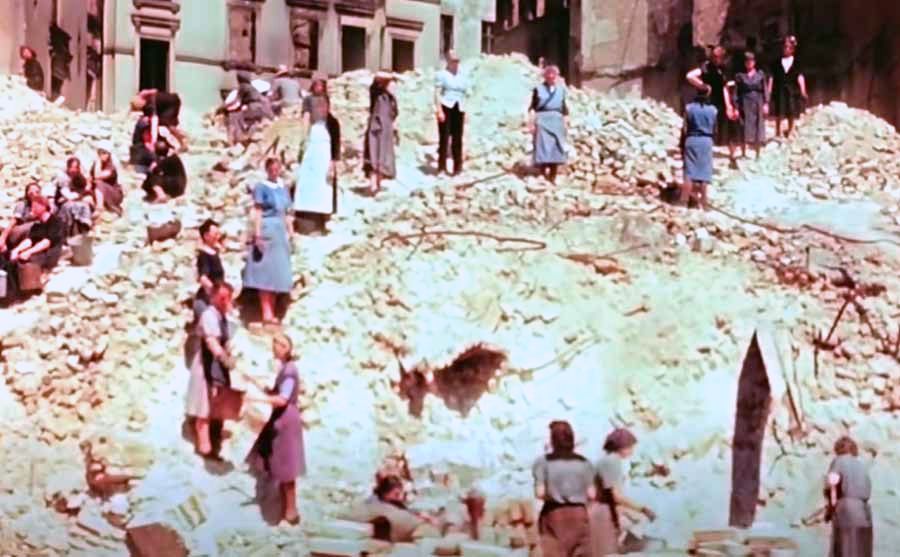
| Berlín era una montaña de escombros al final de la Segunda Guerra Mundial | ||
| |
||
|
Los medios rusos a menudo han calificado estas acusaciones de violaciones masivas como mitos occidentales, a pesar de que muchos de los datos provienen del diario escrito por un joven soldado soviético. Vladimir Gelfand, un joven teniente judío originario de Ucrania, escribió un diario crudo y sin censura en el que detalló las atrocidades de la guerra desde 1941, a pesar de la prohibición del ejército de llevar diarios por motivos de seguridad. Su manuscrito ha sido ampliamente publicado y ofrece una visión caótica de la vida en su batallón, marcada por la escasez de alimentos, la presencia de piojos, el antisemitismo y el robo incluso entre compañeros de armas. En febrero de 1945, Gelfand estaba cerca de la represa del río Oder, donde el ejército se preparaba para el asalto final a Berlín. En sus escritos, describió cómo sus camaradas rodearon y eliminaron batallones de mujeres alemanas que estaban luchando. Gelfand expresó su horror ante estas acciones y señaló que algunos soldados sugerían métodos extremadamente crueles de tratar a estas mujeres, mientras que él abogaba por una ejecución más misericordiosa. Uno de los pasajes más conmovedores de su diario ocurrió el 25 de abril, cuando ya habían llegado a Berlín. En ese momento, Gelfand se encontraba en una bicicleta junto al río Spree y se topó con un grupo de mujeres alemanas que llevaban maletas y pertenencias. Al preguntarles en alemán hacia dónde se dirigían y por qué habían abandonado sus hogares, las mujeres le relataron con horror las terribles experiencias que habían vivido cuando el Ejército Rojo llegó a la ciudad. Sus historias incluían abusos sexuales extremos por parte de múltiples soldados soviéticos. Es importante contextualizar estos eventos en el contexto de una guerra brutal en la que los abusos y las violaciones eran lamentablemente comunes por parte de ambos lados. Los soldados alemanes también cometieron atrocidades en la Unión Soviética, aunque es difícil establecer una comparación exacta dadas las circunstancias únicas de cada frente de batalla. En última instancia, es esencial recordar y reflexionar sobre estos eventos oscuros de la historia para comprender plenamente las complejidades de la Segunda Guerra Mundial y aprender de las lecciones que ofrece el pasado. Además, es importante honrar la memoria de todas las víctimas inocentes de la guerra y trabajar hacia un mundo en el que estos horrores no vuelvan a repetirse. |
||
© PERIODISTA DIGITAL, SL NIF B82785809
 Spanish
Periodista Digital
The Terrible Rapes Hidden after the Fall of Berlin
Seventy years later, a review of the final days of the Second World War reveals a dark aspect of history: the numerous rapes suffered by German women at the hands of Soviet soldiers.
ALEX MACKENZIE
The contribution of the troops of the Soviet Union to the defeat of Nazi Germany during the Second World War is widely recognized as one of the most outstanding moments in its history. However, as seventy years have passed since those final days of the war, a dark aspect of this story has emerged that deserves examination: the terrible rapes committed by Soviet soldiers against German women.
On the outskirts of Berlin, in Treptower Park, stands an imposing statue approximately twelve meters high. The sculpture depicts a Soviet soldier holding a sword in one hand and a young German girl in the other, while stepping on a broken swastika.
The monument commemorates the place where 5,000 of the 80,000 Red Army soldiers who fell in Berlin between April 16 and May 2, 1945 lost their lives.
The scale of the monument reflects the enormous sacrifice of life at that historic moment. For some people, however, the memorial is known ironically as “The Tomb of the Unknown Rapist.”
It is important to note that records exist documenting numerous cases of rape committed by Soviet troops in the German capital, although during the years immediately after the end of the war, and especially in present-day Russia, this subject has been regarded as taboo.
Berlin was a mountain of rubble at the end of the Second World War.
Russian media have often described allegations of mass rape as Western myths, even though much of the information comes from the diary written by a young Soviet soldier.
Vladimir Gelfand, a young Jewish lieutenant from Ukraine, wrote a raw and uncensored diary in which he recorded the atrocities of the war beginning in 1941, despite the army’s ban on keeping diaries for security reasons. His manuscript has been widely published and provides a chaotic view of life in his battalion, marked by food shortages, lice, antisemitism, and theft even among comrades-in-arms.
In February 1945 Gelfand was near the Oder River dam, where the army was preparing for the final assault on Berlin. In his writings he described how his comrades surrounded and eliminated battalions of German women who were fighting. Gelfand expressed horror at these actions and noted that some soldiers proposed extremely cruel ways of treating the women, while he argued for a more merciful execution.
One of the most moving passages in his diary occurred on April 25, when they had already reached Berlin. Gelfand was riding a bicycle beside the River Spree and encountered a group of German women carrying suitcases and belongings. When he asked them in German where they were going and why they had left their homes, the women told him in horror about the terrible experiences they had endured when the Red Army arrived in the city. Their accounts included extreme sexual abuse by multiple Soviet soldiers.
It is important to place these events in the context of a brutal war in which abuse and rape were unfortunately common on both sides. German soldiers also committed atrocities in the Soviet Union, although an exact comparison is difficult because of the unique circumstances of each front.
Ultimately, it is essential to remember and reflect on these dark events in history in order to understand fully the complexities of the Second World War and learn the lessons offered by the past. It is also important to honor the memory of all innocent victims of the war and work toward a world in which such horrors are never repeated.
© PERIODISTA DIGITAL
