




 |
|
 |
|
 |
 German
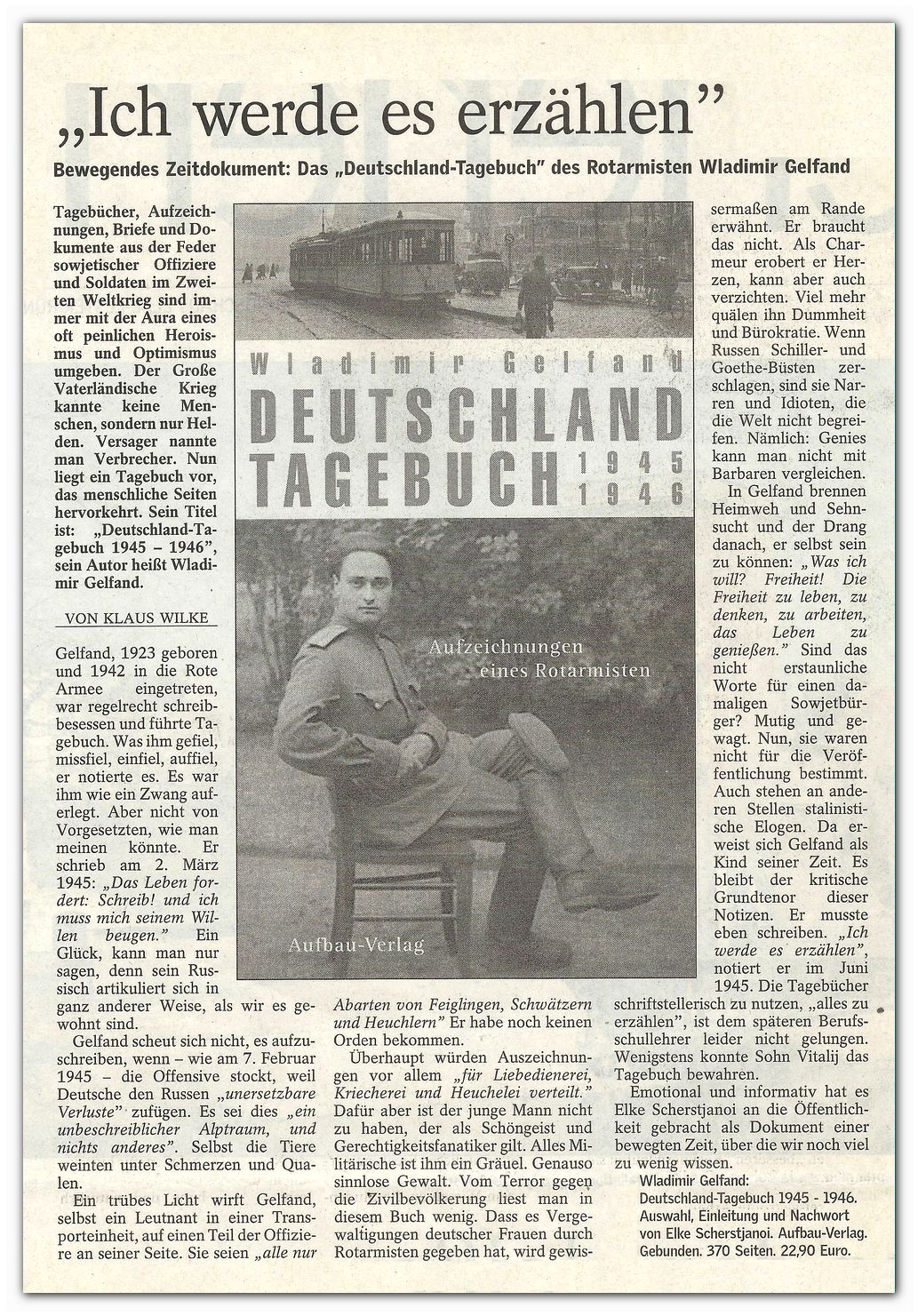
Diaries, notes, letters and documents written by Soviet officers and soldiers during the Second World War have often been surrounded by an aura of awkward heroism and optimism. The Great Patriotic War seemed to know no ordinary people, only heroes. Failure could be branded as criminal. Now there is a diary that brings the human dimension sharply into view. Its title is Germany Diary 1945–1946, and its author is Vladimir Gelfand.
Gelfand, born in 1923, joined the Red Army in 1942. He was an obsessive recorder of experience and kept a diary. Everything that caught his attention, stirred his emotions, astonished or angered him, he wanted to preserve in writing. It seems to have been something he could not resist, almost a compulsion — but certainly not one imposed by his superiors.
“Life demands: write! And I must bow to its will,” he noted on 2 March 1945.
Fortunately so, one might add, because in his diary the Russian language sounds quite different from the official prose with which we are familiar.
Gelfand was not afraid to record bitter truths. On 7 February 1945, for example, he wrote about the stalled offensive and the “irreplaceable losses” suffered by the Russians. It was, he said, “an indescribable nightmare, and nothing else.” Even the animals seemed to cry out in pain and suffering. Lieutenant Gelfand, then serving in a transport unit, made no secret of his contempt for some of his officers. “They are all merely different kinds of cowards, windbags and hypocrites,” he observed, complaining that this was why he himself had received no decorations.
In his view, military awards were often distributed for “toadying, flattery and hypocrisy.” Gelfand, a sensitive man with a keen sense of justice, took such things painfully. To him war was horror in all its forms, especially senseless violence.
The terror directed against civilians appears only intermittently in the diary. He mentions that Red Army soldiers committed violence against German women, but he does not make it the center of his account. It was not his own behavior. He sought women differently, through charm, and if he could seduce, he could also refuse. Stupidity and bureaucracy troubled him far more. When soldiers smashed busts of Schiller and Goethe, he was outraged: people who did such things, he felt, simply did not understand the world. “Geniuses cannot be equated with barbarians,” he said.
Gelfand felt a deep longing for home, but even stronger was his desire to remain himself. “What do I want? Freedom! To live freely, to think, to work, to enjoy life,” he wrote.
Are these not remarkable words for a Soviet citizen of that period? They were courageous and even risky. His diary, however, was not intended for publication. Even when he praised Stalin, the tone is different from an official declaration: here Gelfand appears as a child of his time. Yet the critical voice in his notes never disappears. “I will tell about it,” he wrote in June 1945.
He hoped to use the diaries as the basis of a literary work and to “tell everything,” but that never happened. Later he became a vocational-school teacher, and his dream of becoming a writer remained unfulfilled. At least his son Vitaly succeeded in preserving the diaries.
This emotionally powerful and historically important document about a period we still know too little about was made accessible to a broad public through the work of historian Elke Scherstjanoi.