



 |
 |
|
|
|
||

|
| La
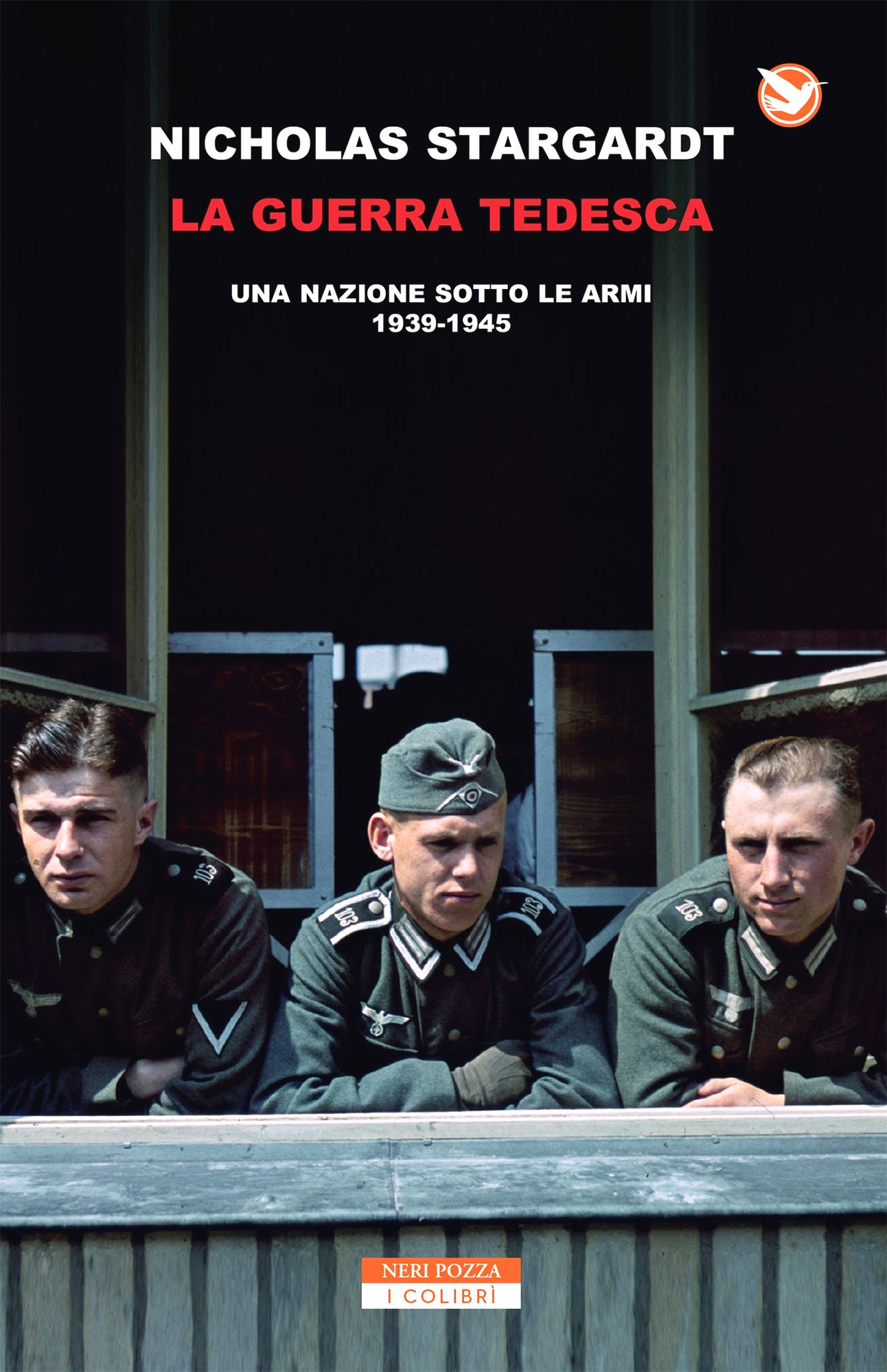
Seconda guerra mondiale fu una guerra come nessun’altra. Nel corso della sua esistenza, il Terzo Reich investì e consumò tutte le sue riserve morali e fisiche, portando alla sconfitta totale del 1945. A distanza di così tanti anni – nonostante gli scaffali di libri dedicati alle origini, all’andamento e alle atrocità della guerra – ancora non sappiamo per che cosa i tedeschi pensassero di stare combattendo, quali furono le esperienze che attraversarono e come fecero a sopportare la guerra fino all’ultimo giorno. Quando scoppiò, nel settembre del 1939, la guerra in Germania non godeva del minimo favore popolare. Senza però la partecipazione e l’impegno offerti attivamente dal popolo tedesco, non avrebbe potuto andare avanti per quasi sei anni. Che cos’era, dunque, la guerra che i tedeschi pensavano di stare combattendo? In che modo il volgere degli eventi del conflitto – le vittorie del Blitzkrieg, le prime sconfitte sul fronte orientale, il bombardamento subito dalle città tedesche – mutò opinioni e aspettative? E quando fu che i tedeschi si resero conto di stare combattendo una guerra genocida? Attingendo a una messe di testimonianze di prima mano, La guerra tedesca è, da decenni a questa parte, il primo tentativo di capire come il popolo tedesco vivesse la Seconda guerra mondiale. Adottando il punto di vista di coloro che la attraversarono – soldati, insegnanti di scuola e casalinghe; nazisti, cristiani ed ebrei – il racconto storico magistrale che ne emerge getta una luce nuova e inquietante sulle convinzioni, le speranze e le paure di un popolo che intraprese, proseguì e combatté sino alla fine una guerra brutale di conquista e genocidio. ________________________________
Sono trascorsi più di settant’anni dalla fine della Seconda guerra mondiale e – nonostante interi scaffali di libri dedicati alle origini, allo svolgersi e alle atrocità del conflitto – non sappiamo ancora perché i tedeschi combatterono fino all’ultimo giorno per la difesa del Terzo Reich. Neppure i giapponesi combatterono fino alle porte del palazzo imperiale di Tokyo come fecero i tedeschi per la Cancelleria del Reich a Berlino. Che cosa li muoveva realmente? Come potevano far proprio il richiamo alla mobilitazione generale da parte di un regime che, nel 1945, mise in atto la propria «sconfitta totale», investendo e consumando tutte le risorse morali e fisiche della nazione? Il carattere di guerra razziale di quel conflitto, con le atrocità e i genocidi conseguenti, non era, inoltre, – come nel periodo della Guerra fredda si è a lungo sostenuto – un’ignobile macchia delle SS e di un manipolo di nazisti intransigenti. A partire dagli anni Novanta, documentazioni fotografiche e numerosi materiali – come una pagina di diario in cui, il 22 novembre 1943, il capitano August Töpperwien annotava: «Stiamo sterminando non solo gli ebrei che comabattono contro di noi, vogliamo letteralmente sterminare questo popolo in quanto tale!» – hanno abbondantemente messo in discussione la comoda scusa di una Wehrmacht buona a fronte delle cattive SS. La tesi perciò che vuole i tedeschi consapevoli a poco a poco di stare combattendo una guerra mirata al genocidio è difficilmente confutabile. Che impatto, tuttavia, ha avuto sulla gente comune una simile consapevolezza? In che maniera la guerra influì sul loro modo di vedere il genocidio? Il diffuso timore, nell’estate 1943, che la Germania non sarebbe riuscita a sottrarsi alle conseguenze di una spietata guerra razziale, di cui era stata essa stessa fautrice, ha avuto un peso rilevante nella mobilitazione generale dei tedeschi? Opera imponente, frutto di un decennale lavoro su una sterminata massa di materiali – i rapporti delle spie del regime, quelli della censura militare, le raccolte di lettere fra amanti, amici stretti, genitori e figli e coppie sposate – La guerra tedesca intreccia magistralmente gli eventi bellici con le vicende personali del popolo tedesco in guerra, e offre al lettore uno dei più importanti libri sulla Germania nazista che siano mai stati scritti. |
 |
|
Prefazione Questo libro rappresenta il coronamento di un periodo di poco più di vent’anni durante i quali ho tentato di comprendere l’esperienza di coloro che vissero in Germania e sotto l’occupazione tedesca durante la seconda guerra mondiale. Si tratta, peraltro, di un libro che inizialmente non avevo intenzione di scrivere. Nel 2005 avevo assicurato a me stesso e a chiunque fosse a portata d’orecchio che, avendo appena terminato La guerra dei bambini. Infanzia e vita quotidiana durante il nazismo, non avrei scritto null’altro sui bambini, l’Olocausto o la Germania nazista. Questo libro aveva cominciato a prendere vita come un breve saggio che affrontava la questione di ciò per cui combattevano i tedeschi: era qualcosa che avevo l’impressione fosse necessario dire prima di potermi dedicare ad altro, e iniziò a prendere la forma di qualcosa di più consistente durante un anno sabbatico che passai all’Università libera di Berlino nel 2006-2007. Vi sono alcune chiare continuità fra i due libri, la più evidente delle quali è l’interesse che mi porta a esplorare le dimensioni soggettive della storia sociale, ricorrendo alle testimonianze dell’epoca per riuscire ad avere un’idea di quale fosse il giudizio che le persone davano e quale la comprensione che avevano degli eventi nel momento in cui si stavano svolgendo attorno a loro e prima di sapere quale ne sarebbe stato l’esito finale. Vi sono anche delle chiare differenze. Ne La guerra dei bambini volevo più di ogni altra cosa trattare i bambini come attori sociali in tutto e per tutto; e avevo inoltre intenzione di mettere l’una accanto all’altra le prospettive, fra loro irriducibili, dei bambini che la guerra e le persecuzioni razziali dividevano in vincitori e perdenti. La guerra tedesca presenta un diverso problema: come fare a mettere in luce quali fossero i timori e le speranze della società da cui provenivano i vincitori e gli esecutori materiali, e così facendo comprendere quale giustificazione si dessero i tedeschi per questa guerra. Per focalizzare la questione il mio intento è stato andare, per così dire, in ampiezza e in profondità: in ampiezza utilizzando «macro» istantanee d’opinione, attinte a quanto, delle conversazioni pubbliche, riferivano i rapporti delle spie che stavano in ascolto per conto del regime o della censura militare che prelevava i campioni di lettere dai sacchi della posta; in profondità seguendo un cast selezionato di individui, tratto da un’ampia varietà di contesti, in un arco di tempo considerevole, andando a vedere come speranze e progetti personali risultassero intrecciati con l’esperienza mutevole che la guerra li portava ad avere. In tal modo la voce delle vittime non ha più la stessa rilevanza che aveva ne La guerra dei bambini, ma non è mai del tutto assente: senza il loro punto di vista contrastante non sapremmo quante differenze – e spesso atteggiamento solipsistico – vi fossero nel modo in cui i tedeschi si facevano un’idea della guerra. Uno
degli ingredienti principali di questo libro sono le raccolte di
lettere fra amanti, amici stretti, genitori e figli e coppie sposate.
È un tipo di fonti che è stato utilizzato da
molti
storici, ma con esiti spesso diversi. Per esempio, la Bibliothek
für Zeitgeschichte («Biblioteca di storia
contemporanea») di Stoccarda possiede una celebre collezione
di
circa venticinquemila lettere messa insieme da Reinhold Sterz.
Purtroppo le lettere sono state catalogate per periodo e non per
autore, cosicché esse forniscono un’istantanea
delle
opinioni soggettive in un momento preciso della guerra, senza che sia
possibile verificare quanto strettamente l’autore di una
lettera
si attenne a queste opinioni in un dato arco di tempo. Quel che ha
guidato la mia selezione è stato il principio opposto: ho
voluto
leggere raccolte di corrispondenza in cui siano conservate lettere di
una parte e dell’altra e che siano andate avanti per almeno
alcuni anni, facendo in tal modo vedere come nel corso della guerra si
svilupparono e modificarono le relazioni personali fra i corrispondenti
(che sono poi il motivo principale per cui ci si scrive).
Ciò ci
consente di ricostruire con maggior precisione quale fosse il filtro
personale attraverso cui ogni individuo percepiva i grandi eventi.
È il genere di ricerca che gli storici della prima guerra
mondiale vanno sviluppando dagli anni Novanta, e ho imparato molto su
come si fa da Christa Hämmerle. |
© Nick Stargardt
© Neri Pozza Editore, Vicenza
 Italian
Publisher: Neri Pozza (December 6, 2018)
Language: Italian
Paperback: 832 pages
ISBN-10: 8854514306
ISBN-13: 978-8854514300
Dimensions: 5.71 × 1.97 × 8.58 inches
Filippo Verzotto
2018, 832 pp., €9.99
ISBN: 9788854517288
Series: I Colibrì
Genres: Essays, History
Nicholas Stargardt is one of Britain’s leading historians of Nazi Germany. He teaches Modern European History at Magdalen College, Oxford, and is the author of Witnesses of War: Children’s Lives Under the Nazis and The German Idea of Militarism: Radical and Socialist Critics 1866–1914.
E-book information:
ASIN: B07DGK3FPP
Publisher: Neri Pozza (June 1, 2018)
Language: Italian
File size: 8155 KB
Text-to-Speech: Enabled
Screen reader: Supported
Enhanced typesetting: Enabled
Word Wise: Not enabled
Print length: 889 pages
Author: Nick Stargardt
Translator: Filippo Verzotto
Format: EPUB2 with Adobe DRM
The Second World War was a war like no other. In the course of its existence, the Third Reich invested and consumed all of its moral and physical reserves, leading to total defeat in 1945. So many years later—despite shelves of books devoted to the origins, course, and atrocities of the war—we still do not know what Germans thought they were fighting for, what experiences they went through, and how they managed to endure the war until its final day.
When war broke out in September 1939, it enjoyed almost no popular support in Germany. Yet without the active participation and commitment of the German people, it could not have continued for nearly six years. What, then, was the war Germans believed they were fighting? How did the changing course of events—the victories of the Blitzkrieg, the first defeats on the Eastern Front, the bombing of German cities—alter opinions and expectations? And when did Germans realize that they were fighting a genocidal war?
Drawing on a wealth of first-hand testimony, The German War is the first attempt in decades to understand how the German people experienced the Second World War. By adopting the viewpoint of those who lived through it—soldiers, schoolteachers, and housewives; Nazis, Christians, and Jews—the masterful historical narrative that emerges casts a new and disturbing light on the beliefs, hopes, and fears of a people who began, continued, and fought to the end a brutal war of conquest and genocide.
More than seventy years have passed since the end of the Second World War and—despite whole shelves of books devoted to the origins, course, and atrocities of the conflict—we still do not know why Germans fought to the final day in defense of the Third Reich. Not even the Japanese fought to the gates of the Imperial Palace in Tokyo as the Germans did for the Reich Chancellery in Berlin. What truly drove them? How could they respond to a regime’s call for total mobilization when, in 1945, that regime was bringing about its own “total defeat,” investing and consuming all of the nation’s moral and physical resources?
The racial-war character of the conflict, with the atrocities and genocides that followed from it, was not—as was long claimed during the Cold War—merely a shameful stain attributable to the SS and a handful of hard-line Nazis. Since the 1990s, photographic documentation and many other materials have abundantly challenged the convenient excuse of a “good Wehrmacht” opposed to a “bad SS.” One example is a diary entry in which Captain August Töpperwien wrote on November 22, 1943: “We are exterminating not only the Jews who fight against us; we literally want to exterminate this people as such!”
The argument that Germans gradually became aware that they were fighting a war aimed at genocide is therefore difficult to refute. But what impact did this awareness have on ordinary people? How did the war affect the way they viewed genocide? Did the widespread fear, by the summer of 1943, that Germany would be unable to escape the consequences of the merciless racial war it had itself initiated play an important role in the general mobilization of Germans?
A monumental work based on a decade of research into a vast body of material—reports by regime informers, military-censorship reports, and collections of letters exchanged between lovers, close friends, parents and children, and married couples—The German War masterfully interweaves military events with the personal experiences of Germans at war and offers readers one of the most important books ever written about Nazi Germany.
This book is the culmination of a little more than twenty years during which I have tried to understand the experience of those who lived in Germany and under German occupation during the Second World War. It is, however, a book I initially had no intention of writing. In 2005 I had assured myself, and anyone within earshot, that having just completed Witnesses of War: Children’s Lives Under the Nazis, I would write nothing more about children, the Holocaust, or Nazi Germany. This book began to take shape as a short essay addressing the question of what Germans were fighting for—something I felt needed to be said before I could turn to other things—and it began to grow into something more substantial during a sabbatical year I spent at the Free University of Berlin in 2006–2007.
There are some clear continuities between the two books. The most obvious is my interest in exploring the subjective dimensions of social history, using contemporary testimony to gain a sense of how people judged and understood events while those events were unfolding around them, before they knew how things would ultimately turn out. There are also clear differences. In Witnesses of War, more than anything else, I wanted to treat children as fully fledged social actors; I also wanted to place side by side the irreducibly different perspectives of the children whom war and racial persecution divided into winners and losers. The German War presents a different problem: how to illuminate the fears and hopes of the society from which the victors and perpetrators came, and thereby understand how Germans justified this war to themselves.
To focus the question, my intention was, so to speak, to go both broad and deep: broad by using “macro” snapshots of opinion drawn from reports on public conversations by informers listening on behalf of the regime or by military censors sampling letters from mailbags; and deep by following a selected cast of individuals from a wide variety of backgrounds over a considerable span of time, observing how personal hopes and plans became intertwined with their changing experience of the war. In this way, the voices of victims do not have the same prominence that they had in Witnesses of War, but they are never entirely absent: without their contrasting viewpoint, we would not know how many differences—and how much solipsism—there were in the way Germans formed their picture of the war.
One of the principal ingredients of this book is collections of correspondence between lovers, close friends, parents and children, and married couples. Many historians have used this kind of source, often with different results. The Bibliothek für Zeitgeschichte (“Library of Contemporary History”) in Stuttgart, for example, possesses a famous collection of approximately twenty-five thousand letters assembled by Reinhold Sterz. Unfortunately, the letters were catalogued by period rather than by author, so they provide a snapshot of subjective opinions at a particular moment in the war without making it possible to establish how firmly the writer held those views over time.
My selection was guided by the opposite principle: I wanted to read bodies of correspondence in which letters from both sides had been preserved and which continued for at least several years, thereby showing how the personal relationships between correspondents—the main reason people write to one another—developed and changed during the war. This allows us to reconstruct more precisely the personal filter through which each individual perceived major events. Historians of the First World War have been developing this kind of research since the 1990s, and I learned a great deal about how to do it from Christa Hämmerle.
I was extremely fortunate to have access to the private archive created by Walter Kempowski while he was still alive, and I remember well the generous welcome Walter and Hildegard Kempowski gave me in their home at Nartum; the archive is now held by the Akademie der Künste in Berlin. At the Deutsches Tagebucharchiv (German Diary Archive) in Emmendingen, Gerhard Seitz was enormously helpful, as was Irina Renz at the Bibliothek für Zeitgeschichte in Stuttgart.
In Berlin, Andreas Michaelis at the Deutsches Historisches Museum, Veit Didczuneit and Thomas Jander at the Feldpostarchiv of the Museum für Kommunikation Berlin, and staff at the Bundesarchiv all supplied valuable sources, as did Christiane Botzet at the Bundesarchiv-Militärarchiv in Freiburg. Klaus Baum and Konrad Schulz at the archive of Jehovas Zeugen in Deutschland in Selters im Taunus provided copies of the last letters written by Jehovah’s Witnesses before they were executed for refusing military service. Alexander von Plato at the Institut für Geschichte und Biographie in Lüdenscheid introduced me to the large collection of schoolchildren’s wartime memories, begun in the early 1950s and held in the Wilhelm-Roeßler-Archiv. I am also grateful to Li Gerhalter and Günter Müller for material from the Dokumentation lebensgeschichtlicher Aufzeichnungen and the Sammlung Frauennachlässe, both at the University of Vienna.
I am particularly grateful to Jacques Schuhmacher for his tireless willingness to help in every possible way at various stages of this research. The project received financial support from the Alexander von Humboldt Foundation and the Leverhulme Trust, and I am grateful to both.
A name gives its bearer a human identity, and during the Second World War the inhuman often began with the loss of one’s own name. Unfortunately, names cannot always be given in this book. Some of the people discussed here appear only in official archival records—for example, minors who were held in re-education institutions or in psychiatric wards where killings took place. In such cases I have anonymized the individuals by shortening their surnames. A small number of people are identified by pseudonyms because their stories run throughout the book and are easier for readers to follow when the characters have complete names. Only in the notes are these names abbreviated, in order to make clear that the form used in the text is a pseudonym.
The intellectual debts I have accumulated over such a long period are too numerous and too great for me to do them justice. During 2006–2007 in Berlin, Jürgen Kocka was a wonderful host, and many others made my stay in Germany memorable and productive. Many friends and colleagues encouraged me along the way, sharing ideas and discoveries and giving me a vivid sense of history as a collective enterprise. Among my wonderful Oxford colleagues in the History Faculty and at Magdalen College, I am particularly grateful to Paul Betts, Laurence Brockliss, Jane Caplan, Martin Conway, Robert Gildea, Ruth Harris, Matt Houlbrook, Jane Humphries, John Nightingale, Sian Pooley, and Chris Wickham.
Without the enormous intellectual generosity and support of so many friends, there would have been no book. Paul Betts, Tom Brodie, Stefan Ludwig Hoffmann, Ian Kershaw, Mark Roseman, Jacques Schuhmacher, Jon Waterlow, and Bernd Weisbrod all interrupted their own work to do me the favor of reading the manuscript from beginning to end. I am grateful to each of them for valuable advice, for sharing their research with me, and for keeping me from making historical blunders. Ruth Harris and Lyndal Roper read the whole thing twice and both left an indelible mark on it. At every stage of the project Lyndal discussed its central ideas with me as I struggled to formulate them. I can never thank her enough.
Nicholas Stargardt
Oxford, June 3, 2015
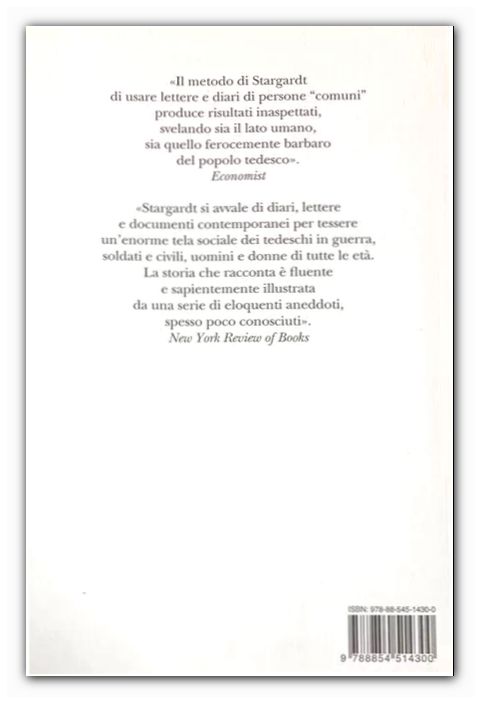
“Stargardt’s method of using letters and diaries of ‘ordinary’ people produces unexpected results, revealing both the human side and the fiercely barbaric side of the German people.” — The Economist
“Stargardt makes use of diaries, letters, and contemporary documents to weave an enormous social canvas of Germans at war: soldiers and civilians, men and women of all ages. The story he tells is fluid and expertly illustrated by a series of eloquent, often little-known anecdotes.” — New York Review of Books
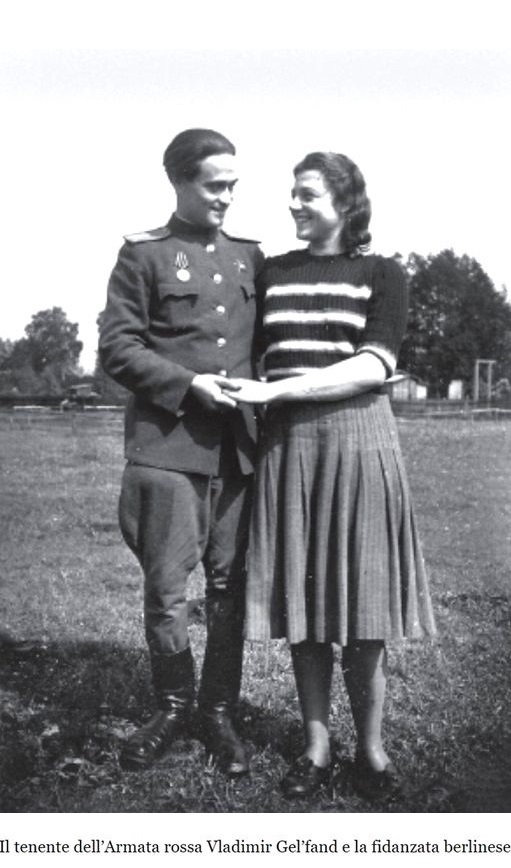
Image caption: Red Army lieutenant Vladimir Gelfand and his Berlin girlfriend (courtesy of Vitaly Gelfand).
© Nick Stargardt
© Neri Pozza Editore, Vicenza