
|
|
 Spanish
On the outskirts of Berlin, in Treptower Park, stands a twelve-metre monument to a Soviet soldier holding a sword and carrying a German girl, his foot crushing a broken swastika. The monument’s scale reflects the magnitude of Soviet sacrifice, and the inscription presents the Soviet people as the force that saved European civilisation from fascism.
Yet for some people the memorial has acquired a very different and bitter nickname: “the Tomb of the Unknown Rapist.”
Vladimir Gelfand was a young Jewish lieutenant from central Ukraine who recorded the atrocities of war with brutal frankness from 1941 onward. He described his comrades surrounding and destroying battalions of German women combatants. “The German cats we captured said they were avenging their dead husbands,” the lieutenant wrote. “We must destroy them without mercy. Our soldiers suggest stabbing them in the genitals, but I would simply execute them.”
Historian Antony Beevor has written that, while researching his work on the fall of Berlin, he found Soviet archival documents describing sexual violence. Reports collected by the Soviet security services and sent to Lavrentiy Beria in late 1944 included accounts of mass rape in East Prussia and of German civilians who killed family members or themselves to avoid such a fate.
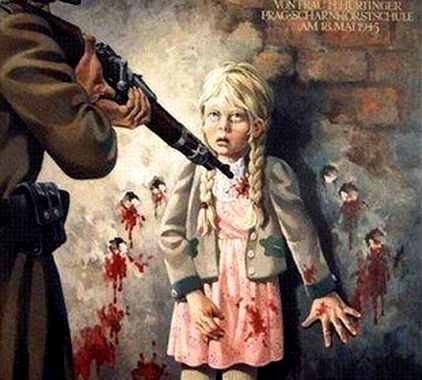
One of the images associated with the discussion shows the killing of Austrian civilians by Czechoslovak soldiers. The surrounding text stresses that the collapse of the Third Reich was accompanied not only by liberation from Nazism but also by revenge, forced displacement, sexual violence and reprisals.
In Svetlana Alexievich’s The Unwomanly Face of War, which records the memories of Soviet veterans, one former serviceman recalled the moral collapse produced by years of war. He remembered soldiers pursuing German women, group rapes, and attacks on girls as young as twelve or thirteen. Looking back, he said he could no longer understand how men from ordinary families had been capable of such acts.
There are many still more disturbing stories. The original page points readers to reports about the hidden history of mass rape during the fall of Berlin and about the atrocities committed against German women during the Second World War.
Standard Oil and IG Farben. The text describes secret commercial ties between the American oil industry and the German chemical conglomerate IG Farben. Cooperation included oil, tetraethyl lead used to raise the octane rating of aviation fuel, patent rights and the financing of synthetic rubber and fuel made from coal. According to the source, some of these patent arrangements were unavailable to the U.S. Navy and were therefore harmful to the American war effort in the Pacific.
IG Farben, meanwhile, used slave labour from concentration camps and served as a screen behind which commercial contacts with American companies could be concealed from public opinion in both countries. At the same time Soviet forces destroyed oil installations in the Caucasus to keep them out of German hands, while Allied bombers suffered heavy losses attacking German refineries.
The Nazi category “Mischling.” The Nazis used the word Mischling for people of partial Jewish ancestry. They were discriminated against as not being “of pure blood.” The text notes that some people from such backgrounds nevertheless served within Nazi institutions, attempting to demonstrate loyalty to the regime. It cites Luftwaffe Field Marshal Erhard Milch and Emil Maurice, one of the early members of the SS, as well-known examples.
ITT and the German arms industry. The American ITT Corporation is described as a major shareholder in Focke-Wulf, manufacturer of the FW-190 fighter. ITT also had investments in Standard Elektrizitäts-Gesellschaft and Lorenz AG, which produced radar equipment and cipher machines. The text states that in 1967 ITT received compensation from the U.S. government for wartime damage to its German holdings.
Henry Ford, General Motors and Nazi Germany. Henry Ford’s antisemitism was widely known, and Hitler openly admired him. Ford and General Motors maintained major commercial interests in Germany during the 1930s. Their German operations produced trucks and other vehicles while the parent companies also supplied the Allied war effort in the United States. Ford and senior company representatives met Nazi leaders and received German honours.
South America and the war. The United States tried to shield the Western Hemisphere from Nazi influence and pressed Latin American governments to break with the Axis. Brazil and Mexico actively joined the Allied cause, while Argentina, Chile and Uruguay remained neutral for much longer. Strong German communities and commercial links shaped politics in the region.
One incident discussed was the sinking of the neutral Chilean steamship MN Toltén by a German submarine in the North Atlantic in 1942, after it was mistaken for an enemy convoy. Two days earlier, according to the account, a US Coast Guard order had instructed its captain to turn off the ship’s lights, contrary to the usual recommendation that neutral vessels keep their lights on to identify themselves.
The text describes German intelligence activity in the Southern Cone. Sicherheitsdienst and Abwehr networks used secret radio stations and Spanish-flagged shipping to pass information on maritime traffic and suspicious activity to Europe. These networks were eventually uncovered by Argentine and Chilean police during 1942–1944.
After the war, thousands of Nazi criminals escaped to South America under false names. Among the best-known were Adolf Eichmann, Klaus Barbie, Josef Mengele and Walter Rauff.
When the Second World War ended, the United States possessed enormous stocks of bombs and ammunition. Keeping them in storage was expensive and dangerous, and rendering the entire stockpile harmless would also have cost huge sums. One solution was to dump weapons into the sea, in international waters or in waters belonging to Allied countries.
This created a long-term environmental problem. Bombs and shells contain substances such as TNT that are toxic to marine life and potentially carcinogenic. Salt water eventually corrodes the metal casings and allows chemicals to enter the environment and the food chain. The source notes estimates that ordinary aerial bombs can begin leaking significant quantities after roughly sixty years, while some artillery shells may take around eighty years.
Signs of contamination have already been reported in places such as Canadian and Scottish waters, including diseased or dying fish. Because of the huge quantities of discarded munitions, the discussion warns of a large environmental problem whose effects may only now be becoming visible.
A documentary referred to on the page asks where obsolete weapons ultimately end up. It notes that some CIA documents described these materials as “special weapons” and raises the question of weapons containing radioactive material.
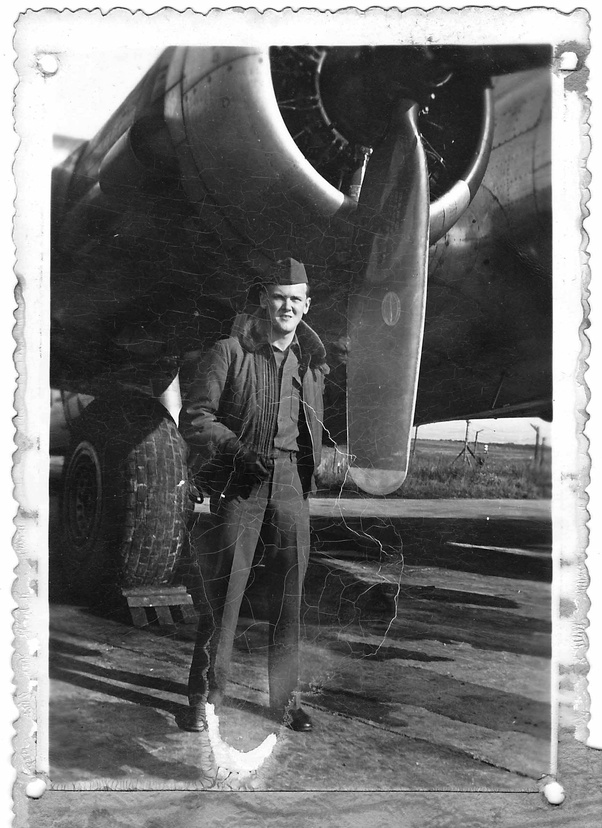
One contributor writes that his father served as a waist gunner in a B-17 bomber of the U.S. Eighth Air Force in England and flew combat missions over Germany. By the time he joined his unit in the autumn of 1943, it had already lost around eighty percent of its aircraft in combat.
He took the place of a gunner who had been killed when a 20-mm cannon shell from a German fighter struck the aircraft. The explosion tore the gunner’s body apart. Because the interior of a B-17 was full of inaccessible spaces, wiring and equipment, the aircraft could not be completely cleaned.
After a few days a terrible smell filled the bomber. When the replacement gunner arrived, he asked what had happened. He was told that the aircraft would continue flying because it remained serviceable. He stepped out and vomited. From then on, every time he flew in it he could smell the remains of the dead gunner. The memory followed him for the rest of his life and contributed to nightmares about the war. He spoke very little about what he had experienced; what his family knew came largely from a small wartime newspaper or diary he had quietly kept.
The discussion also refers to units composed of violent criminals and men who seemed to take pleasure in the suffering of their victims. It argues that those who created such formations and ordered attacks on civilians bore responsibility for crimes later judged at Nuremberg and in subsequent proceedings.
The text stresses that atrocities were not confined to one army. Sexual violence against women and girls accompanied many military campaigns: German troops committed rape across occupied Europe; Japanese forces committed enormous crimes against Chinese women; Soviet soldiers committed mass rape in Eastern and Central Europe; and American servicemen also committed sexual violence in several theatres of war.
The final Soviet advance into Germany was especially traumatic for civilians. The page cites estimates of very large numbers of German women assaulted by Soviet soldiers and describes suicides, flight, forced relationships and sex exchanged for food, medicine and other necessities in the chaos of the postwar years.
It also notes the suffering of Polish Jews who tried to flee eastward after the German-Soviet partition of Poland. Soviet authorities closed borders and later deported many refugees into the Soviet interior, where harsh conditions caused further deaths.
Another painful issue is the claim, made after the war by many Germans and Austrians, that they knew nothing about the extermination camps. The discussion points out that some camps were close enough to towns for residents to smell burning bodies when the wind blew toward populated areas, yet many people remained silent.
The page states that many bombs dropped on German cities were fitted with delayed fuses and could explode eight to twelve hours after impact. Such delays endangered firefighters, rescue workers and civilians returning to damaged buildings.
The victorious powers — the United States, Britain, France and the Soviet Union — are often remembered as a single united front against Nazism. The discussion argues that the war developed in two distinct phases and that alliances changed dramatically as the conflict unfolded.
From September 1939 to June 1941 Germany fought Poland, Britain, France, the Netherlands, Belgium, Luxembourg and Norway. Italy joined the Axis in 1940, followed by Hungary, Romania and Slovakia. Germany and Italy also invaded Yugoslavia and Greece in 1941. France capitulated and the Vichy regime collaborated with Germany.
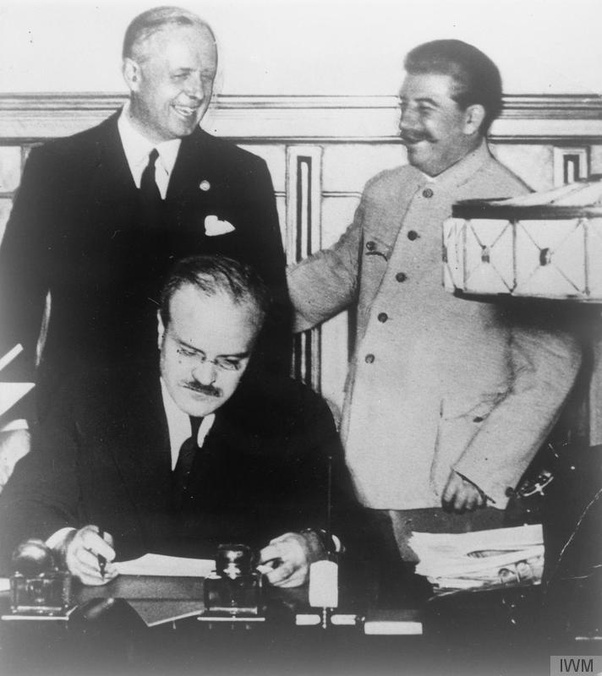
During this first phase, the Soviet Union and Germany were bound by the Molotov–Ribbentrop Pact and its secret protocols, which divided spheres of influence in Eastern Europe. The agreement allowed Hitler to attack Poland without immediately facing a two-front war. Soviet and German forces met after their respective invasions of Poland and staged a joint military parade in Brest.
The Soviet Union subsequently occupied the Baltic states and attacked Finland. Its war against Finland led to its expulsion from the League of Nations. By early 1941 Britain was the principal major power still at open war with Germany in the west.
June 1941 changed everything. Hitler broke the pact and invaded the Soviet Union. Cooperation between the two dictatorships gave way to an immense and brutal war. Some historians have argued that Stalin himself had offensive plans; what is certain is that the German attack surprised the Soviet leadership.
At the end of 1941 Japan attacked Pearl Harbor and the United States entered the war. Germany soon declared war on the United States. From that point the coalition of Britain, the United States and the Soviet Union became the core alliance that eventually defeated Nazi Germany.
Stalingrad in 1942–1943 marked a decisive shift in strategic momentum. From 1943 onward Axis states either changed sides, as Italy did, or were gradually liberated or occupied by Allied forces.
The source argues that Soviet official memory later focused almost entirely on the “Great Patriotic War” of 1941–1945, pushing the Soviet-German cooperation of 1939–1941 into the background. In the United States, mass support for entry into the war also developed only after Pearl Harbor; before then Roosevelt faced strong isolationist currents represented by public figures such as Charles Lindbergh, Gerald P. Nye and Rush D. Holt.
Popular memory and Hollywood cinema, the text adds, have tended to emphasise the second phase of the conflict and to leave the diplomatic manoeuvring and shifting alignments of the earlier years in the shadows.
The discussion also notes that Hitler and Mussolini had supported Franco during the Spanish Civil War, yet Britain and France had not treated that intervention as a reason to begin a wider European war. By the time war officially erupted in 1939, Germany and Italy had already expanded their influence across substantial parts of Europe and Africa.
The United States' appropriation of technologies and industrial and intellectual-property patents from the Nazis and Germans more generally, including inventions with military, computing and civilian applications, is another little-known aspect. Hundreds of German scientists were taken to the United States — some against their will, others voluntarily — to develop those technologies. German scientists helped solve problems that American researchers had been unable to overcome in developing the atomic bomb. According to this account, those appropriated advances also contributed to rockets for the space race, the initially military development of the internet and the first computers, as well as aircraft, engines of many kinds and submarines. The United States continues to benefit from them today.
© Quora Inc. 2019