

 |
|
Российская политическая
энциклопедия
 |
 |
|
|
|
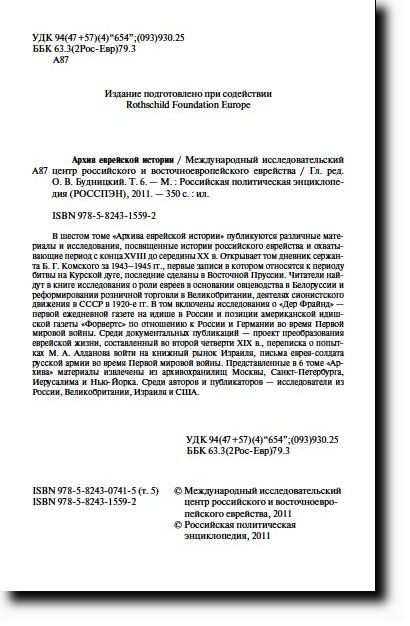
Представленные в 6 томе «Архива» материалы извлечены из архивохранилищ Москвы, Санкт-Петербурга, Иерусалима и Нью-Йорка. Среди авторов и публикаторов — исследователи из России, Великобритании, Израиля и США |

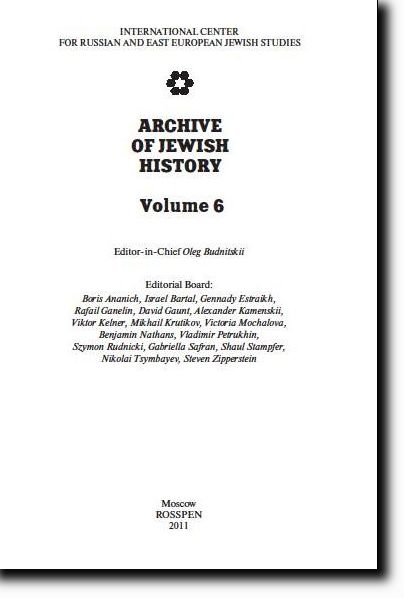
“Archive of Jewish History,” Volume 6: “Diaries”
Russian Political Encyclopedia
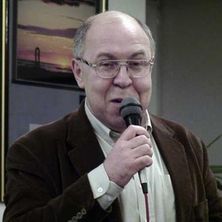
Oleg Vitalyevich Budnitskii, editor-in-chief, is a Doctor of Historical Sciences, a senior researcher at the Institute of Russian History of the Russian Academy of Sciences, and academic director of the International Center for Russian and East European Jewish Studies. He is the author of more than two hundred scholarly works on the history of Russia and Russian Jewry in the second half of the nineteenth and twentieth centuries, including the monographs Terrorism in the Russian Liberation Movement: Ideology, Ethics, Psychology and Russian Jews Between the Reds and the Whites (1917–1920). Together with Professor Terence Emmons of Stanford University he edits the series Russian Treasures of the Hoover Tower, published by ROSSPEN and the Hoover Institution. He serves on the editorial boards of Kritika: Explorations in Russian and Eurasian History, East European Jewish Affairs, and Jews in Russia and Eastern Europe, and is a professor at the Faculty of History of the Higher School of Economics. He is also an author of scholarly and popular works, a participant and host of television and radio programs, a publicist and a popularizer of history.
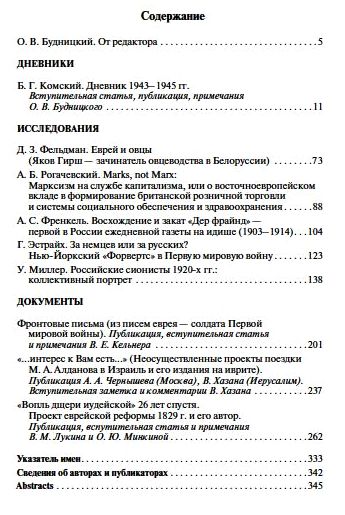
Volume 6 of the Archive of Jewish History publishes documents and studies devoted to the history of Russian Jewry from the late eighteenth century to the middle of the twentieth century. The volume opens with the diary of Sergeant B. G. Komsky for 1943–1945: its first entries date from the Battle of Kursk and its last were written in East Prussia.
Readers will also find studies of the role of Jews in the establishment of sheep farming in Belarus and in the reform of retail trade in Britain, as well as studies of figures in the Zionist movement in the USSR during the 1920s. The volume includes research on Der Fraynd, the first daily Yiddish newspaper in Russia, and on the attitude of the American Yiddish newspaper Forverts toward Russia and Germany during the First World War.
Among the documentary publications are a project for transforming Jewish life drafted in the second quarter of the nineteenth century, correspondence concerning M. A. Aldanov’s attempts to enter the Israeli book market, and letters written by a Jewish soldier in the Russian Army during the First World War.
The materials presented in Volume 6 of the Archive were drawn from archival repositories in Moscow, St Petersburg, Jerusalem and New York. The authors and editors include researchers from Russia, Great Britain, Israel and the United States.
English translation of the twelve book-page scans shown on this page (pp. 11–21 and the contents page).
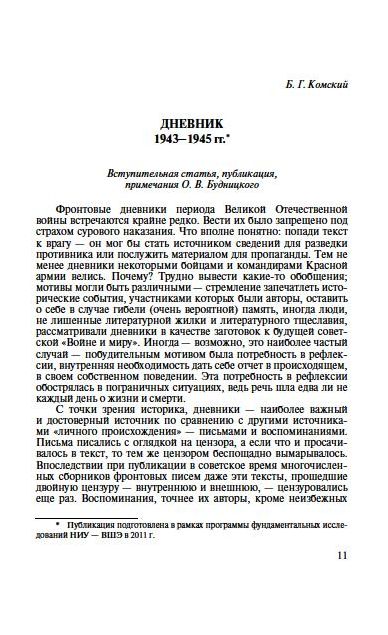
B. G. Komsky
DIARY
1943–1945*
Introductory article, publication and notes by O. V. Budnitskii
Front-line diaries from the period of the Great Patriotic War are extremely rare. Keeping them was forbidden under threat of severe punishment. This is quite understandable: if such a text fell into enemy hands, it could become a source of intelligence for the opposing side or serve as propaganda material. Nevertheless, some soldiers and commanders of the Red Army did keep diaries. Why? It is difficult to generalize; the motives may have differed — a desire to record historic events in which the authors themselves were taking part, to leave a memory of themselves in the event of their (very probable) death, or, in some cases, because people with a literary streak and literary vanity regarded their diaries as preparatory material for a future Soviet War and Peace. At times — perhaps most often — the motive was a need for reflection, an inner necessity to account to oneself for what was happening and for one’s own conduct. This need for reflection became especially acute in extreme situations, when almost every day involved questions of life and death.
From a historian’s point of view, diaries are the most important and reliable source in comparison with other sources “of personal origin” — letters and memoirs. Letters were written with the censor in mind, and if anything did seep into the text, the same censor mercilessly crossed it out. Later, when numerous collections of front-line letters were published in Soviet times, even those texts, which had already passed through double censorship — internal and external — were censored once again. Memoirs, or rather their authors, in addition to the inevitable errors of memory, were influenced by what they had read, heard and seen.
* This publication was prepared within the framework of the HSE fundamental research program in 2011.
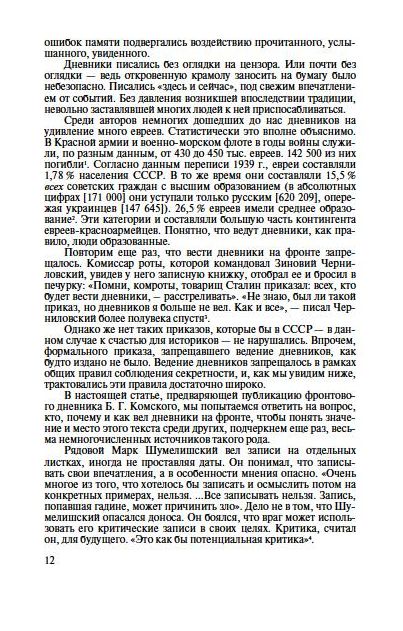
Diaries were written without looking over one’s shoulder at a censor. Or almost without doing so — it was unsafe to put open sedition on paper. They were written “here and now,” under the fresh impression of events, without the pressure of the tradition that arose later and involuntarily forced many people to adapt themselves to it.
Among the authors of the few surviving diaries, there are surprisingly many Jews. Statistically, this is quite understandable. According to different estimates, between 430,000 and 450,000 Jews served in the Red Army and Navy during the war. Of them, 142,500 were killed.1 According to the 1939 census, Jews made up 1.78 percent of the population of the USSR. At the same time, they accounted for 15.5 percent of all Soviet citizens with higher education (in absolute figures [171,000] they were second only to Russians [620,209], and ahead of Ukrainians [147,645]). Another 26.5 percent of Jews had secondary education.2 These categories made up a large part of the contingent of Jewish Red Army soldiers. It is clear that diaries are usually kept by educated people.
Let us repeat once more that keeping diaries at the front was forbidden. The commissar of the company commanded by Zinovy Chernilovsky saw a notebook in his possession, took it away and threw it into the stove: “Remember, company commander, Comrade Stalin has ordered that everyone who keeps diaries is to be shot.” “I do not know whether such an order existed, but I never kept a diary again. Like everyone else,” Chernilovsky wrote more than half a century later.3
Yet there were no orders in the USSR that were not violated — in this case, fortunately for historians. It appears, moreover, that no formal order specifically prohibiting diaries was ever issued. Diaries were forbidden under the general rules for preserving secrecy, and, as we shall see below, those rules were interpreted quite broadly.
In this article, which precedes the publication of B. G. Komsky’s front-line diary, we shall try to answer the question of who kept diaries at the front, why they did so and how, in order to understand the significance and place of this text among the other — let us emphasize again, very few — sources of this kind.
Private Mark Shumelishsky made notes on separate sheets of paper, sometimes without putting dates on them. He understood that recording his impressions, and especially his opinions, was dangerous. “There is a great deal that I would like to write down and think through later using concrete examples, but I cannot. … One cannot write everything down. A note that falls into the hands of the scum can cause harm.” Shumelishsky was not afraid of denunciation. He feared that the enemy might use his critical notes for its own purposes. Criticism, he believed, was for the future. “It is, as it were, potential criticism.”4
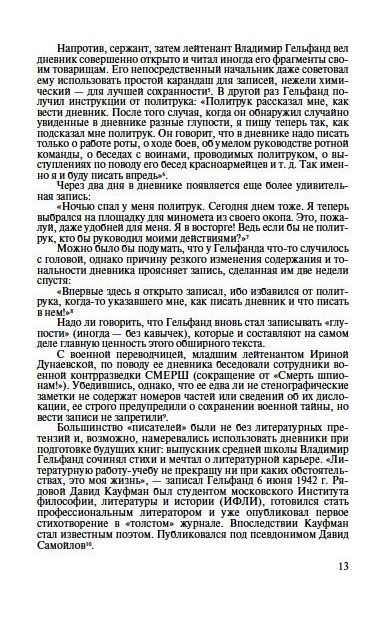
By contrast, Sergeant, later Lieutenant, Vladimir Gelfand kept his diary quite openly and sometimes read passages from it to his comrades. His immediate superior even advised him to use an ordinary pencil rather than a copying pencil, so that the writing would be better preserved.5 On another occasion Gelfand received instructions from the political instructor:
“The political instructor told me how to keep a diary. After that incident when he accidentally saw various stupid things written in the diary, I now write the way the political instructor advised me. He says that in a diary one should write only about the work of the company, the course of the fighting, the skillful leadership of the company command, talks with the soldiers conducted by the political instructor, Red Army men’s comments on his talks, and so on. That is exactly how I shall write from now on.”6
Two days later an even more astonishing entry appeared in the diary:
“The political instructor slept at my place during the night. Today, during the day, too. I have now moved out of my trench onto the mortar platform. Perhaps this is even more convenient for me. I am delighted! After all, if it were not for the political instructor, who would guide my actions?”7
One might think that something had happened to Gelfand’s mind, but the reason for the abrupt change in the contents and tone of the diary is clarified by an entry he made two weeks later:
“For the first time here I have written openly, because I have got rid of the political instructor who once told me how to write a diary and what to write in it!”8
Needless to say, Gelfand once again began recording “stupid things” (sometimes without quotation marks), which in fact constitute the chief value of this extensive text.
Military translator Junior Lieutenant Irina Dunaevskaya was questioned about her diary by officers of SMERSH military counterintelligence (the abbreviation stands for “Death to Spies!”). Having established, however, that her almost stenographic notes contained neither unit numbers nor information on their deployment, they sternly warned her about preserving military secrets but did not forbid her to continue making notes.9
Most of these “writers” were not without literary ambitions and may have intended to use their diaries in preparing future books. Vladimir Gelfand, a secondary-school graduate, wrote poetry and dreamed of a literary career. “I shall not stop my literary work and study under any circumstances; it is my life,” Gelfand wrote on 6 June 1942. Private David Kaufman was a student at the Moscow Institute of Philosophy, Literature and History (IFLI), preparing to become a professional writer, and had already published his first poem in a “thick” literary journal. Kaufman later became a well-known poet, publishing under the pen name David Samoilov.10
Engineer Mark Shumelishsky asked himself “again and again”: “‘Why the hell do I keep trying to make some sort of notes?’ I am constantly haunted by the idea of collecting material and, in time, writing a good truthful book that would reflect the real moods of certain groups of people in the rear at this great time. Of course, such a book could be written many years later, when everything has been lived through, thought over and assessed. But now it is necessary to record many small details.”11
Senior Lieutenant Boris Suris copied down German surnames from a roster of one platoon that came into his hands — Nittel, Liebold, Wagner, Winkler, Wolf — so that “I will not have to rack my brains for Fritz surnames when I write my n-n-novel.”12 The ironic Odessan mocked his own literary ambitions and wrote “novel” with three “r”s in Russian. Yet his intentions were quite serious: later the diary contains notes on the stylistic features of works by Priestley, Dos Passos and Hemingway (Suris read them in translation). Closest to him was — of course! — Hemingway. The future art historian never wrote a novel, but he did manage to write several short stories, published only in the twenty-first century, twenty years after his death.
Of course, one did not have to be Jewish to make literary plans. Writing ambitions were also characteristic of Sergeant Nikolai Inozemtsev, author of an extensive diary and later a Soviet academician-economist and speechwriter for Leonid Brezhnev,13 and of Private Vasily Tsymbal, formerly a teacher of literature at the Yeisk Pedagogical College. Even before the war Tsymbal had sent his literary attempts to Gorky, who did not approve of them.14
Irina Dunaevskaya had kept a diary since childhood (she destroyed it when she joined the people’s militia in July 1941). She, like other women, was rather quickly sent home from the militia, to Leningrad. She resumed her diary, which became a diary of the siege. But she destroyed that one too in April 1942 when she left for the second time — this time seriously and for a long period — for the front. In the army, following an ingrained habit, she once again began recording her impressions of her “labors and days,” her experiences and the people around her.15 Yet literary ambitions were not alien to her either: “If I am maimed and cannot work, I will write a book about myself — an ordinary girl who grew up between wars and took part in the Patriotic War. I know I can do it.” The “girl,” however, was not entirely ordinary: hardly anyone else on all the fronts of the Great Patriotic War, like Irina Dunaevskaya, a student of the Philology Faculty of Leningrad University, read Chateaubriand before going to sleep and regretted having to read him in Russian because “where could one find him in French?”16
Sergeant Pavel Elkinson had no intention of writing novels. He began keeping a diary for a very specific reason. On 28 August 1944 Elkinson wrote:
“At last the long-awaited day of the complete expulsion of the Germans from our land on our sector of the front has come. Here is the Prut, here is the border. Only six days have passed since we began the offensive, and how much has been done. Bessarabia has been completely cleared. Peace has been concluded with Romania. Tomorrow we shall cross the border. Did I ever think that I would have a chance to go abroad? It turns out I did. How I want to remember everything I see and write it down briefly. After all, something like this happens only once in a lifetime…”17
Elkinson, who served as an artillery reconnaissance man, had quite an opportunity to “travel” around Europe: from August 1944 to May 1945 he was in Romania, Bulgaria, Yugoslavia, Hungary and Austria.
How representative are these texts? Can the wartime experience of hundreds of thousands of Jewish Red Army soldiers be judged on the basis of several diaries? This, again, is an eternal question for historians. How many sources must be analyzed before one can say: this is typical and that is not? Obviously these few texts do not reflect the experience of all Jews who fought in the Red Army. At the same time, in our view it is indisputable that these several young men, who by force of circumstances became participants in the great war and recorded their experience on paper at the time, were, so to speak, “sociologically” similar to many of their contemporaries. Like almost half of Soviet Jews before the war, all of them lived in major cities (Moscow, Leningrad, Kyiv, Zaporizhia, Dnepropetrovsk, Odessa). All were secondary-school graduates, university students or university graduates. This too was fairly typical. In 1939 there were 98,216 Jewish students in the USSR (11.1 percent of all students); in Moscow Jews made up 17.1 percent of all students, in Leningrad 19 percent, in Kharkov 24.6 percent, in Kyiv 35.6 percent and in Odessa 45.8 percent.18 Despite this certain typicality, the combat and life path of each diary author was, of course, unique and interesting in itself.
All of them were one-hundred-percent Soviet patriots. Those who were older volunteered for the people’s militia or the army. School graduates, who also wanted to get into the fighting as soon as possible, were usually called up at the proper time.
It should be noted that the diary writers were people who were not constantly on the front line and did not usually come into direct contact with the enemy. Boris Suris and Irina Dunaevskaya were military translators, Boris Tartakovsky was a political worker,19 Boris Komsky, after being wounded, had to serve “on the Komsomol line,” and Mark Shumelishsky served in artillery in a technical capacity. Of course, situations in war varied. Suris went on a reconnaissance mission with scouts to capture a “tongue,” which ended with his being wounded by shell fragments.
Tartakovsky had to fight on the front line during the hard days of bloody fighting in the Kuban, when every man capable of carrying a rifle was desperately needed. Dunaevskaya was wounded several times (fortunately, only lightly).
This makes the entries directly concerning combat all the more valuable. Among the diaries available to us, the texts of Boris Komsky, who began his combat path in the hottest place on the planet — the Kursk salient — and Pavel Elkinson stand out in this respect. They are laconic, devoid of literary embellishment, and convey with precision the atmosphere (I would even say the fever) of battle. We are also preparing Pavel Elkinson’s diary for publication; for now, however, let us turn to Boris Komsky’s diary, published below. First, a few words about its author.
Boris Grigorievich Komsky was born on 1 February 1924 in the small town of Makarov near Kyiv. In 1929 or 1930 the family moved to Kyiv. Boris’s father became a worker at the Karl Marx confectionery factory, his mother was a housewife; the family also included Boris’s younger brother Zinovy and their grandmother. Boris’s childhood was happy; Kyiv remained his favorite city, and B. G. Komsky considers School No. 44, where he studied, the best school in Kyiv. We shall not attempt to research rankings of prewar Kyiv schools (and did anyone conduct such studies at the time?). What matters to us is something else — the feeling of a happy life, of confidence in oneself and in those around him.20 From an early age Boris had an inclination toward literature — he took part in the literary circle attached to the republican newspaper Young Pioneer, where his first poems and short pieces appeared.21
Boris belonged to the generation of people born and raised under Soviet rule. He grew up as a true Soviet person: he was elected secretary of the school Komsomol committee; after finishing the ninth grade in June 1941 he went to organize a Pioneer camp outside Kyiv as deputy Pioneer leader. It was there that he learned that the war had begun. On returning to Kyiv, Komsky gathered the senior pupils and suggested that they find jobs in order to contribute somehow to the country’s defense. Boris received an assignment to one of the military factories, became a lathe operator’s assistant and machined “jackets” for mortar shells. This was almost a hint from fate — two years later Komsky would begin his combat path as the gunner of an 82-mm mortar.
Then, two or three months later, although Boris was only seventeen, he was called up. A group of about forty “underage” boys like him was formed and, under the command of a building superintendent, sent east on foot. In this way they walked all the way to the Donbas. There the boys were told that through the military enlistment office they had actually been mobilized for the labor front. The meaning of the operation was clear: pre-conscription youths, future soldiers, were being removed from territories threatened by occupation.
Komsky was sent to a collective farm, and later simply released, being told that if he had relatives somewhere he could go to them.
Boris’s father had been called up at the very beginning of the war, apparently not for combat duty but for defensive construction work. He was encircled, like the entire enormous grouping of Soviet troops in the Kyiv area. Later the family received notification that he was missing in action. After the war, however, neighbors said that his father had appeared at home for a time and then disappeared. In Boris Grigorievich Komsky’s view, the most likely explanation is that his father shared the fate of Kyiv’s Jews who were shot at Babi Yar. The other members of the family managed to leave Kyiv and ended up near Voronezh. This happened before Kyiv was encircled, because Boris learned where his mother, brother and grandmother were from a letter from his father.
Boris was reunited with his family. For several months he attended school in Voronezh. The family was then evacuated to Chimkent. There Komsky graduated from the Kyiv Industrial Technical School, which had been evacuated to the same city. In 1942, when he turned eighteen, Boris was called up and sent to the Orel Infantry School, then located in Chardzhou, Turkmenia. Instead of the usual three or four years, wartime officers were trained on an abbreviated six-month program. Yet on the eve of their final examinations the men who were “five minutes away” (more precisely, two days away) from becoming lieutenants were put on a train and sent to the Kursk salient as privates. Boris Komsky became the gunner of an 82-mm mortar in the mortar company of the 916th Regiment, 250th Rifle Division, Bryansk Front. Since this was a sergeant’s post, Boris was immediately promoted to sergeant. And thrown into battle.
After his mortar was destroyed by a German shell, Komsky found himself in the infantry. Komsky’s laconic entries from July–August 1943, at the height of one of the bloodiest battles in world history, are essentially a chronicle of the destruction of his platoon, and indeed of the regiment as a whole. On 6 August Komsky was, as would soon become clear, lucky — he was wounded. Almost all his comrades who remained in the ranks were killed over the following days. Of the men of the cadet company, only one other man survived the war — Genrikh Kats, who was also wounded and, after returning to the front, became a scout (he ended the war as sergeant major of a reconnaissance company).22
We shall not, however, retell the diary, which covers the period from July 1943 to the end of January 1945.
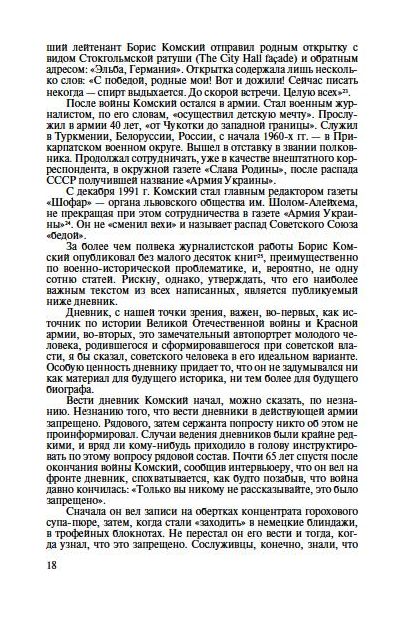
We shall mention only what lies outside its pages: Boris Komsky advanced with the 3rd Army as far as Königsberg; the army was then transferred toward Berlin. He ended the war in the town of Burg on the Elbe — more precisely, on the Elbe–Havel Canal. On 9 May 1945 Junior Lieutenant Boris Komsky sent his family a postcard showing Stockholm City Hall (The City Hall façade) and gave his return address as “Elbe, Germany.”
The postcard contained only a few words: “Congratulations on victory, my dear ones! So we lived to see it! No time to write now — the alcohol is evaporating. See you soon. Kisses to everyone.”23
After the war Komsky remained in the army. He became a military journalist and, in his own words, “fulfilled a childhood dream.” He served in the army for forty years, “from Chukotka to the western border.” He served in Turkmenia, Belarus and Russia, and from the early 1960s in the Carpathian Military District. He retired with the rank of colonel. He continued to contribute, as a freelance correspondent, to the district newspaper Glory of the Motherland, which after the collapse of the USSR was renamed Army of Ukraine.
In December 1991 Komsky became editor-in-chief of the newspaper Shofar, the organ of the Lviv Sholem Aleichem Society, while continuing to contribute to Army of Ukraine.24 He did not “change his landmarks” and calls the collapse of the Soviet Union a “misfortune.”
Over more than half a century of journalistic work Boris Komsky published nearly ten books,25 chiefly on military-historical subjects, and probably several hundred articles. I will nevertheless venture to assert that the most important of all the texts he wrote is the diary published below.
In our view the diary is important, first, as a source on the history of the Great Patriotic War and the Red Army; second, it is a remarkable self-portrait of a young man born and formed under Soviet rule — I would say, a Soviet person in his ideal form. The diary gains particular value from the fact that it was conceived neither as material for a future historian nor, still less, for a future biographer.
Komsky began keeping the diary, one might say, out of ignorance — ignorance of the fact that diaries were forbidden in the active army. The private, later sergeant, had simply never been informed of this. Cases of diary keeping were extremely rare, and it probably never occurred to anyone to give rank-and-file soldiers instructions on the matter. Almost sixty-five years after the end of the war, having told an interviewer that he had kept a diary at the front, Komsky suddenly caught himself, as though forgetting that the war had long been over: “Only don’t tell anyone; it was forbidden.”
At first he wrote on the wrappers of pea-soup concentrate; later, when they began “going into” German dugouts, he used captured notebooks. Nor did he stop when he learned that diary keeping was forbidden. His comrades, of course, knew that he kept a diary, but this caused him no trouble.
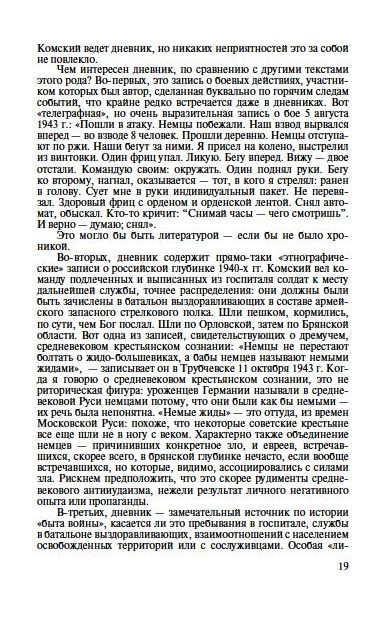
What makes the diary interesting in comparison with other texts of this kind? First, it is a record of combat operations in which the author himself took part, written literally in the immediate aftermath of events — something extremely rare even in diaries. Here is a “telegraphic,” but highly expressive, entry about the fighting on 5 August 1943:
“We went into the attack. The Germans ran. Our platoon broke ahead — eight men left in the platoon. We passed through the village. The Germans are retreating through the rye. Our men run after them. I dropped to one knee and fired my rifle. One Fritz fell. I rejoice. I run forward. I see two have fallen behind. I order my men to surround them. One raised his hands. I run toward the second, catch up with him; it turns out to be the one I shot at: wounded in the head. He thrusts an individual dressing packet into my hands. I did not bandage him. A healthy Fritz, with a decoration and a medal ribbon. I took off his submachine gun and searched him. Someone shouts: ‘Take his watch — what are you staring at?’ Right, I think; I took it.”
This could have been literature — if it were not a chronicle.
Second, the diary contains almost “ethnographic” observations about the Russian hinterland of the 1940s. Komsky was leading a group of soldiers who had recovered from wounds and been discharged from hospital to their next place of service — more precisely, to be reassigned: they were to be enrolled in a convalescent battalion within an army reserve rifle regiment. They walked, surviving essentially on whatever providence provided. They crossed Orel Region and then Bryansk Region. One entry testifies to a dark, medieval peasant mentality: “The Germans never stop babbling about Judeo-Bolsheviks, while the women call the Germans mute Yids,” he wrote in Trubchevsk on 11 October 1943. When I speak of a medieval peasant mentality, this is not a figure of speech: in medieval Rus, people from Germany were called nemtsy (“mutes”) because they were, as it were, mute — their speech was incomprehensible. “Mute Yids” comes from there, from the days of Muscovite Rus: it seems some Soviet peasants were still out of step with the century. Also characteristic is the linking of Germans — who had caused concrete harm — with Jews, whom people in the Bryansk hinterland probably encountered only rarely, if at all, but who apparently were associated with forces of evil. We may venture to suggest that this was more a remnant of medieval anti-Judaism than a result of personal negative experience or propaganda.
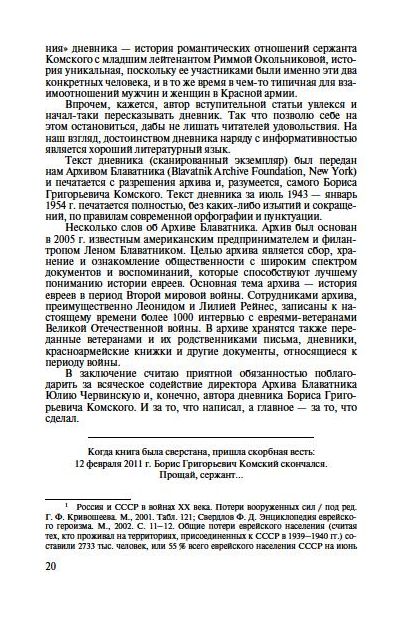
Third, the diary is a remarkable source on the history of the “everyday life of war,” whether it concerns time spent in hospital, service in a convalescent battalion, relations with the population of liberated territories or relations with comrades in arms. A special “line” of the diary is the story of Sergeant Komsky’s romantic relationship with Junior Lieutenant Rimma Okolnikova — a story unique because its participants were these two particular people and at the same time, in some respects, typical of relations between men and women in the Red Army.
It seems, however, that the author of the introductory article has got carried away and has in fact begun retelling the diary. So I shall stop here, in order not to deprive readers of the pleasure of reading it themselves. In our view, along with its wealth of information, one of the diary’s virtues is its good literary language.
The text of the diary (a scanned copy) was given to us by the Blavatnik Archive Foundation, New York, and is published with the permission of the archive and, of course, of Boris Grigorievich Komsky himself. The diary text for July 1943 — January 1954 is printed in full, without omissions or abridgments, according to modern spelling and punctuation rules.
A few words about the Blavatnik Archive. The archive was founded in 2005 by the well-known American businessman and philanthropist Len Blavatnik. Its purpose is to collect, preserve and make the public familiar with a broad range of documents and recollections that contribute to a better understanding of Jewish history. The archive’s principal subject is the history of Jews during the Second World War. By the present time, archive staff — chiefly Leonid and Lilia Reines — have recorded more than one thousand interviews with Jewish veterans of the Great Patriotic War. The archive also holds letters, diaries, Red Army service books and other wartime documents donated by veterans and their relatives.
In conclusion, I regard it as a pleasant duty to thank Julia Chervinskaya, director of the Blavatnik Archive, for every kind of assistance and, of course, the author of the diary, Boris Grigorievich Komsky — both for having written it and, above all, for what he did.
When the book had already been typeset, sad news arrived:
on 12 February 2011 Boris Grigorievich Komsky died.
Farewell, Sergeant…
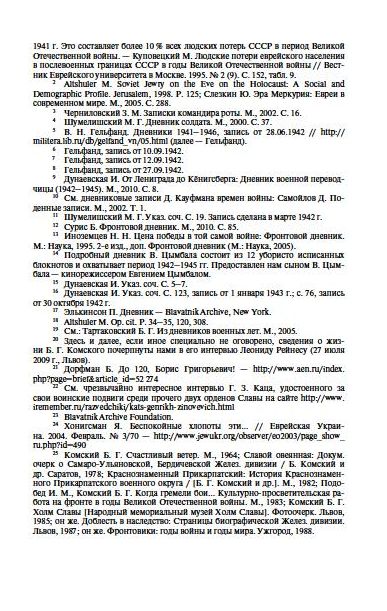
1 Russia and the USSR in the Wars of the Twentieth Century. Losses of the Armed Forces, ed. G. F. Krivosheev. Moscow, 2001, Table 121; F. D. Sverdlov, Encyclopedia of Jewish Heroism. Moscow, 2002, pp. 11–12. Total losses of the Jewish population (including those who lived in territories incorporated into the USSR in 1939–1940) amounted to 2.733 million people, or 55 percent of the entire Jewish population of the USSR as of June 1941.
© International Center for Russian and East European Jewish Studies
© Russian Political Encyclopedia