 |
||
 |
Peter
Handberg
Skriv
ett e-postbrev till kulturredaktören




A Russian Soldier’s German Everyday Life
“We’re in a fix,” it says at the very beginning of Vladimir Gelfand’s war diary, which in Elke Scherstjanoi’s selection runs from 13 January 1944 to September 1946. Enemy shells rain down from the sky on his platoon, but the young officer is certain of victory: “Bite your teeth together, Ivan!”
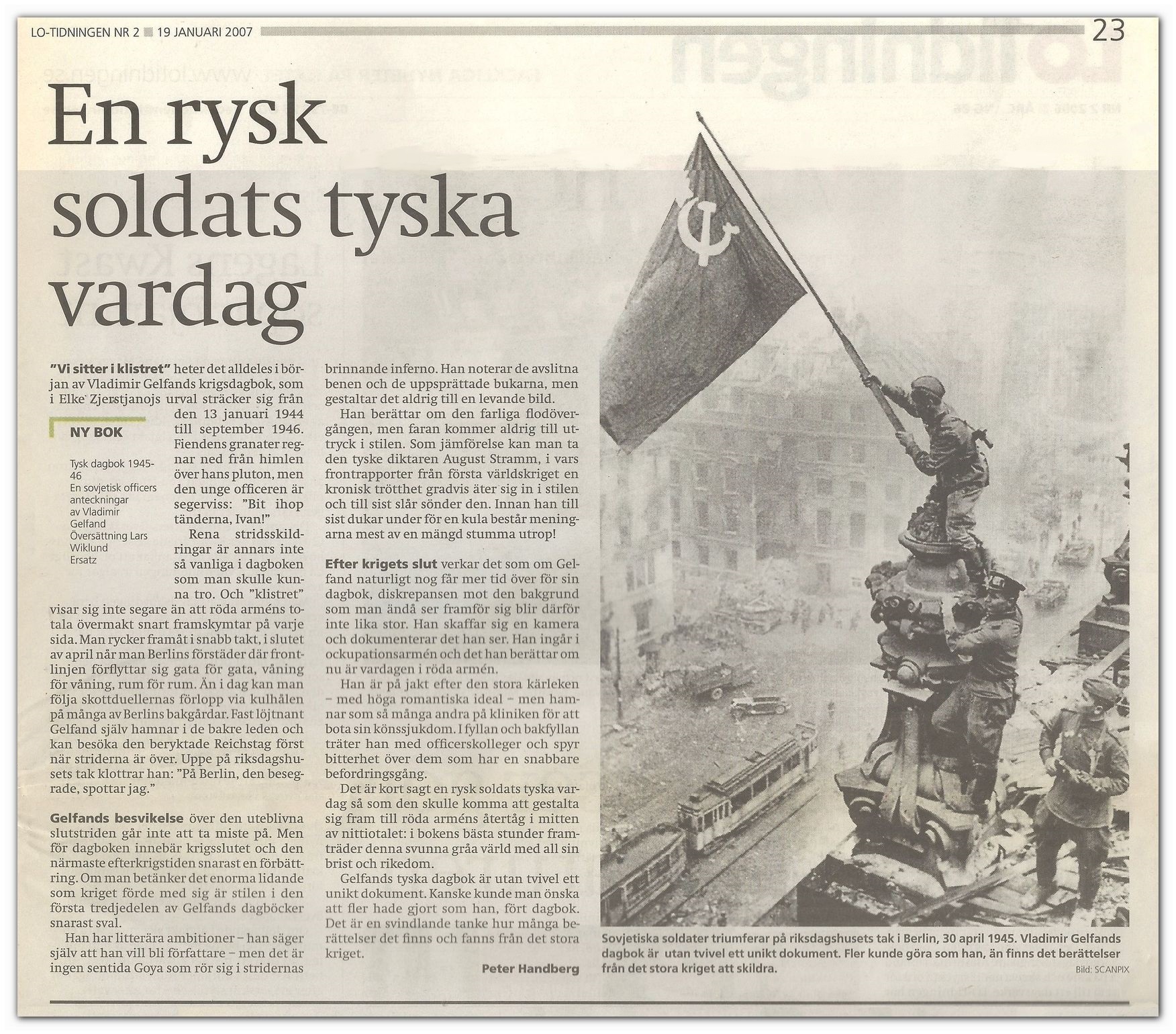
Pure battle descriptions are not as common in the diary as one might expect. And the “fix” does not last long before the Red Army’s overwhelming superiority begins to show on almost every page. The advance is rapid; by late April the troops reach Berlin’s suburbs, where the front line shifts street by street, floor by floor and room by room. Even today the course of those firefights can be traced in bullet holes in many Berlin courtyards. Lieutenant Gelfand himself, however, ends up in the rear ranks and can visit the famous Reichstag only after the fighting is over. On the roof he scrawls: “On Berlin, the defeated, I spit.”
Disappointment at Missing the Final Battle
Gelfand’s disappointment at missing the final battle is unmistakable. For the diary itself, however, the end of the war and the immediate postwar period are rather an improvement. Considering the enormous suffering caused by the war, the style of the first third of Gelfand’s diary is surprisingly cool and restrained.
Gelfand has literary ambitions — he says himself that he wants to become a writer — but he is no latter-day Goya moving through the burning inferno of battle. He notes severed legs and ripped-open bellies but never shapes them into a living picture. He describes a dangerous river crossing, yet the danger never finds expression in the style. By comparison, one may think of the German poet August Stramm, whose First World War front reports show chronic exhaustion gradually eating into the language until it finally breaks it apart; before a bullet ultimately kills him, his sentences consist largely of mute exclamations.
After the War
After the war Gelfand naturally seems to have more time for his diary, so the discrepancy between the writing and the background the reader inevitably imagines becomes smaller. He acquires a camera and documents what he sees. He is now part of the occupation army, and what he describes is the everyday life of the Red Army.
In Search of Great Love
He is looking for great love — with lofty romantic ideals — but, like so many others, ends up at a clinic to be treated for a venereal disease. Amid drinking and hangovers he quarrels with fellow officers and pours out his bitterness about those who are promoted faster than he is.
In short, this is a Russian soldier’s German everyday life, much as it would continue until the Red Army withdrew in the mid-1990s; at the book’s best moments this vanished grey world emerges with all its poverty and richness.
Gelfand’s German diary is without doubt a unique document. One can only wish that more people had done as he did and kept diaries. It is dizzying to think how many stories there are, and once were, from the great war.
Peter Handberg