


Ryk gwałconych kobiet idzie przez pokolenia. Mało kto się nim przejmuje |
||
|
|
||
|
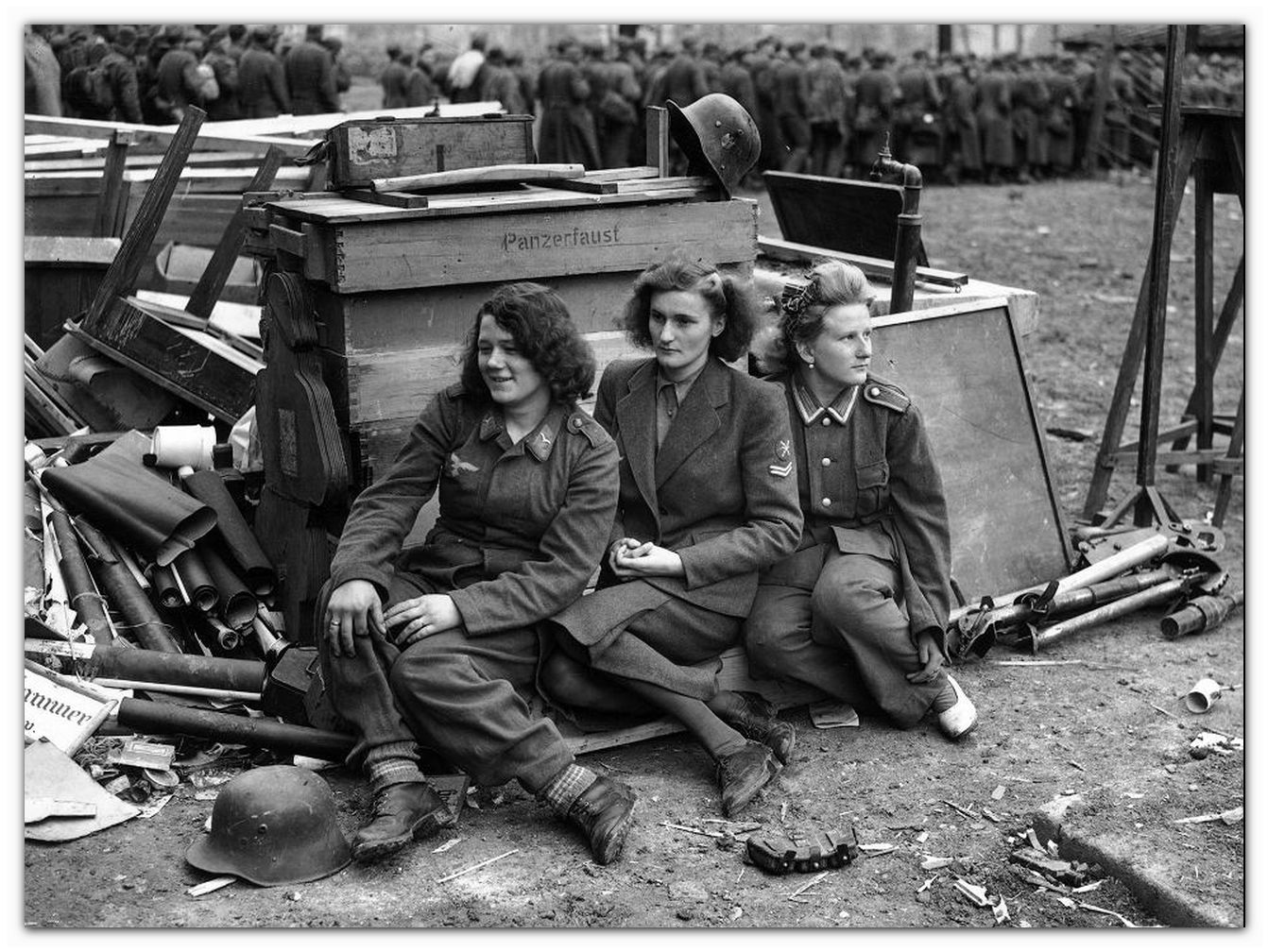
Umundurowane
Niemki pojmane przez amerykańskich żołnierzy czekają na transport do
obozu jenieckiego (Fot.
Horace Abrahams / Getty Images)
|
||
| Kobiety bierze się publicznie. Z zasady się nie bronią. Cichną pod naporem. Przemarsz armii sprzymierzonej bywa klęską równą wejściu wroga. | ||
| |
||
| –
O Boże, Boże! – wołają żołnierki z
niemieckiego batalionu kobiecego. Drżą na całym ciele. Po nieudanym
kontrataku gdzieś nad Odrą, między Kostrzynem a Mieszkowicami, dostały
się do sowieckiej niewoli. Koteczki – zapisuje w dzienniku 21
lutego 1945 r. Władymir Gelfand – walczyły na lewej flance
jego
oddziału. Chciały pomścić zabitych na wojnie mężów, lecz ich
batalion został rozbity w puch. Radziecki podporucznik, rocznik 1923,
nie wie, co ostatecznie zrobiono z kobietami. Odnotowuje tylko
zaskoczenie żołnierzy tym niechcianym darem. Ciąć szmaty
piłami,
zaczynając od narządów rodnych –
proponują. Sam,
dodaje, zlikwidowałby je w jakiś mniej wyszukany sposób. |
||
 |
||
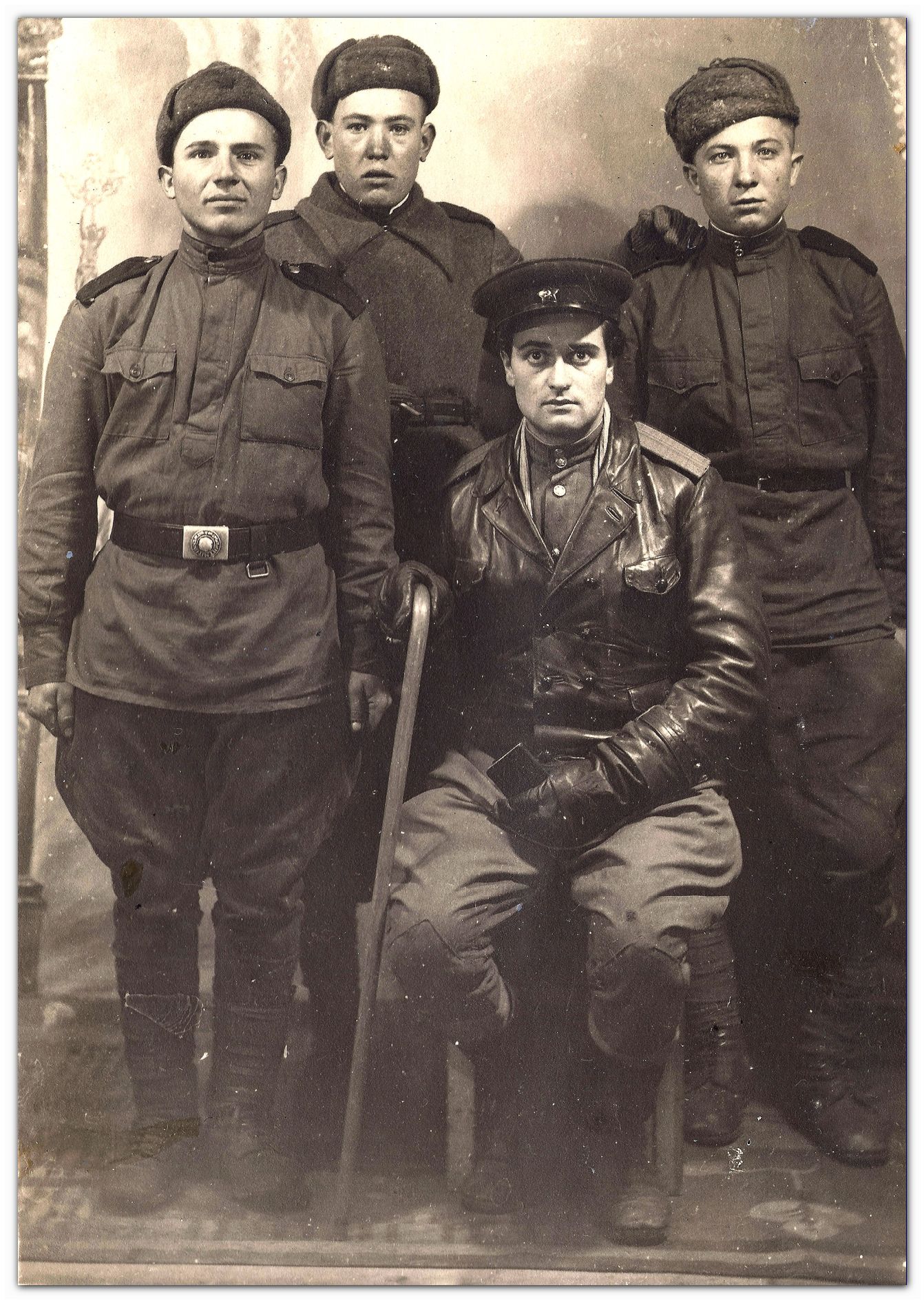
| Lejtnant Władymir Gelfand (siedzi), żołnierz Armii Czerwonej, autor pamiętnika pisanego na bieżąco w latach 1941-46 Fot. Domena publiczna | ||
| |
||
| Barlinecka selekcja Miesiąc później, we wtorek 20 marca, w Moryniu starszy sierżant Andriejew opowiada Władymirowi szczegóły związane z pojmaniem innego batalionu kobiecego. Znają się od dawna. Stoją kwaterą w jednym z piękniejszych miasteczek dawnej Nowej Marchii brandenburskiej. Rybacka osada przeszła w ręce Armii Czerwonej bez strzału. Niemieccy mieszkańcy uciekli. Powitało ją kilkudziesięciu robotników przymusowych. Żadnych zniszczeń. Nieopodal jezioro. Pogoda dopełnia idylli – zmienna jak w marcu, niemniej słońce z dnia na dzień grzeje mocniej. Chwilami temperatury prawie letnie. Podczas walk o niedaleki Barlinek, wtedy Berlinchen, oddział piechoty, w którym służył Andriejew, zostaje zaatakowany przez batalion kobiet. Uzbrojone w karabiny nacierają tyralierą w trzech szeregach. Rząd czwarty tworzą wspierający je mężczyźni. Dobrze okopanym żołnierzom radzieckim serca o mało nie wyskoczą z piersi. Dowództwo nie wydaje rozkazu strzelania. Dopiero gdy rozzuchwalone sowieckim milczeniem Niemki zbliżą się do okopów, z flank odzywają się karabiny maszynowe. Gęsto padają zabici. Szczególnie, można się domyślać, w ostatnim szeregu. Kobiety rzucają broń i uciekają w panice jedną z ulic miasta. Tam wpadają w ręce radzieckich żołnierzy, którzy podejmują je z mieszaniną nienawiści, radości i poczucia triumfu. Nieszczęśliwe wojowniczki trą oczy i zawodzą: – O Boże, Boże, Boże! Ich lament Władymir zapisuje fonetycznie i, jak zaznacza niemiecka wydawczyni źródła Elke Scherstjanoi, wielokrotnie poprawia. Chce oddać dobrze to, co najwyraźniej często słyszy: (Oj, Gote, Gote, Gote). Rosyjski zapis brzmi autentycznie. Prowadzi, jak się zdaje, do dialektu dolno- i środkowoniemieckiego, gdzie „Gott” bywa wymawiany jak „Gote” właśnie. Okazuje się, kontynuuje Andriejew, że w batalionie służą mężatki i panny. Żołnierze dokonują selekcji. Najpierw przesłuchują dwie 19-letnie rosyjskie ochotniczki i bez dyskusji je rozstrzeliwują. Następnie wydzielają kobiety zamężne i mające krewnych w tej samej jednostce. Tekst nie jest w tym miejscu jasny. Chyba i one giną. Na własne życzenie – sugeruje podporucznik Gelfand za swoim informatorem. Meldują się jako żony oficerów, których obie strony traktują z tą samą bezwzględnością. Naprawdę interesują radzieckich strzelców jedynie panny. Najmłodsze mają po 17 lat. „Łup” zostaje rozdzielony pomiędzy łóżka, gdzie żołnierze poddają dziewczęta rozlicznym eksperymentom. Lepiej spuścić zasłonę na szczegóły – wycofuje się Gelfand. Przerażone Niemki nie opierają się młodym żołnierzom. Odwrotnie, błagają, by z nimi spali, chroniąc przed pohańbieniem przez starszyznę. Do szczęściarzy zalicza się również sierżant Andriejew. Udaje mu się wybrać najmłodszą żołnierkę. W jej uroczych oczach dostrzega blask szmaragdowych łez skruchy. Zaprowadzona na kwaterę odmawia zaspokojenia jego niecierpiącej zwłoki sprawy. Kręci przecząco głową i szepce, że jest dziewicą. Wyznanie to tym bardziej rozpala naszego bohatera – zapisuje z nutką ciepłej ironii Władymir. Dziewczę wciąż się opiera – dopóki Andriejew nie wyciągnie pistoletu. Wtedy cichnie i drżąc, opuszcza rajtuzy. Zniecierpliwiony Rosjanin zmierza prosto do celu. Nie dowierza oświadczeniu o cnocie. Umiesz się ruchać? – pyta bez ceregieli. Zapada cisza. Żołnierz ponownie wskazuje na broń. Niemka, widząc jego stanowczość, przytakuje parokrotnie: Zrobię dobrze. Sierżant ostrzega ponownie: Tylko dobrze, a nie źle – przy czym słowa „dobrze” i „źle” wypowiada po niemiecku. Dziewczyna „sama” przyciąga do siebie Andriejewa, który z radością rejestruje pęknięcie błony dziewiczej. Nastolatka wydaje okrzyk bólu, potem żałosny jęk, wreszcie zmusza się do uśmiechu. Sierżant obdarowuje ją sukienką i z satysfakcją obserwuje, jak oszołomiona, lecz wesoła wychodzi ubrana po cywilnemu do towarzyszek niedoli. |
||
| |
||
 |
||
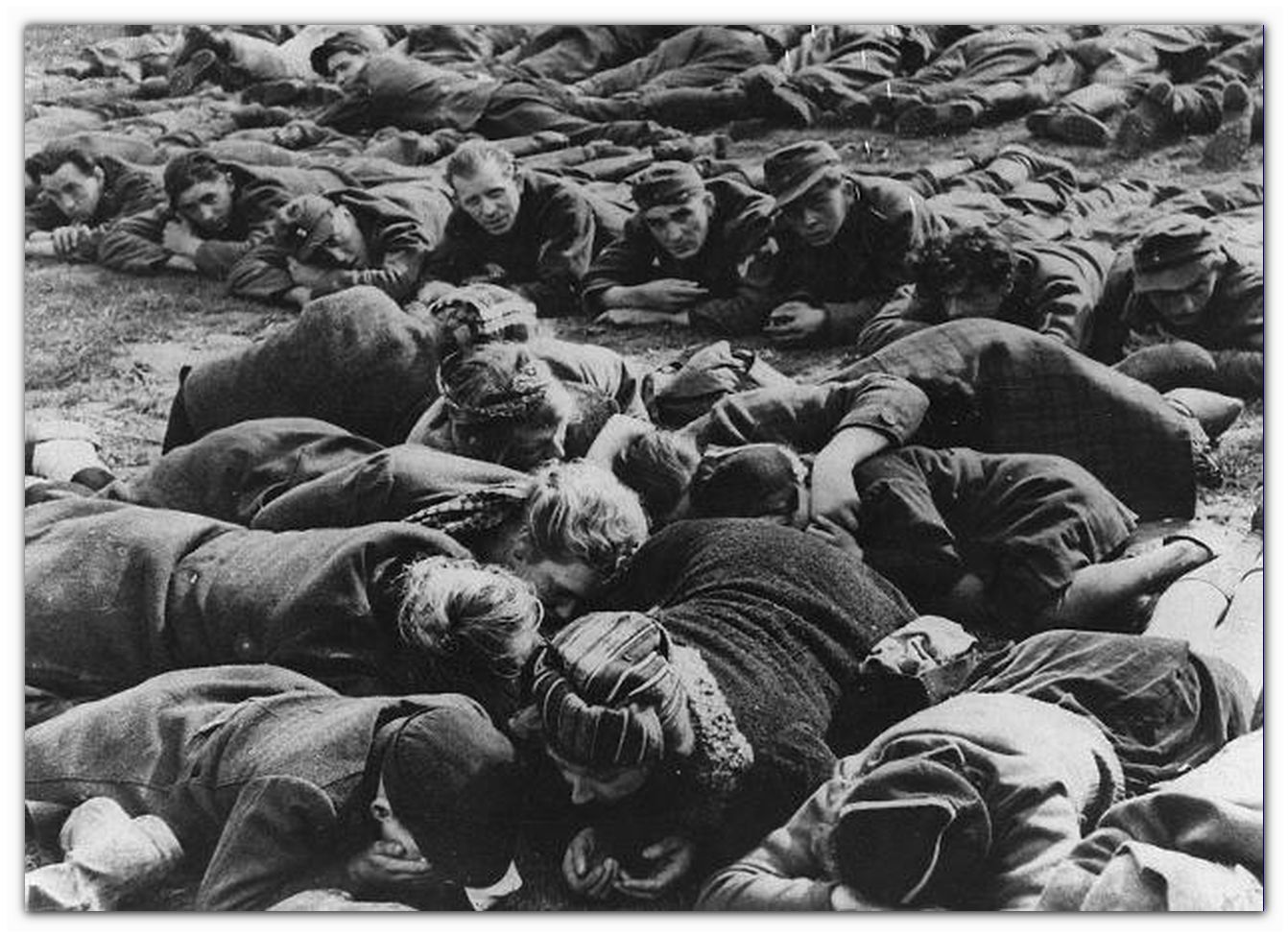
| Żołnierze niemieccy oraz kobiety wzięci do niewoli przez żołnierzy amerykańskich w marcu 1945 r. Fot. Robert Capa / Getty Images | ||
| |
||
| Przejście frontu Oknem wystawowym piekieł, zainscenizowanym dla pognębienia i poniżenia człowieczeństwa, nazwał obrazowo przejście frontu Stanisław Vincenz. Pokaz, który pisarz oglądał na Węgrzech, w kraju sojuszniczym Trzeciej Rzeszy, rządzi się własnymi prawami i ma, rzec można, interaktywny charakter. Wykorzystując głęboką wiedzę na temat naszych atawistycznych skłonności, diabelscy projektanci szkicują ogólne ramy wystawy. Potem przyglądają się ludzkiej pomysłowości. Wtapiają się w tłum, podszeptują, ale nie podpowiadają konkretów. Sprawdzają, czym ich zaskoczymy. Podkład muzyczny dramatycznej scenerii stanowi krzyk seryjnie gwałconych kobiet. Niemka z wyzwalanej przez Francuzów Tybingi nie może go zapomnieć po dziesięcioleciach. Ryk kobiet rozrywa ściany domów – odnotowuje Libussa von Krockow pod Słupskiem, gdy docierają pierwsze sowieckie zagony. Mało kto się nim przejmuje. Jest wojna, są żołnierze i baby – konstatuje czeski robotnik przymusowy obserwujący nad Renem gwałty wojsk amerykańskich. Na linii frontu, stwierdza Wilhelm Reich, kobieta spada do roli klozetu. Amerykański psychiatra wie, co mówi. Urodził się u schyłku XIX w. pod Lwowem. Od 1914 r., początku pierwszej wojny światowej, maszerują tędy kolejne armie. Galicyjskie kobiety ledwo powłóczą nogami – zapisuje w dziennikach Izaak Babel podczas wojny polsko-bolszewickiej 1920 r. Szczególnie dotyczy to Żydówek, gdyż w świecie narodów nikt nie bierze ich w obronę. Wojsko polskie jest o tyle lepsze od bolszewików, że nie równa wszystkiego z ziemią. Armia rewolucyjna przypomina rosyjskiemu pisarzowi niszczycielską lawę. Lecz przecież żołnierze perscy w pierwszym szerzej opisanym konflikcie europejskim zachowują się podobnie. Palą miasta. Zbiorowe gwałty są na porządku dziennym. Niejedna Greczynka przypłaciła je śmiercią – notuje współczesny wydarzeniom Herodot. Władymira Gelfanda opisy spotkań żołnierzy sowieckich z niemieckimi batalionami kobiecymi mrożą krew w żyłach. Mimo to są bliskie realiów swojego czasu i miejsca. W lutym 1945 r. Armia Czerwona błyskawicznym uderzeniem znad Wisły staje nad Odrą. Niemcy rzucają do boju ostatnie rezerwy. Przede wszystkim mniej czy bardziej siłą wcielanych do wojska „ochotników”, rekrutowanych spośród narodów sprzymierzonych i głodzonych jeńców radzieckich. Dziewczyny i młode bezdzietne kobiety służą w jednostkach pomocniczych Wehrmachtu od początku wojny. To jedna z nielicznych możliwości uniknięcia pracy w fabryce amunicji. Zarazem szansa na spełnienie marzeń o pięknym mundurze czy poznaniu smaku przygody. Nikt nie wybiera czasów, na które przypadnie jego młodość. Jęk kobiet towarzyszy zajmowaniu Niemiec i krajów sojuszniczych. Jeśli na wschodzie jest głośniejszy, to dlatego, że wojna ma tu od początku zupełnie inny przebieg niż na zachodzie, a masy żołnierzy są liczniejsze. Kobiety bierze się publicznie. Z zasady się nie bronią. Cichną pod naporem, jak Greffowa w „Blaszanym bębenku”. Bliscy chowają się za nimi. Odwet kosztuje zbyt wiele i dotyka nawet osoby postronne. Przynajmniej od czasów Cycerona wiadomo, że przemarsz armii sprzymierzonej bywa klęską równą wejściu wroga. Jeśli jednak porównywanie ma sens, to nie jest nim zestawienie pobieżnych podobieństw, lecz wydobywanie różnic. Wymęczeni wojną Polacy nie szczędzą sowieckim żołnierzom ciepłego słowa. Wyrażają się prawie z miłością o Rosji – stwierdza Gelfand. Dziewczęta z podziwem pozdrawiają wyzwolicieli – dodaje gdzieś między Żninem a Janowcem. Relacje, także z Kresów, potwierdzają, że Armię Czerwoną wita się na ziemiach polskich z radością większą, niż gotowi jesteśmy dzisiaj przyznać. Każdy objaw wdzięczności rozbraja żołnierza – zauważa Vincenz na Węgrzech. Gelfand nie kryje wstydu z powodu zachowania swoich żołnierzy w Polsce. Przekroczywszy granicę Niemiec, nie potrafi wykrzesać współczucia: Niemcy stoją w ogniu, a człowiek się jakoś raduje, przyglądając się tej złej grze. Śmierć za śmierć, krew za krew. Nie szkoda mi (...) tych zwierząt. Żołnierze radzieccy są wreszcie na terenie wroga. W kraju niczyim – stwierdza Władymir. Przez pierwsze dni obowiązuje zasada bezkarności. Wokół wszystko płonie. Jak nie wskutek ostrzału sowieckich katiusz, to w wyniku nalotów anglosaskiego lotnictwa, które zmienia w ruinę jedno miasto za drugim. Na koniec Świnoujście. Do Berlina pozostało sto kilometrów. Oficerom trudno karać młodych żołnierzy. Przeszli kawał drogi. Z domów wyrwano ich lata temu. Na wojnie zdziczeli i zapomnieli, że istnieje inne życie. Im bliżej jej zakończenia, tym bardziej boją się śmierci. Bohaterstwo miesza się z okrucieństwem w sposób niemożliwy do rozdzielenia. |
||
| |
||
 |
||
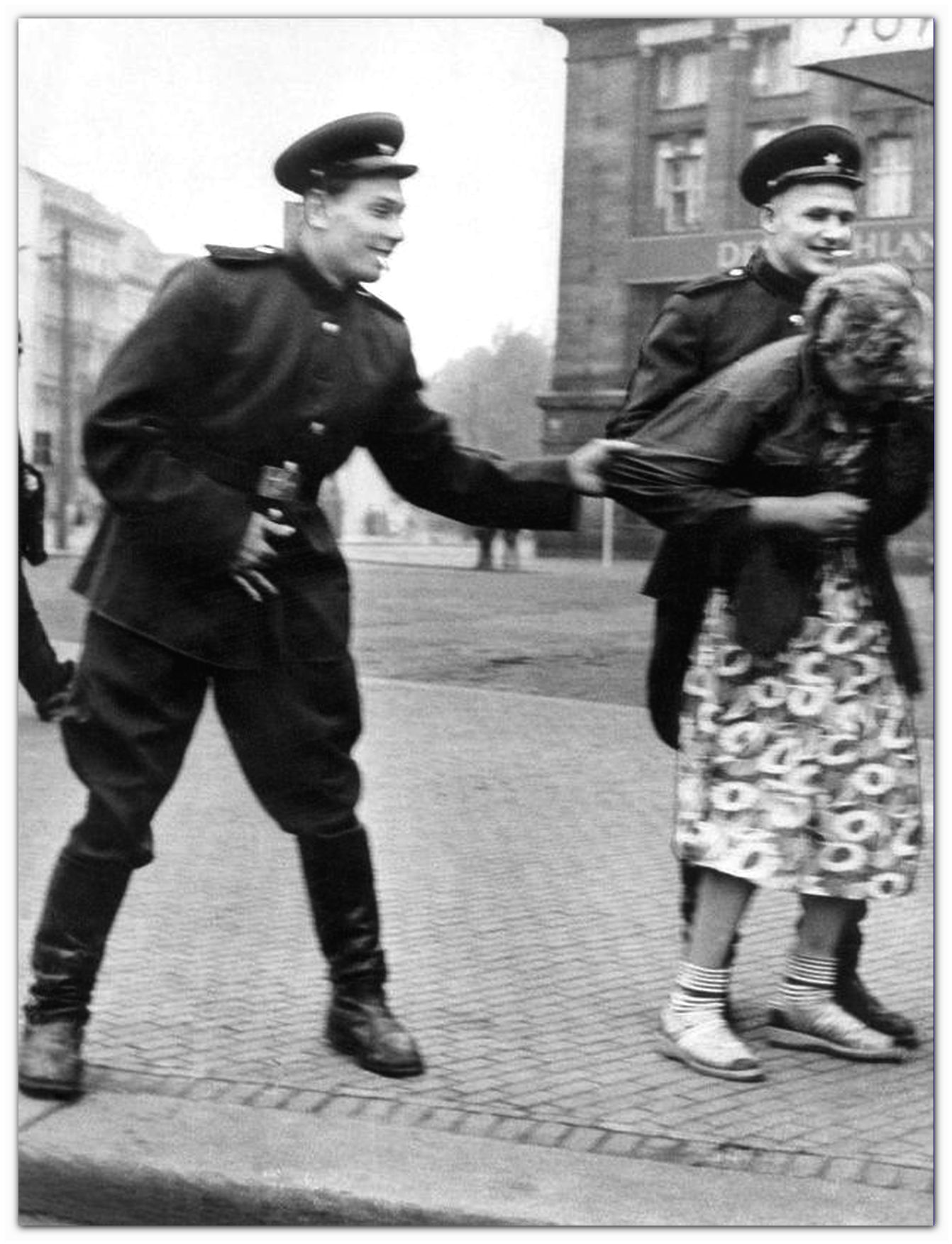
| Żołnierze sowieccy zaczepiają Niemkę na ulicy w Lipsku latem 1945 r. Fot. Domena publiczna | ||
|
Zły – kto źle nie czyni Przed wejściem we frontową strefę śmierci, pisał Anton Myrer, żołnierzy ogarnia delirium pożądania, które prawie odbiera przytomność. Amerykański pisarz uczestniczył w wojnie na Pacyfiku. Jego powieści służą jako podręczniki w szkołach dowodzenia. Liczy się przede wszystkim fizjologia i biologia gatunkowa. Jelita wyrzucają wszystko, co mogłoby przeszkadzać w ucieczce. Instynkt podpowiada: zanim zginiesz, rozsiej nasienie. Zdolności decyzyjne żołnierzy ogranicza niewyspanie. Niemniej reakcje żołnierzy, jak pokazuje na przykładzie Austrii węgierska badaczka Andrea Peto, nie są automatyczne. Gdzie przejęcie osady wiąże się z ciężkimi walkami, tam „odwetowe” gwałty dotykają nawet 40 proc. populacji kobiecej. Gdzie nie stawia się oporu, wskaźnik ten spada poniżej 6 proc. Na terenach rzadko zasiedlonych – jeszcze niżej. W wielkim wojsku, wiedział już Eurypides, swawola żołnierzy gorsza od ognia. Zły – kto źle nie czyni – mówi ustami Hekabe patrzącej na zagładę Troi i męki Trojanek. Faktycznie jest gorzej. Żołnierze przestają odróżniać zło od dobra. Najgorzej, gdy emocje i zmęczenie zmieszają się z alkoholem. Używek na wojnie nigdy nie brakuje. Już psalmy wspominają przebudzenie wojownika rozgrzanego winem. Myrer opowiada o pijanych amfibiach atakujących Japończyków. Gelfand wyznaje, że boi się pijackiej zgrai. Żołnierze nieprzerwanie piją, a wtedy palą, rabują, gwałcą. Na koniec umierają z przepicia i w wypadkach. Alkohol i gwałty to problem nawet w strefach oddalonych od frontu. Kamil Janicki w „Pijanej wojnie” przytacza skargi Brytyjek na zezwierzęcenie polskich lotników. Nie sposób przejść bezpiecznie obok ich baz. Gdy któraś z kobiet zabija agresora łyżką do butów, dowódcy się żalą. Rzecz jasna, inna jest tu skala problemu, lecz mechanizm ten sam. Każdy wylot jest dla lotnika wejściem w strefę śmierci. Lotnik jest więcej wart niż kobieta i czuje się w zasadzie bezkarny. Susan Brownmiller, autorka klasycznej rozprawy o gwałcie w kulturze, przekonuje, że podczas konfliktów ciało kobiece staje się ceremonialnym polem walki i miejscem parady zwycięstwa. Zapewne ma rację, choć mocniej podkreśliłbym, zwłaszcza w wypadku długich wojen, uwarunkowania natury biologicznej. I nie zapominałbym o diamentach. Znajdziemy je w każdej armii, szczególnie wśród żołnierzy doświadczonych. Za pomocą różnych forteli próbują ograniczyć zasięg dewastacji. Nie są w stanie zdziałać wiele, ale dokonują cudów. Diabłom na pohybel przenoszą cywilizację ludzką przez barbarzyńskie czasy. Bez nich dawno byśmy wyginęli. Autentyczne historie nieprawdziwe Relacja Władymira Gelfanda kipi autentyzmem w szczegółach. Od opisu „dobrowolnego” gwałtu w czasach, gdy, jak pisze Etgar Keret, dobrowolności było mniej niż gwałtów, aż po obdarowanie dziewczyny sukienką. Żołnierze rabują babską bieliznę – dziwi się Izaak Babel. To stary proceder. Kradną ją dla zaspokojenia ukrytych pragnień, jako fetysze, i na podarki. Dzięki nim nie muszą potem nazywać gwałtu po imieniu. W złych czasach tabuizuje się przemoc i związane z nią słownictwo, stwarza iluzję dobrowolności. Dotyczy to wszystkich stron. Mimo pozorów autentyzmu relacja Gelfanda nie odpowiada faktom. Pod Kostrzynem i Barlinkiem, ani chyba nigdzie indziej, nie doszło do ataku niemieckich batalionów kobiecych na pozycje sowieckie. Jednostek takich nie było w wojsku niemieckim. Relacja jest wyrazem odwiecznych żołnierskich pragnień. Gdy nad Morze Czarne przybyły amazonki, przekonywał Herodot dwa i pół tysiąca lat temu, Scytowie ani myśleli wojować z kobietami. Uradzili, że wyznaczą spośród siebie dziarskich młodzieńców, którzy przekonają je do życia z mężczyznami. Kronikarz nie wątpił, że plan się powiódł. Wydarzenia apokryficzne dotyczące kobiet rzadko zostają zapisane. Żołnierze nie chwalą się nimi, podobnie jak nastolatki nie chełpią się, poza swoim kręgiem rówieśniczym, fantazjami erotycznymi. Historycy lekceważyli tego typu relacje, traktując je jako fałsz w sensie faktografii „twardej”. Interesowali się nimi co najwyżej pisarze, od pewnego czasu także psychologowie. Cervantes, sam żołnierz, przytacza marzenia mężczyzn o pannach kąpiących ich nago. Ernest Hemingway, który zjechał niejedną wojnę, przywołuje historię żołnierza piechoty morskiej, który wrócił z Niemiec rok po zakończeniu wojny. W Ameryce nikt już nie chciał słuchać o jej okropnościach, powtarzał więc zasłyszaną od kolegów opowieść o odbiciu w Lesie Argońskim Niemek przykutych łańcuchami do karabinów maszynowych. Żołnierze nie idą na wojnę z radością. Gdy w koszarach przeniknie ich świadomość, że wojna blisko, zaczyna im brakować kobiet. Najpierw marzą o ostatniej przepustce. Zgarnę kilka dziwek – fantazjuje rekrut z powieści Myrera – przyskrzynię w pokoiku nie większym niż budka telefoniczna i powiem: nie mam za dużo czasu. Zdejmować majtki, nóżki do góry i po kolei. Następnie roją o łatwych kobietach wroga, które zawsze były cenionym łupem wojennym. Chłopcy wysyłani na wojny przeciw krajom ogarniętym rewolucją drżą na myśl o doświadczonych seksualnie proletariuszkach. Wyzwolenie, jeśli nie dotyczy własnego domu, pociąga. Żołnierzom włoskim wyruszającym do Afryki śnią się etiopskie piękności. Kolor skóry pobudza wyobraźnię. Amerykański żołnierz z opowiadania Toni Morrison przyłapuje koreańską dziewczynkę na wykradaniu pomarańczy ze śmietnika. Przestraszona, ale uśmiechnięta, proponuje mu „jum-jum”. Oferta „zrobienia laski” najwyraźniej wcześniej skutkowała. Dzieci najszybciej uczą się na wojnie. Tym razem żołnierz, zawstydzony przelotnym podnieceniem, zabija dziewczynkę. Zwyczaje wojenne, a tym bardziej ludzką mentalność, trudno zmienić. Nadzieje wiązano z rekrutacją kobiet. W Armii Czerwonej są one wszędzie. Reportaże Swietłany Aleksijewicz „Wojna nie ma w sobie nic z kobiety” nie mogły powstać gdzie indziej. Jednak ich tytuł myli. Prawda, że kobiety mają inną pamięć o wojnie, wielobarwną i dotykającą szczegółów, lecz zachowują się na wojnie podobnie jak mężczyźni. Pałają chęcią zemsty. Zabijają. Cieszą się nawet z gwałtów na kobietach wroga. Wiele relacji, nie tylko męskich, sugeruje, że są bardziej skore do rabunku i brutalniejsze, aczkolwiek wyznania takie mogą być wynikiem zderzenia kulturowych wyobrażeń o łagodnych kobietach z atawistyczną wojenną rzeczywistością. O męskich batalionach wroga żołnierki raczej nie marzą. Z trudem bronią się przed nadmiarem chętnych mężczyzn we własnych szeregach. Nie mogą wyjść z namiotu nawet za potrzebą. W irackim więzieniu Abu Ghraib podtekst tortur bywa jednak erotyczny. Amerykańskie żołnierki bawią się związanymi muzułmańskimi mężczyznami. Poniżają ich, zadają im ból, sznurują drutem genitalia. Kobiety na wojnie marzą przede wszystkim o miłości. Mimo że w tym punkcie poddają swoje wypowiedzi szczególnej autocenzurze, nie ma powodu im nie wierzyć. Nie różnią się od mężczyzn, którzy swobodniej mówią na te tematy. Wciąż marzę (...) o miłości, niechby już nawet do Niemki, jeśli będzie dostatecznie mądra, ładna, czysta, i jeśli będzie – przede wszystkim – wiernie kochała – rozmarza się Władymir Gelfand w Berlinie miesiąc po wojnie. Własnych kobiet się brzydzi. Traktuje je wszystkie jako „cichodajki”. Nie inaczej niż wcześniej Babel, który mawia o nich: „towarzyszki kurwy”. Żołnierze są wybiórczy. Gwałty wojenne im nie szkodzą, nawet w oczach kobiet. Wypinają pierś po medale, uwodząc łakome dziewczęta, gdy tymczasem żołnierki ukrywają swój udział w wojnie. W czasie powojennego niedoboru mężczyzn na pewno trudniej im realizować wojenne marzenia na czas pokoju. Prof. dr hab. Jan M. Piskorski – historyk, wykładowca akademicki, pracuje na Uniwersytecie Szczecińskim. Wykład wygłoszony w Bibliotece Miejskiej w Chojnie na zebraniu stowarzyszenia Terra Incognita |
© Wyborcza.pl
 Polish
German women in uniform, captured by American soldiers, await transport to a prisoner-of-war camp. Photo: Horace Abrahams / Getty Images
The women endure what is happening in silence. As a rule, they do not defend themselves. Under the pressure of circumstances they fall silent. The advance of an allied army can turn into a catastrophe no less terrible than the arrival of an enemy force.
“Oh God! God!” the soldiers of a German women’s battalion cry, their whole bodies shaking. After an unsuccessful attack somewhere on the Oder, between Küstrin (today Kostrzyn, Poland) and Bärwalde (today Mieszkowice, Poland), they have fallen into Soviet captivity.
Lieutenant Vladimir Gelfand, seated, was a Red Army soldier and the author of a diary that he kept regularly from 1941 to 1946. Public domain.
“German pussycats,” Lieutenant Vladimir Gelfand writes in his diary on 21 February 1945. The women’s battalion had operated on the left flank of his unit. The women wanted revenge for husbands killed in the war, but their detachment was completely destroyed. The Soviet lieutenant, born in 1923, does not know what eventually happened to the prisoners. He records only the confusion of his comrades at this unexpected “gift.” Some soldiers proposed “stabbing [them] through the genitals.” Gelfand adds that he himself would have disposed of them “in a less inventive way.”
A month later, on 20 March, in Mohrin (today Moryń, Poland), Senior Lieutenant Andreyev tells Gelfand details of another capture of a women’s battalion. The two men have known one another for a long time; now they are billeted in one of the most picturesque towns of the former Neumark. The fishing town passed to the Red Army without a shot: the entire German population had fled, and only several dozen forced laborers remained to greet the troops. The town survived intact. There is a lake nearby, spring is already in the air, the sun grows warmer by the day, and at times the weather is almost summery.
During the fighting for nearby Berlinchen (today Barlinek), Andreyev’s unit encountered an advancing enemy women’s battalion. The women, armed with automatic weapons, advanced in a formation three ranks deep; supporting men followed in a fourth line. The well-entrenched Soviet soldiers were astonished. No order to fire came. Only when the German women, encouraged by the silence of the Soviet guns, came close to the positions did machine guns open fire from the flanks. The dead fell particularly thickly in the fourth rank. The remaining women dropped their weapons and fled in panic through the streets. There Soviet soldiers captured them, meeting them with a vivid mixture of hatred, malicious satisfaction, and excitement.
The prisoners cried as they wiped away their tears: “Oh God, God, God!” Gelfand writes the exclamations phonetically and, as the German editor of his diary Elke Scherstjanoi notes, repeatedly corrects them in an effort to convey what he most often heard: “Oy, Gote, Gote, Gote.” The Russian transcription sounds authentic. It probably reflects a Low or Middle German dialect in which the word Gott could indeed sound like Gote.
According to Andreyev, both married women and young girls served in the battalion. They were separated. First two Russian volunteers were questioned and shot without further discussion. Then the women whose husbands or relatives served in the same unit were set apart. At this point the story becomes less clear; apparently these women too were killed. Some, Andreyev said, “admitted themselves” that they were officers’ wives, and both sides treated such admissions with equal severity.
The Soviet infantrymen, it seems, were interested only in the girls. The youngest were seventeen. The “trophies” were distributed among beds. There the girls were subjected to various sexual “experiments,” “impossible to put on paper,” as Gelfand cautiously writes. The terrified German women did not resist the young soldiers; on the contrary, they begged the young men to sleep with them, hoping in this way to avoid rape by older men.
Sergeant Andreyev was among the “lucky ones.” He chose the youngest prisoner. “Emerald tears of bitterness” shone in her beautiful eyes.
Placed in the same apartment with him, the girl refused to “help with the urgent matter.” She shook her head and whispered that she was still a virgin. The admission only increased the desire of “our hero,” as Gelfand writes with a touch of warm irony. The girl continued to resist until Andreyev took out a pistol. Then she fell silent, trembled, and slowly removed her leggings. The impatient Russian immediately proceeded. He did not entirely believe her claim of innocence.
“Do you know how to move with it?” he asked bluntly. The girl was silent. The soldier pointed again to the weapon. Realizing that he would not back down, the German woman said “yes” twice.
“I will do it well,” she added. The sergeant warned: “Only well, not badly,” pronouncing the words in German: “gut, nicht schlecht.”
The girl then “herself” pulled Andreyev toward her. He noted with satisfaction the tearing of her hymen. The teenage girl cried out in pain, then moaned, and finally forced a smile.
The sergeant gave her a civilian dress and watched with pleasure as she emerged, confused but smiling, to join the other prisoners.
German soldiers and women captured by American troops in March 1945. Robert Capa / Getty Images
The writer Stanisław Vincenz metaphorically called the advancing front a display window of hell built for the torment and humiliation of the human race. The scene he observed in Hungary, an ally of the Third Reich, followed its own rules and was, one might say, interactive. Knowing our atavistic instincts perfectly well, the infernal designers merely sketched the general frame of the display. Then they listened to human inventiveness. They whispered—but did not dictate—and waited with interest to see how humanity would surprise them.
The musical background to this dramatic spectacle was the crying of women subjected to mass rape. A German woman from Tübingen, liberated by the French, could not forget that sound even decades later.
“The crying of women tears through the walls of houses,” Libussa von Krockow wrote as she watched Soviet forward units approach Stolp (today Słupsk, Poland).
“There is a war. There are soldiers, and there are women,” stated a Czech forced laborer who witnessed rapes committed by American soldiers on the Rhine.
At the front, Wilhelm Reich argued, a woman is reduced to the role of a living latrine. He knew what he was talking about: the American psychiatrist was born around the turn of the twentieth century near Lviv, a region across which army after army had passed from 1914 onward with the outbreak of the First World War.
“All the girls and women can barely walk,” Isaac Babel wrote in Galicia in 1920 during the Polish-Bolshevik War. This applied especially to Jewish women; among the peoples of the world, no one came to their defense.
The Polish army was better than the Bolsheviks only in that it did not wipe everything from the face of the earth. To the Russian writer, the revolutionary army resembled lava—destroying everything and rushing forward indiscriminately. Persian soldiers in one of the first European conflicts described in any detail behaved similarly: they burned cities and mass rape was commonplace.
“More than one Greek woman paid the Persians with her death,” wrote Herodotus, a contemporary of those events.
Vladimir Gelfand’s recollections of Red Army encounters with Wehrmacht women’s battalions make the blood run cold. Yet they are precise in another sense: they reflect the realities, fears, fantasies, and moral atmosphere of that time and place. In February 1945, after a rapid advance from the Vistula, the Red Army reached the Oder. The Germans threw their final reserves into battle, above all forcibly mobilized “volunteers” from allied peoples and starving Soviet prisoners of war. Girls and young women had served in Wehrmacht auxiliary formations from the beginning of the war. For some, it was one of the few ways to avoid heavy factory labor; for others it was the fulfillment of a dream to wear an attractive uniform and touch a life of adventure. No one chooses the historical moment into which youth happens to fall.
The groans of women accompanied the occupation of Germany and its allies. They sounded louder in the East only because war there had been waged differently from the outset and the armies were larger.
Women were taken in front of everyone. As a rule, they did not defend themselves. They remained silent under pressure, like Greff in The Tin Drum. Their relatives hid behind them. Revenge would have cost too much and could have fallen even on the innocent.
At least since Cicero it has been understood that the march of an allied army can, in the scale of the disaster it causes, resemble an enemy invasion. Yet the comparison is useful only insofar as it helps us understand differences. Exhausted Poles were not sparing in their kind words about the Red Army.
“The Poles speak of Russia almost with affection,” Gelfand says. “The girls enthusiastically greet their liberators,” he adds, remembering the road between Żnin and Janowiec. Testimony from eastern Poland confirms that the Red Army was at that time welcomed with more joy than many people today are prepared to acknowledge.
Every expression of gratitude, Vincenz observed in Hungary, disarms a soldier. Gelfand does not hide his shame at the behavior of his comrades in Poland. Yet after crossing the German border he is no longer capable of sympathy:
“Germany is burning, and for some reason it is gratifying to watch this evil spectacle. Death for death, blood for blood. I do not pity these haters of humanity.”
The Soviet soldiers are finally on enemy soil—“on no man’s land,” as Gelfand himself writes. In the first days, a law of impunity prevails. Everything burns: if not from Katyusha rockets, then from British and American air attacks that turn cities into heaps of stone. Swinemünde, today Świnoujście in Poland, is one such place. Berlin is one hundred kilometers away. Officers find it difficult to punish their men. The soldiers have gone through the entire war, torn from their homes while still boys, and now they are brutalized and barely remember what any other life means. The closer the end comes, the stronger the fear. Heroism becomes so tightly intertwined with cruelty that it is no longer possible to separate one from the other.
Soviet soldiers meet a German woman on a street in Leipzig in the summer of 1945. Photo: public domain
Before reaching the front, the zone of death, soldiers are seized by a fever of lust, Anton Myrer wrote. The condition almost robs them of reason. The American writer, a veteran of the Pacific War whose books are now used as teaching texts in military academies, argued that physiology and the biology of the species come to the fore. The intestines rid themselves of everything that might hinder flight. Instinct dictates: before you die, leave your seed behind. The ability to make rational decisions is diminished; chronic sleep deprivation makes sustained thinking impossible.
And yet soldiers’ reactions are not entirely automatic. Data cited by the Hungarian researcher Andrea Pető concerning Austria demonstrate this. Where a settlement was taken by force, up to 40 percent of local women were subjected to “punitive” rape. Where there was no resistance, the figure fell below 6 percent, and in sparsely populated areas it was lower still.
Euripides already knew that in a great army the arbitrary violence of soldiers can be more dangerous than fire. “He who avoids evil is weak at heart,” he has Hecuba say as she watches the fall of Troy and the suffering of its women. Soldiers lose the ability to distinguish good from evil. The worst situations arise when exhaustion and fear are mixed with alcohol. Myrer remembers “drunken amphibians” going into battle against the Japanese. Gelfand admits frankly that he fears drunken packs of soldiers. Soldiers drink constantly; afterward they shoot, rob, and rape. In the end they die—from alcohol poisoning, accidents, or their own violence.
Alcohol and violence are not problems only at the front; they also appear deep in the rear. In his book Drunken War, Kamil Janicki cites testimony from British women who complained about the brutal behavior of Polish airmen. Women could not pass their bases without risking attack. When one woman killed a man who assaulted her with a shoehorn, officers mourned the dead man. The scale is different, but the mechanism is similar. Every mission is a pilot’s step into the death zone. His life is valued more highly in wartime than a woman’s, and this can create a sense of impunity.
Susan Brownmiller, author of a major study of sexualized violence in culture, argues that during conflict the female body becomes a ceremonial battlefield, an arena for the victor’s parade. She is certainly right, although I would emphasize the role of biology more strongly, especially under the conditions of a prolonged war.
Yet one should not forget the truly exceptional people found in every army, most often among veterans. By all kinds of stratagems they try to limit the scale of violence. Their possibilities are restricted, but they accomplish the seemingly impossible. In defiance of the devil, these people carried human civilization through a barbarous age. Without them, we would have destroyed ourselves long ago.
Gelfand’s diary exudes authenticity in its details, from the description of “voluntary” rape in a time when, to borrow Etgar Keret’s formulation, there was less voluntariness than violence, to the dress given to the girl. Isaac Babel had already been struck by soldiers stealing women’s underwear. It is an old story: underwear is stolen to satisfy secret fetishistic desires, but also as a gift, a way to rationalize an act of violence and avoid calling it rape. In hard times violence becomes taboo along with the vocabulary used to describe it. An illusion of voluntariness appears. It affects both sides.
And yet, despite their apparent authenticity, the episodes described by Gelfand do not correspond to established facts. Near Küstrin and Barlinek, and apparently nowhere else, women’s battalions did not attack Soviet positions. Units of this type did not exist in the German army. What Gelfand records is more likely an expression of soldiers’ fantasies than a literal reflection of reality.
Herodotus wrote that when the Amazons landed on the Black Sea coast, the Scythians did not want to fight them. Instead, they selected bold young men from among their own people to persuade the women to live together with men. The historian had no doubt that the plan would succeed.
Stories like these almost never entered official chronicles. Soldiers rarely boasted about such episodes, just as adolescents do not usually share erotic fantasies outside a circle of peers. Historians, for their part, ignored such testimony as unworthy of attention within “hard” factual history. Only writers and, later, psychologists took an interest in it.
Cervantes, himself a former soldier, described soldiers dreaming of naked maidens bathing. Hemingway, who lived through more than one war, tells of a Marine who did not return from Germany until a year after the war ended. By then no one in America wanted to hear about the horrors of war, and he kept repeating a story he had heard about soldiers finding German women chained to machine guns in the Argonne Forest.
People do not go to war joyfully. When soldiers in barracks realize how close the front is, they become especially conscious of the absence of women. At first they dream of one last leave.
“I’ll grab a few girls,” one of Myrer’s characters fantasizes, “pack them into a room no bigger than a telephone booth and say: there isn’t much time. Panties off, legs up—one after another.” Then the fantasies turn to enemy women, who throughout history have been regarded as valuable spoils of war.
Young men sent to fight revolutionary countries tremble at the thought of sexually liberated proletarian women. Liberation is exciting—until it reaches their own home.
Italian soldiers setting out for Africa dream of Ethiopian women. Skin color excites the imagination. In a story by Toni Morrison, an American soldier catches a Korean girl stealing oranges from a refuse container. Terrified, she smiles and offers “yum-yum,” evidently hoping to make a bargain. Children learn fastest in war. The soldier experiences a moment of arousal, then feels ashamed—and kills her.
Military customs, and still more deeply human mentalities, change only with great difficulty. Today some hopes are placed in the increasing presence of women in armies. In the Red Army they were everywhere. Svetlana Alexievich’s reports in The Unwomanly Face of War could hardly have appeared in any other culture. Yet the title itself can mislead. Women certainly preserve a distinctive memory of war—vivid and attentive to detail—but in war they can behave much like men. They want revenge. They kill. Some even rejoice at the rape of enemy women. Certain memoirs, and not only men’s memoirs, suggest that women may also engage in looting and cruelty. Perhaps this impression results partly from the collision between the cultural stereotype of the “gentle woman” and the reality of war.
Women are unlikely to dream of enemy male battalions. They already have difficulty fending off endless male harassment within their own army. Sometimes they cannot leave a tent even to relieve themselves. History also knows contrary examples. At Abu Ghraib prison in Iraq, American female servicemembers humiliated bound Muslim prisoners, inflicted pain on them, and attached wires to their genitals. The abuse had an obvious erotic undertone.
Women at war dream above all of love. When speaking about it they are more likely to censor themselves, but there is no reason not to believe them. In this respect they are no different from men, who discuss the same longing much more openly.
“Everything is futile. I dream of love. Even with a German woman, as long as she is intelligent, beautiful, clean—and, above all, devotedly loves me,” Vladimir Gelfand dreams in Berlin one month after the end of the war. At the same time he despises Soviet women soldiers, calling them “depraved and vulgar creatures.” In this he differs little from Babel, who wrote about the women of the Red Cavalry: “All are whores, but comrades.”
Soldiers are selective. Rape does not damage their reputation in women’s eyes. They display their medals and court the women they desire. Women, by contrast, often have to conceal their participation in the war. In the postwar shortage of men, it becomes especially difficult for them to turn into peaceful reality the dreams that were born in the hell of war.
Jan M. Piskorski is a historian and professor at the University of Szczecin.
The lecture was delivered at a meeting of the Terra Incognita association at the Municipal Library in Chojna.