


 |
 |
|
| 24 сентября 2015 | 24 вересня 2015 |
|
||
Изнасилование Берлина:неизвестная история войны
|
||
 |
||
|
В России выходит в продажу примечательная книга - дневник офицера Советской Армии Владимира Гельфанда, в которой без прикрас и купюр описаны кровавые будни Великой Отечественной войны. Некоторые полагают, что критический подход к прошлому неэтичен или просто недопустим, учитывая героические жертвы и гибель 27 миллионов советских граждан. Другие считают, что будущие поколения должны знать истинные ужасы войны и заслуживают того, чтобы увидеть неприукрашенную картину. Корреспондент Би-би-си Люси Эш попыталась разобраться в некоторых малоизвестных страницах истории последней мировой войны. Некоторые факты и обстоятельства, изложенные в ее статье, могут быть неподходящими для детей. _____________________________
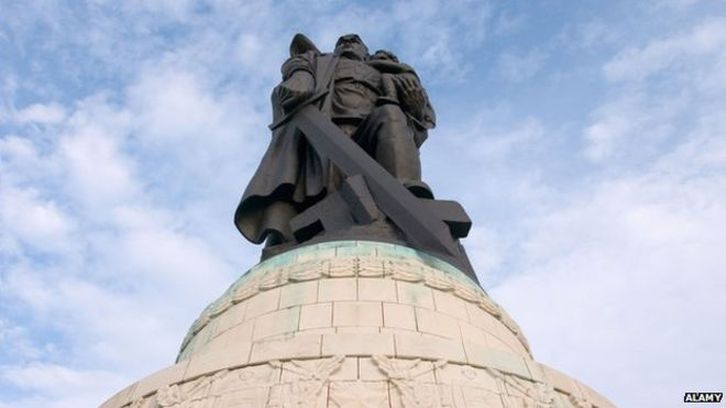
В Трептов-парке на окраине Берлина сгущаются сумерки. Я смотрю на возвышающийся надо мной на фоне закатного неба памятник воину-освободителю. Стоящий на обломках свастики солдат высотой 12 метров в одной руке держит меч, а на другой его руке сидит маленькая немецкая девочка. Здесь похоронены пять тысяч из 80 тысяч советских солдат, погибших в битве за Берлин в период с 16 апреля по 2 мая 1945 года. Колоссальные пропорции этого монумента отражают масштабы жертв. На вершине постамента, куда ведет длинная лестница, виден вход в памятный зал, освещенный как религиозная святыня. Мое внимание привлекла надпись, напоминающая, что советские люди спасли европейскую цивилизацию от фашизма. Но для некоторых в Германии этот мемориал - повод для иных воспоминаний. Советские солдаты изнасиловали бессчетное число женщин по пути к Берлину, но об этом редко говорили после войны - как в Восточной, так и в Западной Германии. И в России сегодня об этом мало кто говорит. Дневник Владимира ГельфандаМногие российские СМИ регулярно отвергают
рассказы об изнасилованиях как миф, состряпанный на Западе, однако один
из многочисленных источников, поведавших нам о том, что происходило, -
это дневник советского офицера. |
||
 |
||
|
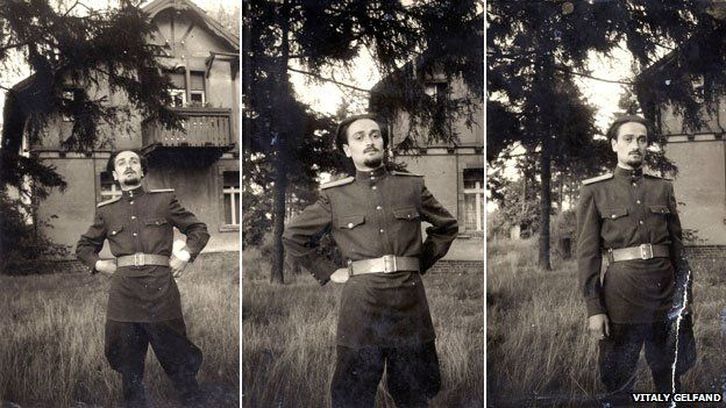
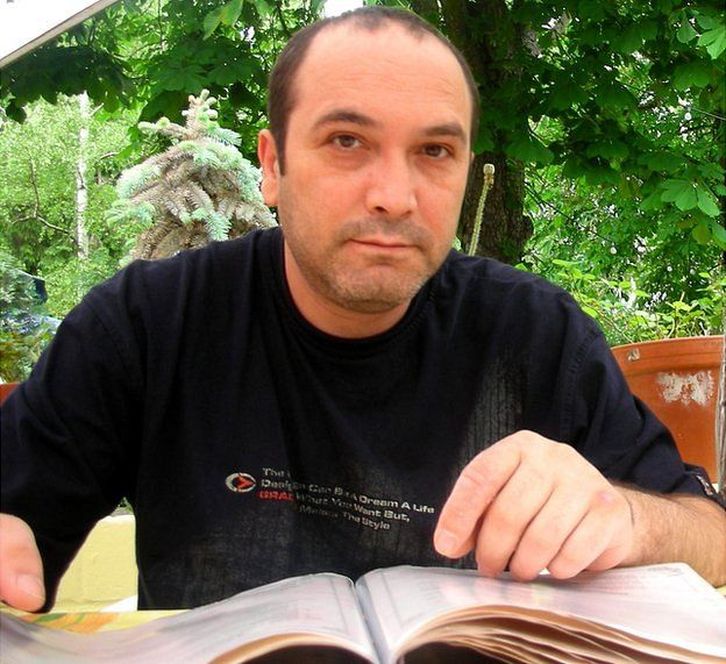
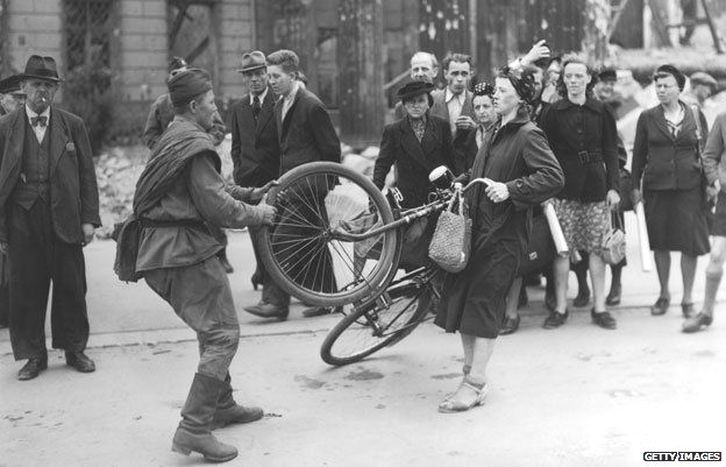
Лейтенант Владимир Гельфанд, молодой еврей родом из Украины, с 1941 года и до конца войны вел свои записи с необыкновенной искренностью, несмотря на существовавший тогда запрет на ведение дневников в советской армии. Его сын Виталий, который позволил мне почитать рукопись, нашел дневник, когда разбирал бумаги отца после его смерти. Дневник был доступен в сети, но теперь впервые публикуется в России в виде книги. Два сокращенных издания дневника выходили в Германии и Швеции. Дневник повествует об отсутствии порядка и дисциплины в регулярных войсках: скудные рационы, вши, рутинный антисемитизм и бесконечное воровство. Как он рассказывает, солдаты воровали даже сапоги своих товарищей. В феврале 1945 года воинская часть Гельфанда базировалась недалеко от реки Одер, готовясь к наступлению на Берлин. Он вспоминает, как его товарищи окружили и захватили в плен немецкий женский батальон. "Позавчера на левом фланге действовал женский батальон. Его разбили наголову, а пленные кошки-немки объявили себя мстительницами за погибших на фронте мужей. Не знаю, что с ними сделали, но надо было бы казнить негодяек безжалостно", - писал Владимир Гельфанд. Один из самых показательных рассказов Гельфанда относится к 25 апреля, когда он был уже в Берлине. Там Гельфанд впервые в жизни прокатился на велосипеде. Проезжая вдоль берега реки Шпрее, он увидел группу женщин, тащивших куда-то свои чемоданы и узлы.
|
||
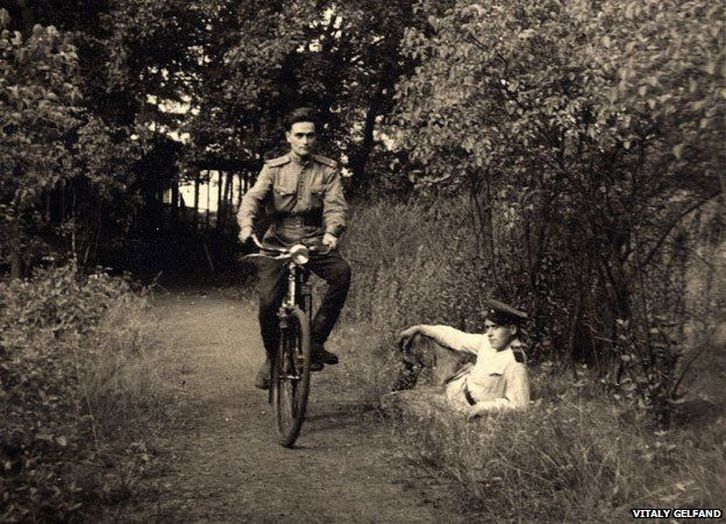 В феврале 1945 года воинская часть Гельфанда базировалась недалеко от реки Одер, готовясь к наступлению на Берлин |
||
| "Я спросил немок, где они живут, на ломаном немецком, и поинтересовался, зачем они ушли из своего дома, и они с ужасом рассказали о том горе, которое причинили им передовики фронта в первую ночь прихода сюда Красной Армии", - пишет автор дневника. "Они тыкали сюда, - объясняла красивая немка, задирая юбку, - всю ночь, и их было так много. Я была девушкой, - вздохнула она и заплакала. - Они мне испортили молодость. Среди них были старые, прыщавые, и все лезли на меня, все тыкали. Их было не меньше двадцати, да, да, - и залилась слезами". "Они насиловали при мне мою дочь, - вставила бедная мать, - они могут еще прийти и снова насиловать мою девочку. - От этого снова все пришли в ужас, и горькое рыдание пронеслось из угла в угол подвала, куда привели меня хозяева. "Оставайся здесь, - вдруг бросилась ко мне девушка, - ты будешь со мной спать. Ты сможешь со мной делать все, что захочешь, но только ты один!" - пишет Гельфанд в своем дневнике. "Пробил час мести!"Немецкие солдаты к тому времени запятнали себя на советской территории чудовищными преступлениями, которые они совершали в течение почти четырех лет. Владимир Гельфанд сталкивался со свидетельствами этих преступлений по мере того, как его часть продвигалась с боями к Германии. "Когда каждый день убийства, каждый день ранения, когда они проходят через деревни, уничтоженные фашистами... У папы очень много описаний, где уничтожали деревни, вплоть до детей, уничтожали маленьких детей еврейской национальности... Даже годовалых, двухгодовалых... И это не в течение какого-то времени, это годы. Люди шли и это видели. И шли они с одной целью - мстить и убивать", - рассказывает сын Владимира Гельфанда Виталий. Виталий Гельфанд обнаружил этот дневник уже после смерти отца. Вермахт, как предполагали идеологи нацизма, был хорошо организованной силой арийцев, которые не опустятся до полового контакта с "унтерменшами" ("недочеловеками"). Но этот запрет игнорировался, говорит историк Высшей школы экономики Олег Будницкий. Немецкое командование было настолько озабочено распространением венерических болезней в войсках, что организовало на оккупированных территориях сеть армейских публичных домов. |
||
 |
||
| Трудно найти прямые свидетельства того, как немецкие солдаты обращались с русскими женщинами. Многие жертвы просто не выжили. Но в Германо-российском музее в Берлине его директор Йорг Морре показал мне фотографию из личного альбома немецкого солдата, сделанную в Крыму. На фотографии – тело женщины, распластанное на земле. "Выглядит так, как будто она была убита при изнасиловании или после него. Ее юбка задрана, а руки закрывают лицо", - говорит директор музея. "Это шокирующее фото. У нас в музее были споры о том, нужно ли выставлять такие фотографии. Это война, это сексуальное насилие в Советском Союзе при немцах. Мы показываем войну. Не говорим о войне, а показываем ее", - говорит Йорг Морре. Когда Красная армия вошла в "логово фашистского зверя", как называла тогда советская пресса Берлин, плакаты поощряли ярость солдат: "Солдат, ты на немецкой земле. Пробил час мести!" Политотдел 19-й Армии, наступавшей на Берлин вдоль побережья Балтийского моря, объявил, что настоящий советский солдат настолько полон ненависти, что мысль о половом контакте с немками будет ему отвратительна. Но и на этот раз солдаты доказали, что их идеологи ошибались. Историк Энтони Бивор, проводя исследования для своей книги "Берлин: падение", вышедшей в свет в 2002 году, нашел в российском государственном архиве отчеты об эпидемии сексуального насилия на территории Германии. Эти отчеты в конце 1944 года посылались сотрудниками НКВД Лаврентию Берии. "Они передавались Сталину, - говорит Бивор. - Можно увидеть по отметкам, читались они или нет. Они сообщают о массовых изнасилованиях в Восточной Пруссии и о том, как немецкие женщины пытались убивать себя и своих детей, чтобы избежать этой участи". "Жители подземелья"Другой дневник военного времени, который вела невеста немецкого солдата, рассказывает о том, как некоторые женщины приспосабливались к этой ужасающей ситуации в попытках выжить. С 20 апреля 1945 года женщина, имя которой не называется, оставляла на бумаге безжалостные в своей честности наблюдения, проницательные и местами сдобренные юмором висельника. Автор дневника описывает себя как "бледную блондинку, всегда одетую в одно и то же зимнее пальто". Она рисует яркие картины жизни своих соседей в бомбоубежище под их многоквартирным домом. Среди ее соседок – "молодой человек в серых брюках и очках в толстой оправе, при ближайшем рассмотрении оказывающийся женщиной", а также три пожилые сестры, как она пишет, "все трое – портнихи, сбившиеся в один большой черный пудинг". |
||
 |
||
В ожидании приближавшихся частей Красной армии женщины шутили: "Лучше русский на мне, чем янки надо мной", имея в виду, что лучше уж быть изнасилованной, чем погибнуть при ковровой бомбардировке американской авиации. Но когда солдаты вошли в их подвал и попытались вытащить оттуда женщин, те начали умолять автора дневника использовать ее знание русского языка, чтобы пожаловаться советскому командованию. На превращенных в руины улицах ей удается найти советского офицера. Он пожимает плечами. Несмотря на сталинский декрет, запрещающий насилие в отношении гражданского населения, как он говорит, "это все равно происходит". Тем не менее офицер спускается с ней в подвал и отчитывает солдат. Но один из них вне себя от гнева. "О чем ты говоришь? Посмотри, что немцы сделали с нашими женщинами! - кричит он. - Они взяли мою сестру и…" Офицер его успокаивает и выводит солдат на улицу. Но когда автор дневника выходит в коридор, чтобы проверить, ушли они или нет, ее хватают поджидавшие солдаты и жестоко насилуют, едва не задушив. Объятые ужасом соседи, или "жители подземелья", как она их называет, прячутся в подвале, заперев за собой дверь. "Наконец, открылись два железных засова. Все уставились на меня, - пишет она. - Мои чулки спущены, мои руки держат остатки пояса. Я начинаю кричать: "Вы свиньи! Меня тут изнасиловали дважды подряд, а вы оставляете меня лежать здесь как кусок грязи!" В итоге автор дневника приходит к мысли, что ей нужно найти одного "волка", чтобы защититься от новых групповых изнасилований "зверьем мужского пола". Она находит офицера из Ленинграда, с которым делит постель. Постепенно отношения между агрессором и жертвой становятся менее жестокими, более взаимными и неоднозначными. Немка и советский офицер даже обсуждают литературу и смысл жизни. "Никоим образом нельзя утверждать, что майор меня насилует, - пишет она. – Почему я это делаю? За бекон, сахар, свечи, мясные консервы? В какой-то степени я уверена, что так и есть. Но к тому же мне нравится майор, и чем меньше он хочет получить от меня как мужчина, тем больше он мне нравится как человек". Многие из ее соседок заключали подобные сделки с победителями поверженного Берлина. |
||
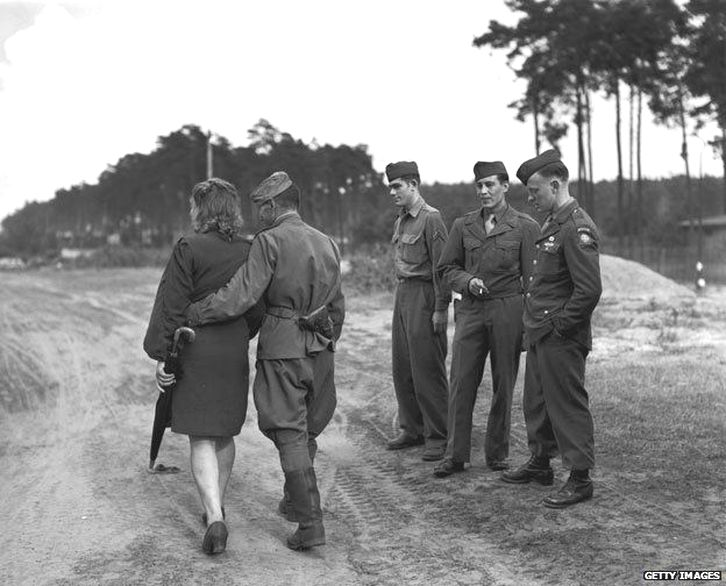 Некоторые немки нашли способ
приспособиться к этой ужасной ситуации
|
||
Когда в 1959 году дневник был опубликован в Германии под названием "Женщина в Берлине", этот откровенный рассказ вызвал волну обвинений в том, что он опорочил честь немецких женщин. Не удивительно, что автор, предчувствуя это, потребовала не публиковать больше дневник до своей смерти. Эйзенхауэр: расстреливать на местеИзнасилования были проблемой не только Красной Армии. Боб Лилли, историк из университета Северного Кентукки, смог получить доступ к архивам военных судов США. Его книга (Taken by Force) вызвала столько споров, что вначале ни одно американское издательство не решалось его опубликовать, и первое издание появилось во Франции. По приблизительным подсчетам Лилли, около 14 тысяч изнасилований было совершено американскими солдатами в Англии, Франции и Германии с 1942 по 1945 годы. "В Англии случаев изнасилований было совсем мало, но как только американские солдаты пересекли Ла Манш, их число резко возросло", - рассказывает Лилли. По его словам, изнасилования стали проблемой не только имиджа, но и армейской дисциплины. "Эйзенхауэр сказал расстреливать солдат на месте преступления и сообщать о казнях в военных газетах, таких как Stars and Stripes. В Германии был пик этого явления", - рассказывает он. - А были казнены солдаты за изнасилования? - О да! - Но не в Германии? - Нет. Ни одного солдата не казнили за изнасилование или убийство немецких граждан, - признает Лилли. Сегодня историки продолжают расследовать факты сексуальных преступлений, совершенных войсками союзников в Германии. В течение многих лет тема сексуального насилия со стороны войск союзников – американских, британских, французских и советских солдат - на территории Германии официально замалчивалась. Мало кто об этом сообщал, и еще меньше желающих было все это слушать. МолчаниеО таких вещах в обществе вообще говорить непросто. Кроме того, в Восточной Германии считалось едва ли не богохульством критиковать советских героев, победивших фашизм. А в Западной Германии вина, которую испытывали немцы за преступления нацизма, затмевала тему страданий этого народа. Но в 2008 году в Германии по дневнику жительницы Берлина вышел фильм "Безымянная – одна женщина в Берлине" с актрисой Ниной Хосс в главной роли. Этот фильм стал откровением для немцев и побудил многих женщин рассказать о том, что с ними произошло. Среди этих женщин - Ингеборг Буллерт. Сейчас 90-летняя Ингеборг живет в Гамбурге в квартире, полной фотографий кошек и книг о театре. В 1945 году ей было 20. Она мечтала стать актрисой и жила с матерью на довольно фешенебельной улице в берлинском районе Шарлоттенбург. |
||
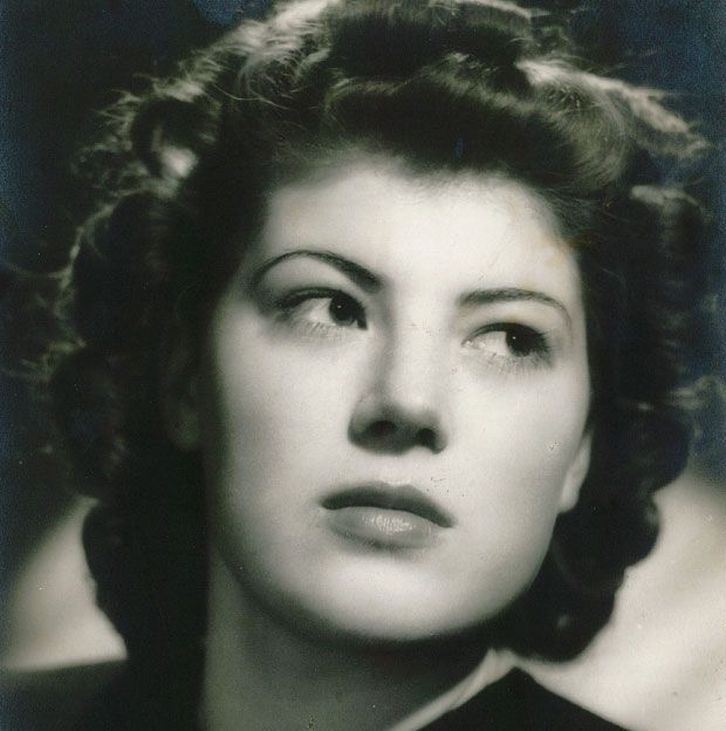 "Я думала, что они меня убьют", -
говорит Ингеборг Буллурт
|
||
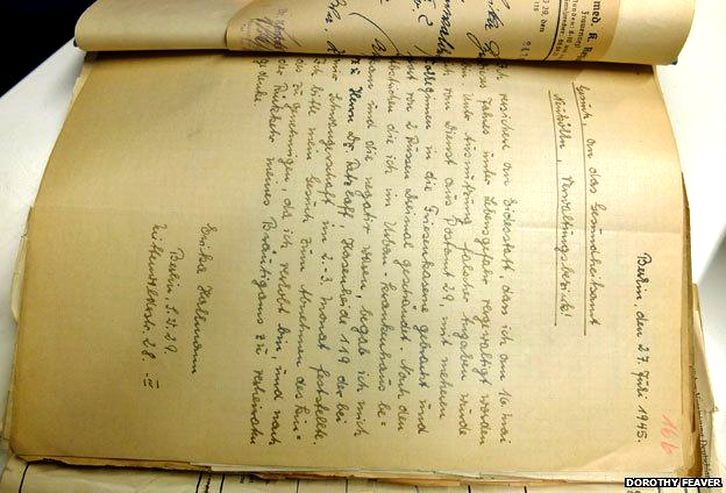
Когда началось советское наступление на город, она спряталась в подвале своего дома, как и автор дневника "Женщина в Берлине". "Неожиданно на нашей улице появились танки, повсюду лежали тела русских и немецких солдат, - вспоминает она. – Я помню ужасающий протяжный звук падающих русских бомб. Мы называли их Stalinorgels ("сталинские органы")". Как-то раз в перерыве между бомбежками Ингеборг вылезла из подвала и побежала наверх за веревкой, которую она приспособила под фитиль для лампы. "Неожиданно я увидела двух русских, направивших на меня пистолеты, - говорит она. – Один из них заставил меня раздеться и изнасиловал меня. Потом они поменялись местами, и меня изнасиловал другой. Я думала, что умру, что они меня убьют". Тогда Ингеборг не рассказала о том, что с ней случилось. Она молчала об этом несколько десятилетий, потому что говорить об этом было бы слишком тяжело. "Моя мать любила хвастать тем, что ее дочь не тронули", - вспоминает она. Волна абортовНо изнасилованиям подверглись многие женщины в Берлине. Ингеборг вспоминает, что сразу после войны женщинам от 15 до 55 лет было приказано сдать анализ на венерические болезни. "Для того, чтобы получить продуктовые карточки, нужна была медицинская справка, и я помню, что у всех докторов, их выдававших, приемные были полны женщин", - вспоминает она. Каков был реальный масштаб изнасилований? Чаще всего называются цифры в 100 тысяч женщин в Берлине и два миллиона по всей Германии. Эти цифры, горячо оспариваемые, были эстраполированы из скудных медицинских записей, сохранившихся до наших дней. |
||
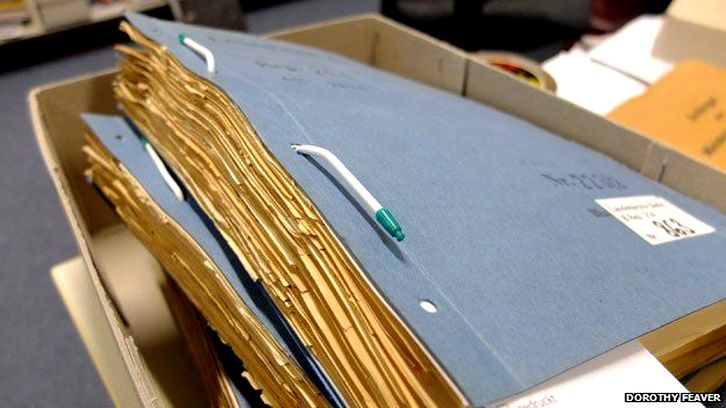 Эти медицинские документы 1945
года чудом уцелели
|
||
|
||
На бывшем военном заводе, где сейчас хранится государственный архив, его сотрудник Мартин Люхтерханд показывает мне пачку синих картонных папок. В них содержатся данные об абортах с июня по октябрь 1945 года в Нойкелльне, одном из 24 районов Берлина. То, что они сохранились нетронутыми – маленькое чудо. В Германии того времени аборты были запрещены согласно статье 218 уголовного кодекса. Но Люхтерханд говорит, что после войны был короткий промежуток времени, когда женщинам было разрешено прерывать беременность. Особая ситуация была связана с массовыми изнасилованиями в 1945 году. С июня 1945 по 1946 год только в этом районе Берлина было одобрено 995 просьб об аборте. Папки содержат более тысячи страниц разного цвета и размера. Одна из девушек округлым детским почерком пишет, что была изнасилована дома, в гостиной на глазах своих родителей. Хлеб вместо местиДля некоторых солдат, стоило им подвыпить, женщины становились такими же трофеями, как часы или велосипеды. Но другие вели себя совсем иначе. В Москве я встретила 92-летнего ветерана Юрия Ляшенко, который помнит, как вместо того, чтобы мстить, солдаты раздавали немцам хлеб.
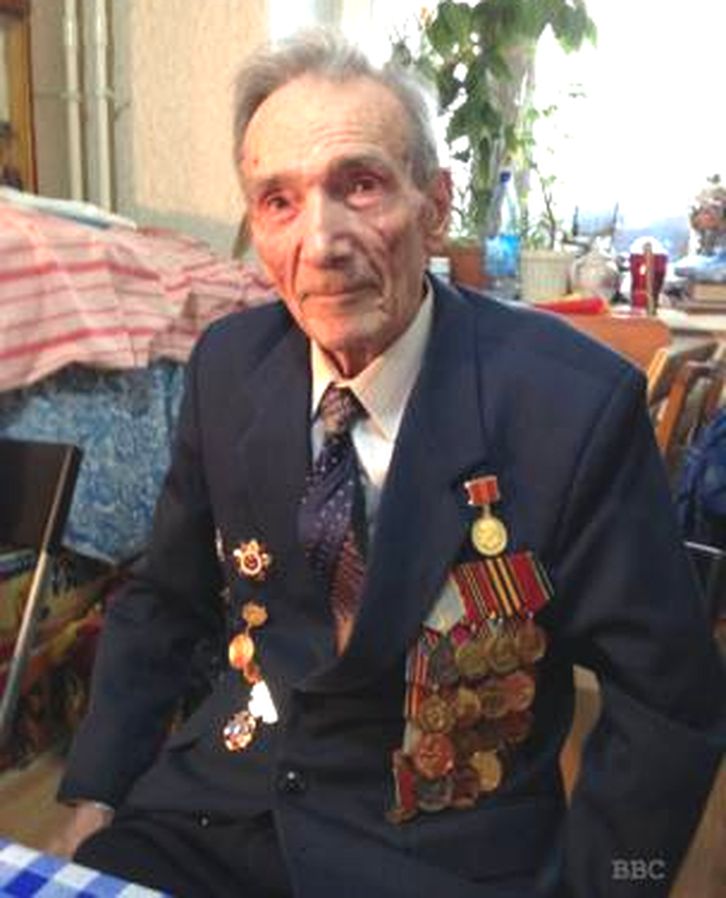
Юрий Ляшенко говорит, что советские солдаты в Берлине вели себя по-разному
“Кормить, конечно, мы всех не могли, так? А тем, что у нас было, мы делились с детьми. Маленькие дети такие запуганные, глаза такие страшные… жалко детей", - вспоминает он. В пиджаке, увешанном орденами и медалями, Юрий Ляшенко приглашает меня в свою маленькую квартирку на верхнем этаже многоэтажного дома и угощает коньяком и вареными яйцами. Он рассказывает мне, что хотел стать инженером, но был призван в армию и так же, как Владимир Гельфанд, прошел всю войну до Берлина. Наливая в рюмки коньяк, он предлагает тост за мир. Тосты за мир часто звучат заученно, но тут чувствуется, что слова идут от сердца. Мы говорим о начале войны, когда ему чуть не ампутировали ногу, и о том, что он почувствовал, когда увидел красный флаг над Рейхстагом. Спустя некоторое время я решаюсь спросить его об изнасилованиях. "Не знаю, у нашего подразделения такого не было… Конечно, очевидно, такие случаи были в зависимости от самого человека, от людей, - говорит ветеран войны. - Вот попадется один такой… Один поможет, а другой надругается... На лице у него не написано, не знаешь его". Оглянуться в прошлоеНаверное, мы никогда не узнаем настоящих масштабов изнасилований. Материалы советских военных трибуналов и многие другие документы остаются закрытыми. Недавно Государственная дума одобрила закон "о посягательстве на историческую память", согласно которому любой, кто принижает вклад СССР в победу над фашизмом, может заработать денежный штраф и до пяти лет лишения свободы. Молодой историк Гуманитарного университета в Москве Вера Дубина говорит, что ничего не знала об этих изнасилованиях до тех пор, пока не получила стипендию для учебы в Берлине. После учебы в Германии она написала работу на эту тему, но не смогла ее опубликовать. "Российские СМИ отреагировали очень агрессивно, - говорит она. - Люди хотят знать только о нашей славной победе в Великой Отечественной войне, и сейчас становится все сложнее вести серьезные исследования". |
||
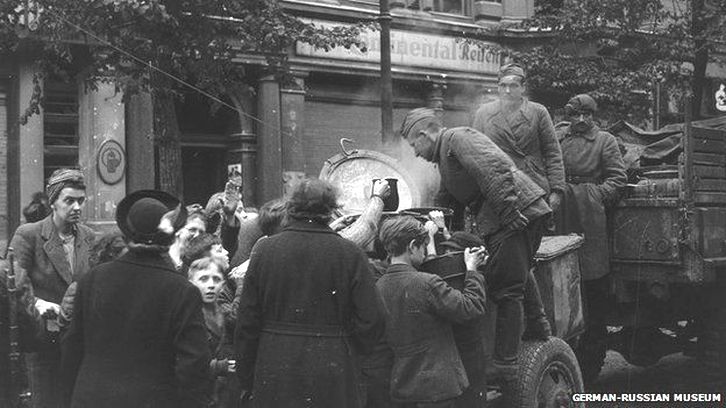 Советские полевые кухни раздавали жителям Берлина еду |
||
История часто переписывается в угоду конъюнктуре. Именно поэтому свидетельства очевидцев столь важны. Свидетельства тех, кто осмелился говорить на эту тему сейчас, в преклонном возрасте, и рассказы тогда еще молодых людей, записавших в годы войны свои свидетельства о происходившем. Виталий, сын автора армейского дневника Владимира Гельфанда, говорит о том, что многие советские солдаты проявили великий героизм в годы Второй мировой войны. Но это не вся история, считает он. "Если люди не хотят знать правду, хотят заблуждаться и хотят говорить о том, как было все красиво и благородно - это глупо, это самообман, - напоминает он. - Весь мир это понимает, и Россия это понимает. И даже те, кто стоит за этими законами об искажении прошлого, они тоже понимают. Мы не можем двигаться в будущее, пока не разберемся с прошлым".
____________________________
Примечание. 25 и 28 сентября 2015 года этот материал был изменен. Мы удалили подписи к двум фотографиям, а также написанные на их основе посты в твиттере. Они не соответствуют редакционным стандартам Би-би-си, и мы понимаем, что многие посчитали их оскорбительными. Мы приносим свои искренние извинения. |
||
| ____________________________
|
||
| The Rape of Berlin is on BBC World Service on Saturday 2 May at 18.06 BST and Sunday 3 May at 11.06 BST, or listen on iPlayer |
||
  |
|
||
Зґвалтування Берліна: невідома історія війни
|
||
|
||
|
У Росії виходить у продаж примітна книга - щоденник офіцера Радянської Армії Володимира Гельфанда, в якому без прикрас і купюр описані криваві будні Великої Вітчизняної війни. Дехто вважає, що критичний підхід до минулого неетичний або просто недопустимий, враховуючи героїчні жертви і загибель 27 мільйонів радянських громадян. Інші вважають, що майбутні покоління повинні знати про справжні жахи війни і заслуговують на те, аби побачити неприкрашену картину. Кореспондент ВВС Люсі Еш спробувала розібратися в деяких маловідомих сторінках історії останньої світової війни. Деякі факти і обставини, викладені у її статті, можуть бути неприйнятними для дітей.
|
||
|
|
||
|
У Трептов-парку на околиці Берліна згущаються сутінки. Я дивлюся на пам'ятник воїну-визволителю, що височіє наді мною на тлі вечірнього неба. Солдат заввишки 12 метрів, що стоїть на уламках свастики, в одній руці тримає меч, а на іншій його руці сидить маленька німецька дівчинка. Тут поховані 5 з 80 тисяч радянських солдатів, що загинули у битві за Берлін у період з 16 квітня до 2 травня 1945 року. Колосальні пропорції цього монумента відбивають масштаби жертв. На вершині постаменту, куди ведуть довгі сходи, видно вхід до пам'ятної зали, освітленої, наче релігійна святиня. Мою увагу привернув напис, який нагадує, що радянські люди врятували європейську цивілізацію від фашизму. Але для декого у Німеччині цей меморіал - привід для інших спогадів. Радянські солдати зґвалтували незліченну кількість жінок на шляху до Берлiна, але про це рідко говорили після війни - як у Східній, так і в Західній Німеччині. І у Росії нині про це мало хто говорить. Щоденник Володимира ГельфандаБагато російських ЗМІ регулярно відкидають розповіді про зґвалтуваннях як міф, створений на Заході, але одне з численних джерел, які розповідають нам про те, що відбувалося, - це щоденник радянського офіцера. Лейтенант Володимир Гельфанд, молодий єврей родом з України, від 1941 року і до кінця війни вів свої записи з незвичайною щирістю, незважаючи на чинну тоді в радянській армії заборону вести щоденники. Його син Віталій, який дозволив мені почитати рукопис, знайшов щоденник, коли розбирав папери батька після його смерті. Щоденник був доступний у мережі, але тепер вперше публікується у Росії у вигляді книги. Два скорочених його видання виходили у Німеччині та Швеції.
|
||
| У лютому 1945 року військова частина Гельфанда базувалася неподалік річки Одер, готуючись до наступу на Берлін |
||
| Щоденник оповідає про відсутність порядку і дисципліни у регулярних військах: мізерні раціони, воші, рутинний антисемітизм і нескінченне злодійство. Як він розповідає, солдати крали навіть чоботи своїх товаришів. У лютому 1945 року військова частина Гельфанда базувалася недалеко від річки Одер, готуючись до наступу на Берлін. Він згадує, як його товариші оточили і захопили у полон німецький жіночий батальйон. "Позавчора на лівому фланзі діяв жіночий батальйон. Його розбили наголову, а полонені кішки-німкені оголосили себе месницями за загиблих на фронті чоловіків. Не знаю, що з ними зробили, але треба було би стратити негідниць безжально", - писав Володимир Гельфанд. Одна з найбільш показових розповідей Гельфанда стосується 25 квітня, коли він був уже в Берліні. Там Гельфанд уперше в житті прокатався на велосипеді. Проїжджаючи вздовж берега річки Шпрее, він побачив групу жінок, які тягли кудись валізи і вузли. "Я запитав німкень, де вони живуть, ламаною німецькою та поцікавився, навіщо вони пішли з дому, і вони з жахом розповіли про те горе, яке заподіяли їм передовики фронту у першу ніч приходу сюди Червоної Армії", - пише автор щоденника. "Вони тикали сюди, - пояснювала красива німкеня, задираючи спідницю, - всю ніч, і їх було так багато. Я була дівчиною, - зітхнула вона і заплакала. - Вони мені зіпсували молодість. Серед них були старі, прищаві, і всі лізли на мене, всі тикали. Їх було не менше двадцяти, так, так", - і залилася сльозами". "Вони ґвалтували при мені мою доньку, - вставила бідна мати, - вони можуть ще прийти і знову ґвалтувати мою дівчинку". - Від цього знову усіх пройняв жах, і гірке ридання пронеслося з кутка у куток підвалу, куди привели мене господарі. "Залишайся тут, - раптом кинулася до мене дівчина, - ти будеш зі мною спати. Ти зможеш зі мною робити все, що захочеш, але тільки ти один!" - пише Гельфанд у своєму щоденнику. "Пробив час помсти!"Німецькі солдати до того часу заплямували себе на радянській території жахливими злочинами, які вони вчиняли протягом майже чотирьох років. Володимир Гельфанд стикався зі свідченнями цих злочинів разом з тим, як його частина просувалася з боями до Німеччини. "Коли кожен день вбивства, кожен день поранення, коли вони проходять через села, знищені фашистами... У тата дуже багато описів, де знищували села, аж до дітей, знищували маленьких дітей єврейської національності... Навіть однорічних, дворічних... І це не протягом якогось часу, це роки. Люди йшли і це бачили. І йшли вони з однією метою - мстити і вбивати", - розповідає син Володимира Гельфанда Віталій. |
||
|
|
||
| Він виявив цей щоденник вже після смерті батька. Вермахт, як вважали ідеологи нацизму, був добре організованою силою арійців, які не опустяться до статевого контакту з "унтерменшами" ("недолюдьми"). Але ту заборону ігнорували, каже історик Вищої школи економіки Олег Будницький. Німецьке командування було настільки стурбоване поширенням венеричних хвороб у військах, що організувало на окупованих територіях мережу армійських публічних будинків. Важко знайти прямі свідчення того, як німецькі солдати поводилися з російськими жінками. Багато жертв просто не вижили. Але в Німецько-російському музеї у Берліні його директор Йорг Морро показав мені фотографію з особистого альбому німецького солдата, зроблену у Криму. На фотографії - тіло жінки, розпластане на землі. "Виглядає так, ніби її вбили при зґвалтуванні або після нього. Її спідниця задерта, а руки закривають обличчя", - каже директор музею. "Це шокуюче фото. У нас у музеї були суперечки про те, чи потрібно виставляти такі фотографії. Це війна, це сексуальне насильство у Радянському Союзі за німців. Ми показуємо війну. Не кажемо про війну, а показуємо її", - говорить Йорг Морро. |
||
| |
||
Коли Червона армія увійшла до "лігва фашистського звіра", як називала тоді радянська преса Берлін, плакати заохочували лють солдатів: "Солдат, ти на німецькій землі. Пробив час помсти!". Політвідділ 19-ї Армії, яка наступала на Берлін вздовж узбережжя Балтійського моря, оголосив, що справжній радянський солдат настільки сповнений ненависті, що думка про статевий контакт з німкенями буде йому огидна. Але й цього разу солдати довели, що їхні ідеологи помилялися. Історик Ентоні Бівер, проводячи дослідження для своєї книги "Берлін: падіння", що вийшла у світ у 2002 році, знайшов у російському державному архіві звіти про епідемію сексуального насильства на території Німеччини. Ці звіти у кінці 1944 року надсилали співробітники НКВС Лаврентію Берії. "Їх передавали Сталіну, - говорить Бівер. - Можна побачити за відмітками, читалися вони чи ні. Вони повідомляють про масові зґвалтування у Східній Пруссії і про те, як німецькі жінки намагалися вбивати себе і своїх дітей, щоб уникнути цієї долі". "Жителі підземелля"Інший щоденник воєнного часу, який вела наречена німецького солдата, розповідає про те, як деякі жінки пристосовувалися до цієї страхітливої ситуації у спробах вижити. З 20 квітня 1945 року жінка, ім'я якої не називається, залишала на папері безжальні у своїй чесності спостереження, проникливі і місцями присмачені гумором повішеника. Автор щоденника описує себе як "бліду блондинку, завжди одягнену в одне і те саме зимове пальто". Вона малює яскраві картини життя своїх сусідів у бомбосховищі під їхнім багатоквартирним будинком. Серед її сусідок - "молодий чоловік у сірих штанях і окулярах у товстій оправі, що після уважнішого розгляду виявляється жінкою", а також три літні сестри, як вона пише, "усі троє - кравчині, збилися в один великий чорний пудинг". В очікуванні частин Червоної армії, що наближалися, жінки жартували: "Краще росіянин на мені, ніж янкі наді мною", маючи на увазі, що краще вже бути зґвалтованою, аніж загинути під час килимового бомбардування американської авіації. Але коли солдати увійшли до їхнього підвалу і спробували витягти звідти жінок, ті почали благати автора щоденника використати її знання російської мови, аби поскаржитися радянському командуванню. |
||
Деякі німкені знайшли спосіб
пристосуватися до тієї жахливої ситуації
|
||
На перетворених на руїни вулицях їй вдається знайти радянського офіцера. Він знизує плечима. Незважаючи на сталінський декрет, що забороняє насильство щодо цивільного населення, як він каже, "це все одно відбувається". Тим не менш, офіцер спускається з нею до підвалу і вичитує солдатам. Але один із них нетямиться від гніву. "Про що ти говориш? Подивися, що німці зробили з нашими жінками! - кричить він. - Вони взяли мою сестру і...". Офіцер його заспокоює і виводить солдатів на вулицю. Але коли автор щоденника виходить у коридор, щоб перевірити, пішли вони чи ні, її хапають солдати, що на неї чекали, і жорстоко ґвалтують, ледь не задушивши. Охоплені жахом сусіди або "жителі підземелля", як вона їх називає, ховаються у підвалі, замкнувши за собою двері. "Нарешті, відчинилися два залізні засуви. Усі втупилися в мене, - пише вона. - Мої панчохи спущені, мої руки тримають залишки пояса. Я починаю кричати: "Ви свині! Мене тут зґвалтували двічі поспіль, а ви залишаєте мене лежати тут як шматок бруду!". У підсумку автор щоденника приходить до думки, що їй потрібно знайти одного "вовка", щоб захиститися від нових групових зґвалтувань "звіриною чоловічої статі". Вона знаходить офіцера з Ленінграда, з яким ділить ліжко. Поступово відносини між агресором і жертвою стають менш жорстокими, більш взаємними і неоднозначними. Німкеня і радянський офіцер навіть обговорюють літературу і сенс життя. "Жодним чином не можна стверджувати, що майор мене ґвалтує, - пише вона. - Чому я це роблю? За бекон, цукор, свічки, м'ясні консерви? Якоюсь мірою я впевнена, що так і є. Але до того ж мені подобається майор, і чим менше він хоче отримати від мене як чоловік, тим більше він мені подобається як людина". Багато з її сусідок укладали подібні угоди з переможцями поваленого Берліна. Коли у 1959 році щоденник опублікували у Німеччині під назвою "Жінка у Берліні", ця відверта розповідь викликала хвилю звинувачень у тому, що вона спаплюжила честь німецьких жінок. Не дивно, що автор, передчуваючи це, зажадала більше не публікувати щоденник до своєї смерті. Ейзенхауер: розстрілювати на місціЗґвалтування були проблемою не лише Червоної Армії. Боб Ліллі, історик з університету Північного Кентуккі, зміг отримати доступ до архівів військових судів США. Його книга (Taken by Force) викликала стільки суперечок, що спершу жодне американське видавництво не наважувалася її опублікувати, і перше видання з'явилося у Франції. За приблизними підрахунками Ліллі, у 1942-1945 роках американські солдати вчинили у Англії, Франції та Німеччині приблизно 14 тисяч зґвалтувань. "В Англії випадків зґвалтувань було зовсім мало, але щойно американські солдати перетнули Ла Манш, їхня кількість різко зросла", - розповідає Ліллі. За його словами, зґвалтування стали проблемою не тільки іміджу, але й армійської дисципліни. "Ейзенхауер сказав розстрілювати солдатів на місці злочину і повідомляти про страти у військових газетах, таких як Stars and Stripes. У Німеччині був пік цього явища", - розповідає він. - А були страчені солдати за зґвалтування? - О так! - Але не у Німеччині? - Ні. Жодного солдата не стратили за зґвалтування або вбивство німецьких громадян, - визнає Ліллі. Нині історики продовжують розслідувати факти сексуальних злочинів, скоєних військами союзниками у Німеччині. Протягом багатьох років тему сексуального насильства з боку військ союзників - американських, британських, французьких і радянських солдатів - на території Німеччини офіційно замовчували. Мало хто про це повідомляв, і ще менше було охочих про все це слухати. МовчанняПро такі речі у суспільстві взагалі говорити непросто. Крім того, у Східній Німеччині вважалося чи не богохульством критикувати радянських героїв, що перемогли фашизм. А у Західній Німеччині вина, яку відчували німці за злочини нацизму, затьмарювала тему страждань цього народу. Але у 2008 році у Німеччині за щоденником мешканки Берліна вийшов фільм "Анонім: жінка з Берліна" з актрисою Ніною Хосс у головній ролі. Цей фільм став одкровенням для німців і спонукав багатьох жінок розповісти про те, що з ними сталося. Серед цих жінок - Інгеборг Буллерт. |
||
|
"Я думала, що вони мене вб'ють",
- говорить Інгебог Буллерт
|
||
Зараз 90-річна Інгеборг живе у Гамбурзі в квартирі, сповненій фотографіями кішок і книг про театр. У 1945 році їй було 20. Вона мріяла стати актрисою і жила з матір'ю на досить фешенебельній вулиці у берлінському районі Шарлоттенбург. Коли почався радянський наступ на місто, вона сховалася у підвалі свого будинку, як і автор щоденника "Жінка у Берліні". "Несподівано на нашій вулиці з'явилися танки, всюди лежали тіла російських і німецьких солдатів, - згадує вона. - Я пам'ятаю страхітливий протяжний звук падіння російських бомб. Ми називали їх Stalinorgels ("органи Сталіна")". Якось раз у перерві між бомбардуваннями Інгеборг вилізла з підвалу і побігла нагору за мотузкою, яку вона пристосувала під гніт для лампи. "Несподівано я побачила двох росіян, які наставили на мене пістолети, - говорить вона. - Один з них змусив мене роздягнутися і зґвалтував мене. Потім вони помінялися місцями, і мене зґвалтував інший. Я думала, що помру, що вони мене вб'ють". Тоді Інгеборг не розказала про те, що з нею трапилося. Вона мовчала про це кілька десятиліть, бо говорити про це було би занадто важко. "Моя мати любила хизуватися тим, що її дочку не зачепили", - згадує вона. Хвиля абортівАле зґвалтувань зазнали багато жінок у Берліні. Інгеборг згадує, що одразу після війни жінкам від 15 до 55 років наказали здати аналіз на венеричні хвороби. |
||
Ці медичні документи 1945 року
дивом вціліли
|
||
| "Для того, щоб отримати продуктові картки, потрібна була медична довідка, і я пам'ятаю, що у всіх лікарів, які їх видавали, приймальні були повні жінок", - згадує вона. Який був реальний масштаб зґвалтувань? Найчастіше називаються цифри у 100 тисяч жінок у Берліні і 2 мільйони по всій Німеччині. Ці цифри, навколо яких лунали палкі суперечки, екстраполювали з убогих медичних записів, які збереглися до наших днів. На колишньому військовому заводі, де зараз зберігають державний архів, його співробітник Мартін Люхтерханд показує мені пачку синіх картонних папок. У них містяться дані про аборти з червня по жовтень 1945 року у Нойкелльні, одному з 24 районів Берліна. Те, що вони збереглися - маленьке диво. |
||
|
|
||
| У Німеччині того часу аборти були заборонені відповідно до статті 218 кримінального кодексу. Але Люхтерханд каже, що після війни був короткий проміжок часу, коли жінкам дозволили переривати вагітність. Особлива ситуація була пов'язана з масовими зґвалтуваннями у 1945 році. З червня 1945-го по 1946 рік тільки у цьому районі Берліна схвалили 995 прохань про аборт. Папки містять понад тисячу сторінок різного кольору і розміру. Одна з дівчат округлим дитячим почерком пише, що була зґвалтована вдома, у вітальні на очах у батьків. Хліб замість помстиДля деяких солдатів, варто було їм трохи випити, жінки ставали такими ж трофеями, як годинники або велосипеди. Але інші поводилися зовсім інакше. У Москві я зустріла 92-річного ветерана Юрія Ляшенка, який пам'ятає, як замість того, щоб мстити, солдати роздавали німцям хліб.
Юрій Ляшенко каже, що радянські солдати у Берліні поводилися по-різному
"Годувати, звичайно, ми усіх не могли, так? А тим, що у нас було, ми ділилися з дітьми. Маленькі діти такі залякані, очі такі страшні... шкода дітей", - згадує він. У піджаку, обвішаному орденами і медалями, Юрій Ляшенко запрошує мене до своєї маленької квартирки на горішньому поверсі багатоповерхового будинку і пригощає коньяком і вареними яйцями. Він розповідає мені, що хотів стати інженером, але його призвали до армії, і так само, як Володимир Гельфанд, він пройшов усю війну до Берліна. Наливаючи у чарки коньяк, він пропонує тост за мир. Тости за мир часто лунають завчено, але тут відчувається, що слова лунають від серця. Ми говоримо про початок війни, коли йому ледь не ампутували ногу, і про те, що він відчув, коли побачив червоний прапор над Рейхстагом. Через деякий час я наважуюся запитати його про зґвалтування. "Не знаю, у нашого підрозділу такого не було... Звичайно, очевидно, такі випадки були залежно від самої людини, від людей, - говорить ветеран війни. - Ось трапиться один такий... Один допоможе, а інший поглумиться... На обличчі у нього не написано, не знаєш його". Озирнутися в минулеНапевно, ми ніколи не дізнаємося справжніх масштабів зґвалтувань. Матеріали радянських військових трибуналів та багато інших документів залишаються закритими. Нещодавно Державна дума схвалила закон "про посягання на історичну пам'ять", згідно з яким кожному, хто принижує внесок СРСР у перемогу над фашизмом, можуть присудити грошовий штраф і до п'яти років позбавлення волі. |
||
Радянські польові кухні роздавали жителям Берліна їжу |
||
Молодий історик Гуманітарного університету у Москві Віра Дубіна каже, що нічого не знала про ці зґвалтуваннях доти, доки не отримала стипендію для навчання у Берліні. Після навчання у Німеччині вона написала роботу на цю тему, але не змогла її опублікувати. "Російські ЗМІ відреагували дуже агресивно, - говорить вона. - Люди хочуть знати тільки про нашу славну перемогу у Великій Вітчизняній війні, і зараз стає дедалі складніше вести серйозні дослідження". Історію часто переписують на догоду кон'юнктурі. Саме тому свідчення очевидців настільки важливі. Свідчення тих, хто наважився говорити на цю тему зараз, у літньому віці, і розповіді тоді ще молодих людей, які записали у роки війни свої свідчення про те, що відбувалося. Віталій, син автора армійського щоденника Володимира Гельфанда, говорить про те, що багато радянських солдатів продемонстрували великий героїзм у роки Другої світової війни. Але це не вся історія, вважає він. "Якщо люди не хочуть знати правду, хочуть помилятися і хочуть говорити про те, як було все красиво і благородно - це нерозумно, це самообман, - нагадує він. - Весь світ це розуміє, і Росія це розуміє. І навіть ті, хто стоїть за цими законами про спотворення минулого, вони теж розуміють. Ми не можемо рухатися у майбутнє, поки не з'ясуємо усе з минулим ". |
||
|
______________________________
|
||
| Примітка.
25 вересня 2015 року цей матеріал був змінений. Ми видалили підпис до
фотографії. Він не відповідає редакційним стандартам BBC, і ми
розуміємо, що багато хто вважає його образливим. Ми висловлюємо свої
щирі вибачення. |
||
| |
||
|
______________________________
|
||
The Rape of Berlin is on BBC World Service on Saturday 2 May at 18.06 BST and Sunday 3 May at 11.06 BST, or listen on iPlayer
|
||
|
|
||
|
The
rape of
Berlin So
it's nearly
dusk and I've come to Treptower Park in East Berlin to see the massive
monument
to the Soviet war dead. I can see a man and he's holding a child. I'm
Lucy Ash
looking up at a 12 metre statue which depicts a Soviet soldier grasping
a sword
in one hand, a small German girl in the other and stamping on a broken
swastika. This
is the final
resting place for 5,000 of the 80,000 Soviet troops who fell in the
Battle of
Berlin between the 16th of April and the 2nd of May 1945. But some call
this
memorial the tomb of the unknown rapist. It's lit up inside, it looks
like a
sort of quasi-religious painting. You
can see
Mother Russia in a red cloak looking down mournfully and it says this
was a war
that saved the civilisation of Europe from the fascists. In this
programme I'll
be asking why so many women suffered at the hands of the heroic
liberators, the
Red Army. On the BBC World Service this is of Berlin. This
is a storey
which includes some graphic and disturbing material. Many Russians find
all
mention of the rapes offensive and they're regularly dismissed as a
western
myth in the Russian media. You certainly can't talk about what happened
in
Germany in 1945 in isolation. To
understand the
background I've had to go to Moscow and go back in time because first
there was
the Nazi invasion of Russia or in Hitler's words the war of
annihilation. I'm
on my way to a suburb in northeast Moscow to meet a war veteran. To be
honest
I'm feeling a bit apprehensive and that's because the Duma or the
Russian
parliament recently passed a law which says that anyone who denigrates
the Red
Army or Russia's record in what's known here as the Great Patriotic War
could
face fines and up to five years in prison. 92
year old Yuri
Vasilievich Lyashenko, covered in medals, has welcomed me into his
cramped flat
at the top of a tower block with boiled eggs and brandy. His dad was a
stage
performer and little Yuri used to dance on stage with him in a red
cloak and a
wooden dagger. He wanted to be an engineer but before he could enrol at
university he was called up to the army. Yuri
Vasilievich
just made a toast saying that they fought a very long difficult war to
bring
peace to Europe and that he hopes there won't be a third world war.
Toast to
peace were a Soviet era cliche and often feel rehearsed but Lyashenko's
words
are heartfelt. Together we take a brandy-fuelled journey back more than
seven
decades to the Ribbentrop-Molotov pact which made Hitler and Stalin
into allies
until one summer day in 1941 the Führer launched Operation
Barbarossa, his
shock invasion of the Soviet Union. Do
you remember
what you were doing on the 22nd of June when the Germans invaded? Of
course I
do. I can picture it very clearly. Our commanders had gone off on a
break, leaving
us alone in our tents. At
4am we heard
the sounds of crackling and clicking then suddenly our tents were
shaking.
Bullets were piercing the canvas. One of his gang of four school
friends found
himself fighting in Byelorussia. He
later wrote to
Lyashenko. He said when the Germans went through a place they destroyed
it
completely. Nothing was left, just chimney stumps where houses used to
be. And
it was the
same storey in Ukraine. Wherever the Germans went, people and villages
were
wiped off the map. Lyashenko survived the first month of Barbarossa. Then
he was
wounded near the Ukrainian city of Vinnytsia and nearly had his leg
amputated.
After two years in a string of military hospitals he was back in
action,
fighting all the way to Berlin, where we'll catch up with him later.
Three
months on from the invasion of the Soviet Union, Hitler was lording it
as the
greatest battle in the history of the world, against an enemy not of
human
beings but of animals. The
Wehrmacht was
supposedly a well-ordered force of Aryans who would never contemplate
sex with
intermension. But what really happened? One man who's researched this
is Oleg
Budnitsky, an eminent historian at the Higher School of Economics in
Moscow, an
archive rat as he calls himself. He's put his head above the parapet by
writing
about sexual violence on both German and Russian territory. You
know,
formally it was prohibited for Germans to have sexual relations with
local
women. There were two reasons, one ideological, but the most important
reason
was the German generals, they were afraid of venereal diseases.
Sexually
transmitted diseases. And
theoretically
it was prohibited. Practically, German soldiers did not pay any
attention to
this prohibition. They established a system of military brothels. Brothels?
Brothels, yeah. And some of local women were forced to serve in these
brothels
because they had no other means to survive. There were rapes also. Sometimes
such
cases were treated by German military courts. According to one German
judge,
Slav women don't understand the concept of honour, so it's not a big
deal to
rape. The major reason of punishment was violation of military
discipline. Right,
so the
violation of discipline was much worse than the violation of the actual
woman?
Yes, exactly. This photo was taken by a German soldier, by a Wehrmacht
soldier.
And you can see his shadow in the picture, he looks like a cornfield. It's
hard to find
direct evidence of how the German soldiers treated Russian women. Many
victims
never survived. Yet Jörg Mori, director of the German-Russian
Museum in Berlin,
has a picture he wants to show me. It's
a photo
taken in Crimea from a German soldier's personal wartime album, showing
a
woman's corpse sprawled on the ground. It looks like that she was
killed by
raping or after the rape. Her skirt is pulled up and the hands are in
front of
the face. And
her stockings
are pulled down. Yeah, it's a shocking photo. It's not talking about
war, but
showing it. Sexual
violence
by German troops is not a talking matter in Russia, but it has
occasionally
surfaced. Babi Sarstva, or Kingdom of Women, a Soviet film from the
late 60s,
shows a 15-year-old village girl helping a German soldier learn
Russian. All
smiles in her cotton frock. She's
correcting
his accent when he tries to rape her. An extraordinary state commission
was set
up by the Supreme Soviet in 1942 to investigate crimes perpetrated by
the Nazi
invaders. It contains some horrific accounts of rape and torture. Yet
afterwards,
few talked about what happened, says Oleg Budnitsky. About 70 million
Russian
people lived on the occupied territories under German rule. 75% of them
were
women. Perhaps
for
Russian men to admit that they left women under the power of German
soldiers,
it was also a kind of shame. Do you have evidence that soldiers,
actually when
they came into German territory through East Prussia, that revenge was
a very
important factor in the way they treated the women? Yes, of course, and
I read
such, as an example, a letter one Soviet soldier sent to his sister to
Moscow,
you know, when the Red Army came to Belorussia. When he saw with his
own eyes
burned villages, burned people, and he wrote, I think that we should
kill
Germans like rabid dogs. The
war is not a
school of humanism. It's a school of cruelty. Captured orders
instructed the
German troops, when commandeering houses, to drive the population out
to perish
in the cold. This
Soviet
propaganda film with an English voiceover from 1942 shows women in
headscarves
wringing their hands over piles of body parts in the snow. A certain
amount of
cruelty in carrying this order into effect is unavoidable, or the
infraction.
By 1944, the tide of the war was turning. Soviet
troops
were liberating their own territory and then advancing westward into
Germany.
The Russian bear was crushing the Nazi eagle, inch by inch, mile by
mile. Back
in the flat in Moscow, I asked veteran Lyashenko whether he or his
comrades in
the Red Army thirsted for revenge. He
doesn't give
me a direct answer, but says for him, there's no moral equivalence.
Hitler
instructed his army to kill off our entire population so there would be
no
Russia. But our political management worked with the civilians and army. Rape
and other
crimes were dealt with in military units by the authorities.
Technically
speaking, the Red Army operated under stern rules, supposed to protect
civilians. Human rights lawyer Maryana Muravyova at Oxford Brookes
University
is an expert in the history of Russian army regulations. Armies
rape not
only enemy women, but their own as well. And that's why you usually
have very
strict military law and military discipline regulations prohibiting,
first of
all, any sort of male treatment of the civilian population, first of
all, your
own. During wartime, that would be a special law in place. That's
exactly
what happened in 1941, which was the introduction of the emergency
situation
due to the war. All these offences started to be liable for prosecution
in the
military courts and military tribunals, they would be called. That is a
death
penalty in the war conditions. The
political
department of the 19th Army also declared, when we breed a true feeling
of
hatred in a soldier, he won't try and have sex with a German woman
because
he'll be repulsed. But despite declarations, decrees and deterrence, we
know
that the Soviet troops took their revenge on women. What we don't know
is the
number of those assaults. Soviet
military
tribunals during wartime remain classified. And we're talking about a
period
which is sacred in Russia's collective memory, according to World War
II
historian Anthony Beaver. The Russians, the Soviet citizens, had
suffered so
much since 1917, the Civil War, the famines, the Stalinist repression,
the
terror. And
1945, the
victory over the fascist beast was the one thing which every Russian,
every
Soviet citizen could really feel proud about. Many state archives are
now
closed, but there are other ways to recapture the past, says Oleg
Budnitsky.
There are a lot of unpublished diaries and memos written even in the
Soviet
period without any hope of publication. Literally
in
every diary of a Soviet soldier who was in Germany at that period of
time, it
is possible to find a pretty frank description of atrocities or
something like
that. Remarkably, I've had access to the typescript of a wartime diary
kept by
Lieutenant Vladimir Gelfand, a Jewish teenager from Ukraine. He was a
staunch
Stalinist and member of the communist youth movement, the Komsomol. Despite
the ban
on diaries as a security risk, he told it like it was throughout the
war. I
rang his son Vitaly, now living in Berlin, who found the diary when he
was
clearing out his father's papers after he died. Dad wrote the diary for
himself. He
was young and
fearless, only 18 at the beginning, not much more than a kid. With war
going on
every day, you don't think what you're writing could be dangerous for
you. He
wrote because he couldn't do otherwise. He
just had to
get it all down. Vitaly reads to us from the manuscript an unvarnished
picture
of disarray in the regular battalions. 20th July 1942, Belinsky village. The
troops are
clapped out. Many have changed into civilian clothes. Most have thrown
down
their weapons. Some
commanders
have torn off their insignia. Such shame. Such unexpected and sad
discrepancy
with newspaper reports. Gelfand
describes
the miserable rations allotted to frontline troops being ravaged by
lice and
men stealing their comrades' possessions, even their boots. As the Red
Army
advanced into what the Soviet press called the lair of the fascist
beast,
posters drummed home the message, soldier, you are now on German soil.
The hour
of revenge has struck. The
Red Army
moved west with Strafbattalions at the front, made up of prisoners and
other
undesirables who could be sacrificed to minefields. Hundreds of
thousands of
German civilians fled before them, abandoning houses full of provisions
that
astonished, delighted, but also angered the Soviet troops. For the
first time
in their lives, eight million Soviet people came abroad. The
Soviet Union
was a closed country. And what they knew about foreign countries is
that there
was unemployment, starvation, exploitation, and so on and so forth. And
when
they came to Europe, they saw something very different than Stalin's
Russia. And
especially
Germany, they were really furious, because they could not understand
why, being
so rich, Germans came to Russia. But anger at the Germans wasn't the
only
motivation for sexual violence. Anyone left behind was ripe for plunder. The
historian
Anthony Beaver reads from a high-level Soviet report about the
treatment of
women who'd been freed from Nazi prison camps. And remember, this is
talking
about the treatment of Soviet women by Soviet troops. In the town of
Bunzlau,
there are over 100 women and girls in the headquarters, but there is no
security there. And
because of
this, there are many offences, and even rape of women who live in this
dormitory by different soldiers, who enter the dormitory at night and
terrorise
the women. Maria Shapova said, I waited for the Red Army for days and
nights. I
waited for my liberation, and now our soldiers treat us worse than the
Germans
did. I
am not happy to
be alive. On the night of the 14th and 15th of February, in one of the
villages
where the cattle are herded, a straff company under the command, or if
it was a
straff company, I'm afraid they were bound to be. They were like the
punishment
battalions? Yes. They
were sort of
totally criminalised as a result of the brutality. I mean, they were
forced to
walk over the mines in front of the other troops. They were told that
they had
to pay their debt to that, pay their debt to the motherland through
their own
blood. Beaver
unearthed
some more disturbing documents in the State Archive of the Russian
Federation.
They date from late 1944, and they were sent by the NKVD, the secret
police, to
their boss in Moscow. Now their reports to Beria, and these were passed
on to
Stalin, and you can actually see from the ticks whether they've been
read or
not, reported the mass rapes in East Prussia, and the way that German
women
would try to kill their children and kill themselves. And
the Nazis
quickly exploited a chance to portray the enemy as bestial. The
government's
propaganda, of course, started with Namersdorf in the October of 1944,
when
there was that first incursion into Reich territory in East Prussia.
There were
storeys of women crucified to barn doors after being raped and so forth. Of
course,
Goebbels seized at the opportunity and brought in camera crews and
still
photographers and all the rest of it. In this episode of the Nazi
Newsreel,
Deutscher Wochenschau, members of the Volkssturm, the German Home
Guard, look
at mutilated corpses of women and children lying on the ground. And
curiously,
the first reaction in Germany was not to take it too seriously, because
they
felt this was probably, you know, this was the propaganda ministry. The
reality only
really started to hit when the refugees from East Prussia started to
arrive in
mid to late January and early February 1945, with their storeys of what
had
been happening in East Prussia, Pomerania, and of course Silesia. And
that is
when I think that the women of Berlin started to realise what they were
about
to face. Standing in front of the rather tinny diorama of the Battle of
Berlin,
in Moscow's huge Second World War museum, I tried to imagine how Yuri
Lyashenko
felt after four years of combat. Did
you see them
putting the flag on the Reichstag? No, when the flag was being put on
the
Reichstag, we were still fighting on all different floors and rooftops.
And how
did you feel when you saw that red flag? Oh, we were all shouting, it's
ours,
it's ours, it's ours. There was such a feeling of, how can I put it,
glee, pure
glee. Everything
flew
into the air. Soldiers shot into the sky from pistols, from machine
guns, from
rifles. Some were even shooting from cannons. But
they had to
be careful because people could get hurt. Berlin was the final point.
When
British Prime Minister Winston Churchill announced victory in Europe on
8 May,
he underlined the nation's gratitude to the Red Army. Today
perhaps we
shall think mostly of ourselves. Tomorrow we shall pay a particular
tribute to
our heroic Russian comrades whose prowess in the field has been one of
the
grand contributions to the general victory. While the Allied leaders
were
clinking glasses of champagne, brandy or vodka, on the streets of
Berlin it was
anarchy. Anthony
Beaver
says many battle-weary soldiers sought oblivion in drink, and he quotes
from
the Soviet Union's best-known war correspondent, Vasily Grossman. This
desperation for alcohol even led them to drinking the formaldehyde, the
stuff
they found in laboratories. Even on the day of victory, Vasily Grossman
describes how all these guys found these cans of chemicals in the
Tiergarten in
Berlin and started drinking it. And
they all went
blind, mad and were killed as a result. The other aspect, of course,
and one of
the most horrific aspects, were the result of the alcohol. They often
were not
able to perform sexually and quite often they would therefore take or
mistake
their revenge on the women using a bottle instead or something horrific. Some
Red Army
soldiers behaved very differently. Veteran Yuri Lyashenko remembers
doling out
bread, not revenge. We couldn't feed everyone, of course, but we shared
what we
had with children. I
remember the
little children who were terrified. I remember the look in their eyes.
It was
awful. I
felt sorry for
them. You've doubtless heard that many women were raped at the time by
Soviet
soldiers. I'm not sure. Well,
we didn't
have anything like that in our division. But, of course, such things
did
happen. It all depended on the character of the people. People
were
different everywhere. One man would help and another would abuse. Man's
intentions aren't clearly written on his face, so you wouldn't know. Red
Army veteran
Yuri Lyashenko. In a few minutes, we'll hear from the women's point of
view in
the city, where the worst of mankind was on display. So, in one of the
art
galleries on Fasanenstrasse, I met a very nice gallery assistant called
Lynn. And
she said
she's going to introduce me to a security guard who can tell us where
these
basements were. Go on. Some red brick steps. In
this special
programme, The Rape of Berlin, on the BBC World Service, I'm
investigating the
sexual violence of 1945, when the Red Army conquered Germany and its
capital,
Berlin. It's a storey that many women were never able to tell, and it
contains
some disturbing material. There were metal doors here, like bunker
doors, which
you could close all the way. The
walls are
sort of brick and blackened, and you can see why it was like dwelling
in a
cave. What happened in this cellar? What secrets does it hold? I could
picture
it thanks to a diary kept by one woman in Berlin throughout the period
of
liberation, which survived and later became a bestseller, although for
decades
nobody knew her name. She eyes herself and her fellow cave dwellers in
the bomb
shelter with a wry detachment. The
young man in
grey trousers and horn-rimmed glasses, who on closer inspection turns
out to be
a young woman. Three elder sisters, all dressmakers, huddled together
like a
big black pudding. Then there's me, a pale-faced blonde, always dressed
in the
same winter coat. The
anonymous
author was a well-travelled journalist in her early 30s. She started
writing on
April 20, 1945, just ten days before Hitler's suicide. It's implied
that she'd
supported the Nazi regime. I
breathe what
was in the air, she reflects, and so it would seem hard to identify
with her.
Yet I found myself drawn in by her honesty and her flashes of gallows
humour.
As the cave dwellers are awaiting the arrival of the Red Army, they
joke better
a ruski on top than a yank overhead. Rape
is preferable
to being pulverised by bombs. But they're scared stiff when soldiers
appear and
try to haul women out. They plead with the anonymous diarist to use her
Russian
language skills and complain to a Soviet officer, and she manages to
find one. Apparently
Stalin
has declared that this kind of thing is not to happen. But it happens
anyway.
The officer shrugs his shoulders. One
of the two
men, being reprimanded, voices his objection, his face twisted in
anger. What
do you mean? What did the Germans do to our women? He's screaming. They
took my
sister and... The officer calms the men down and gets them outside. The
baker's wife
asks hoarsely, Are they gone? I nod, but just to make sure, I step out
into the
dark corridor. Then they have me. Those men were lying in wait. The
diarist is
brutally raped and nearly strangled. The cave dwellers, to save their
own
skins, had shut the basement door against her. Finally, the two iron
levers
open. My
stockings are
down to my shoes. I'm still holding on to what's left of my suspender
belt. I
start yelling, You pigs! Here they rape me twice in a row and you shut
the door
and leave me lying like a piece of dirt. Meanwhile,
on the
outskirts of Berlin, our 22-year-old Red Army diarist, Lieutenant
Wladimir
Gelfand, was whirling around on a bicycle, the first time he'd ever
ridden one,
when he came across a group of German women carrying bundles. He
described the
encounter in his own equally evocative and shocking diary. 25th of
April. I
asked the women
in broken German why they'd left their home and they told me with
horror about
the first night of the Red Army's arrival. They poked here, explained
the
beautiful German girl, lifting up her skirt. All night. They
were all
spotty ones and they all climbed on me and poked, no less than 20. She
burst
into tears. They raped my daughter in front of me, her poor mother
added, and
they can still come back and rape her again. This
thought
horrified everyone. Stay here, the girl suddenly threw herself at me.
Sleep
with me. You
can do
whatever you want with me, but only you. Gelfand's description of the
traumatised girl and her mother corroborates the woman diarist. She
realises
that she needs to find one high-ranking wolf to stave off gang rape by
the male
beasts and the relationship between aggressor and victim becomes more
transactional and more ambiguous. By
no means could
it be said that the Major is raping me. Am I doing it for bacon,
butter, sugar,
candles, canned meat? To some extent, I'm sure I am. In addition, I
like the
Major and the less he wants from me as a man, the more I like him as a
person. The
diary
powerfully shows how new relationships emerge in the rubble of a broken
city
and political loyalties are jettisoned as Hausfrau's snip swastikas out
of red
flags and replace them with the hammer and sickle. When the author's
fiancée
returned from the Eastern Front, she handed him her pile of notebooks.
I could
see that Gerd was taking a back. With
every
sentence, he grew colder. For him, I've been spoiled once and for all.
You've
all turned into a bunch of shameless bitches, every one of you in the
building. It's
horrible
being around you. And she got the same reaction when the diary was
published in
German in 1959. Her candid account of the choices she made to survive
was
attacked for besmirching the honour of German women. No
wonder the
author wouldn't allow the book to be republished until after her death.
But how
far can we trust her version of events? I needed to find someone who
could tell
me face-to-face about what happened in the German capital. Of course,
most of
the women who were raped at the end of the Second World War are no
longer
alive, but we have managed to track down one victim. She's
now living
in Hamburg, and so I've taken a train two hours north of Berlin to meet
her and
to hear her storey. Ingeborg Bullert, a sprightly woman wearing a big
gold
brooch with a surprisingly firm handshake, has welcomed us into her
apartment,
and she's making us coffee. Her living room is lined with photos of
cats and
books about the theatre. Ingeborg
was 20
in 1945 and dreamt of becoming an actress. She'd passed her audition in
the
regime's Reichstheaterkammer and got a grant, but she was also pregnant
by a
married man who was fighting on the Eastern Front. What was your
situation? You
were living with your mother? On 11 April 1945, I had my baby and I had
to
leave the hospital right after delivery to give space to people that
were hurt
by the Russian bombs. I
still see
myself walking along the street with a tiny baby in my arms and when I
arrived
home, I directly went down to the cellar. There was no water, there was
no
electricity and I remember when we were going to the toilet, emptying
the
buckets out of the window. Ingeborg lived in Fasanenstrasse, an
upmarket street
in Charlottenburg. Suddenly,
in this
civil neighbourhood, there were panzer troops and there were many, many
corpses
lying around from Russians and Germans. You know the Stalin pipe? The
special
noise of flight bombs from the Russians? It sounded like... When
Ingeborg got
back from the hospital, her neighbours glanced disapprovingly at her
newborn
son and said they didn't think he'd survive down in the bomb shelter.
In
comparison, the enemy seemed benign. I
remember the
first Russian that came into the cellar was a female soldier. I had the
baby in
a basket and she was very warm-hearted and asked how old it was.
Ingeborg's
second encounter with the Red Army wasn't so pleasant. She'd
left the
cellar to run upstairs to look for a piece of string to use as a wick.
Suddenly, there were two Russians. Well, if I would have stayed in the
cellar,
this wouldn't have happened to me. And
they were
pointing with their pistols at me, the Russians. I was looking good at
that
time, I was young. And one of them forced me to expose myself and he
raped me. And
then they
changed places and the other one raped me as well. But they did not
hurt me in
a sadistic way. They only followed their sexual desire. I
still remember
I thought I would die, they would kill me. Ingeborg tried to forget
about what
happened to her and get on with life. She's just turned 90 and has a
taste for
Mozart and pralines. How
did you feel
later about what had happened? It was more this outrage that this
wasn't
prevented in a big city like Berlin. I was accusing the German army,
the
Wehrmacht, that they didn't protect me and they didn't protect the
women and
they didn't prevent this. You kept it secret almost all your life. My
mother was
even running around boasting that her daughter hasn't been touched. It
was kind
of difficult to tell anybody or her about what had really happened. Did
you
realise that other women and girls in Berlin were also being raped? It
was a
citywide known fact. All
women between
15 and 55, around that, had to go to the doctor to get this certificate
and
test it on sexually transmitted diseases. If they didn't have the
certificate,
they didn't get the food stamps. I remember well that all the doctors
doing the
certificates, they had full waiting rooms. What
was the scale
of the rape? The most often quoted figure is a staggering 100,000 women
in
Berlin and 2 million on German territory. And it comes from the
feminist
filmmaker Helga Sander, who started research for a documentary in the
80s. I
meet her in a cafe in Charlottenburg. My
primary
concern was to find out what is a mass rape, because in all the
literature
about the Second World War and after was always the hint that there
were the
mass rapes. I hoped that I'd get some money from the different
television stations,
but every television station sent me away without interest and they
also didn't
want to disturb the good relationship to Russia. Listening to Helga, I
could
understand why the rapes had been ignored for so long. Besides
the
social stigma, in East Germany it was sacrilegious to criticise the
Soviet
heroes who had defeated fascism, while across the wall in the West, the
guilt
for Nazi crimes made German suffering untouchable. Helga persisted. She
dug out
some of the few surviving hospital records and took these to a
statistician to
extrapolate. Her
conclusion
may be controversial, but what can these documents tell us? I've come
to the
very imposing red brick building that used to be a munitions factory,
but it's
now the Landesarchiv, the state archive of Berlin. I'm met by archivist
Martin
Luchterhand, who's going to show me a cache of documents from
Neukölln, just
one of Berlin's 24 districts that miraculously survived intact. Many of
the
German women who were raped chose to have abortions, and these provide
some
actual numbers. But
even these
come with a warning. As long as we only have the light in that area
here and
the rest of the area is dark completely, we can't really say something
about
Berlin in general. In front of us on the table here, there are three
blue
cardboard folders. Letters
from July
1945 until October, I think. On the first page here, there is a long
list of
names with numbers against them. First they give the address and then
how long
the pregnancy lasted until that time. And
then they had
the date when they got the allowance to abort. The third person on the
list
here, Frau Simon. It says that she was six to seven months pregnant. Yes.
She just
said she was raped by some Russians. And that's enough for the doctors
to
decide. That
shows how
severe the situation was and that they really wanted to help them.
Because
before this special situation, how easy was it to get an abortion in
Germany?
Was it quite straightforward or not? In a way, it was impossible. The
article
218 of the Strafgesetzbuch says that it is illegal to do an abortion. In
the time of
the Nazis? In the time before the Nazis, in the time of the Nazis, in
the time
after the Nazis. There was a small window for those women because of
that
special situation of the mass rapes in 1945. Altogether 995 pleas for
abortion
were approved by this one office between June 45 to 46. It's
quite
overwhelming. The files contain over a thousand fragile scraps of
paper, all
different colours and sizes. A litany of misery in childish round
handwriting
or old-fashioned spiky German. What's
that
storey? Eiderstadt. I swear. I swear that I have been raped on the 20th
of
February 1945 by Russian soldiers. So
it was the
flat of my parents at the same time they were in that room. So they
witnessed
the rape? They witnessed the rape, yes. Historian Atina Grossman took
her
magnifying glass to these cases and points out that the women were
using Nazi
terminology. They
didn't say I
was violated by an occupation soldier. They very clearly recruited
National
Socialist language, racial language. It was as if they were describing
a scene
that they had already seen in a movie because this is what Nazi
propaganda had
told them was going to happen, that the Soviets were marauding Mongols,
sort of
coming like Genghis Khan barbarians across the steppes of the East and
would
penetrate into Germany and vanquish women. And
here is a
mezzanine detail. That says Russian. Russian. Another
Russian.
Severely drunk. Americana. Ah,
an American.
What does that letter say? There was a small party in September 1945.
They also
drank a bit and then she was raped by an American and the evening had
consequences. But,
yeah, there
it seems like she had gone willingly to a party that had been thrown by
the
American soldiers. And so the doctors have to decide whether they
believe her
or not. The drunk Russian was accepted as a reason, but what about the
other
soldier in Berlin? So what about those other soldiers? Here's BBC
correspondent
Richard Dimbleby reporting from Berlin in July 1945 as the Western
Allies were
moving in. The
people move
about in apathy, as though they can't take in all that has happened.
Only the
younger girls seem to have the energy to smile at American and British
soldiers, but then somehow they always do. Rape was not limited to the
Red
Army. All
of the Allied
troops were involved. Bob Lilly is a historian at Northern Kentucky
University
who grew up listening to his father's war storeys around the dinner
table. But
when he accessed records for US military trials, he had to put family
feelings
aside. His
book, Taken
by Force, was so controversial that initially no American publisher
would touch
it and it came out first in France. Lilly estimated there were 14,000
rapes
committed by American soldiers in England, France and Germany between
1942 and
45. The rapes that took place in England were very few, but once the
soldiers
crossed the English Channel, you saw a spike in rapes. The
rapes became
a problem for public relations as well as for discipline for the army,
and
Eisenhower said, execute the soldiers where they committed the crime
and
publicised the executions in such publications as the military's
newspaper
called Stars and Stripes. There was a great, huge spike in Germany. And
were
any soldiers executed for rape alone? Oh yes. But
not in
Germany? No. No soldier was executed for raping or murdering a German
citizen.
Lilly puts a conservative estimate of rapes committed by US troops in
Germany
in 1945 at 11,040, and new research is still emerging. But
at the time,
it was nobody's business to care about the Germans. They're just
Germans, said
one American defence attorney, Atina Grossman. There were indeed many
people,
including Jewish women, who themselves had to fear rape by Soviet
soldiers, who
said, look, they deserved it. Who
cares what
happened to those people after what had been done? So the sexual
violence,
although it had been the stuff of water pump conversations among women
in
Berlin, slid under the official radar. Few reported it, and even fewer
would
listen. It wasn't until 2008, when many victims had already died, that
psychologist Philipp Kuvert was the first to conduct scientific
research into
the post-traumatic stress disorder caused by wartime sexual violence. Sometimes
in the
papers they wrote that it was a taboo, but it was not a real taboo, I
find,
because a real taboo is something you almost don't know. As a child, I
knew
that there were mass graves. It was not hidden, so to speak. But
on the other
side, there was never a possibility to give the survivors an official
acknowledgement somehow. Yet in 2008, there was a movie adaptation of
the
anonymous Berlin woman's diary called Anonyma. It didn't quite capture
the
unsentimental tone of the book, but it had a cathartic effect in
Germany,
encouraging many women to start talking, because this time people were
prepared
to listen. It
was a
mainstream movie. The main actress, for example, Nina Hoss, is one of
the most
famous German actresses so far. And I decided that when we want to
reach the
women, then this was a good chance, and it was a last chance somehow. We
made a kind of
press conference, and then the next day I sat here in this room and the
phone
rang and rang. In his clinic at the University of Greifswald,
surrounded by a
leafy park, Philipp finally assessed just 27 elderly patients. Social
acknowledgement is, he says, the big step in the healing process. But
as with many
families in Germany and Russia, the trauma was closer to home than the
psychologists realised. What I find extremely touching and also
difficult is
last year I had a meeting with my eldest brother in Berlin where we had
some
wine, and then he suddenly told me that my father, as a boy, during
their
flight from Western Prussia, had to witness the rape of his mother by a
Russian
soldier. I was somehow shocked. My
brother said,
Oh, Philipp, I thought that you conducted the study because you knew
it. Across
the old Soviet Union, the 9th of May was celebrated as Victory Day in
the Great
Patriotic War, as it still is today, with the intensity of a religious
ritual.
Vera Dubina, a young historian at the University of Humanities in
Moscow, says
she knew nothing of the rapes until a scholarship took her to Berlin. Nobody
speak
about it, so I try to explain it's a very important topic. Vera Dubina
wrote a
paper in 2010 about the discourse around the wartime rapes, or lack of
it, but
her editors retuned it to put the emphasis on German guilt. Nobody
wanted to
print my article, and the Russian media reacted very aggressively to
this. It's
not true,
and so on and so on. And it's still this collective trauma. There's
still a
Russian inside, and also in Germans, but the Germans speak about it,
and the
Russians not. I
just think that
the new generation, they're just victims of this new ideology about
Second
World War. It's just a myth. Nobody make an investigation anymore. They're
just
praising our victory. Mythologising. Yes, mythologising. And
I just think
that they should know it. It's the fate of history to be rewritten to
suit the
agenda of the present. That's why first-hand accounts are so valuable. From
those who
brave the subject now in their senior years, like veteran Lyashenko and
Ingeborg Bullit, and from those younger voices who put pencil to paper
on the
spot. Vitaly Gelfand, son of our Red Army diarist, Lieutenant Vladimir
Gelfand,
doesn't deny that many Soviet soldiers showed great bravery and
sacrifice in
World War II. But that's not the whole storey. People
weren't
marching around in iron clothes. They didn't face death with stern
smiles and
songs about their motherland. There was everything. Cowardice.
Meanness. Hatred. Looting.
Betrayal. Desertion. Theft
among
soldiers and officers. Alcoholism. There were rapes, murders. There
were
military awards given to those who didn't deserve them at all.
Recently, Vitaly
did an interview on Russian radio, which triggered some anti-Semitic
trolling
on social media, saying the diaries are fake and he should clear off to
Israel.
He's trying to get it published in Russia, but that could be a long way
off. If
people don't
want to know the truth, they're just deluding themselves. The entire
world
understands it. Russia understands it. And
the people
behind those new laws about defaming the past even they understand it.
We can't
move forward until we look back. I'm Lucy Ash and you've been listening
to The
Rape of Berlin. The
producer was
Dorothy Fever. One final scene. Lilienthal's Trasser Cemetery. Tucked
away here
is the only public inscription I can find that mentions the rapes. I'm
with
Elfriede Muller from Berlin's Public Art Bureau. Very close to the
gate,
there's a granite stone and there's a big wreath with cream and yellow
and red
flowers and a ribbon with the German flag. Can
you read me
the inscription, Elfriede? Against war and violence for the victims of
expulsion, deportation, rape and forced labour. Innocent children,
mothers,
women and girls. Their sufferings in the Second World War should be
unforgotten
to prevent future suffering. And
you could quite
easily walk past it, couldn't you? I think it's not really a memorial,
it's a
kind of collective grave. Transkribiert
von TurboScribe.ai.
|
 Russian / Ukrainian
So it's nearly dusk and I've come to Treptower Park in East Berlin to see the massive monument to the Soviet war dead. I can see a man and he's holding a child. I'm Lucy Ash looking up at a 12 metre statue which depicts a Soviet soldier grasping a sword in one hand, a small German girl in the other and stamping on a broken swastika.
This is the final resting place for 5,000 of the 80,000 Soviet troops who fell in the Battle of Berlin between the 16th of April and the 2nd of May 1945. But some call this memorial the tomb of the unknown rapist. It's lit up inside, it looks like a sort of quasi-religious painting.
You can see Mother Russia in a red cloak looking down mournfully and it says this was a war that saved the civilisation of Europe from the fascists. In this programme I'll be asking why so many women suffered at the hands of the heroic liberators, the Red Army. On the BBC World Service, this is The Rape of Berlin.
This is a story which includes some graphic and disturbing material. Many Russians find all mention of the rapes offensive and they're regularly dismissed as a western myth in the Russian media. You certainly can't talk about what happened in Germany in 1945 in isolation.
To understand the background I've had to go to Moscow and go back in time because first there was the Nazi invasion of Russia or in Hitler's words the war of annihilation. I'm on my way to a suburb in northeast Moscow to meet a war veteran. To be honest I'm feeling a bit apprehensive and that's because the Duma or the Russian parliament recently passed a law which says that anyone who denigrates the Red Army or Russia's record in what's known here as the Great Patriotic War could face fines and up to five years in prison.
92 year old Yuri Vasilievich Lyashenko, covered in medals, has welcomed me into his cramped flat at the top of a tower block with boiled eggs and brandy. His dad was a stage performer and little Yuri used to dance on stage with him in a red cloak and a wooden dagger. He wanted to be an engineer but before he could enrol at university he was called up to the army.
Yuri Vasilievich just made a toast saying that they fought a very long difficult war to bring peace to Europe and that he hopes there won't be a third world war. Toasts to peace were a Soviet-era cliche and often feel rehearsed but Lyashenko's words are heartfelt. Together we take a brandy- fuelled journey back more than seven decades to the Ribbentrop-Molotov pact which made Hitler and Stalin into allies until one summer day in 1941 the Führer launched Operation Barbarossa, his shock invasion of the Soviet Union.
Do you remember what you were doing on the 22nd of June when the Germans invaded? Of course I do. I can picture it very clearly. Our commanders had gone off on a break, leaving us alone in our tents.
At 4am we heard the sounds of crackling and clicking then suddenly our tents were shaking. Bullets were piercing the canvas. One of his gang of four school friends found himself fighting in Byelorussia.
He later wrote to Lyashenko. He said when the Germans went through a place they destroyed it completely. Nothing was left, just chimney stumps where houses used to be.
And it was the same storey in Ukraine. Wherever the Germans went, people and villages were wiped off the map. Lyashenko survived the first month of Barbarossa.
Then he was wounded near the Ukrainian city of Vinnytsia and nearly had his leg amputated. After two years in a string of military hospitals he was back in action, fighting all the way to Berlin, where we'll catch up with him later. Three months on from the invasion of the Soviet Union, Hitler was lording it as the greatest battle in the history of the world, against an enemy not of human beings but of animals.
The Wehrmacht was supposedly a well-ordered force of Aryans who would never contemplate sex with intermension. But what really happened? One man who's researched this is Oleg Budnitsky, an eminent historian at the Higher School of Economics in Moscow, an archive rat as he calls himself. He's put his head above the parapet by writing about sexual violence on both German and Russian territory.
You know, formally it was prohibited for Germans to have sexual relations with local women. There were two reasons, one ideological, but the most important reason was the German generals, they were afraid of venereal diseases. Sexually transmitted diseases.
And theoretically it was prohibited. Practically, German soldiers did not pay any attention to this prohibition. They established a system of military brothels.
Brothels? Brothels, yeah. And some of local women were forced to serve in these brothels because they had no other means to survive. There were rapes also.
Sometimes such cases were treated by German military courts. According to one German judge, Slav women don't understand the concept of honour, so it's not a big deal to rape. The major reason of punishment was violation of military discipline.
Right, so the violation of discipline was much worse than the violation of the actual woman? Yes, exactly. This photo was taken by a German soldier, by a Wehrmacht soldier. And you can see his shadow in the picture, he looks like a cornfield.
It's hard to find direct evidence of how the German soldiers treated Russian women. Many victims never survived. Yet Jörg Mori, director of the German- Russian Museum in Berlin, has a picture he wants to show me.
It's a photo taken in Crimea from a German soldier's personal wartime album, showing a woman's corpse sprawled on the ground. It looks like that she was killed by raping or after the rape. Her skirt is pulled up and the hands are in front of the face.
And her stockings are pulled down. Yeah, it's a shocking photo. It's not talking about war, but showing it.
Sexual violence by German troops is not a talking matter in Russia, but it has occasionally surfaced. Babi Sarstva, or Kingdom of Women, a Soviet film from the late 60s, shows a 15-year-old village girl helping a German soldier learn Russian. All smiles in her cotton frock.
She's correcting his accent when he tries to rape her. An extraordinary state commission was set up by the Supreme Soviet in 1942 to investigate crimes perpetrated by the Nazi invaders. It contains some horrific accounts of rape and torture.
Yet afterwards, few talked about what happened, says Oleg Budnitsky. About 70 million Russian people lived on the occupied territories under German rule. 75% of them were women.
Perhaps for Russian men to admit that they left women under the power of German soldiers, it was also a kind of shame. Do you have evidence that soldiers, actually when they came into German territory through East Prussia, that revenge was a very important factor in the way they treated the women? Yes, of course, and I read such, as an example, a letter one Soviet soldier sent to his sister to Moscow, you know, when the Red Army came to Belorussia. When he saw with his own eyes burned villages, burned people, and he wrote, I think that we should kill Germans like rabid dogs.
The war is not a school of humanism. It's a school of cruelty. Captured orders instructed the German troops, when commandeering houses, to drive the population out to perish in the cold.
This Soviet propaganda film with an English voiceover from 1942 shows women in headscarves wringing their hands over piles of body parts in the snow. A certain amount of cruelty in carrying this order into effect is unavoidable, or the infraction. By 1944, the tide of the war was turning.
Soviet troops were liberating their own territory and then advancing westward into Germany. The Russian bear was crushing the Nazi eagle, inch by inch, mile by mile. Back in the flat in Moscow, I asked veteran Lyashenko whether he or his comrades in the Red Army thirsted for revenge.
He doesn't give me a direct answer, but says for him, there's no moral equivalence. Hitler instructed his army to kill off our entire population so there would be no Russia. But our political management worked with the civilians and army.
Rape and other crimes were dealt with in military units by the authorities. Technically speaking, the Red Army operated under stern rules, supposed to protect civilians. Human rights lawyer Maryana Muravyova at Oxford Brookes University is an expert in the history of Russian army regulations.
Armies rape not only enemy women, but their own as well. And that's why you usually have very strict military law and military discipline regulations prohibiting, first of all, any sort of male treatment of the civilian population, first of all, your own. During wartime, that would be a special law in place.
That's exactly what happened in 1941, which was the introduction of the emergency situation due to the war. All these offences started to be liable for prosecution in the military courts and military tribunals, they would be called. That is a death penalty in the war conditions.
The political department of the 19th Army also declared, when we breed a true feeling of hatred in a soldier, he won't try and have sex with a German woman because he'll be repulsed. But despite declarations, decrees and deterrence, we know that the Soviet troops took their revenge on women. What we don't know is the number of those assaults.
Soviet military tribunals during wartime remain classified. And we're talking about a period which is sacred in Russia's collective memory, according to World War II historian Anthony Beaver. The Russians, the Soviet citizens, had suffered so much since 1917, the Civil War, the famines, the Stalinist repression, the terror.
And 1945, the victory over the fascist beast was the one thing which every Russian, every Soviet citizen could really feel proud about. Many state archives are now closed, but there are other ways to recapture the past, says Oleg Budnitsky. There are a lot of unpublished diaries and memos written even in the Soviet period without any hope of publication.
Literally in every diary of a Soviet soldier who was in Germany at that period of time, it is possible to find a pretty frank description of atrocities or something like that. Remarkably, I've had access to the typescript of a wartime diary kept by Lieutenant Vladimir Gelfand, a Jewish teenager from Ukraine. He was a staunch Stalinist and member of the communist youth movement, the Komsomol.
Despite the ban on diaries as a security risk, he told it like it was throughout the war. I rang his son Vitaly, now living in Berlin, who found the diary when he was clearing out his father's papers after he died. Dad wrote the diary for himself.
He was young and fearless, only 18 at the beginning, not much more than a kid. With war going on every day, you don't think what you're writing could be dangerous for you. He wrote because he couldn't do otherwise.
He just had to get it all down. Vitaly reads to us from the manuscript an unvarnished picture of disarray in the regular battalions. 20th July 1942, Belinsky village.
The troops are clapped out. Many have changed into civilian clothes. Most have thrown down their weapons.
Some commanders have torn off their insignia. Such shame. Such unexpected and sad discrepancy with newspaper reports.
Gelfand describes the miserable rations allotted to frontline troops being ravaged by lice and men stealing their comrades' possessions, even their boots. As the Red Army advanced into what the Soviet press called the lair of the fascist beast, posters drummed home the message, soldier, you are now on German soil. The hour of revenge has struck.
The Red Army moved west with Strafbattalions at the front, made up of prisoners and other undesirables who could be sacrificed to minefields. Hundreds of thousands of German civilians fled before them, abandoning houses full of provisions that astonished, delighted, but also angered the Soviet troops. For the first time in their lives, eight million Soviet people came abroad.
The Soviet Union was a closed country. And what they knew about foreign countries is that there was unemployment, starvation, exploitation, and so on and so forth. And when they came to Europe, they saw something very different than Stalin's Russia.
And especially Germany, they were really furious, because they could not understand why, being so rich, Germans came to Russia. But anger at the Germans wasn't the only motivation for sexual violence. Anyone left behind was ripe for plunder.
The historian Anthony Beaver reads from a high-level Soviet report about the treatment of women who'd been freed from Nazi prison camps. And remember, this is talking about the treatment of Soviet women by Soviet troops. In the town of Bunzlau, there are over 100 women and girls in the headquarters, but there is no security there.
And because of this, there are many offences, and even rape of women who live in this dormitory by different soldiers, who enter the dormitory at night and terrorise the women. Maria Shapova said, I waited for the Red Army for days and nights. I waited for my liberation, and now our soldiers treat us worse than the Germans did.
I am not happy to be alive. On the night of the 14th and 15th of February, in one of the villages where the cattle are herded, a straff company under the command, or if it was a straff company, I'm afraid they were bound to be. They were like the punishment battalions? Yes.
They were sort of totally criminalised as a result of the brutality. I mean, they were forced to walk over the mines in front of the other troops. They were told that they had to pay their debt to that, pay their debt to the motherland through their own blood.
Beaver unearthed some more disturbing documents in the State Archive of the Russian Federation. They date from late 1944, and they were sent by the NKVD, the secret police, to their boss in Moscow. Now their reports to Beria, and these were passed on to Stalin, and you can actually see from the ticks whether they've been read or not, reported the mass rapes in East Prussia, and the way that German women would try to kill their children and kill themselves.
And the Nazis quickly exploited a chance to portray the enemy as bestial. The government's propaganda, of course, started with Namersdorf in the October of 1944, when there was that first incursion into Reich territory in East Prussia. There were storeys of women crucified to barn doors after being raped and so forth.
Of course, Goebbels seized at the opportunity and brought in camera crews and still photographers and all the rest of it. In this episode of the Nazi Newsreel, Deutscher Wochenschau, members of the Volkssturm, the German Home Guard, look at mutilated corpses of women and children lying on the ground. And curiously, the first reaction in Germany was not to take it too seriously, because they felt this was probably, you know, this was the propaganda ministry.
The reality only really started to hit when the refugees from East Prussia started to arrive in mid to late January and early February 1945, with their storeys of what had been happening in East Prussia, Pomerania, and of course Silesia. And that is when I think that the women of Berlin started to realise what they were about to face. Standing in front of the rather tinny diorama of the Battle of Berlin, in Moscow's huge Second World War museum, I tried to imagine how Yuri Lyashenko felt after four years of combat.
Did you see them putting the flag on the Reichstag? No, when the flag was being put on the Reichstag, we were still fighting on all different floors and
rooftops. And how did you feel when you saw that red flag? Oh, we were all shouting, it's ours, it's ours, it's ours. There was such a feeling of, how can I put it, glee, pure glee.
Everything flew into the air. Soldiers shot into the sky from pistols, from machine guns, from rifles. Some were even shooting from cannons.
But they had to be careful because people could get hurt. Berlin was the final point. When British Prime Minister Winston Churchill announced victory in Europe on 8 May, he underlined the nation's gratitude to the Red Army.
Today perhaps we shall think mostly of ourselves. Tomorrow we shall pay a particular tribute to our heroic Russian comrades whose prowess in the field has been one of the grand contributions to the general victory. While the Allied leaders were clinking glasses of champagne, brandy or vodka, on the streets of Berlin it was anarchy.
Anthony Beaver says many battle-weary soldiers sought oblivion in drink, and he quotes from the Soviet Union's best-known war correspondent, Vasily Grossman. This desperation for alcohol even led them to drinking the formaldehyde, the stuff they found in laboratories. Even on the day of victory, Vasily Grossman describes how all these guys found these cans of chemicals in the Tiergarten in Berlin and started drinking it.
And they all went blind, mad and were killed as a result. The other aspect, of course, and one of the most horrific aspects, were the result of the alcohol. They often were not able to perform sexually and quite often they would therefore take or mistake their revenge on the women using a bottle instead or something horrific.
Some Red Army soldiers behaved very differently. Veteran Yuri Lyashenko remembers doling out bread, not revenge. We couldn't feed everyone, of course, but we shared what we had with children.
I remember the little children who were terrified. I remember the look in their eyes. It was awful.
I felt sorry for them. You've doubtless heard that many women were raped at the time by Soviet soldiers. I'm not sure.
Well, we didn't have anything like that in our division. But, of course, such things did happen. It all depended on the character of the people.
People were different everywhere. One man would help and another would abuse. Man's intentions aren't clearly written on his face, so you wouldn't know.
Red Army veteran Yuri Lyashenko. In a few minutes, we'll hear from the women's point of view in the city, where the worst of mankind was on display. So, in one of the art galleries on Fasanenstrasse, I met a very nice gallery assistant called Lynn.
And she said she's going to introduce me to a security guard who can tell us where these basements were. Go on. Some red brick steps.
In this special programme, The Rape of Berlin, on the BBC World Service, I'm investigating the sexual violence of 1945, when the Red Army conquered Germany and its capital, Berlin. It's a storey that many women were never able to tell, and it contains some disturbing material. There were metal doors here, like bunker doors, which you could close all the way.
The walls are sort of brick and blackened, and you can see why it was like dwelling in a cave. What happened in this cellar? What secrets does it hold? I could picture it thanks to a diary kept by one woman in Berlin throughout the period of liberation, which survived and later became a bestseller, although for decades nobody knew her name. She eyes herself and her fellow cave dwellers in the bomb shelter with a wry detachment.
The young man in grey trousers and horn-rimmed glasses, who on closer inspection turns out to be a young woman. Three elder sisters, all dressmakers, huddled together like a big black pudding. Then there's me, a pale-faced blonde, always dressed in the same winter coat.
The anonymous author was a well-travelled journalist in her early 30s. She started writing on April 20, 1945, just ten days before Hitler's suicide. It's implied that she'd supported the Nazi regime.
I breathe what was in the air, she reflects, and so it would seem hard to identify with her. Yet I found myself drawn in by her honesty and her flashes of gallows humour. As the cave dwellers are awaiting the arrival of the Red Army, they joke better a ruski on top than a yank overhead.
Rape is preferable to being pulverised by bombs. But they're scared stiff when soldiers appear and try to haul women out. They plead with the anonymous diarist to use her Russian language skills and complain to a Soviet officer, and she manages to find one.
Apparently Stalin has declared that this kind of thing is not to happen. But it happens anyway. The officer shrugs his shoulders.
One of the two men, being reprimanded, voices his objection, his face twisted in anger. What do you mean? What did the Germans do to our women? He's screaming. They took my sister and... The officer calms the men down and gets them outside.
The baker's wife asks hoarsely, Are they gone? I nod, but just to make sure, I step out into the dark corridor. Then they have me. Those men were lying in wait.
The diarist is brutally raped and nearly strangled. The cave dwellers, to save their own skins, had shut the basement door against her. Finally, the two iron levers open.
My stockings are down to my shoes. I'm still holding on to what's left of my suspender belt. I start yelling, You pigs! Here they rape me twice in a row and you shut the door and leave me lying like a piece of dirt.
Meanwhile, on the outskirts of Berlin, our 22-year-old Red Army diarist, Lieutenant Wladimir Gelfand, was whirling around on a bicycle, the first time he'd ever ridden one, when he came across a group of German women carrying bundles. He described the encounter in his own equally evocative and shocking diary. 25th of April.
I asked the women in broken German why they'd left their home and they told me with horror about the first night of the Red Army's arrival. They poked here, explained the beautiful German girl, lifting up her skirt. All night.
They were all spotty ones and they all climbed on me and poked, no less than 20. She burst into tears. They raped my daughter in front of me, her poor mother added, and they can still come back and rape her again.
This thought horrified everyone. Stay here, the girl suddenly threw herself at me. Sleep with me.
You can do whatever you want with me, but only you. Gelfand's description of the traumatised girl and her mother corroborates the woman diarist. She realises that she needs to find one high-ranking wolf to stave off gang rape by the male beasts and the relationship between aggressor and victim becomes more transactional and more ambiguous.
By no means could it be said that the Major is raping me. Am I doing it for bacon, butter, sugar, candles, canned meat? To some extent, I'm sure I am. In addition, I like the Major and the less he wants from me as a man, the more I like him as a person.
The diary powerfully shows how new relationships emerge in the rubble of a broken city and political loyalties are jettisoned as Hausfrau's snip swastikas out of red flags and replace them with the hammer and sickle. When the author's fiancée returned from the Eastern Front, she handed him her pile of notebooks. I could see that Gerd was taking a back.
With every sentence, he grew colder. For him, I've been spoiled once and for all. You've all turned into a bunch of shameless bitches, every one of you in the building.
It's horrible being around you. And she got the same reaction when the diary was published in German in 1959. Her candid account of the choices she made to survive was attacked for besmirching the honour of German women.
No wonder the author wouldn't allow the book to be republished until after her death. But how far can we trust her version of events? I needed to find someone who could tell me face-to-face about what happened in the German capital. Of course, most of the women who were raped at the end of the Second World War are no longer alive, but we have managed to track down one victim.
She's now living in Hamburg, and so I've taken a train two hours north of Berlin to meet her and to hear her storey. Ingeborg Bullert, a sprightly woman wearing a big gold brooch with a surprisingly firm handshake, has welcomed us into her apartment, and she's making us coffee. Her living room is lined with photos of cats and books about the theatre.
Ingeborg was 20 in 1945 and dreamt of becoming an actress. She'd passed her audition in the regime's Reichstheaterkammer and got a grant, but she was also pregnant by a married man who was fighting on the Eastern Front. What was your situation? You were living with your mother? On 11 April 1945, I had my baby and I had to leave the hospital right after delivery to give space to people that were hurt by the Russian bombs.
I still see myself walking along the street with a tiny baby in my arms and when I arrived home, I directly went down to the cellar. There was no water, there was no electricity and I remember when we were going to the toilet, emptying the buckets out of the window. Ingeborg lived in Fasanenstrasse, an upmarket street in Charlottenburg.
Suddenly, in this civil neighbourhood, there were panzer troops and there were many, many corpses lying around from Russians and Germans. You know the Stalin pipe? The special noise of flight bombs from the Russians? It sounded like... When Ingeborg got back from the hospital, her neighbours glanced disapprovingly at her newborn son and said they didn't think he'd survive down in the bomb shelter. In comparison, the enemy seemed benign.
I remember the first Russian that came into the cellar was a female soldier. I had the baby in a basket and she was very warm-hearted and asked how old it was. Ingeborg's second encounter with the Red Army wasn't so pleasant.
She'd left the cellar to run upstairs to look for a piece of string to use as a wick. Suddenly, there were two Russians. Well, if I would have stayed in the cellar, this wouldn't have happened to me.
And they were pointing with their pistols at me, the Russians. I was looking good at that time, I was young. And one of them forced me to expose myself and he raped me.
And then they changed places and the other one raped me as well. But they did not hurt me in a sadistic way. They only followed their sexual desire.
I still remember I thought I would die, they would kill me. Ingeborg tried to forget about what happened to her and get on with life. She's just turned 90 and has a taste for Mozart and pralines.
How did you feel later about what had happened? It was more this outrage that this wasn't prevented in a big city like Berlin. I was accusing the German army, the Wehrmacht, that they didn't protect me and they didn't protect the women and they didn't prevent this. You kept it secret almost all your life.
My mother was even running around boasting that her daughter hasn't been touched. It was kind of difficult to tell anybody or her about what had really happened. Did you realise that other women and girls in Berlin were also being raped? It was a citywide known fact.
All women between 15 and 55, around that, had to go to the doctor to get this certificate and test it on sexually transmitted diseases. If they didn't have the certificate, they didn't get the food stamps. I remember well that all the doctors doing the certificates, they had full waiting rooms.
What was the scale of the rape? The most often quoted figure is a staggering 100,000 women in Berlin and 2 million on German territory. And it comes from the feminist filmmaker Helga Sander, who started research for a documentary in the 80s. I meet her in a cafe in Charlottenburg.
My primary concern was to find out what is a mass rape, because in all the literature about the Second World War and after was always the hint that there were the mass rapes. I hoped that I'd get some money from the different television stations, but every television station sent me away without interest and they also didn't want to disturb the good relationship to Russia. Listening to Helga, I could understand why the rapes had been ignored for so long.
Besides the social stigma, in East Germany it was sacrilegious to criticise the Soviet heroes who had defeated fascism, while across the wall in the West, the guilt for Nazi crimes made German suffering untouchable. Helga persisted. She dug out some of the few surviving hospital records and took these to a statistician to extrapolate.
Her conclusion may be controversial, but what can these documents tell us? I've come to the very imposing red brick building that used to be a
munitions factory, but it's now the Landesarchiv, the state archive of Berlin. I'm met by archivist Martin Luchterhand, who's going to show me a cache of documents from Neukölln, just one of Berlin's 24 districts that miraculously survived intact. Many of the German women who were raped chose to have abortions, and these provide some actual numbers.
But even these come with a warning. As long as we only have the light in that area here and the rest of the area is dark completely, we can't really say something about Berlin in general. In front of us on the table here, there are three blue cardboard folders.
Letters from July 1945 until October, I think. On the first page here, there is a long list of names with numbers against them. First they give the address and then how long the pregnancy lasted until that time.
And then they had the date when they got the allowance to abort. The third person on the list here, Frau Simon. It says that she was six to seven months pregnant.
Yes. She just said she was raped by some Russians. And that's enough for the doctors to decide.
That shows how severe the situation was and that they really wanted to help them. Because before this special situation, how easy was it to get an abortion in Germany? Was it quite straightforward or not? In a way, it was impossible. The article 218 of the Strafgesetzbuch says that it is illegal to do an abortion.
In the time of the Nazis? In the time before the Nazis, in the time of the Nazis, in the time after the Nazis. There was a small window for those women because of that special situation of the mass rapes in 1945. Altogether 995 pleas for abortion were approved by this one office between June 45 to 46.
It's quite overwhelming. The files contain over a thousand fragile scraps of paper, all different colours and sizes. A litany of misery in childish round handwriting or old-fashioned spiky German.
What's that storey? Eiderstadt. I swear. I swear that I have been raped on the 20th of February 1945 by Russian soldiers.
So it was the flat of my parents at the same time they were in that room. So they witnessed the rape? They witnessed the rape, yes. Historian Atina Grossman took her magnifying glass to these cases and points out that the women were using Nazi terminology.
They didn't say I was violated by an occupation soldier. They very clearly recruited National Socialist language, racial language. It was as if they were describing a scene that they had already seen in a movie because this is
what Nazi propaganda had told them was going to happen, that the Soviets were marauding Mongols, sort of coming like Genghis Khan barbarians across the steppes of the East and would penetrate into Germany and vanquish women.
And here is a mezzanine detail. That says Russian. Russian.
Another Russian. Severely drunk. Americana.
Ah, an American. What does that letter say? There was a small party in September 1945. They also drank a bit and then she was raped by an American and the evening had consequences.
But, yeah, there it seems like she had gone willingly to a party that had been thrown by the American soldiers. And so the doctors have to decide whether they believe her or not. The drunk Russian was accepted as a reason, but what about the other soldier in Berlin? So what about those other soldiers? Here's BBC correspondent Richard Dimbleby reporting from Berlin in July 1945 as the Western Allies were moving in.
The people move about in apathy, as though they can't take in all that has happened. Only the younger girls seem to have the energy to smile at American and British soldiers, but then somehow they always do. Rape was not limited to the Red Army.
All of the Allied troops were involved. Bob Lilly is a historian at Northern Kentucky University who grew up listening to his father's war storeys around the dinner table. But when he accessed records for US military trials, he had to put family feelings aside.
His book, Taken by Force, was so controversial that initially no American publisher would touch it and it came out first in France. Lilly estimated there were 14,000 rapes committed by American soldiers in England, France and Germany between 1942 and 45. The rapes that took place in England were very few, but once the soldiers crossed the English Channel, you saw a spike in rapes.
The rapes became a problem for public relations as well as for discipline for the army, and Eisenhower said, execute the soldiers where they committed the crime and publicised the executions in such publications as the military's newspaper called Stars and Stripes. There was a great, huge spike in Germany. And were any soldiers executed for rape alone? Oh yes.
But not in Germany? No. No soldier was executed for raping or murdering a German citizen. Lilly puts a conservative estimate of rapes committed by US troops in Germany in 1945 at 11,040, and new research is still emerging.
But at the time, it was nobody's business to care about the Germans. They're just Germans, said one American defence attorney, Atina Grossman.
There were indeed many people, including Jewish women, who themselves had to fear rape by Soviet soldiers, who said, look, they deserved it.
Who cares what happened to those people after what had been done? So the sexual violence, although it had been the stuff of water pump conversations among women in Berlin, slid under the official radar. Few reported it, and even fewer would listen. It wasn't until 2008, when many victims had already died, that psychologist Philipp Kuvert was the first to conduct scientific research into the post-traumatic stress disorder caused by wartime sexual violence.
Sometimes in the papers they wrote that it was a taboo, but it was not a real taboo, I find, because a real taboo is something you almost don't know. As a child, I knew that there were mass graves. It was not hidden, so to speak.
But on the other side, there was never a possibility to give the survivors an official acknowledgement somehow. Yet in 2008, there was a movie adaptation of the anonymous Berlin woman's diary called Anonyma. It didn't quite capture the unsentimental tone of the book, but it had a cathartic effect in Germany, encouraging many women to start talking, because this time people were prepared to listen.
It was a mainstream movie. The main actress, for example, Nina Hoss, is one of the most famous German actresses so far. And I decided that when we want to reach the women, then this was a good chance, and it was a last chance somehow.
We made a kind of press conference, and then the next day I sat here in this room and the phone rang and rang. In his clinic at the University of Greifswald, surrounded by a leafy park, Philipp finally assessed just 27 elderly patients. Social acknowledgement is, he says, the big step in the healing process.
But as with many families in Germany and Russia, the trauma was closer to home than the psychologists realised. What I find extremely touching and also difficult is last year I had a meeting with my eldest brother in Berlin where we had some wine, and then he suddenly told me that my father, as a boy, during their flight from Western Prussia, had to witness the rape of his mother by a Russian soldier. I was somehow shocked.
My brother said, Oh, Philipp, I thought that you conducted the study because you knew it. Across the old Soviet Union, the 9th of May was celebrated as Victory Day in the Great Patriotic War, as it still is today, with the intensity of a religious ritual. Vera Dubina, a young historian at the University of Humanities in Moscow, says she knew nothing of the rapes until a scholarship took her to Berlin.
Nobody speak about it, so I try to explain it's a very important topic. Vera Dubina wrote a paper in 2010 about the discourse around the wartime
rapes, or lack of it, but her editors retuned it to put the emphasis on German guilt. Nobody wanted to print my article, and the Russian media reacted very aggressively to this.
It's not true, and so on and so on. And it's still this collective trauma. There's still a Russian inside, and also in Germans, but the Germans speak about it, and the Russians not.
I just think that the new generation, they're just victims of this new ideology about Second World War. It's just a myth. Nobody make an investigation anymore.
They're just praising our victory. Mythologising. Yes, mythologising.
And I just think that they should know it. It's the fate of history to be rewritten to suit the agenda of the present. That's why first-hand accounts are so valuable.
From those who brave the subject now in their senior years, like veteran Lyashenko and Ingeborg Bullit, and from those younger voices who put pencil to paper on the spot. Vitaly Gelfand, son of our Red Army diarist, Lieutenant Vladimir Gelfand, doesn't deny that many Soviet soldiers showed great bravery and sacrifice in World War II. But that's not the whole storey.
People weren't marching around in iron clothes. They didn't face death with stern smiles and songs about their motherland. There was everything.
Cowardice. Meanness. Hatred.
Looting. Betrayal. Desertion.
Theft among soldiers and officers. Alcoholism. There were rapes, murders.
There were military awards given to those who didn't deserve them at all. Recently, Vitaly did an interview on Russian radio, which triggered some anti-Semitic trolling on social media, saying the diaries are fake and he should clear off to Israel. He's trying to get it published in Russia, but that could be a long way off.
If people don't want to know the truth, they're just deluding themselves. The entire world understands it. Russia understands it.
And the people behind those new laws about defaming the past even they understand it. We can't move forward until we look back. I'm Lucy Ash and you've been listening to The Rape of Berlin.
The producer was Dorothy Fever. One final scene. Lilienthal's Trasser Cemetery.
Tucked away here is the only public inscription I can find that mentions the rapes. I'm with Elfriede Muller from Berlin's Public Art Bureau. Very close to the gate, there's a granite stone and there's a big wreath with cream and yellow and red flowers and a ribbon with the German flag.
Can you read me the inscription, Elfriede? Against war and violence for the victims of expulsion, deportation, rape and forced labour. Innocent children, mothers, women and girls. Their sufferings in the Second World War should be unforgotten to prevent future suffering.
And you could quite easily walk past it, couldn't you? I think it's not really a memorial, it's a kind of collective grave.