



 |
 |
||
| |
|||

|
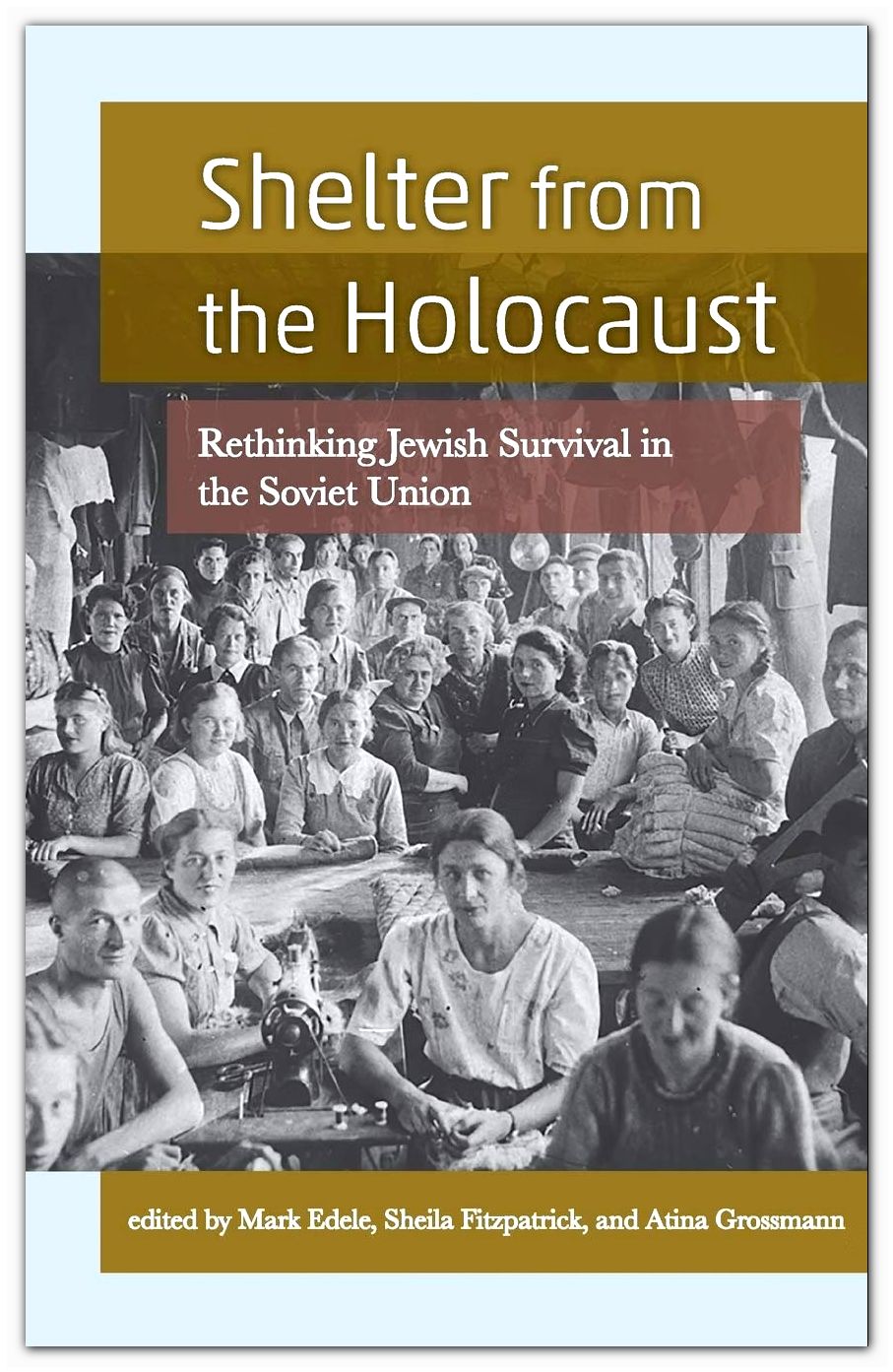
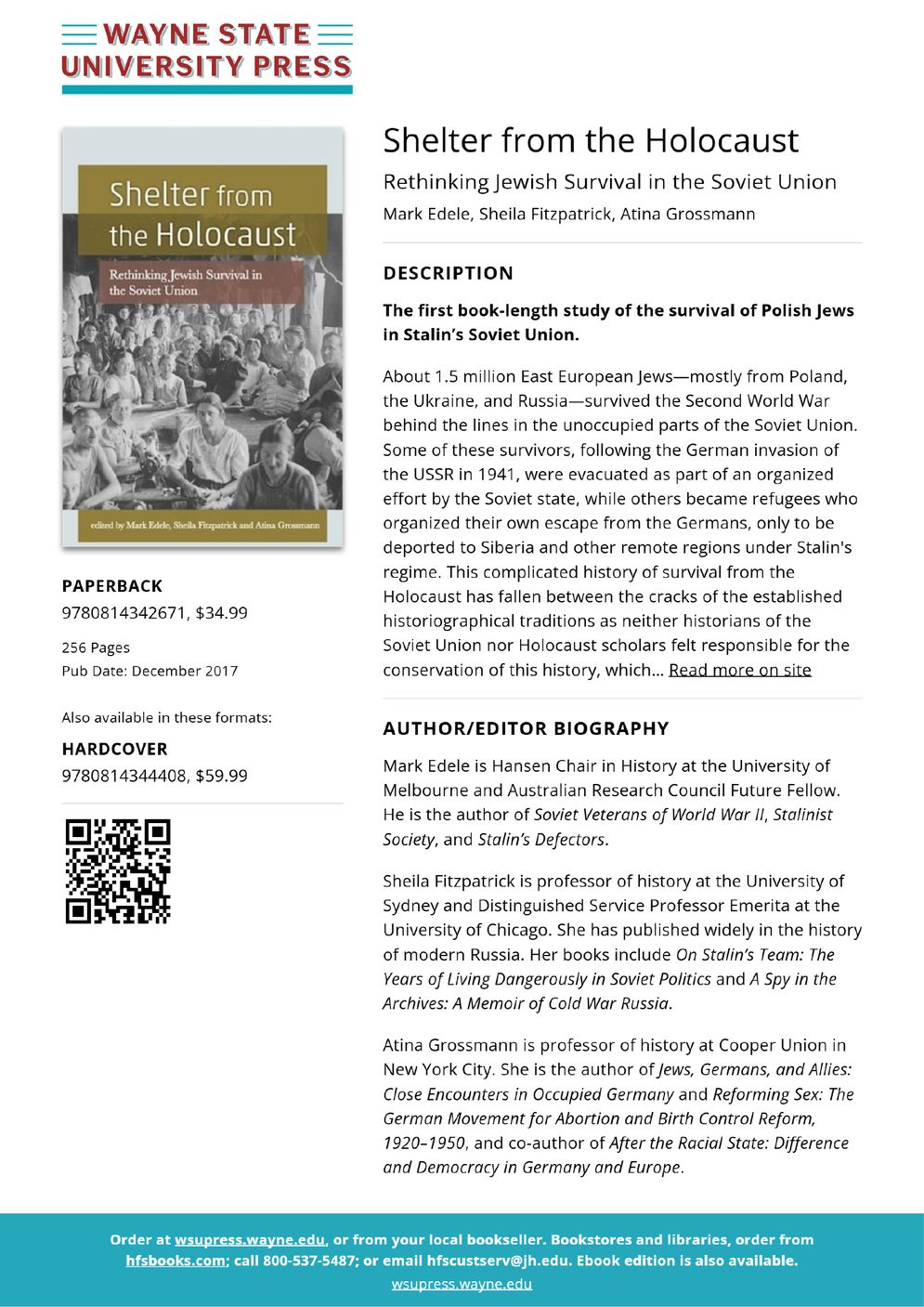
Shelter from the HolocaustRethinking Jewish Survival in the Soviet Union |
||
| The first book-length study of the survival of Polish Jews in Stalin’s Soviet Union. About 1.5 million East European Jews—mostly from Poland, the Ukraine, and Russia—survived the Second World War behind the lines in the unoccupied parts of the Soviet Union. Some of these survivors, following the German invasion of the USSR in 1941, were evacuated as part of an organized effort by the Soviet state, while others became refugees who organized their own escape from the Germans, only to be deported to Siberia and other remote regions under Stalin's regime. This complicated history of survival from the Holocaust has fallen between the cracks of the established historiographical traditions as neither historians of the Soviet Union nor Holocaust scholars felt responsible for the conservation of this history, which at best is pushed to the margins and often silenced or forgotten altogether. With Shelter from the Holocaust: Rethinking Jewish Survival in the Soviet Union, editors Mark Edele, Sheila Fitzpatrick, and Atina Grossmann have compiled essays that are at the forefront of developing this entirely new field of transnational study, which seeks to integrate scholarship from the areas of the history of the Second World War and the Holocaust, the history of Poland and the Soviet Union, and the study of refugees and displaced persons. Life as an escapee of the Holocaust was terribly difficult and often lethal, but it at least offered the opportunity for survival and, therefore, an experience fundamentally different than the systematic genocide the Nazis unleashed on those left behind in the territories under their control. What became of these survivors varies greatly—some joined Soviet Jewish evacuees in harsh exile in Central Asia; some Polish Jews evacuated to Iran in 1942 with the exile Anders Army, moving on to Palestine; most were eventually repatriated to postwar Poland, and many of them then fled further to displaced persons camps in allied-occupied Europe, where they constituted the largest group of East European Jewish survivors. Shelter from the Holocaust addresses these very different paths in seven chapters, beginning with a general overview of migration patterns, including a specific example of postwar memory focusing on those who ended up in Australia. The book continues with an exploration of the diverse ways Polish Jewish survivors talk about their experiences and identity with regard to the Holocaust, and ends with one family's personal narrative of experiences in Uzbekistan during World War II. Shelter from the Holocaust came to fruition as the result of the opening of formerly classified Soviet and Polish archives, determined efforts to interview the last remaining Holocaust survivors, and the growing interest in the histories of displaced persons and migration. This pioneering volume will interest scholars of eastern European history and Holocaust studies, as well as those with an interest in refugee and migration issues. |
||
 |
||
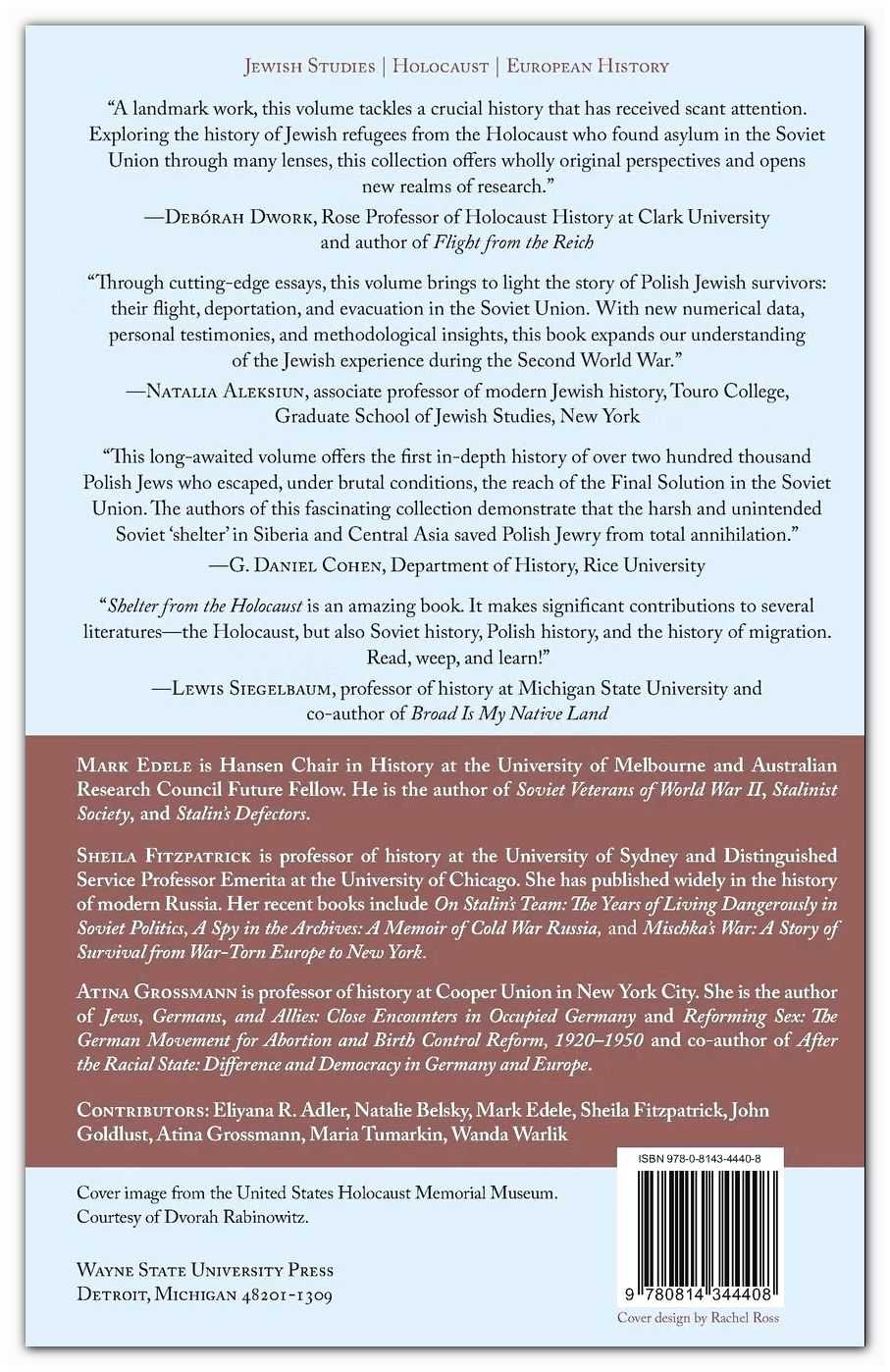
| “Collectively, the contributions
to Shelter from
the Holocaust reframe the debates about the meaning of "Holocaust
survival"; show the profound impact of Polish-Jewish displacement on
domestic wartime and postwar Polish and Soviet societies; and, most
importantly, draw narratives of Polish Jewish refuge in the Soviet
Union from the margins of established historiographies into the center
of a new field of transnational Eurasian migration and diaspora
studies.” “This book brings to light the
mostly forgotten
story of Polish Jewish Holocaust survivors who found shelter from the
Holocaust in the Soviet hinterland. This is a new aspect of Holocaust
history that is very important for our understanding of the problems
and dilemmas Holocaust survivors faced.” “This long-awaited volume offers
the first
in-depth history of over two hundred thousand Polish Jews who escaped,
under brutal conditions, the reach of the Final Solution in the Soviet
Union. Their experiences as refugees and deportees in the Soviet
hinterland are commonly considered peripheral to ‘Holocaust
history.’ The authors of this fascinating collection of
essays
demonstrate however that the harsh and unintended Soviet
‘shelter’ in Siberia and Central Asia saved Polish
Jewry
from total annihilation.” “This volume deserves to be
appreciated for
bringing to light untold stories of Holocaust survivors and East
European Jews in general. It is also significant that this book allows
the reader to better comprehend the scope of the Holocaust and the
facts of the ‘Soviet shelter’, and the background
to the
founding of the State of Israel in the postwar period.” “This highly engaging book opens
up as many, if
not more questions than it answers. It delineates a new sub-field in
the history of the Holocaust and in other fields besides, and makes for
exciting and fresh reading.” “This fine collective work will
stimulate work on
still neglected subjects such as the relations between the Ashkenazi
migrants and autochthonous Central Asian Jews, cultural life along the
migrants, and their experiences of return after 1944.” “One of the least known facts of
the Holocaust is
the survival of hundreds of thousands of Jews in the Soviet Union. This
excellent volume provides the first systematic treatment of this
fascinating chapter of Jewish survival.” “Shelter from the Holocaust is an
amazing book. It
makes significant contributions to several literatures: the Holocaust,
but also Soviet history, Polish history, and the history of migration.
It consists of seven scholarly essays chock full of new perspectives
based on fresh research into painful and important questions, a
brilliant introduction, and a moving epilogue. Read, weep, and
learn!” “Through eight cutting-edge
essays, this volume
pushes us to rethink Jewish survival strategies during the Holocaust.
It brings to light the story of majority of Polish Jewish survivors:
their flight, deportation, and evacuation in the Soviet Union. With new
numerical data, personal testimonies, and methodological insights, this
book expands our understanding of the Jewish experience during the
Second World War.” “A landmark work, this volume
tackles a crucial
history that has received scant attention. Exploring the history of
Jewish refugees from the Holocaust who found asylum in the Soviet Union
through many lenses, this collection offers wholly original
perspectives and opens new realms of research.” “Extensively researched, this book
lends greater
dimension to the word 'survivor,' taking the definition beyond the
ghetto/concentration camp victims. It is a welcome appreciation of an
overlooked group who merit a place of their own within the landscape of
Holocaust experience.” |
||
|
Sheila Fitzpatrick — Annexation, Evacuation, and Antisemitism in the Soviet Union, 1939–1946, in Shelter from the Holocaust: Rethinking Jewish Survival in the Soviet Union (Wayne State University Press, 2017), chapter 3, printed pp. 139–143; notes on pp. 155–157. Evacuation from the western regionsAfter the German attack, Soviet evacuation of population from the western regions was chaotic, with no special provision or priority for evacuation of Jews. In fact, official Soviet instructions and reporting on evacuation virtually never distinguished evacuees by nationality. Some local officials encouraged them to leave and supported their efforts, while others were less sympathetic. Paradigmatic in the latter category was Panteleimon Ponomarenko, first secretary of the party in Belarus, who, in a context of praising the steadfastness of Belarusian peasants in the face of German attack in a report to Stalin in July 1941, contrasted them unfavorably with white-collar urbanities who “only think of saving their own skins”: “This can be explained, in the main, by the large Jewish stratum of the population in the cities. They have been gripped by an animal fear of Hitler and, instead of fighting, they flee.”36 WARTIME ANTISEMITISM AND JEWISH ACTIVISMThe outbreak of war brought a sudden and quite spectacular upsurge of popular antisemitism in the Soviet Union.38 All at once, antisemitic comments that would previously have been inadmissible were heard almost openly made in public. In October 1941, the diary of a young Ukrainian Jew recorded the following: In the streets and in the park, in the bread shop and in queues for kerosene—everywhere you hear the whisper—quiet, horrifying, merry but full of hate. They are talking about Jews. They are still saying it a bit timidly, looking round. Jews are thieves. One Jewish woman stole such and such. Jews have money. One Jewish woman had 50,000 [rubles], but she railed against fate and said that she was naked and barefoot. One Jewish man had still more money, but he considers himself unfortunate. Jews do not like working. Jews do not want to serve in the Red Army. Jews live in the cities without a permit. Jews have oppressed them. In a word, Jews are the source of all misfortunes.39 This upsurge at first sight seems counterintuitive, given that antisemitism was such a prominent part of the enemy’s ideology. In the opinion of one Russian historian, the antisemitism surged immediately after the staggeringly successful German attack because many Soviet citizens expected a Soviet defeat and therefore turned against the Soviet regime, reverting to the old equation of Communists and Jews.40 No doubt another contributing factor was Nazi antisemitic leaflets dropped from the skies in the western regions of the country from the earliest days of the war and aimed partly at Soviet soldiers. The leaflets emphasized that Germany was “waging war principally against the Jews and Communism,” that is, not against the Russian and Ukrainian population as a whole.41 Judging by the number of Soviet army defectors who came over to the German side, often leaflet in hand, their impact was considerable.42 The same young Ukrainian Jew, who was also a Soviet patriot with no sympathy for the Nazi cause, noted ruefully that antisemitism was the only part of the leaflets’ pitch that was likely to hit home with Soviet readers.43 Yet, from the nature of the antisemitic comments of the early war months, particularly in the panic of October 1941 when Moscow nearly fell to the Germans, it is hard to avoid the sense that flight and evacuation of Jews from the western regions eastward into the Soviet hinterland after the German attack was a key issue. Evacuated from Dnepropetrovsk to Essentuki in the North Caucasus, the young Ukrainian Jew noted in his diary in September that “those who remained in the city were looking indignantly at those who left, and some people started to say that it is just the Jews who are running away, that they have hoarded thousands [of rubles] and therefore they are making a dash for it.”44 Belarusian first secretary Ponomarenko’s comment to Stalin in July (quoted above) similarly implied that Jews who fled were cowards. In September, security chief Beria reported in a memo to Stalin on the upsurge of popular anti-semitism, quoting comments picked up by police surveillance, such as this one (from a retired Russian professor): “There are no Jews at the front, they have all run away to any place where everything will be quiet.”45 In the panicky October days when government and individual citizens were trying to decide whether to evacuate Moscow, there were reports of Jews being pulled with their suitcases out of cars on the highways out of town and beaten.46 “The last remnants of the Jews are fleeing. A sort of ‘deJudaization’ of Moscow is occurring,” another Russian diarist reported, not without satisfaction, on 19 October.47 Perlustrated letters coming out of the city revealed that the public was “upset by the perceived massive flight of Jews from Moscow.”48 The evacuation was “a turning point in the openness with which [antisemitic] sentiments were expressed,” an American historian concludes.49 Jews were a previously unknown quantity in many parts of the hinterland, including Central Asia, to which they were evacuated or congregated after release from deportation. But the arrival of millions of evacuees needing housing and provisions put enormous strain on local administrations and populations.50 While Jews were overall a minority of evacuees, they were overrepresented in the evacuation from some regions.51 Well over half of Moscow’s Jewish population chose evacuation, and in some receiving centers in the hinterland they were a majority of evacuees. In Uzbekistan’s capital, Tashkent, 63 percent of evacuees as of late 1941 were Jewish, and the Jewish theaters of Moscow, Kiev, and Odessa were among the institutions evacuated to the city.52 The prejudice Jews encountered was to some degree prejudice against evacuees in general, but it was also often specifically antisemitic, sparked perhaps by non-Jewish evacuees from places such as Ukraine and fueled later in the war by demobilized wounded soldiers who contributed the view prevalent in the army (although apparently unfounded) that Jews were underrepresented at the front.53 On 20 August 1942, Beria reported on antisemitic incidents and statements in Uzbekistan arising “in connection with the coming to the republic via evacuation of a significant number of citizens of the Soviet Union of Jewish nationality.” Pogrom rumors abounded among the Jewish refugees, although most were without foundation.54 But in the Sverdlovsk region in the Urals there actually was some sort of pogrom, with rampagers shouting “Here’s your second front—kill the yids.” Similar reports of growing antisemitism came from all over Central Asia. Evacuated Jews had “squeezed out Uzbeks and Russians” from all the good jobs, they were saying in Tashkent. In Frunze (Kyrgyzstan), demobilized soldiers were “openly say[ing] that Jews have refused to participate in the war and that they sit in the rear in warm places.” In Alma-Ata, rumor had it that “Jews were evading army service and that they had stolen money during the Moscow panic and were living in the rear ‘like kings.’ ”55 It has sometimes been claimed that rising wartime antisemitism was at least in part a reflection of greater official tolerance than before the war, since the regime was hamstrung by fear of appearing to confirm Nazi equations of Jews and Communism.56 This may be. Certainly, party leaders must have been put on guard when, after a (state-sanctioned) Jewish rally by the same activists who were later leaders of the JAC was broadcast in Moscow in August 1941, NKVD surveillance reported strong negative reactions by citizens who interpreted the speakers’ affirmations of Jewish identity along with Soviet patriotism as evidence that Jews were running Russia.57 On the other hand, a large part of the evidence we have about wartime antisemitism comes from official reports and, most important, prosecutions.58 Official condemnation of antisemitism may have slackened somewhat during the war, but it clearly had not disappeared. Like the NKVD, the JAC was also monitoring antisemitism, being kept informed of it by an endless flow of complaints and appeals from evacuated Jews. The JAC leaders were very concerned about it and tried to get action in response to specific individual complaints via their contacts in the party and government leadership.59 But they were in a bind: their official mandate was to rally international Jewish support for the Soviet Union against Nazi ideological antisemitism, not to complicate the issue by complaining about its everyday Soviet counterpart. Some heated debates went on in the closed counsels of the JAC on the issue, with the Jewish writer Ilya Ehrenburg—one of the most popular Soviet journalists of the wartime period, known for his vitriolic anti-German as well as anti-Nazi propaganda— arguing vehemently that domestic antisemitism must become one of the JAC’s central concerns, against a more prudent majority warning that any such revision of mission would get the committee closed down.60 Notes36. Albert Kaganovitch, “Jewish Refugees and Soviet Authorities during World War II,” Yad Vashem Studies 38, no. 2 (2010): 89. Ponomarenko, a Ukrainian of peasant origins promoted rapidly in the wake of the Great Purges, the top Soviet official in the region, along with Khrushchev in Ukraine, gets generally bad press from memoirists and historians on Jewish issues. The only exception is Polish Jewish Communist Jakub Berman, who gives him higher marks than Khrushchev, at least in having a sense of the contingency of the German alliance in 1939–41. Teresa Toranska, Oni: Stalin’s Polish Puppets (London: Collins Harvill, 1987), 210–12.38. See Oleg V. Budnitskii, “The Great Patriotic War and Soviet Society: Defeatism, 1941–42,” Kritika: Explorations in Russian and Eurasian History 15, no. 4 (2014): 782–83; and Karel C. Berkhoff, “ ‘Total Annihilation of the Jewish Population’: The Holocaust in the Soviet Media, 1941–45,” Kritika: Explorations in Russian and Eurasian History 10, no. 1 (2009): 102–3. 39. Diary entry for 23 October 1941, in Vladimir Gelfand, Dnevnik 1941–1946, ed. Oleg V. Budnitskii (Moscow: ROSSPEN, 2015), 44. 40. Budnitskii, “Great Patriotic War,” 782–83. 41. Mordechai Altshuler, “Escape and Evacuation of Soviet Jews at the Time of the Nazi Invasion: Policies and Realities,” in The Holocaust in the Soviet Union: Studies and Sources on the Destruction of the Jews in the Nazi-Occupied Territories of the USSR, 1941–1945, ed. Lucjan Dobroszycki and Jeffrey S. Gurock (Armonk, NY: M. E. Sharpe, 1993), 89. 42. See Heil Beil! Flugblattpropaganda im Zweiten Weltkrieg: Dokumentation und Analyse, ed. Ortwin Buchbender and Horst Schuh (Stuttgart: Seewald Verlag, 1974), 49–50. Thanks to Mark Edele for this reference. For more detail, see Mark Edele, Stalin’s Defectors: How Red Army Soldiers Became Hitler’s Collaborators, 1941–1945 (Oxford: Oxford University Press, 2017). 43. Gelfand, Dnevnik, 70 (diary entry for 12 June 1942). 44. Ibid., 34–35 (diary entry for 18 September 1941). 45. Moskva prifrontovaia 1941–1942: Arkhivnye dokumenty i materialy (Moscow: Mosgorarkhiv, 2001), 629n64. 46. Manley, To the Tashkent Station, 112; Mikhail M. Gorinov, “Muscovites’ Moods, 22 June 1941 to May 1942,” in The People’s War: Responses to World War II in the Soviet Union, ed. Robert W. Thurston and Bernd Bonwetsch (Urbana: University of Illinois Press, 2000), 123. 47. Moskva prifrontovaia, 291. 48. Gorinov, “Muscovites’ Moods,” 126. 49. Manley, To the Tashkent Station, 112. 50. See Natalie Belsky, “Encounters in the East: Evacuees in the Soviet Hinterland during the Second World War” (PhD diss., University of Chicago, 2014), esp. 337–47 (unfamiliarity of Jews), 90–135 (housing), and 206–63 (provisioning). 51. Vadim Dubson, “Toward a Central Database” (102–3), calculates that Jews made up 22 percent of the 4 million persons evacuated from Moscow and Leningrad and over half of those fleeing the western regions of the country. His estimate of the total number of evacuees, 7.5 million (96), is at the low end of a continuum whose high end is about 20 million. See Mark Harrison, Soviet Planning in Peace and War, 1938–1945 (Cambridge: Cambridge University Press, 1985), 72 (adding the 4 million Moscow and Leningrad evacuees not included in Harrison’s calculation of 16.5 million). 52. Manley, To the Tashkent Station, 230. 53. See Belsky, “Encounters in the East,” 342. 54. Kostyrchenko, Gosudarstvennyi antisemitizm, 32–34. 55. Manley, To the Tashkent Station, 230–33. 56. Oleg V. Budnitskii, introduction to Gelfand, Dnevnik, 18–19. Berkhoff, in “ ‘Total Annihilation’ ” (103–4), makes a similar point when he suggests that Soviet reticence about publishing news of Nazi antisemitic atrocities may reflect official fears that such publicity might encourage popular antisemitism. 57. On the rally, see Redlich, Propaganda and Nationalism, 41. For negative reaction, see Beria’s report to Stalin of September 1941, in Moskva prifrontovaia, 629n64. The report includes the following statement from a retired Russian professor: “I not only turned off the radio when they broadcast the Jewish meeting but didn’t read the paper today because of its publication in Pravda.” 58. Prosecutions form the basic data source for the discussions of local antisemitism in Kaganovitch, “Jewish Refugees and Soviet Authorities,” 117–20, and Manley, To the Tashkent Station, 229–33. 59. For examples, see documents published in Redlich, War, Holocaust, and Stalinism, 225–63. 60. On Ehrenburg’s position, see GARF, f. 8114 [Jewish Anti-Fascist Committee], op. 1, d. 919, l. 36; and Redlich, War, Holocaust, and Stalinism, 29. |
||||
 Shelter
from the
Holocaust: Rethinking Jewish Survival in the SU Mark Edele, Sheila Fitzpatrick, John Goldlust, and Atina Grossmann The numbers involved in this history are contentious. There are competing statistics, of different dates and provenances. Some were collected by the Polish exile government during the war, others by the Soviet authorities, and still others by Jewish organizations or repatriation agencies in Poland after the war. Scholars, including those contributing to this volume, do not always agree on which numbers to trust. Sometimes historians cite old numbers from earlier publications, not realizing that more reliable numbers have since emerged from the archives. In this volume, contributors have been guided by the numerical ranges presented, after exhaustive comparative evaluation of the sources, in the six tables appended to Edele and Warlik’s contribution. But they have been free to offer alternatives with an explanation of why they prefer them and, in a few cases, have done so. Indeed, even the best available numbers can provide no more than an orientation, given—as Adler points out in her chapter—the constant back-and-forth of many of the groups involved. Nevertheless, a basic overview is necessary. Prewar Poland had a Jewish population of approximately 3 million, the Baltic states about 255,000, and Romania 756,000.47 In 1939–40, as a result of the German-Soviet Non-Aggression Pact, the Soviet Union occupied and annexed the whole of the Baltic states, eastern Poland, and part of Romanian Bessarabia, adding about 2 million Jews to the Soviet population.48 These included 1.3 million Polish Jews from the former eastern Poland, and adding refugees from the German-held territories of Poland brings this number to between 1.4 and 1.6 million.49 Of the formerly Polish Jews, some 68,000–71,000 were deported before 22 June 1941 and another 23,600 arrested; perhaps 10,000–21,000 were drafted into the Red Army. To these altogether 101,600–115,600 who had been coercively removed from the path of the Wehrmacht, we need to add 40,000–53,000 who volunteered to work in the Soviet hinterland before the Nazi storm broke over Soviet lands. At a minimum, then, 141,600 and maybe as many as 168,600 were thus saved from the German Einsatzgruppen. In addition, perhaps 210,000 Jews evacuated or fled east once the Germans attacked. These figures mean that, at the very least, 146,100 and as many as 384,600 were saved from the Holocaust by the often harsh haven of the Soviet Union.50 This range is consistent with the figure of 200,000–230,000 used by many recent historians. As Edele and Warlik show in their analysis of these numbers, the lower of the two series is clearly too low. This volume focuses on one particularly large group of Holocaust survivors: formerly Polish Jews.51 John Goldlust’s chapter 1 gives a general overview of their history and the process of postwar forgetting and focuses on those who ended up in Australia. Building on this sketch, Edele and Warlik, in chapter 2, map the basic wartime trajectories of Polish Jews in the Soviet Union. One group traveled, equipped with Japanese exit visas, across the entire Soviet Union to Vladivostok and on to Japan. If they did not immediately emigrate elsewhere, they usually ended up in Shanghai for the rest of the war. A second group either was deported or traveled voluntarily to the Soviet hinterland and exited the Soviet Union with the Anders army via Iran in 1942. A third group later joined the nominally Polish Berling army and returned with it to Poland at war’s end. A fourth group left only after the war during “repatriation” to Poland, and a fifth group remained in the Soviet Union for good. The chapter also uses declassified Soviet and Polish archival materials to give estimates for the relative sizes of these various groups. In chapter 3, Sheila Fitzpatrick considers the effects that the wartime displacement of Jews to the Soviet Union had on Soviet society at large. Under the secret treaties of the Nazi-Soviet pact of August 1939, the Soviet Union acquired territories on its western borders with a population of 23 million, 2 million of whom were Jews. The Jewish population of former eastern Poland included refugees from the west, now occupied by Germany. When the Germans attacked the Soviet Union in June 1941, many Jews were evacuated or fled on their own to the east, into the Soviet hinterland. Thus, largely unwittingly, the Soviet Union provided a haven that enabled hundreds of thousands of European Jews to survive the Holocaust. But there were other consequences. In the first place, the sudden arrival in the Russian hinterland of large numbers of Jews, many of them penniless and non-Russian-speaking, was quickly followed by a rise of popular antisemitism. In the second place, the concern for the plight of the Polish Jews on the part of Soviet Jewish public figures, such as the theater director Solomon Mikhoels and the Yiddish poet Perets Markish, was a major factor in the creation a few years later of the Jewish Anti-Fascist Committee, a remarkable body, quite anomalous in Soviet terms, that for some years, until its postwar liquidation, acted as a forceful and influential lobbyist for Jewish interests in the highest councils of the Soviet government and party, as well as being a very effective international fund-raiser for the Soviet war effort. |
|
| |
|
|
Mark Edele is Hansen Chair in History at the University of Melbourne and Australian Research Council Future Fellow. He is the author of Soviet Veterans of World War II, Stalinist Society, and Stalin’s Defectors. Sheila Fitzpatrick is professor of history at the University of Sydney and Distinguished Service Professor Emerita at the University of Chicago. She has published widely in the history of modern Russia. Her books include On Stalin’s Team: The Years of Living Dangerously in Soviet Politics and A Spy in the Archives: A Memoir of Cold War Russia. Atina Grossmann is professor of history at Cooper Union in New York City. She is the author of Jews, Germans, and Allies: Close Encounters in Occupied Germany and Reforming Sex: The German Movement for Abortion and Birth Control Reform, 1920–1950, and co-author of After the Racial State: Difference and Democracy in Germany and Europe. |
|
 |
 |
© Wayne State University Press
© Mark Edele
© Sheila Fitzpatrick
© Atina Grossmann