



© Flensborg Avis

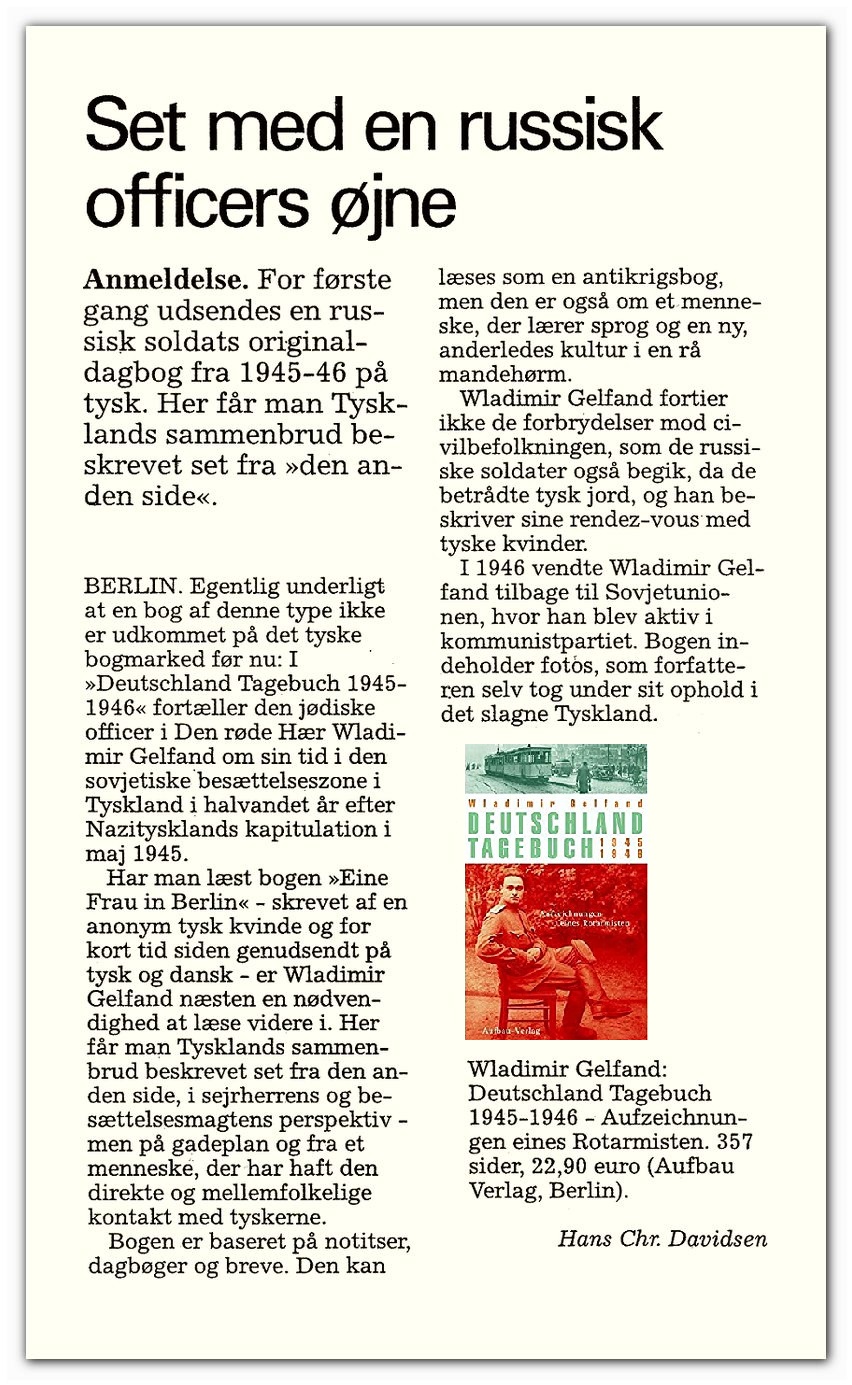
Берлин. Удивительно, что книга такого рода до сих пор не была представлена на немецком книжном рынке. В «Немецком дневнике 1945-1946» еврейский офицер Красной армии Владимир Гельфанд подробно рассказывает о своём пребывании в советской оккупационной зоне в Германии в течение полутора лет после капитуляции нацистского режима в 1945 году.
Тем, кто уже читал «Женщину в Берлине» — анонимные записки немецкой женщины, недавно переизданные на немецком и датском языках, — дневники Владимира Гельфанда станут логичным продолжением. Здесь представлено видение краха Германии с другой перспективы: глазами победителя и оккупанта, но на уровне улиц, через повседневные впечатления человека, который имел непосредственный и личный контакт с немцами.
Книга основана на дневниковых записях, заметках и письмах. Её можно рассматривать как антивоенное произведение, но в то же время она рассказывает о человеке, который изучает язык, знакомится с новой, чужой для себя культурой и делает это в живом диалоге с окружающим миром.
Владимир Гельфанд не замалчивает преступления, совершённые советскими солдатами против гражданского населения при входе на немецкую территорию. Он также описывает свои личные встречи и отношения с немецкими женщинами.
В 1946 году Гельфанд вернулся в Советский Союз, где стал активным членом Коммунистической партии. Книга включает фотографии, сделанные самим автором во время его пребывания в побеждённой Германии.
 Danish
Flensborg Avis
23 March 2005
Seen Through the Eyes of a Russian Officer
Review: for the first time, the original diary of a Soviet soldier from 1945-1946 is being published in German. It presents ruined Germany from "the other side."
Berlin. It is surprising that a book of this kind had not previously appeared on the German book market. In Germany Diary 1945-1946, Jewish Red Army officer Vladimir Gelfand describes in detail the year and a half he spent in the Soviet occupation zone after the capitulation of the Nazi regime in 1945.
For readers who already know A Woman in Berlin - the anonymous notes of a German woman recently reissued in German and Danish - Gelfand's diary provides a logical counterpart. It shows Germany's collapse from another perspective: through the eyes of a victor and occupier, but at street level, through the everyday impressions of someone who had direct personal contact with Germans.
The book is based on diary entries, notes and letters. It can be read as an anti-war work, but it is also the story of a man learning a language and becoming acquainted with a new and foreign culture in an active dialogue with the world around him.
Gelfand does not conceal crimes committed by Soviet soldiers against civilians as the Red Army entered German territory. He also describes his own meetings and relationships with German women.
In 1946 Gelfand returned to the Soviet Union, where he became an active member of the Communist Party. The book contains photographs he took himself while in defeated Germany.
Vladimir Gelfand: Germany Diary 1945-1946 - Notes of a Red Army Soldier. 357 pages, EUR 22.90 (Aufbau Verlag, Berlin).
Hans Chr. Davidsen