


|
|||
 |
|||
 |
  |
||
| © Dagens Nyheter. |
|
|
|
шведско-русский перевод: Irina Ratouchnai |
КУЛЬТУРА
ЛИТЕРАТУРА
Книжные рецензии
Дневник
советского солдата.
Увлекательное чтение, несмотря на ужасы войны
 Swedish
Published in Dagens Nyheter, 24 October 2006 — Culture / Literature / Book Reviews
A Soviet Soldier’s Diary — Compelling Reading Despite the Horrors of War
Sixty years after the end of the Second World War, almost everything seems to have been said about the collapse of the “thousand-year Reich.” Far less has been told about how the victors, and above all the Red Army, entered Hitler’s Germany after it had been bombed to ruins.
In the former GDR there was of course an entire literature about liberation from fascism. German émigrés who had served on the Soviet side also often described how the peace-loving Stalin had broken the backbone of German fascism. One of the few people in the post-war period who dared to speak about rape and looting committed against Germans was the officer and later Nobel laureate Aleksandr Solzhenitsyn.
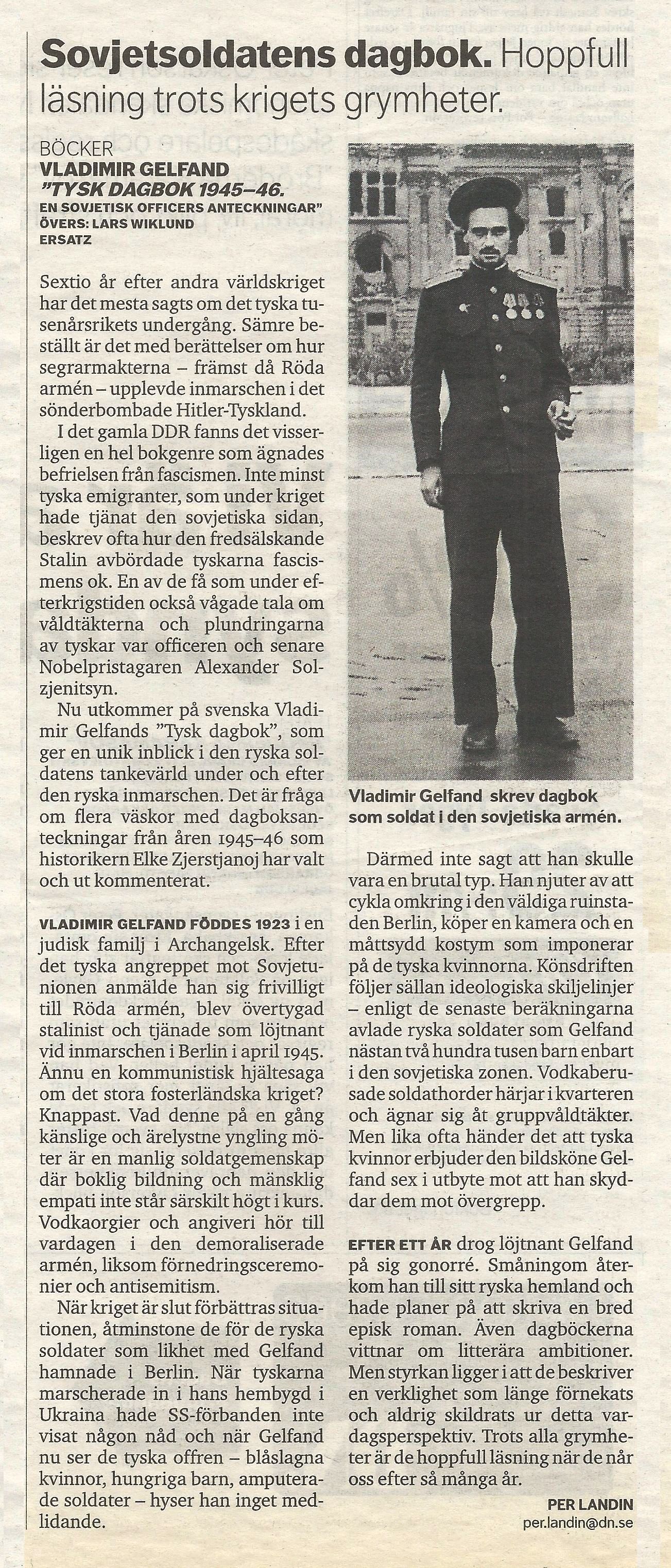
Vladimir Gelfand’s Germany Diary has now appeared in Swedish and offers an unusual glimpse into the inner world of Soviet soldiers during and after the advance into Germany. The surviving material consists of several bags of diary notes from 1945–46, from which historian Elke Scherstjanoi selected and annotated the published text.
Gelfand was born in 1923 into a Jewish family in Ukraine. After Germany attacked the Soviet Union he joined the Red Army and served as a lieutenant during the advance on Berlin in 1945. Is this just another Communist heroic tale of the Great Patriotic War? Hardly. The sensitive and ambitious young man found himself in an overwhelmingly male military world in which book learning and human sympathy were not highly valued. Drunken excess, denunciations, humiliating rituals and antisemitism formed part of daily life in a demoralised army.
After the war the situation improves — at least for Soviet soldiers such as Gelfand who find themselves in Berlin. His own family had suffered under German occupation in Ukraine, so at first he feels little sympathy for German victims: beaten women, hungry children and amputee soldiers.
Yet he is not portrayed as a cruel man. He enjoys riding a bicycle through the enormous ruined city, buys a camera and an elegant suit, and attracts German women. Sexual desire rarely follows ideological dividing lines. Soviet soldiers committed widespread sexual violence, but German women could also seek relationships with officers such as Gelfand in the hope of protection and material security. About a year later Gelfand contracts gonorrhoea.
Eventually he returns to the Soviet Union and dreams of writing a broad epic novel. The diaries themselves reveal his literary ambition. Their strength lies in the description of a reality long denied and rarely shown from the perspective of everyday life. Despite all the horrors, Per Landin concludes, the diary remains absorbing reading that has reached us after many decades.
Per Landin